




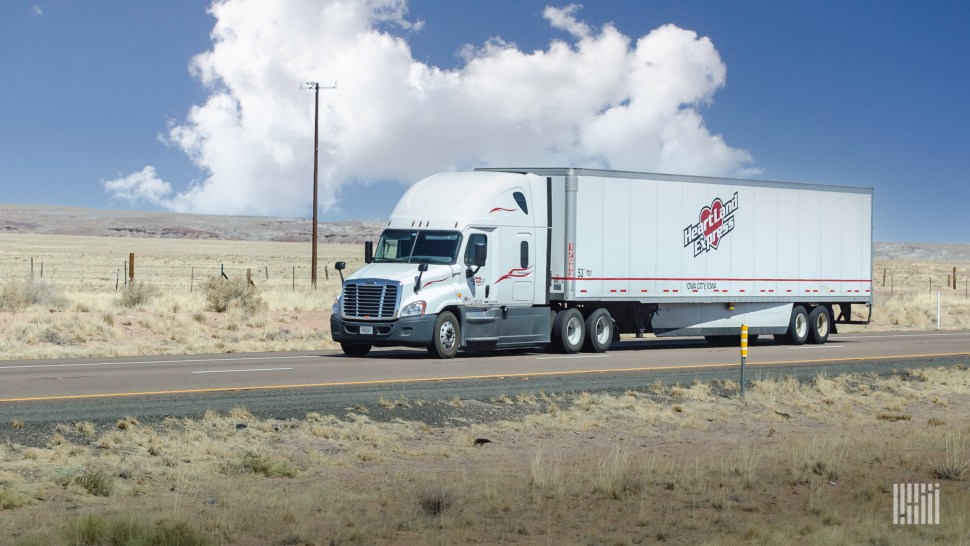
Truckload carrier Heartland Express reported its seventh straight net loss (excluding one-time gains) on Wednesday.
The North Liberty, Iowa-based company reported a net loss of $13.9 million for the first quarter, or 18 cents per share. That compared to a net loss of 19 cents in the year-ago period. Consensus estimates ranged from breakeven to a 10-cent loss for the recent period.
Gains on the sale of rolling stock were a 2-cent tailwind (at a normalized tax rate) compared to last year.
Revenue fell 19% year over year to $219 million. (Heartland does not provide operating metrics for utilization and pricing.)
“Our consolidated operating results for the three months ended March 31, 2025, reflect a combination of adverse weather experienced in January and February, tariff uncertainties amongst our customers in March, along with prolonged industry-wide challenges where operating cost inflation continued to outpace customer freight demand and freight rate improvements,” CEO Mike Gerdin stated in a Wednesday news release.

Heartland (NASDAQ: HTLD) reported a 107.1% adjusted operating ratio, which was 150 bps worse y/y. It said its legacy Heartland Express fleet was profitable in the quarter and “continued to operate in line with the best full truckload carriers in our industry.”
However, its other three brands – Millis Transfer, Smith Transport and Contract Freighters Inc. – lost money in the period. Poor equipment utilization, higher costs and issues with driver retention were cited as the culprits.
Heartland is focused on shrinking the fleet and is “evaluating all cost measures for opportunities for efficiency.”
Salaries, wages and benefits (as a percentage of revenue) were up 80 bps y/y. Operations and maintenance expenses increased 190 bps, and depreciation and amortization was up 180 bps. Those increases were partially offset by a 230-bp reduction in rents and purchased transportation expenses.
The average tractor age crept higher to 2.6 years from 2.4 years in the 2024 first quarter, likely weighing on the maintenance expense line.

The company had $176 million in net debt (inclusive of financing lease obligations) at the end of the quarter with no balance on a revolving credit facility that has $88.3 million in availability.
It had $188 million in net debt at the end of 2024.
Shares of HTLD were off 3.1% on Wednesday to $7.60 compared to the S&P 500, which was up 0.2%. The stock is down 31% year to date.
Brokerage Compliance Symposium
The day before F3. Every compliance issue you face - fraud exposure, carrier liability, FMCSA rules, cargo theft, insurance gaps - navigated by attorneys and operators defining best practices in a changing industry.
F3 Awards Dinner
The night before F3. FreightTech100 companies honored. FreightTech 25 and Shipper of Choice winners revealed live. Cocktail reception into dinner and live music - 300 industry leaders in one purpose-built room.
F3: Future of Freight Festival
Industry-defining keynotes, rapid-fire technology demos, and industry leaders networking in experiences across Chattanooga - plus the inaugural F3 Awards Dinner featuring the FreightTech and Shipper of Choice reveals.
The day before F3. Every compliance issue you face - fraud exposure, carrier liability, FMCSA rules, cargo theft, insurance gaps - navigated by attorneys and operators defining best practices in a changing industry.
The Signal at Chattanooga Choo Choo • Chattanooga, TN Register NowThe night before F3. FreightTech100 companies honored. FreightTech 25 and Shipper of Choice winners revealed live. Cocktail reception into dinner and live music - 300 industry leaders in one purpose-built room.
The Signal at Chattanooga Choo Choo • Chattanooga, TN Register NowIndustry-defining keynotes, rapid-fire technology demos, and industry leaders networking in experiences across Chattanooga - plus the inaugural F3 Awards Dinner featuring the FreightTech and Shipper of Choice reveals.
The Signal at Chattanooga Choo Choo • Chattanooga, TN Register Now