
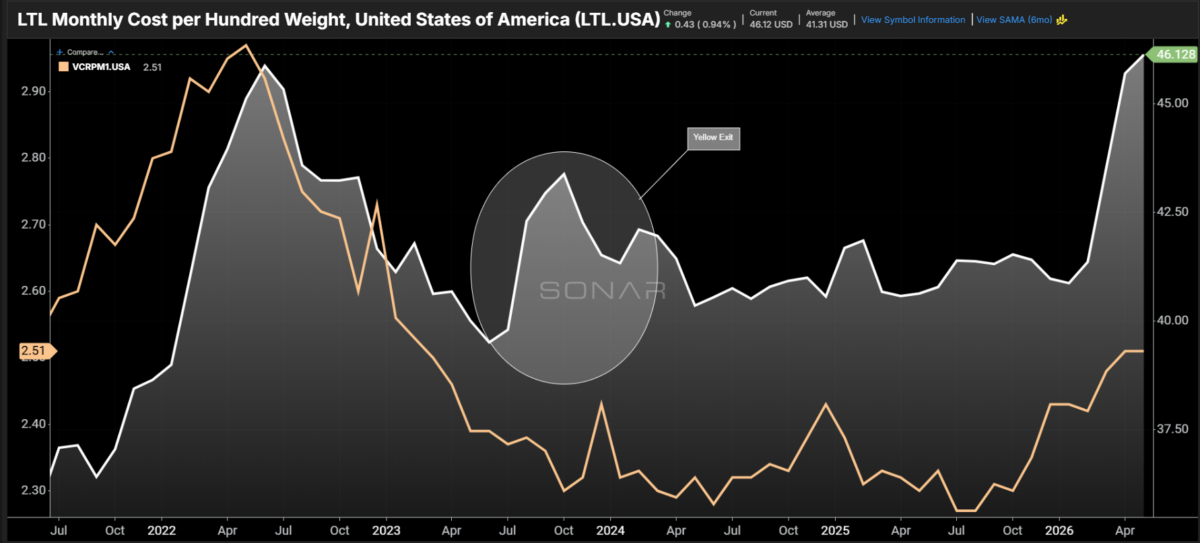
Chart of the Week: LTL Monthly Cost per Hundred Weight, Van Contract Rate per Mile – USA SONAR: LTL.USA, VCRPM1.USA
The headline numbers look impressive. LTL all-in revenue per hundredweight is up sharply on SONAR’s LTL.USA index, with the current reading at $46.13, well above the six-month average of $41.31 and at its highest level in the five-year window shown in the chart above. LTL carriers, by one reading, are having their best pricing moment since the post-COVID freight boom.
The orange line complicates that story, but not in the way it might first appear. Van contract rates per mile, VCRPM1.USA, bottomed out near $2.25 per mile in mid-2025 after a multi-year freight recession that shed more than 20% from the 2022 peak. What has happened since is the part that matters: over the past eight months, VCRPM1 has staged one of its sharpest recoveries of the five-year period, climbing back to $2.51 per mile and still trending upward. That is not a number failing to confirm the LTL rally. That is a number setting up the next leg of it.
The fuel surcharge is the whole story for now
First, the honest accounting of where the LTL gains actually came from. When diesel averaged $3.50 per gallon in May 2025 — using a generalized fuel surcharge table that starts at 0.5% when the DOE’s weekly figure is at $1.20 and increases 0.5% for every $0.06 increment — fuel costs were estimated at roughly 19.5% of the base linehaul rate. By May 2026, diesel had surged to $5.60 per gallon, a 60% increase, pushing the surcharge to 37.0%. On a median LTL shipment, that swing alone added more than $5.80 per hundredweight to the invoice, more than accounting for the entire year-over-year all-in rate increase.

Strip the fuel surcharge out and the picture inverts. SONAR’s LCWT1.USA index, which tracks initial contract base rates on paid invoices with fuel excluded, shows base rates flat to slightly negative year-over-year. Carriers have actually been cutting rates across nearly every freight class — Class 50 (dense, efficient freight) by as much as 21% — to compete for volume in what has been, beneath the fuel noise, a buyer’s market at the base rate level.
This is the defining characteristic of the current LTL moment: the all-in rate is at a multi-year high, the underlying rate is not, and the gap between them is almost entirely diesel.
The Yellow exit set the floor
That divergence did not begin in a vacuum. The circled annotation on the chart marks the exit of Yellow Freight, the Yellow liquidation in mid-2023 that removed roughly 10% of U.S. LTL capacity overnight. The event was widely expected to produce an immediate repricing of the market. It produced a floor instead. The remaining carriers — Old Dominion, Saia, XPO, ArcBest, Estes and others — absorbed the displaced volume with unusual discipline, holding GRI cadence steady and preventing the kind of base rate collapse that hit the truckload market during the same period.
Look at the white line on the chart in the months immediately following that annotation. LTL.USA held its level through late 2023 and into 2024 even as the freight recession continued — a notable divergence from the deep trough truckload rates were experiencing at the same time. The Yellow exit did not ignite an LTL pricing surge. What it did was ensure there was a base from which to launch one, once the broader freight cycle turned.
That turn is now visible on both lines of the chart simultaneously.
The truckload recovery is the signal
The VCRPM1 move of the past eight months is not a rounding error. Van contract rates fell from a peak above $2.90 per mile in mid-2022 all the way to roughly $2.24 per mile at the trough, a decline of more than 20% over nearly three years. The recovery off that floor has now retraced approximately half of that decline in less than a year. The slope of the orange line since October 2025 is the steepest sustained upward move in the five-year window outside of the 2021-22 boom.
This matters directly to LTL because every major LTL carrier is also a significant purchaser of truckload capacity. Full trailers or doubles running between breakbulk hubs and service centers are functionally indistinguishable from standard TL moves, and a meaningful share of that linehaul is outsourced to third-party carriers. When VCRPM1 rises, LTL purchased-transportation costs follow — typically with a lag of one to two quarters — and carriers eventually push those costs into base rates and GRI filings rather than absorb them.
The forward market is flashing the same message even louder. SONAR’s Outbound Tender Rejection Index (STRI.USA) sits at 16.9% — more than double its six-month average of 8.28% and at a multi-year high — signaling that TL capacity is being absorbed faster than the market can replenish it. The National Truckload Index (NTI) hit a 13-quarter high in Q1 2026. Spot rates lead contract rates by several months, and that gap is already wide. The conditions that historically precede another leg up in VCRPM1 are all present.
A sustained move in van contract rates toward $2.65 or $2.70 per mile — plausible given the current trajectory — would represent a meaningful increase in LTL linehaul costs that fuel surcharges alone cannot fully offset. That is the mechanism by which TL tightening becomes an LTL base rate story.
Carriers are already pricing the future
The market is not waiting for those thresholds to be formally breached. ArcBest implemented a 5.9% general rate increase effective June 22, 2026 — approximately six weeks ahead of its prior 11-month cadence — continuing a multi-year trend of compressing GRI calendars. Most major LTL carriers moved GRIs roughly one month early in 2025; by 2026, that lead time is stretching toward six weeks. The industry is pulling pricing actions forward, which is exactly what carriers do when they believe the underlying rate environment is about to shift in their favor.
Q1 2026 carrier earnings told a story of strategic divergence that is now starting to converge. Old Dominion shed nearly 8% of its daily shipments while growing revenue per hundredweight by 4.4% ex-fuel, a deliberate yield-over-volume posture that is increasingly looking prescient. XPO balanced volume growth with yield improvement. ArcBest appeared to grow shipments at the cost of a 4% base rate decline, then reversed course with its June GRI and a Q2 guidance raise that cited pricing initiatives explicitly. When the carrier most aggressively chasing volume pivots to pricing in the same quarter that TL rejection rates double, it is worth paying attention.
It should be noted that in the same Q1 report, ArcBest cited a 6.3% increase to contract rates, which superficially contradicts the revenue-per-CWT decline. This is an inherent limitation of using revenue per CWT as a pricing benchmark, since a shift toward lower freight classes or shorter haul distances will reduce the figure even when contract rates are rising. The most likely reading is that ArcBest added new business at lower rates while simultaneously improving its existing contract book, a dynamic that aggregate metrics tend to obscure rather than illuminate.
The two-act structure of this market
The five-year chart above is best understood as two separate stories overlaid on each other. The first story is fuel, a transitory but massive surge in diesel prices that has inflated all-in LTL revenue per hundredweight to levels with no precedent in the prior four years of the chart. That story has a shelf life. Diesel has already eased from its May peak, and SONAR’s ULSDR.USA wholesale rack price was at $3.77 as of this writing, suggesting further retail declines are possible. If diesel retreats meaningfully, the LTL.USA headline compresses quickly, not because anything structural changed, but because the arithmetic of the fuel surcharge works both ways.
The second story is structural, and the truckload contract trend is telling it. The truckload market spent nearly three years working off the excess capacity accumulated in 2021 and 2022, and it is now tightening faster than most of the industry expected.
The LTL market is a piece of the total surface transportation market and as such is heavily influenced by each mode. Part of that capacity is overlapping and in this sense, the LTL carriers are like the shippers who procure capacity. They are subject to the same pricing pressure and will subsequently have to offset it. The market will also demand it as service deteriorates. So far, the hyperreactive fuel surcharge is doing most of the work, but that will most likely have to shift into a more sustained mechanism.
SONAR subscribers have access to the latest Sitrep on the LTL market for a deeper dive.
About the Chart of the Week
The FreightWaves Chart of the Week is a chart selection from SONAR that provides an interesting data point to describe the state of the freight markets. A chart is chosen from thousands of potential charts on SONAR to help participants visualize the freight market in real time. Each week a Market Expert will post a chart, along with commentary, live on the front page. After that, the Chart of the Week will be archived on FreightWaves.com for future reference.
SONAR aggregates data from hundreds of sources, presenting the data in charts and maps and providing commentary on what freight market experts want to know about the industry in real time.
The FreightWaves data science and product teams are releasing new datasets each week and enhancing the client experience.
To request a SONAR demo, click here.
Brokerage Compliance Symposium
The day before F3. Every compliance issue you face - fraud exposure, carrier liability, FMCSA rules, cargo theft, insurance gaps - navigated by attorneys and operators defining best practices in a changing industry.
F3 Awards Dinner
The night before F3. FreightTech100 companies honored. FreightTech 25 and Shipper of Choice winners revealed live. Cocktail reception into dinner and live music - 300 industry leaders in one purpose-built room.
F3: Future of Freight Festival
Industry-defining keynotes, rapid-fire technology demos, and industry leaders networking in experiences across Chattanooga - plus the inaugural F3 Awards Dinner featuring the FreightTech and Shipper of Choice reveals.
The day before F3. Every compliance issue you face - fraud exposure, carrier liability, FMCSA rules, cargo theft, insurance gaps - navigated by attorneys and operators defining best practices in a changing industry.
The Signal at Chattanooga Choo Choo • Chattanooga, TN Register NowThe night before F3. FreightTech100 companies honored. FreightTech 25 and Shipper of Choice winners revealed live. Cocktail reception into dinner and live music - 300 industry leaders in one purpose-built room.
The Signal at Chattanooga Choo Choo • Chattanooga, TN Register NowIndustry-defining keynotes, rapid-fire technology demos, and industry leaders networking in experiences across Chattanooga - plus the inaugural F3 Awards Dinner featuring the FreightTech and Shipper of Choice reveals.
The Signal at Chattanooga Choo Choo • Chattanooga, TN Register Now