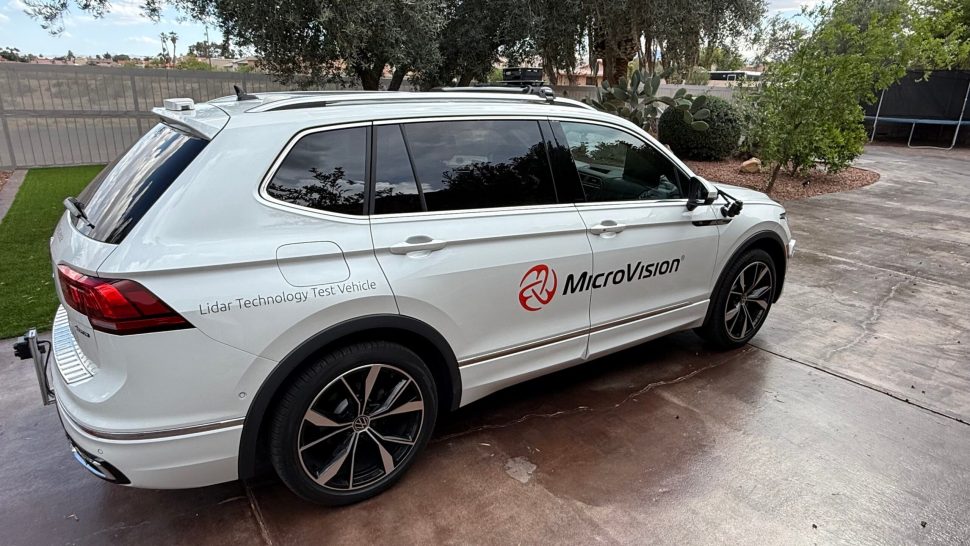
LAS VEGAS — The automated driving gold rush of the past decade produced hundreds of companies chasing self-driving trucks and robotaxis. Unfortunately for many, the economics never panned out. Things like billion-dollar development costs, expensive sensor suites and unsustainable business models led to flash-in-the-pan announcements that quietly faded.
What survived, according to MicroVision’s leadership, was something more valuable: the infrastructure, algorithms and talent that now form the foundation of what the company calls LiDAR 2.0.
“The mindset of Silicon Valley was to focus on performance: deliver the highest performance system and solution that you can give. And then over time, volumes will come and prices go down,” said Greg Scharenbroch, vice president of global engineering at MicroVision. “But that’s not really what happened.”
Scharenbroch, a 30-year automotive veteran who joined MicroVision in November after working on ADAS systems and software-defined vehicle compute, believes the industry learned hard lessons from what he calls LiDAR 1.0.
The company is now applying automotive discipline to sensor development, targeting commercial trucks, passenger vehicles, industrial automation and defense applications. This modular portfolio is designed primarily for cost efficiency.
Four Pillars Driving the Strategy
MicroVision’s approach rests on a broad portfolio that smooths revenue cycles by reusing core technology across sectors. Its design-to-cost mindset is rooted in automotive heritage and an emphasis on software differentiation.
“We’re automotive folks. Our legacy is automotive,” Scharenbroch said. “Automotive development runway times are two, three, three and a half years of development investment before you see the first dollar of revenue from the program. So we have to diversify our portfolio.”
The company’s open software framework is a departure from industry norms. It allows customers to run their own code directly on MicroVision’s sensor processor. This reduces development layers while letting customers differentiate their products using proprietary algorithms.
“We’re offering our customers the ability to put their code into our processor on our sensor,” Scharenbroch said. “That’s really different and unique.”
Fiscal discipline is another pillar of this strategy. MicroVision maintains a fixed spending envelope and refuses to make massive capital outlays before securing customer commitments.
Acquisitions Accelerate the Roadmap
Three strategic moves since January have reshaped MicroVision’s product roadmap. The Luminar acquisition, secured for $33 million after the company’s bankruptcy, brought production programs with Volvo and other automakers. Additionally, MicroVision gained an ASIC design team in Colorado Springs and world-class validation facilities in Orlando worth hundreds of millions of dollars.
“At one point [Luminar] was valued at between $9 billion and $10 billion,” Scharenbroch said. “In bankruptcy, we got it for $33 million.”
The Scantinel acquisition added frequency-modulated continuous-wave technology capable of measuring range and velocity simultaneously. Its detection potential reaches one kilometer. Both projects that proved the technology could fit into small wafers have been completed, with a tape-out expected in 2027.
The result is a consolidated sensor lineup spanning short-range Movia products for last-mile and parking applications, long-range Iris and Halo sensors that detect objects at 250 yards and beyond, and ultra-long-range FMCW systems.
Commercial Trucking’s Dollar-and-Cents Case
For fleet operators, the value proposition directly translates to cost-per-mile savings. Scharenbroch cited a Bosch study showing automated braking and lane-keeping systems produced accident cost avoidance of approximately 4 cents per mile.
“If you drive 100,000 miles, that’s $4,000,” he said.
Insurance data supports the case. The Insurance Institute for Highway Safety found fleets with regularly used ADAS systems achieved 15 percent lower average accident costs, with some insurers offering up to 20 percent reduced premiums.
Bendix data on its Wingman system showed operational efficiencies of 6 to 8 cents per mile through smoother speed profiles and reduced wear on tires and brakes.
The safety imperative is another factor: approximately 650,000 crashes involving Class 8 trucks occur annually in the United States, with roughly 5,000 fatalities. LiDAR shines in scenarios where cameras struggle, including detecting small objects like shredded tires at night beyond headlamp range.
“A camera system can only see as far at night as the headlamps — that’s 200 feet,” Scharenbroch said. “We mentioned it takes 500-plus feet for a truck to stop.”
MicroVision is currently in the evaluation stage with a commercial vehicle original equipment manufacturer in Europe and in discussions with retrofit suppliers and towing system developers. These moves also position the company for potential production programs as the industry moves toward 24/7 autonomous hub-to-hub operations.
Brokerage Compliance Symposium
The day before F3. Every compliance issue you face - fraud exposure, carrier liability, FMCSA rules, cargo theft, insurance gaps - navigated by attorneys and operators defining best practices in a changing industry.
F3 Awards Dinner
The night before F3. FreightTech100 companies honored. FreightTech 25 and Shipper of Choice winners revealed live. Cocktail reception into dinner and live music - 300 industry leaders in one purpose-built room.
F3: Future of Freight Festival
Industry-defining keynotes, rapid-fire technology demos, and industry leaders networking in experiences across Chattanooga - plus the inaugural F3 Awards Dinner featuring the FreightTech and Shipper of Choice reveals.
The day before F3. Every compliance issue you face - fraud exposure, carrier liability, FMCSA rules, cargo theft, insurance gaps - navigated by attorneys and operators defining best practices in a changing industry.
The Signal at Chattanooga Choo Choo • Chattanooga, TN Register NowThe night before F3. FreightTech100 companies honored. FreightTech 25 and Shipper of Choice winners revealed live. Cocktail reception into dinner and live music - 300 industry leaders in one purpose-built room.
The Signal at Chattanooga Choo Choo • Chattanooga, TN Register NowIndustry-defining keynotes, rapid-fire technology demos, and industry leaders networking in experiences across Chattanooga - plus the inaugural F3 Awards Dinner featuring the FreightTech and Shipper of Choice reveals.
The Signal at Chattanooga Choo Choo • Chattanooga, TN Register Now