




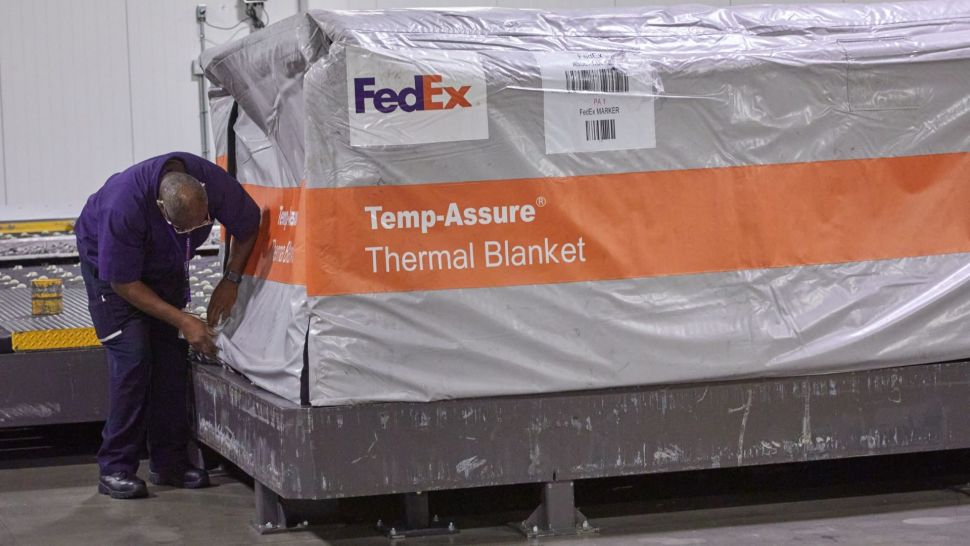
FedEx Corp. has launched a life sciences division offering specialized logistics services for companies shipping pharmaceuticals, medical devices, biologics, clinical trial drugs and other critical healthcare shipments, the company announced on Thursday.
The move is part of a growing strategy at FedEx (NYSE: FDX), as well as rivals UPS and DHL, to pivot from the legacy parcel delivery business to focus on high-margin, premium market segments such as healthcare.
Chief Commercial Officer Brie Carere first mentioned the launch of FedEx Life Sciences during the company’s earnings presentation on June 23, saying the company saw strong growth opportunities in the $80 billion healthcare transportation market.
“Transporting vital healthcare deliveries requires more than just standard logistics. It depends upon an intelligent, highly specialized network built for patient-critical needs,” she said in Thursday’s news release.
Most of FedEx’s 13% revenue growth during the fourth quarter ended May 31 came from B2B premium markets such as automotive, healthcare, aerospace, data centers and specialized B2C.
Life sciences companies have little tolerance for transportation mistakes because their shipments, such as vaccines, tissue and blood samples, and protein and gene therapies, are highly regulated and very sensitive to temperature changes and other environmental conditions. Speed, precision, visibility and reliability tend to be more important than price for them.
FedEx has long invested in cold-chain storage and transportation services for the healthcare industry and says it generated about $10 billion in healthcare revenue in the past 12 months, up from $9 billion in the previous fiscal year. UPS gets similar revenue from healthcare and DHL has set a target of more than $10 billion in healthcare revenue by 2030.
Establishment of FedEx Life Sciences pulls capabilities across the parcel and supply chain organizations under one roof with a dedicated team and advanced monitoring capabilities, providing more of an end-to-end solution for customers.
FedEx already has six global life sciences centers, including in Asia and Europe, and manages temperature-controlled corridors between key markets. Last year, for example, FedEx launched direct flights between Dublin, Ireland, and Indianapolis — two top healthcare and biopharma hubs. In 2025, FedEx secured corporate-level certification from the International Air Transport Association for ground handling of pharmaceuticals across its air hubs and ramps. FedEx said it recently appointed a vice president of global quality, healthcare and life sciences to oversee global quality management systems for the organization and support the standards required by pharmaceutical and medical device manufacturers.
Temperature-sensitive shipments are supported by FedEx Surround, a monitoring and intervention service that uses machine learning to proactively identify potential disruptions, such as transport delays or deviation from prescribed temperature ranges, and support quick intervention
FedEx named Nick Gennari as president of healthcare and life sciences to lead the new organization. He has spent more than 30 years at FedEx in a variety of sales and supply chain roles serving the healthcare, aerospace and high-tech industries, before assuming leadership of the healthcare vertical in 2024.
Click here for more FreightWaves/American Shipper stories by Eric Kulisch.
Write to Eric Kulisch at ekulisch@freightwaves.com.
RELATED STORIES:
FedEx boosts revenue behind premium parcel, freight volumes
UPS expands healthcare reach with completion of Andlauer deal
Brokerage Compliance Symposium
The day before F3. Every compliance issue you face - fraud exposure, carrier liability, FMCSA rules, cargo theft, insurance gaps - navigated by attorneys and operators defining best practices in a changing industry.
F3 Awards Dinner
The night before F3. FreightTech100 companies honored. FreightTech 25 and Shipper of Choice winners revealed live. Cocktail reception into dinner and live music - 300 industry leaders in one purpose-built room.
F3: Future of Freight Festival
Industry-defining keynotes, rapid-fire technology demos, and industry leaders networking in experiences across Chattanooga - plus the inaugural F3 Awards Dinner featuring the FreightTech and Shipper of Choice reveals.
The day before F3. Every compliance issue you face - fraud exposure, carrier liability, FMCSA rules, cargo theft, insurance gaps - navigated by attorneys and operators defining best practices in a changing industry.
The Signal at Chattanooga Choo Choo • Chattanooga, TN Register NowThe night before F3. FreightTech100 companies honored. FreightTech 25 and Shipper of Choice winners revealed live. Cocktail reception into dinner and live music - 300 industry leaders in one purpose-built room.
The Signal at Chattanooga Choo Choo • Chattanooga, TN Register NowIndustry-defining keynotes, rapid-fire technology demos, and industry leaders networking in experiences across Chattanooga - plus the inaugural F3 Awards Dinner featuring the FreightTech and Shipper of Choice reveals.
The Signal at Chattanooga Choo Choo • Chattanooga, TN Register Now