




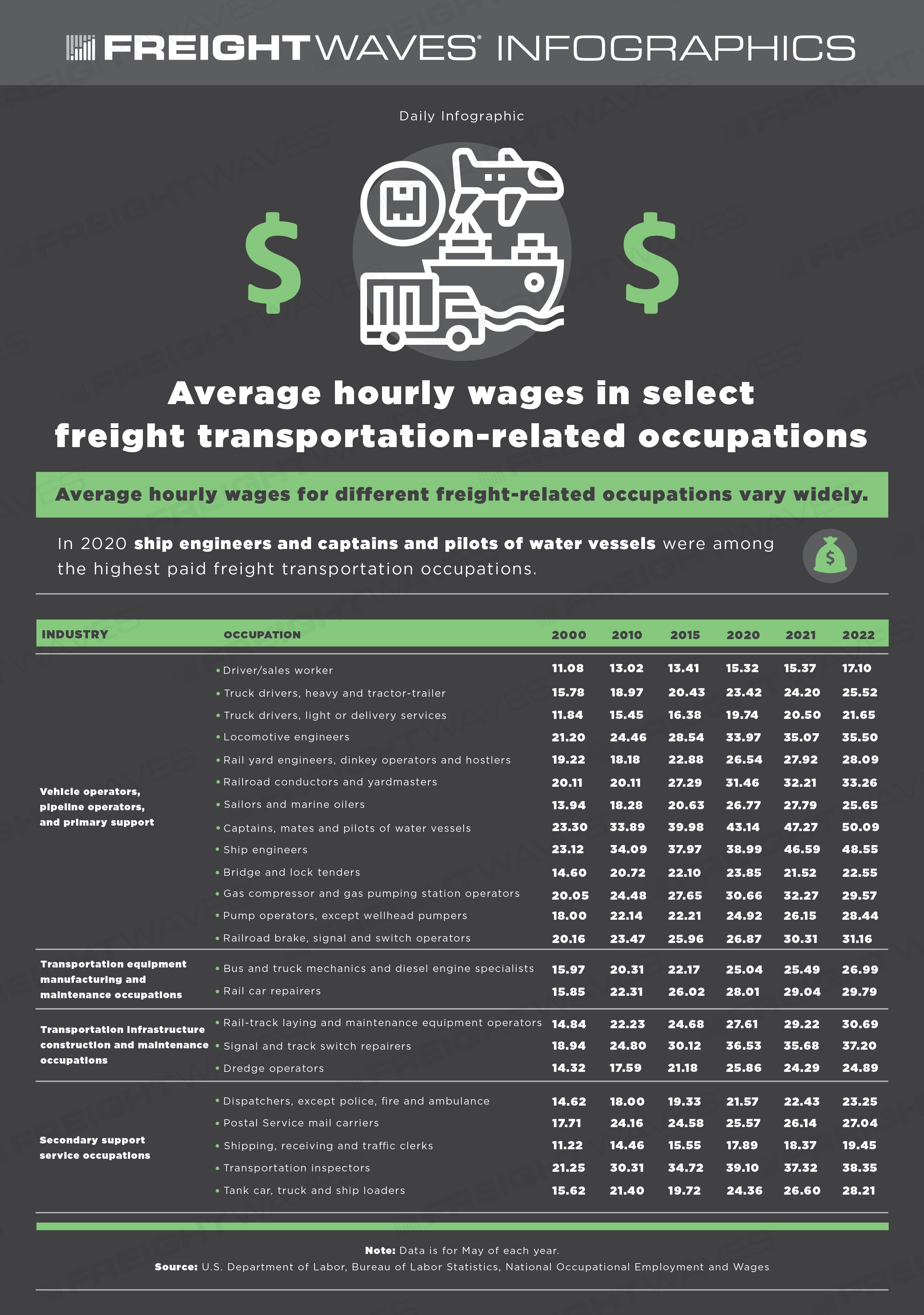
Daily Infographic: Average hourly wages in select freight transportation-related occupations

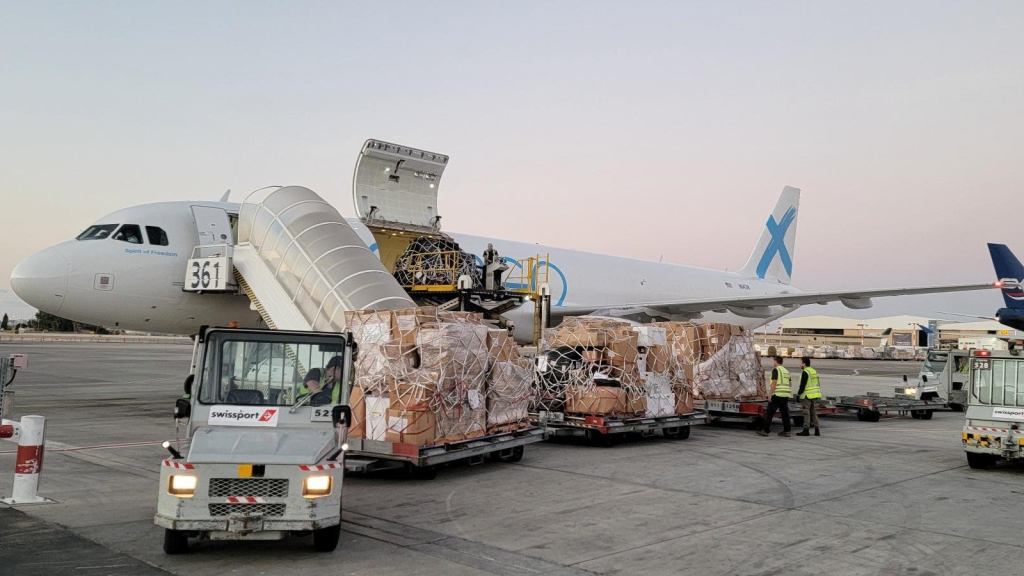
Israel will need to import more goods because the war effort makes domestic production more difficult and DHL Group has already responded by organizing a new daily freighter operation, according to logistics professionals who briefed members of the media on Tuesday.
DHL Group, the second-largest global logistics provider with headquarters in Bonn, Germany, and Chicago-based Seko Logistics are already responding to strong interest from businesses to ship to Israel, executives said.
The call-up of tens of thousands of army reservists will limit Israel’s economic output and ability to support itself, driving a need for imported goods and related logistics support, Brian Bourke, global chief commercial officer at Seko Logistics, told reporters on a conference call. Seko has 65 employees in the country.
The departure of Israeli citizens from their regular jobs to join the Israel Defense Forces “has impacts on supply chains because factories are not going to be producing as much, distribution centers aren’t going to be moving goods as much,” said Bourke. “And so Israel as a country is going to be needing to import a lot more than they were before. And traditionally they import quite a bit.”
Israel is a big market for sectors like high-tech, although much of the trade flow in technology is outbound. In 2022, Israel imported $107.7 billion worth of merchandise from the world, led by raw materials and consumer goods, according to the U.S. International Trade Administration.
The Israeli government last week exempted many high-priority imported products from inspections and document requirements to ease their entry into the country, according to Reuters.
The Port of Ashdod is open, but working at less efficiency with workers having to take shelter when there are rocket attacks and some personnel called up for military duty. The northern Port of Haifa and Tel Aviv Airport are open and operating close to normal.
DHL Global Forwarding this week introduced a dedicated freighter operation out of Liege Airport in Belgium to Tel Aviv, said CEO Tim Robertson on a separate call. The company’s international freight arm has chartered a Boeing 767 from a cargo airline for the daily service, a spokesman elaborated.
The flights are in addition to regular flights in the DHL Express package network. As previously reported, DHL Express is operating once or twice a day from its hub in Leipzig, Germany, to Tel Aviv with Boeing 757 cargo jets, according to flight tracking sites.
Operating in a conflict zone is challenging for commercial transportation providers. Many international passenger and cargo airlines have suspended flights to Tel Aviv until hostilities subside. Aviation experts say there is a risk that an aircraft could be accidentally struck by a missile fired by Hamas in Gaza or Iran-backed forces in southern Lebanon or by Israel’s antimissile defense system. Interference with GPS signals also could cause aircraft to move off their intended flight paths and into more dangerous skies. Israeli authorities counter that their mitigation measures make it safe to fly into Tel Aviv.
DHL rival FedEx quietly resumed flights to Tel Aviv from Athens, Greece, last week with its own purple-tail aircraft after initially suspending service. Other freighter operators serving Tel Aviv include MNG Airlines (Turkey), SkyTaxi (Poland), Silk Way West Airlines (Azerbaijan) and Israel’s own Challenge Group, with a fleet of Boeing 747 and 767 jets.
Global Crossing Airlines, a small Miami-based startup with three Airbus A321 converted freighters, has made two trips to Tel Aviv with more than 50 tons of medical and first-responder equipment. The planes aren’t designed for long-haul flights so the airline has to take the long way north into Europe, with several fuel stops along the way.
The flights were arranged under the auspices of the Florida Division of Emergency Management (FDEM) as part of Gov. Ron DeSantis’ self-declared Israel rescue mission. Hospitals and government agencies in Israel requested the aid and FDEM collected donations of bandages, hospital gowns, IV kits, needles, syringes, ventilators and comfort items for children — enough to fill 85 pallets — from Florida hospitals, local communities and the Agency for HealthCare Administration, the governor’s office said in a news release Tuesday.
DeSantis, who is running for the Republican nomination for president and a frequent critic of the Biden administration, issued an executive order on Oct. 12 to help repatriate Floridians and other Americans, and provide aid to Israel, because he said the U.S. government had failed to launch any evacuation effort. The Biden administration launched air and cruise ship charter services on Oct. 13 but is winding down the effort because of limited demand, Politico reported.
Robertson said DHL will lease the charter aircraft for about two weeks and then determine whether to continue flights based on demand.
“We’re very well positioned to support our customers in and out of Israel,” he said.
DHL executives were forceful in their backing of Israel. “We strongly condemn the recent attacks on Israel. We’re doing all possible to support that market here,” Robertson said.
“We’ll never abandon Israel. Our plan to stay there is unequivocal,” said Mike Parra, CEO for the Americas at DHL Express.
Bourke said Seko Logistics has secured a temporary warehouse in Haifa to handle an expected influx of supplies.
Seko is also mobilizing significant amounts of humanitarian aid to Israel, especially medical equipment, and looks forward to soon being able to help nongovernmental organizations get relief supplies to Palestinians in Gaza and the West Bank, when conditions are safe, he added.
Click here for more FreightWaves and American Shipper articles by Eric Kulisch.
Contact Reporter: ekulisch@www.freightwaves.com
RECOMMENDED READING:
Global Crossing Airlines one of few to make Israel cargo flights

The Class I railroads are striving to collaborate more proactively and create a product that can be competitive against the truck markets, CN executives said during the Canadian railway’s earnings call Tuesday to discuss third-quarter 2023 financial results.
The comments echo ones similarly expressed during the third-quarter earnings call for Eastern U.S. Class I rail carrier CSX last week.
“I think it is a change that we’re seeing in the industry for various reasons,” CN President and CEO Tracy Robinson said to investors during the call. “I will tell you that we are open for business and very eager to work with our partners and the other carriers to provide and design the services that make sense for our customers.”
The ones that have been announced recently, such as the partnership with Western U.S. Class I railroad Union Pacific and Grupo Mexico and another partnership with Eastern U.S. Class I carrier Norfolk Southern, “are really targeting getting truck traffic off the road. … We have a product in place now that’s consistently delivering at very truck-like transits. And that’s pretty remarkable,” Robinson said.
“I think you’re going to see more of this. And I would say that the nature of the dialogues that we’ve had so far with all of the carriers is that we’ll conduct ourselves in a way as though we were a single carrier. And that may mean, in some cases, it’s advantageous to one and in another case is advantageous to the other. But that’s a principle that I think needs to underscore these relationships as we go forward.”
Ensuring faster rail transport is also a shared goal within these partnerships, according to CN Chief Marketing Officer Doug MacDonald.
“It’s all about service. The quickest transit times to compete against truck is really what the operating teams between the railways are really focused on,” MacDonald said. “We don’t really care how long the haul is. It’s all about we need to get there as fast as truck. All the teams have been greatly focused on that. They’ve come up with some great products where we think we’re truck competitive in all these corridors and the major truck lanes.”
CN executives also touted the benefits of being the one Class I rail carrier to have exclusive access to the Port of Prince Rupert in British Columbia. Robinson singled out CN’s premium container service from Prince Rupert to U.S. markets as one example.
“There are real structural advantages to Rupert. … We’re two days faster from China to Chicago than the other alternatives and there are some economic advantages,” such as being tied to Canadian currency, Robinson said.
The Port of Prince Rupert announced that it is starting construction on a project to expand rail-to-container transloading capacity at Ridley Island and better facilitate the export of agricultural, forestry and plastic resin products.
And ahead of releasing its third-quarter earnings results, CN said Monday in a separate announcement that it had renewed a five-year transportation agreement with AltaGas. The agreement, which CN says expands the existing one, gives AltaGas access to the Port of Prince Rupert and should enable AltaGas to grow its export business.
“By selling into our capacity and taking advantage of our unique network reach, we are confident in our ability to accelerate sustainable, profitable growth,” Robinson said in Monday’s announcement.
AltaGas President and CEO Vern Yu said, “The agreement provides AltaGas and our customers with cost and service predictability to continue to support ongoing resource development across Western Canada and provide our key downstream customers with energy security to support economic activity and fuel everyday life.”
A 12% decrease in revenue contributed to lower net profits for CN (NYSE: CNI) in the third quarter.
Net income was CA$1.12 billion (US$806.3 million), or $1.69 per diluted share, for the third quarter of 2023, compared with nearly $1.46 billion, or $2.13 per diluted share, for the third quarter of 2022. All financial figures are in Canadian dollars.
Revenue was $3.99 billion in the third quarter, compared with $4.5 billion for the third quarter of 2022. Lower fuel surcharge revenues as a result of lower fuel prices, as well as lower volumes of intermodal, crude oil and forest products, put pressure on revenue, CN said.
Lower volumes were due to lower demand for freight services to move consumer goods, the negative impact of the Pacific Coast dockworkers strike, unfavorable crude oil price spreads and weaker market conditions for lumber and panels as well as lower ancillary services including container storage, CN continued.
Freight rate increases, higher volumes of Canadian grain and potash and the positive translation impact of a weaker Canadian dollar were among the factors that lent support to third-quarter volumes, according to CN.
Operating expenses were $2.47 billion for the third quarter, an 11% decrease year over year (y/y) amid lower fuel prices.
Operating income was $1.52 billion, 21% higher compared with the third quarter of 2022, while operating ratio, an indicator that investors sometimes use to gauge the financial health of a company, was 62% compared with 57.2% y/y. A lower OR implies improved financial health.

“Our ‘Make the Plan, Run the Plan, Sell the Plan’ approach continued to perform well, delivering strong customer service despite weak consumer demand as well as external challenges,” Robinson said in a news release. “As volumes continue to improve, we are well positioned to deliver incremental operating leverage. We remain confident in our ability to accelerate sustainable, profitable growth in 2024 through 2026.”
Subscribe to FreightWaves’ e-newsletters and get the latest insights on freight right in your inbox.
Click here for more FreightWaves articles by Joanna Marsh.

Editor’s note: This story was updated at 6:30 p.m. on Oct. 24 to reflect new information from Estes.
The president of Estes Express went online Tuesday to announce all the company’s operations are back to normal and it has overcome a massive cyberattack.
Tuesday’s announcement came just a few days after Webb Estes took to a public video platform to report that most of the key operations at the LTL carrier that bears his family name have been fixed after a cyberattack early this month. In the video, Webb Estes said all systems had been restored.
The precise date of the start of the Estes cyberattack is not clear, but it became known in the industry by the start of the workweek that began Oct. 2.
Webb Estes said last week the company is “working tirelessly to complete the restoration of our systems and make them even safer,” suggesting then that the entire task of rebuilding after the attack is not complete. However, he did not offer specifics on what systems remain down.
Most importantly, Webb Estes said the company’s application programming interface connections with customers and other counterparties are back online. APIs have been defined as “a set of programming code that enables data transmission between one software product and another.”
“Our API connections are available to integrate our shipping functionality into our customers’ business applications and websites,” Webb Estes said in the recording.
He also said the company had restored the “image document retrieval API.” But that takes time, and Webb Estes said “we’re working hard to get all scanned images into our system so invoicing can resume soon with our APIs.”
Since the Oct. 6 update, the company’s website also was restored, as was its phone service.
Given that Estes is not a public company, outsiders will not be able to ascertain how much of a hit the company took on its cybersecurity attack. The only analogy that could be made, given that they are both LTL carriers, would be to the fourth-quarter 2020 attack at Forward Air (NASDAQ: FWRD).
The companies are admittedly different; Forward Air is an LTL carrier but with its activities focused on moving airfreight. But its Q4 2020 revenue of $350.3 million was followed by first-quarter 2021 revenue of $362.2 million. By the fourth quarter of 2021, revenue had climbed to $459.9 million, admittedly in the midst of a historically good freight market.
In several of his daily updates, chief Deutsche Bank transportation analyst Amit Mehrotra suggested that the third-quarter earnings calls of publicly traded LTL carriers might give some suggestion about how much Estes business was moved over to other companies. However, private conversations with some LTL executives suggest the size of any lost business was minimal, with at least one executive at a leading LTL provider saying his company had seen almost no increase in business that could be attributed to the Estes hack.
Webb Estes gave no hint how large the impact on its business might be as it switched to a more manual system during the cyberattack. But he heaped praise on customers that had remained.
“We continue to see our customers choosing Estes for their shipping needs,” Webb Estes said. “We know you have choices. So we’d like to thank our many customers who’ve stuck by us through this challenge. Your trust in us has helped drive efforts toward returning online quickly, responsibly and safely. We’ve hardened our technology environment, and we’re building back stronger than ever. Again, please accept my sincere thanks for your patience and trust.”
More articles by John Kingston
Taking stock of what happened at Estes
TriumphPay’s EBITDA loss narrows, volume increases, factoring invoices stay flat
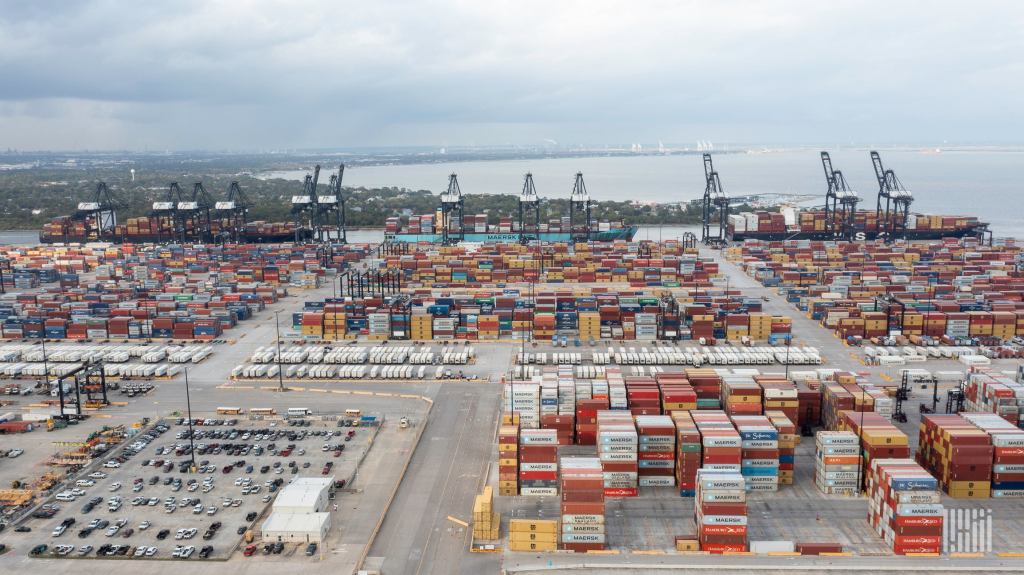
Container flow in September sagged in Houston, while the global demand for crude oil continued to fuel exports through Corpus Christi, Texas. The Port of New Orleans reported plastic resins, chemicals and coffee as its top containerized cargo during the month.
Port Houston handled 325,588 twenty-foot equivalent units in September, a year-over-year (y/y) decrease of 8% compared to the same period last year.
Roger Guenther, executive director at Port Houston, said cargo traffic at the port has remained steady in 2023 but has been lower than the record results of 2022.
“Our overall tonnage in September across all facilities is down versus 2022, which to remind everyone 2022 was a record year,” Guenther said during the port’s monthly commission meeting Tuesday. “Loaded boxes are still coming through our port and we expect it to continue that way. It’s kind of the decline of the empty containers being exported to Asia that is driving the [monthly] totals down a little bit.”
Loaded imports were down 12% y/y at 156,161 TEUs, while loaded exports were up 21% y/y in September at 124,739 TEUs.
Empty import containers increased 63% y/y in September at 16,208 TEUs, while empty export containers decreased 55% y/y to 28,480 TEUs.
Total revenue tonnage was down 16% y/y at 4.9 million tons.
Imports of steel products were down 20% y/y in September at 349,509 tons. General cargo imports were down 37% y/y at 622,911 tons. Container imports decreased 10% y/y to 1.47 million tons.
Exports of steel products were down 94% y/y to 2,992 tons, while general exports decreased 38% y/y to 876,059 tons. Container exports increased 15% to 1.6 million tons.
Chief Port Operations Officer Jeff Davis said on Sept. 26 the port handled 15,491 gate transactions at its Barbours Cut and Bayport container terminals, its busiest day of the month.
“As Roger mentioned, we’re just not seeing those export empties [containers] being returned as imports like we did last year, but we continue to have a solid year,” Davis said during Tuesday’s meeting.
Port Houston recorded 688 ship calls in September, a 2% y/y increase, while barge calls totaled 287, a 37% y/y decline.
The Port of Corpus Christi posted a 10% y/y increase in total shipments during September, handling 17.1 million tons compared to 15.6 million tons in 2022.
Exports of crude oil totaled 10.2 million tons in September, a 19% y/y increase compared to the same year-ago period.
Petroleum shipments decreased 2% y/y in September to 4.9 million tons, with exports totaling 3.9 million tons during the month.
Dry bulk cargo decreased 32% y/y to 519,297 tons, while chemical cargo volumes totaled 287,829 tons in September, a 38% y/y increase from 2022.
Shipments of bulk grain increased 1,164% y/y in September to 189,620 tons, while breakbulk shipments increased 480% y/y to 28,701 tons.
Liquid bulk shipments increased 13% y/y to 70,756 tons.
The Port of Corpus Christi had 456 barge calls in September, a 10% y/y decline. Ship calls during September totaled 209, a 12% y/y increase compared to 2022.
For the first time in its history, the port moved more than 50 million tons of goods through the Corpus Christi Ship Channel during a quarter, according to a news release.
Port officials said 52 million tons of freight moved through the ship channel during the third quarter, a 7.7% y/y increase compared to the same period a year ago.
Port of Corpus Christi customers moved 151.3 million tons through the gateway during the first nine months of 2023, a 9.4% increase from the same period in 2022. The leading commodities from January through September were crude oil, refined products and liquified natural gas.
The Port of New Orleans’ top containerized cargo in September were exports of plastic resins and chemicals and imports of coffee and organic chemicals.
The top breakbulk cargo commodities for the month were steel and rubber imports.
“Besides the regular types of cargo, we saw some lumber imports (breakbulk) from Europe,” port spokeswoman Kimberly Curth told FreightWaves.
Breakbulk tons totaled 59,152 in September, while container volume totaled 41,249 TEUs.
The port did not provide y/y monthly data, but container traffic increased 12% compared to August and is up 10.6% year to date; breakbulk cargo fell 50% compared to August.
“There were 30 vessel calls in September, and vessel calls are up 36% compared to this time last year,” Curth said.
The port handled 7,927 Class I rail car switches in September, an 8% decline from August. The port handles switching operations for six Class I railroads: BNSF, CN, CSX, CPKC, Norfolk Southern and Union Pacific.
Click for more FreightWaves articles by Noi Mahoney.
More articles by Noi Mahoney
Borderlands: Cargo theft trends changing as supply chains shift to border regions
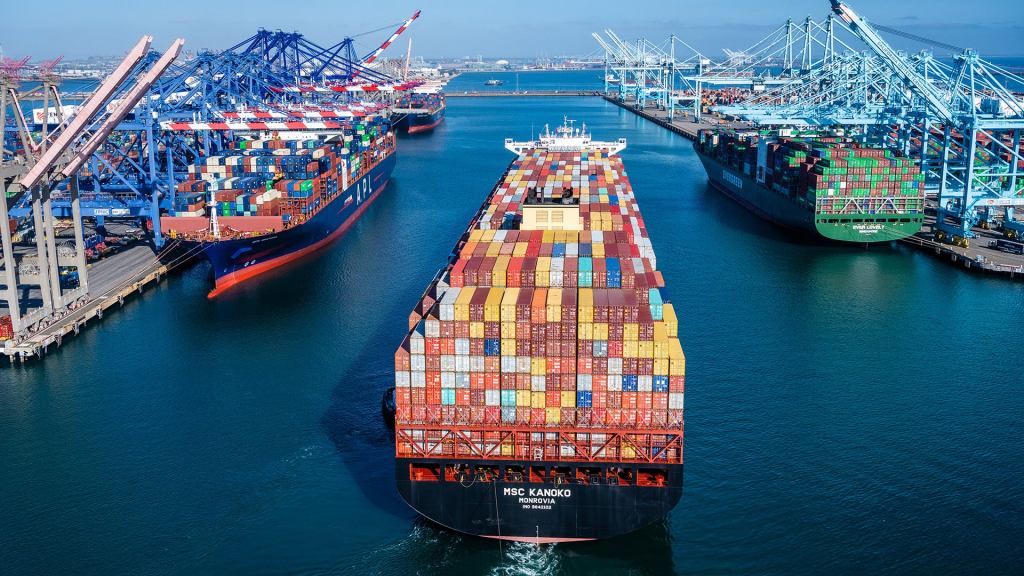
Port of Los Angeles Executive Director Gene Seroka said a 55% year-over-year (y/y) increase in exports in September bodes well not only for the West Coast gateway but for the entire country.
“Exports are trending up and that’s good news because narrowing the trade gap boosts the U.S. economy. Additionally, export jobs on average pay more than work in other segments,” Seroka said during a media briefing on Monday.
Seroka reported that for the second consecutive month, the port’s cargo volume increased compared to 2022. The Port of LA handled 748,400 twenty-foot equivalent units, a 5.4% increase from September 2022. In addition to the 55% increase in exports to 120,635 TEUs, imports were up 14% y/y to 392,608 TEUs. Empty containers handled totaled 235,197 TEUs, an 18.5% decline y/y.
“With a long-term dockworker contract in place, we’re seeing more cargo shifting back to Los Angeles,” Seroka said. “The table is set to scale up as demand increases.”
Mario Cordero, CEO of the neighboring Port of Long Beach, last week also credited the International Longshore and Warehouse Union contract, which was ratified at the end of August, for a return of positive cargo numbers to San Pedro Bay.
Intermittent work stoppages this year during contract negotiations between the ILWU and Pacific Maritime Association negatively impacted both ports. From Jan. 1 through Sept. 30, the Port of LA processed 6,398,126 TEUs, an 18.6% drop from the same period in 2022.
At Monday’s media briefing, Seroka hosted Matthew Shay, president and CEO of the National Retail Federation, who shared the port chief’s optimism.
“Retailers have been hard at work getting holiday inventories in place to provide consumers with great products, competitive prices and convenience at every opportunity,” Shay said. “As we gear up for the holiday season, we expect moderate growth to continue as consumers focus on value and household priorities.”
Port of Long Beach CEO: ‘Consumer confidence is on the rise’
Port of Long Beach: Consumer spending decline contributed to import drop
October bountiful for ports on East, Gulf coasts
Click here for more American Shipper/FreightWaves stories by Senior Editor Kim Link-Wills.


Welcome to Check Call, our corner of the internet for all things 3PL, freight broker and supply chain. Check Call the podcast comes out every Tuesday at 12:30 p.m. EDT. Catch up on previous episodes here. If this was forwarded to you, sign up for Check Call the newsletter here.

(GIF:GIPHY)
Over the course of the past week, the news cycle has his a little closer to home. Convoy is closing up shop, aside from a few workers who were helping facilitate a sale, and now Slync is looking at bankruptcy as well. After a few years of the highest of highs, the lowest of lows has come and it paints a bleak future.
How did we get to this point? Freight brokerages came on to the scene in a significant way in the early 2000s, moving the occasional load here and there for shippers. It wasn’t very common to be a major part of a shipper’s organization. Fast forward to now and it’s extremely common to have 3PLs and freight brokers moving a majority of a shipper’s freight. There’s an entire service of managed transportation that companies offer so a shipper doesn’t have to build out an entire logistics department.
During the pandemic, anyone who ever thought of becoming a freight broker did. Starting off 2023, there were roughly 300,000 active freight brokers, according to the Federal Motor Carrier Safety Administration. That was an all-time high. July turned broker registrations negative, and as of Oct. 1 there are 5.6% fewer brokerages active and authorized than in October 2022, according to Brush Pass Research.
It’s been hard for everyone in a down market. Why is Convoy’s closure different? Convoy raised money quickly and grew even faster. Offering discounts to early shippers and introducing the tech options shippers were desperate for, they made a big splash in the industry. They were the leading investors to consider FreightTech and supply chain as strong investments.
Everything was in their favor until the hard times came.
Convoy’s impact will be felt for years to come. It forced everyone to up the status quo and improve their tech stack. It helped set the new standard table stakes that will be required by most shippers.
As for the rest of us, it’s going to get worse before it gets better. Bid season is different this year. Less-than-truckload shippers are going to want to look at strong options or rebid the network if they were caught up with Yellow earlier in the year. The short-term solution to keep the network moving is likely not a long-term solution.
Truckload doesn’t look much better as spot rates leave a lot to be desired. When there is too much capacity and spot rates are barely at a breakeven point for carriers, it’s going to make for soft contract rates. Margin will shrink to very little. When the spread between contract and spot market widens, it decimates margin and exacerbates any financial issues a brokerage may have.
How much longer do we have to go? Depending on whom you talk to, the answer could change. The Q4 retail peak season didn’t create as much demand as expected. It’ll likely be the middle of 2024 before rates start to tick up, but not likely in a dramatic way. If you’re going off FreightWaves CEO’s call, it looks like about 78 more weeks.

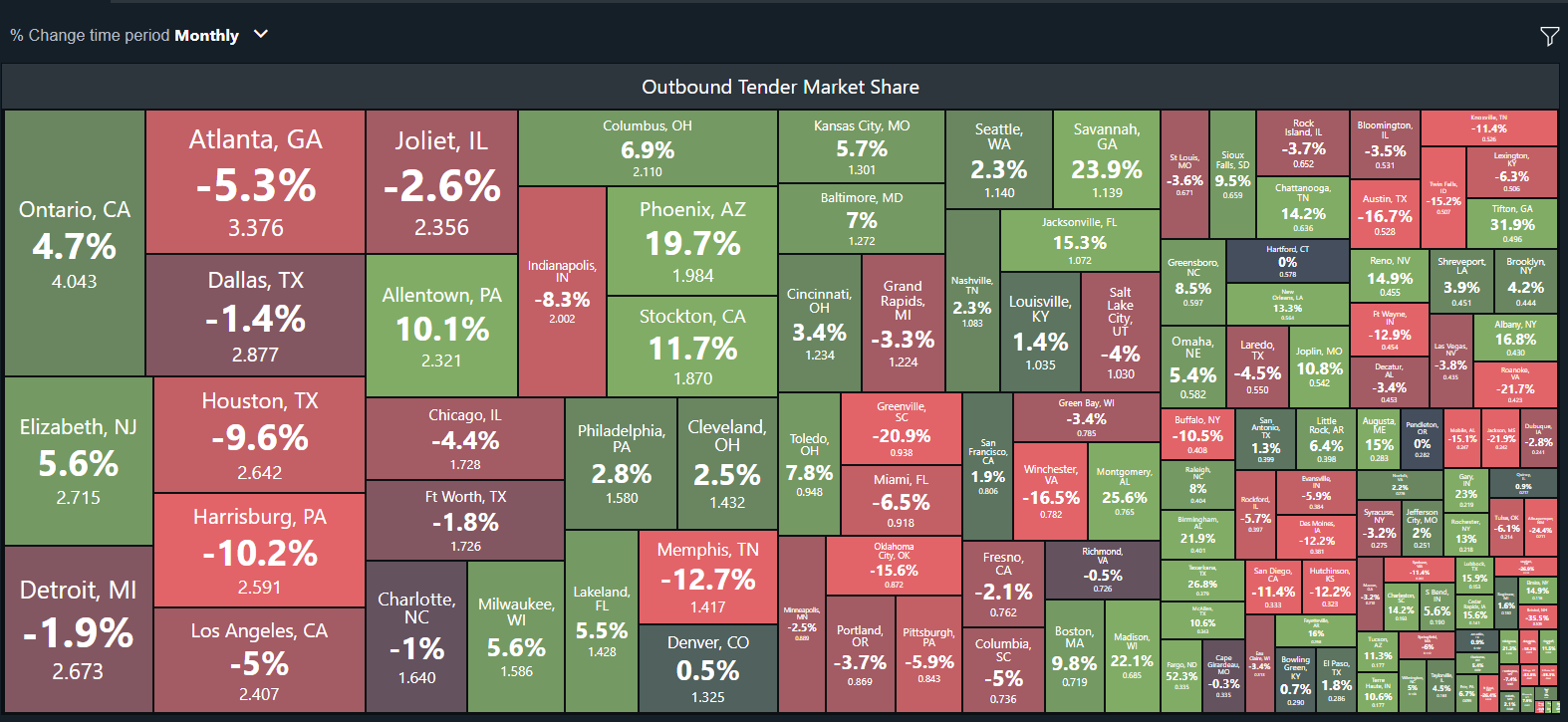
SONAR Ticker: OTMSY
Market Check. The Outbound Tender Market Share Index shows which markets have the most impact on truck volumes. A larger market share means the market demands more trucks and has a stronger impact on freight market capacity. When market share levels change, network imbalances can show up, creating potential spot market activity. The above chart focuses on month-over-month (m/m) changes. Southern California has made a comeback to have Ontario as the top freight market. In most industries, October kicks off peak season. While it’s expected to be a muted peak season, November and December are going to see elevated volumes compared to now. There have been few dramatic changes m/m, as Harrisburg, Pennsylvania, drops double digits (10.2% decrease) and Phoenix takes a nearly 20% increase in market share.
Is SONAR for you? Check it out with a demo!

(GIF: Tenor)
Who’s with Whom? It’s my favorite time of year, when the LTL carriers are ranked against each other. Mastio & Co. has released its annual survey of LTL carriers, and this year’s winner was Averitt. The carrier that started in the Southeast has ousted Peninsula from the top spot. Peninsula came in at No. 4 this year. The top 5 this year, in order, were Averitt Express, Daylight Transport, Old Dominion Freight Lines, Peninsula and Southeastern Freight Lines.
Todd Maiden’s article breaks down how the survey is conducted: “The survey ranks carriers on numerous metrics, including on-time pickup and delivery, shortages, damages, weighing accuracy, transit times, pricing and technology, as well as back-end functions like billing accuracy, claims processing, problem resolution and carrier responsiveness.”
Amid legal woes, Slync seeks alternative to bankruptcy, winds down operations
Edge Logistics fighting through the freight brokerage winter
What shippers need to know to succeed in Mexico in 2024
Fighting back in a cybersecurity world where bad guys are getting bolder
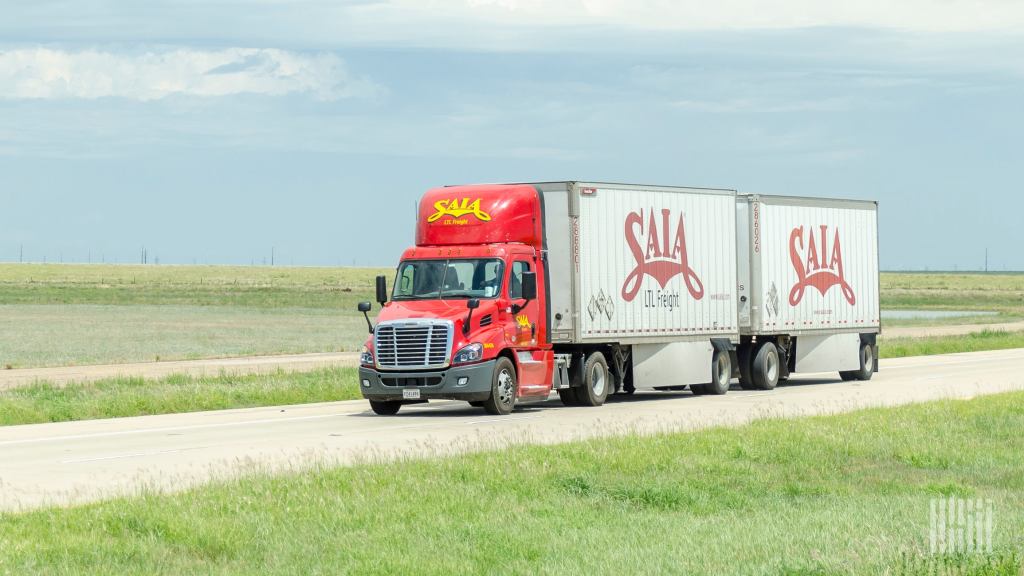
Saia is using favorable less-than-truckload fundamentals to implement a 7.5% general rate increase (GRI), which will take effect Dec. 4.
Most LTL carriers announce annual GRIs on general tariff codes at the end or beginning of a year. The increases are used to adjust base rates and vary by lane and weight class. The percentage indicated for a GRI is the expected average change the GRIs will produce. The increases are used to counter cost inflation and make capital investments.
A news release said some accessorial and minimum charges will be impacted as well.
Saia’s (NASDAQ: SAIA) increase is nearly two months earlier this year and 100 basis points higher than the increase implemented at the end of January.
“By continuously investing in our network, employees, equipment, technology, and sustainability, we are able to provide customers with the industry-leading service they require,” said Matthew Batteh, Saia’s VP of finance. “A GRI allows us to partially offset the rising costs of these expenditures as well as other investments that are essential to providing service to our customers.”
The company has opened eight new service centers this year in addition to relocating existing terminals to larger locations.
FedEx Freight (NYSE: FDX) said in late August that its 2024 GRI would average between 5.9% and 6.9%, 100 bps lower on both ends of the range than the 2023 increase. The new increase takes effect Jan. 1.
Since the exit of Yellow, most carriers have seen an influx of freight into their networks, which has pushed analysts to raise estimates heading into the third-quarter reporting period. Saia has been one of the biggest beneficiaries of the capacity shake-up. Its shipments increased 14% year over year (y/y) in August following a 6% increase in July.

The recent and immediate change in LTL fundamentals was preceded by a period of stagnant freight demand. The group saw volumes begin to roll over at the end of summer 2022, with the y/y declines accelerating to close the year. Volumes were flat sequentially for most of the first half of 2023 until it became evident that Yellow would close.
Some carriers used dynamic pricing strategies, which match available capacity to available transactional shipments, to offset the volume declines. However, that approach was largely unwound as Yellow’s freight was redistributed across the industry, immediately absorbing slack capacity.
“We believe SAIA is pursuing the best strategy in the current LTL market,” Deutsche Bank (NYSE: DB) analyst Amit Mehrotra said in a Tuesday note to clients. “While this comes with extra costs upfront, they are taking the most market share and providing good service, which allows the most growth in earnings capacity in the mid to long term (i.e. total profit growth well in excess of profit per shipment growth, which reflects market share gains). The key will be the company’s ability to maintain good service while taking on additional volume.”
Saia was named Sunday as one of three national carriers that exceeded the industry benchmark for value and loyalty in an annual shipper survey conducted by Mastio & Co.
“It is always our goal to provide the overall best on-time and claims-free service in the industry,” said Batteh. “We are constantly exploring ways to improve our service while working to balance customer demand with the costs of doing business.”
Saia will report third-quarter results before the market opens on Friday.
More FreightWaves articles by Todd Maiden

At TFI International Inc.’s (NYSE: TFII) still-struggling U.S. less-than-truckload business, TForce Freight, the focus for the rest of the year and through 2024 will be on how to reduce costs rather than building volumes or increasing prices, the parent’s CEO said Tuesday.
The U.S. LTL unit reported a 0.8% year-over-year tonnage decline and a 7.5% drop in shipments. Revenue per shipment, excluding fuel, was flat. Adjusted operating ratio, the ratio of revenues to expenses, was also flat at 90.8%. Alain Bédard, TFI’s chairman, president and CEO, said he’s pushing for an operating ratio in 2024 of 87% to 90%. Achieving next year’s goals will be complicated by a roughly 5% increase in labor costs under the first year of the unit’s new five-year contract with the Teamsters union. The contract was ratified at the end of July.
In July, TFI reported that the U.S. LTL unit would gain 3,000 additional daily shipments in the wake of Yellow Corp.’s bankruptcy and departure from the LTL market. That brought TForce’s daily shipment count to 26,000. It has since backed off to between 24,000 and 25,000 shipments per day. However, the unit had to bring on additional labor to handle the volume increase as it rose over the summer, Bédard said.
Bédard told analysts in the wake of TFI’s third-quarter results disclosed late Monday that TForce Freight needs to be more efficient and to “do more with less.” U.S. terminal managers will have new technology at their disposal to give them more real-time visibility into their costs, Bédard said.
Up to now, managers have real-time visibility only into labor cost per shipment. Once the technology is installed, managers will no longer have any reasons not to act and react quickly to changes in their cost structures, he said.
Bédard said he expects a subpar U.S. LTL market to continue to 2024. Pricing initiatives will take a back seat to the increased focus on cost reduction at the unit, he said. “We aren’t focused on getting more money from our customers,” he said.
TFI’s overall third-quarter results reflected the bleak macroenvironment. Revenues declined at its four business units, with LTL revenues dropping year over year by $100 million and truckload revenues, which make up a smaller part of TFI’s trucking mix, dropping by $109 million. Truckload operating income was nearly cut in half year over year, with the unit’s 87.5% operating ratio much worse than analysts’ estimates. TFI’s logistics unit reported the only year-over-year gain in operating income.
Third-quarter adjusted diluted earnings per share of $1.57 was well below consensus estimates. Total revenues of $1.64 billion was down from $1.86 billion in the year-earlier quarter. Operating income of $200.6 million was off by nearly $118 million from the 2022 period.
TFI last quarter lowered its 2023 earnings guidance to between $6 and $6.50 per share. The outlook at the time did not account for any gains from Yellow’s exit. On Tuesday’s call, Bédard expressed optimism that the full-year guidance will be closer to the higher end of the range.
He said he expects fourth-quarter results to show sequential improvement, albeit small. He said that 2024 could be a transition year but that it was hard to tell at this time.
At mid-day on Tuesday, shares of TFI were trading lower by more than 7%.

Nikola Corp. won $165 million in arbitration with its convicted founder Trevor Milton. That is more than enough to pay a $125 million plus interest on a Securities and Exchange Commission fine. But the electric truck startup wants more of Milton’s millions.
An arbitration panel in New York ruled in the company’s favor last Friday. It was a rare bit of good news for the company beset by an expensive recall of its battery-electric trucks and a stock price teetering around $1 a share.
Even as it has paid to bring more than 200 recalled battery-electric trucks back to its plant in Coolidge, Arizona, for battery pack replacements, Nikola has begun production of hydrogen-powered fuel cell trucks for delivery to customers before year-end.
A company spokesperson said more details on the arbitration would be shared during the third-quarter earnings call on Nov. 2.
The arbitration with Milton concluded a couple of months ago. Nikola agreed to pay a $125 million fine to the Securities and Exchange Commission related to comments Milton had made that led to him — but not the company — being criminally charged with fraud in July 2021.
Milton was convicted in October 2022 on three counts related to lying about the company’s technology promise and prowess to inflate the price of Nikola stock. Immediately after agreeing to the fine, Nikola said it would seek to recover the cost from Milton, who is free on a $100 million bond and faces sentencing in November in U.S. District Court in New York.
Milton has not commented on the arbitration, which included testimony from some of the witnesses prosecutors called in Milton’s trial.
Nikola has spent tens of millions on Milton’s defense, money it also wants to recover.
“The Company intends to file with the arbitration panel an application to recover attorneys’ fees related to the matter,” Nikola said in SEC 8-K filing Tuesday.
Milton founded Nikola in 2014 to make fuel cell commercial trucks. It went public via VectoIQ, a special purpose acquisition company in June 2020. Milton frequently posted about the company’s achievements on social media and in business publications. At one point, shares traded above $90 before beginning a long descent.
At one point, Milton was listed among the Forbes 400 with a net worth estimated at $3.5 billion based on his then-26% ownership of the company’s stock. He has sold tens of millions in shares since a lockup expired in December 2021.
Many of Milton’s claims were proved untrue following a 67-page report by short seller Hindenburg Research that came days after an announced partnership with General Motors.
The GM deal and one to build refuse trucks for Republic Services fell apart following Milton’s resignation as executive chairman in September 2020. Milton also gave up his board seat.
Nikola’s current CEO is Steve Girsky, who led the SPAC. The company had two other CEOs after Milton. The most recent, Michael Lohscheller, departed for family reasons in August. The Nikola board, which Girsky chaired, appointed him CEO effective Aug. 3.
Editor’s note: Deletes reference to additional details during earnings call.
Nikola founder loses bid for a new trial
Nikola founder Trevor Milton guilty on 3 fraud counts
Milton cashes out $131M in Nikola stock, slicing dominant ownership