




The Lantry, South Dakota Post Office serves ZIP Code 57636. Photo by Jimmy Emerson, some rights reserved. Photo shared under the Creative Commons License.
Lantry Post Office
14 Wheat Ave
Lantry, SD 57636
Location at Google Maps
The Lantry, South Dakota Post Office serves ZIP Code 57636. Photo by Jimmy Emerson, some rights reserved. Photo shared under the Creative Commons License.
Lantry Post Office
14 Wheat Ave
Lantry, SD 57636
Location at Google Maps
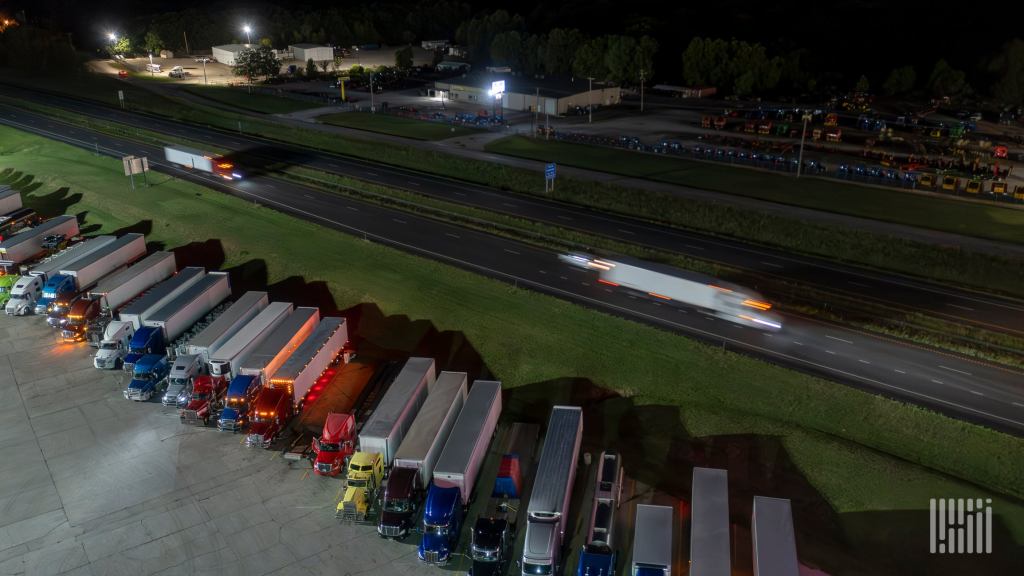
Borderlands is a weekly rundown of developments in the world of United States-Mexico cross-border trucking and trade. This week: Cargo theft trends are changing as supply chains shift to border regions; a $65 million cold storage facility could be headed to Central Texas; Gebrüder Weiss opens a logistics operation in Laredo; and a truck driver is stopped at the border with $12 million in cocaine.
Crimes against truckers in the United States, Mexico and Canada are on the rise, costing trucking and logistics industries up to $1 billion annually.
Traditionally, cargo theft in the U.S. has been concentrated in places such as ports and facilities in California, Texas and Florida. In Canada, the majority of thefts usually occur in the Toronto region, while in Mexico trucks and logistics centers in the country’s central states are often targeted.
With more manufacturers leaving Asia and moving facilities to Mexico, Canada or other locations near or along border regions to capitalize on shifting supply chains, trade experts say it could affect cargo thieves’ patterns and methods.
“The criminal element within our industry and really any industry, they know when to exercise against people’s vulnerabilities when it comes to the supply chains, specifically for the United States,” Karl Fillouer, vice president of sales at Circle Logistics, told FreightWaves. “Any increase or decrease in capacity, any increase or decrease in the associated volume of freight moving, and any change in where that freight moves, the lanes it’s moving in, creates opportunity for thieves.”
Fort Wayne, Indiana-based Circle Logistics is an asset-based full-service logistics company founded in 2011. The company has nine locations across the U.S., including a facility in Laredo, Texas.
Fillouer said the freight industry in the U.S. has seen a large uptick in incidences of fraud and cargo thefts over the last year, with criminals using fake web domains and spoofing software to throw off tracking devices.
“We are seeing a very sophisticated approach to fraudulent activity that’s probably being managed overseas or in some country other than the U.S.,” Fillouer said. “This includes not only spoofing and tracking software, but also setting up fake domains for small and large carriers.”
Truckload carriers across the U.S. saw a sharp rise in cargo thefts during the second quarter — with thieves targeting everything from electronic goods to food and beverage products and construction materials.
Verisk Analytics’ firm CargoNet, which tracks voluntarily reported cargo thefts, said there were 566 incidents in the U.S. and 16 in Canada in the second quarter, a 57% year-over-year increase compared to 2022.
Cargo thefts were most common in California, Texas, Florida and Illinois, CargoNet said.
The most targeted loads included electronics, home and garden goods, as well as food and beverage supplies, building and industrial materials and auto parts.
In Mexico, 1,280 cargo theft incidents were recorded from January through September, about 142 per month, according to Mexico’s National Association of Vehicle Tracking and Protection Companies (ANERPV).
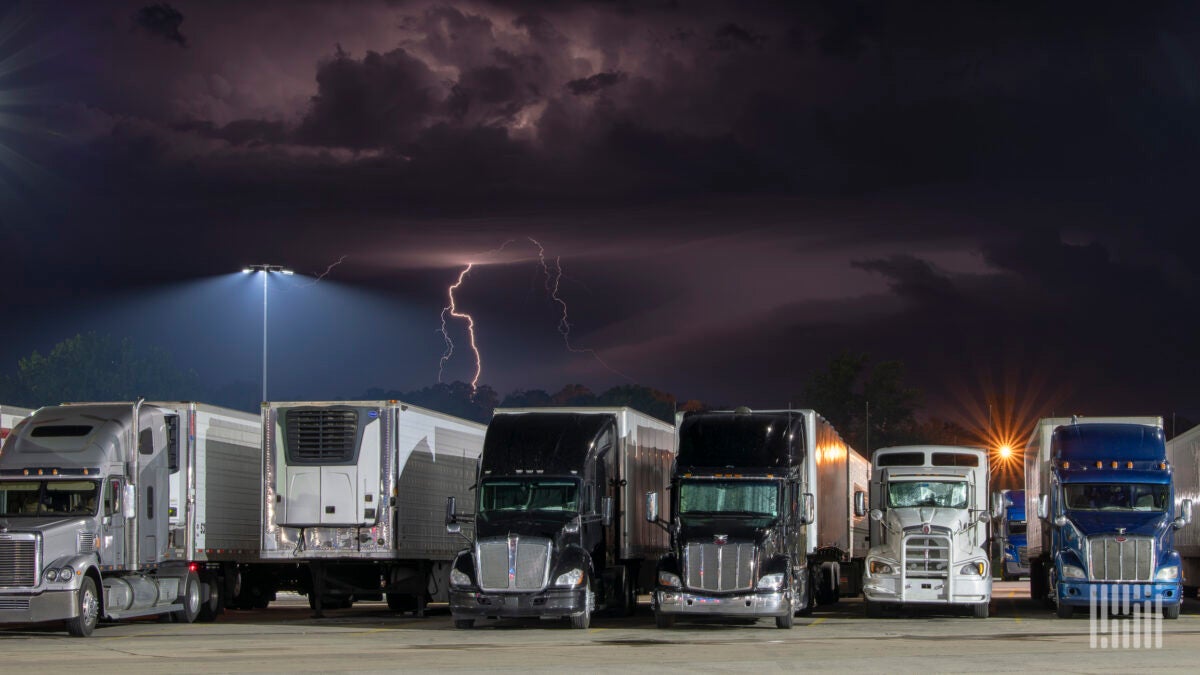
Circle Logistics has been fortunate in fighting against cargo thieves with a strong anti-fraud approach while focusing on standard operating procedures, Fillouer said.
“One of the things I preach to shippers, the actual customer that’s making the shipment, they’ve got access to the carrier when the carrier is picking up the freight,” Fillouer said. “We need more shippers to insist on, when a driver shows up, the shipper checks the driver’s license, as well as the equipment that needs to be logged and verified.”
Fillouer said shippers should also make sure the truck picking up a load belongs to the carrier it was brokered too.
A recent cargo theft incident tracked and investigated by Circle Logistics involved a shipment that was supposed to leave Dallas and head to the East Coast.
“It started with a small carrier that we use regularly. Somebody spoofed their identification by creating a fake domain,” Fillouer said. “They were calling for shipments from us that were on our load board. Whether or not the person who was doing this was still involved with that carrier we use, we don’t know. But they were able to have us dispatch a load to them.”
When Circle Logistics dispatched the load to the fake carrier, they turned around and brokered the load to a top 10 U.S. brokerage/carrier, Fillouer said.
“That Top 10 broker/carrier turned around and re-brokered it to an unsuspecting carrier. It was that carrier that actually picked up the freight in Texas, and they started moving down the road,” Fillouer said. “They were able to pick up the freight by fraudulently representing themselves as Circle Logistics.”
The cargo thieves used spoofing software to move cellphone tracking, making it appear as if the load was heading to the East Coast, which was where it was supposed to go. In actuality, the load was eventually transported to a warehouse in the Los Angeles area.
“The sheriff’s department in Los Angeles County orchestrated a raid on that warehouse, arrested more than a dozen people and found it was more than half full with all stolen items,” Fillouer said. “They were able to find our bill of lading, but the product that got stolen from us was gone.”
RealCold, a national cold chain provider, plans to build a 310,000-square-foot cold storage facility in the town of Lockhart, just south of Austin, Texas.
The Lockhart cold chain facility will house over 36,000 pallets and is aimed at catering to the increasing demands from customers, RealCold officials said.
Along with the Lockhart facility, RealCold also announced plans to simultaneously build a 376,000-square-foot cold chain facility in Lakeland, Florida.
“These next-generation facilities will service 10 million and six million people within 100 miles of Lakeland and Lockhart, respectively, and become a gateway to fulfill refrigerated and frozen products across the southern U.S.,” Keith Goldsmith, CEO of RealCold, said in a news release.
RealCold plans to break ground on both of these multi-temperature facilities by the end of the year, with constructions scheduled to be completed in 2025.
RealCold was founded in 2022 and is backed by Related Fund Management, a real estate asset investment advisory firm based in New York.

Transport and logistics operator Gebrüder Weiss has opened a 16,146-square-foot warehouse in Laredo.
The company will provide logistics services, as well as customs clearance and bonded storage at the facility.
“Our new team is located in Laredo directly at the intersection of two countries, both of which are major trading partners,” said Mark McCullough, country manager of Gebrüder Weiss North America. “As much as 40% of the trade between Mexico and the United States is handled via Laredo.”
Gebrüder Weiss also has logistics operations in Dallas and El Paso, Texas. The company has 10 locations across the U.S.
Austria-based Gebrüder Weiss has around 8,000 employees working at 180 company-owned locations in 35 countries.
A Mexican national is facing charges of possession with intent to distribute cocaine from Mexico into the U.S., according to court documents.
Truck driver Oswaldo Lopez-Escobar arrived at the Mariposa port of entry in Nogales driving a tractor-trailer on Oct. 4.
During a search, U.S. Customs and Border Protection officers found 155 packages of alleged cocaine concealed in the trailer. The alleged narcotics have an estimated value of around $10 million to $12 million.
Lopez-Escobar faces up to life in prison and a fine of $10 million if convicted.
Click for more FreightWaves articles by Noi Mahoney.
More articles by Noi Mahoney
Texas DPS ends truck safety inspections after $1.9B impact
Tesla’s electric vehicle factory in Mexico could be delayed
Texas resumes cargo truck inspections at Laredo port of entry

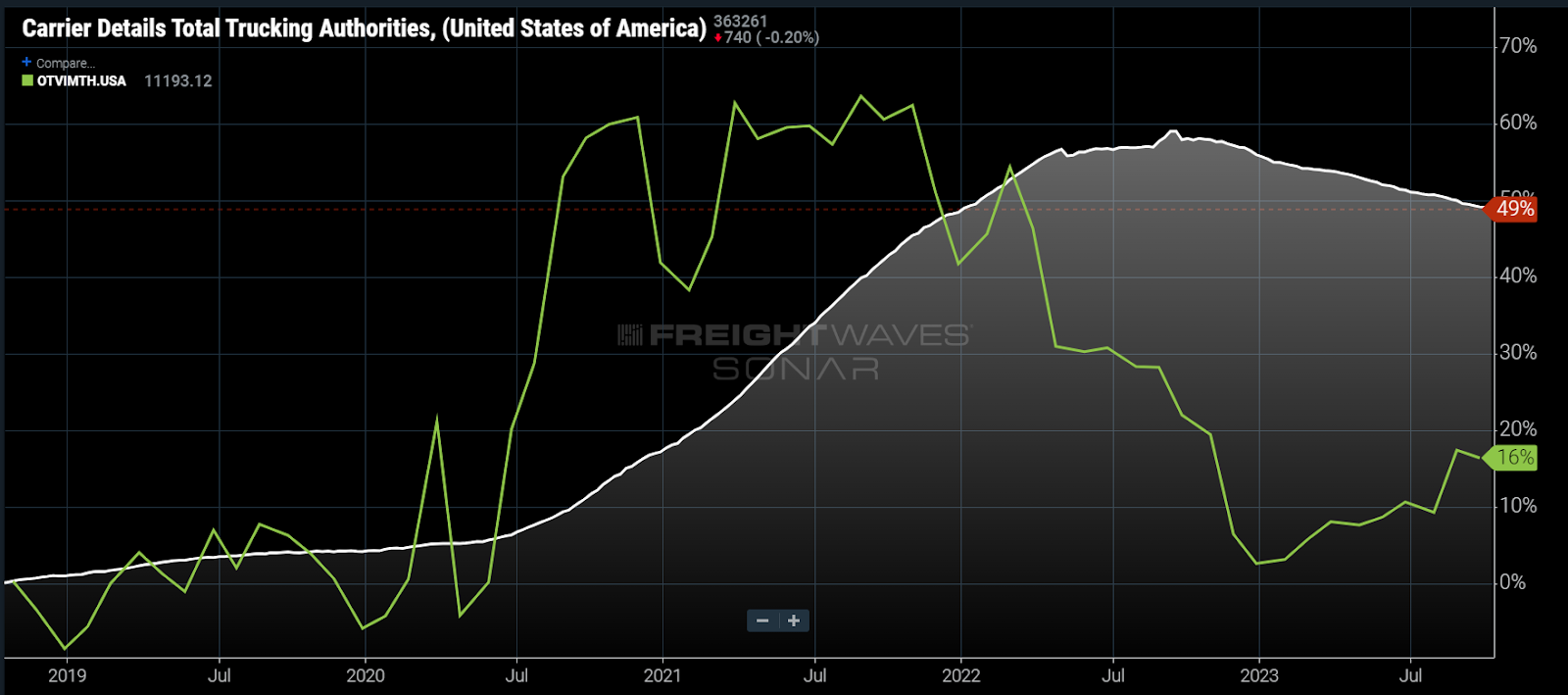
Chart of the Week: Carrier Details Total Trucking Authorities, Outbound Tender Volume Index Monthly – USA SONAR: CDTTA.USA, OTVIMTH.USA
Monthly truckload tender volumes for September were 16% higher than September of 2018. The number of carrier operating authorities reported by Carrier Details using FMCSA data has risen 49% over the same period.
The extraordinary excess of capacity is what is driving the current freight market conditions and as the chart suggests, capacity changes are very slow in relation to demand. Transportation service providers are forced into a waiting game of survival until it ends. While it may not seem like it, the tide is already turning.
Strangely, the pandemic was indirectly responsible for overstimulating the global economy. Government stimulus packages and increased time at home created the perfect storm of consumption of goods while travel and leisure services faltered.
In 2022, this trend reversed with violent force, a consummate example of an economic bubble manifesting in durable goods purchases. Not all have felt the shift equally, but the aggregate U.S. economy has certainly cooled since then.
None have felt that cooling more than transportation service providers, which have been dealing with challenging conditions since early 2022, when demand eroded rapidly. Some of the volume has recovered, but not nearly enough to support the existing capacity.
The latest example of the tough market conditions occurred last week as Convoy announced it was shutting down its brokerage division due to “a massive freight recession and a contraction in capital markets.”
FreightWaves CEO and founder Craig Fuller wrote an article earlier in the week about how brokerages were prolonging the capacity glut in this freight market downturn due to increasing presence in shipper routing guides and ability to connect smaller carriers to larger shippers.
As a byproduct of their rapid expansion and utility, they are now nearly as exposed to exiting the market as the asset-based fleets.
There has been a lot of speculation about how long this downcycle will persist. I wrote a piece at the end of February of this year stating that there was at least 25% too much capacity based on my analysis of tender data.
Over time, the type of analysis I used becomes difficult to reapply due to a lack of visibility around supply-side dynamics. The above chart suggests that may have been an understatement.
Fuller wrote in his article mentioned above that the market has about a year and a half before capacity is more in alignment with demand, but he admits this is subject to economic changes and accelerations in carrier exits — the latter being very likely over the winter.
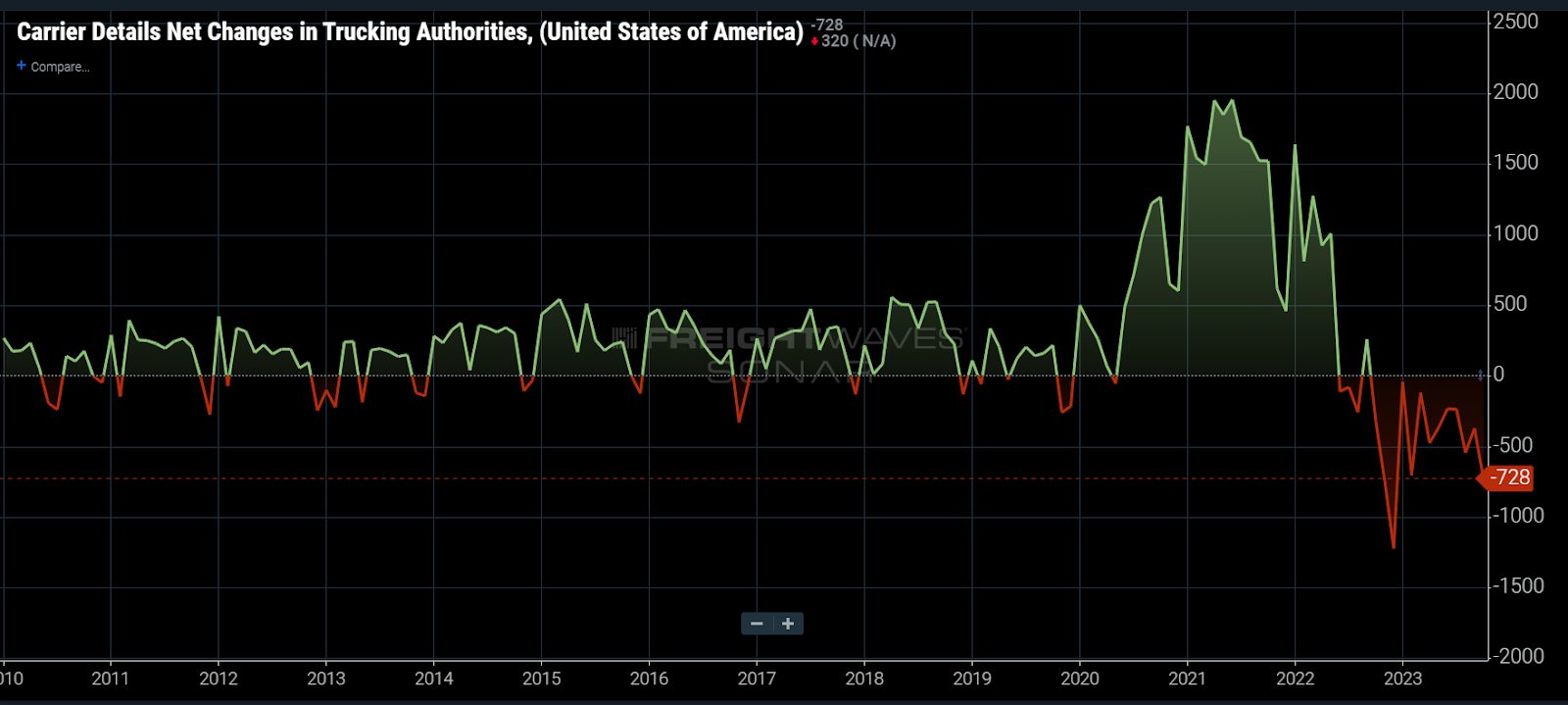
Looking at Carrier Details net changes in trucking authorities, which is based on FMCSA data, we have already seen a record rate of monthly exits that started in late 2022. The rate of exits has not come close to the rate of new authorities granted in 2021. Notice the rate of growth/exits hit low points near the turn of the year, an important trend to monitor.
While operating authorities are not a pure measure of capacity addition or subtraction, they are very good at explaining directionally where capacity is heading and at what rate. The problem with most estimations at this point is that they assume demand and supply side consistency and project it forward in a relatively linear manner.
We are not in a stable pattern as the economy continues to show puzzling signs and the rate of carrier exits will most assuredly increase as the downturn persists.
The good and bad of all this is that it will not last. The market is already moving back toward equilibrium, though this is difficult to see. Spot and contract rates have traditionally been the manner to measure market conditions but have become convoluted with rapid cost inflation and sentimentality.
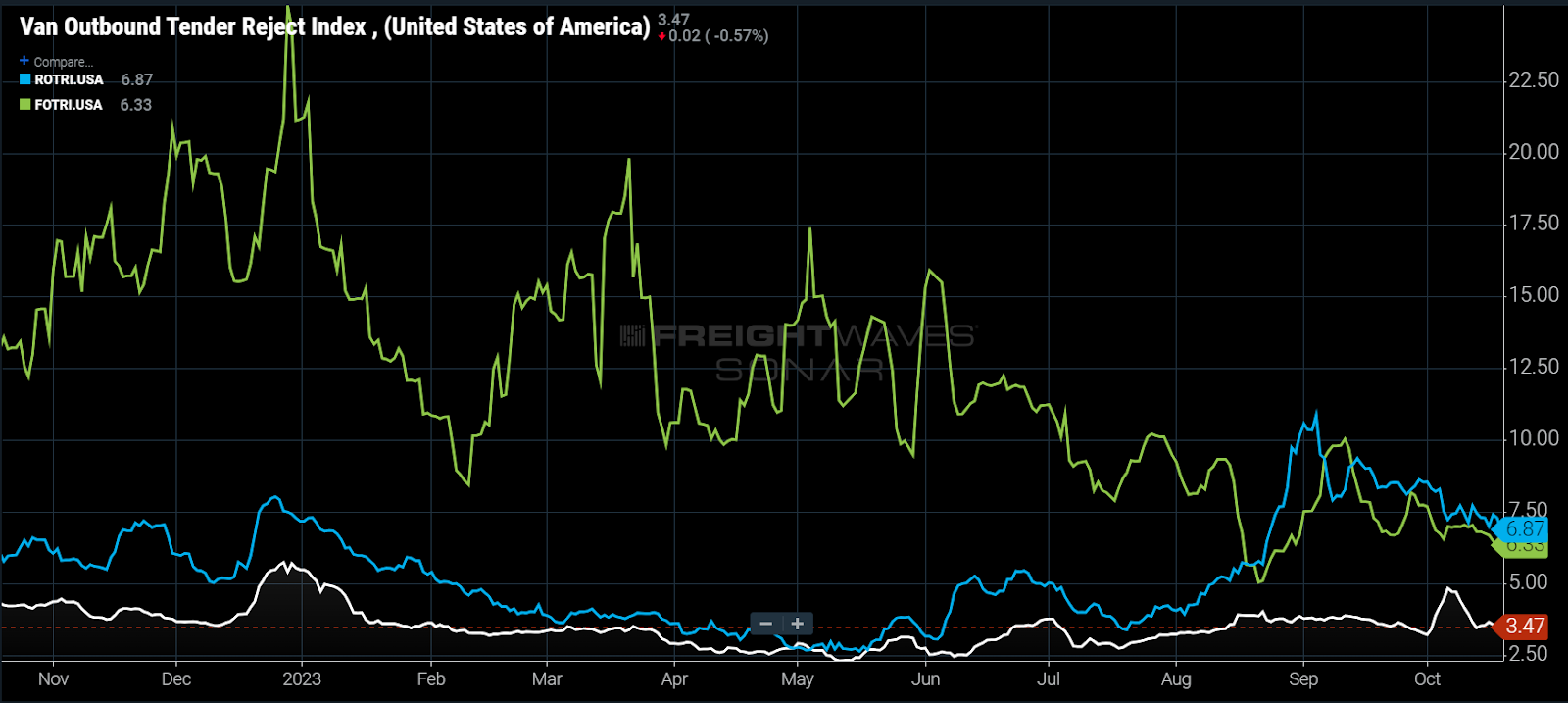
Tender rejection rates are far less noisy and probably paint the cleanest picture of the freight economy. Looking at rejection rates for dry van (white), refrigerated (blue) and flatbed (green) loads, the van market is still in a deep deflationary environment.
Flatbed has had a unique experience after supply chains unkinked in 2022 but has slowly moderated this year.
Perhaps the most interesting is the refrigerated sector’s recent pop that occurred in August. While there is some seasonality involved here, it is worth noting that seasonal factors have not been as pronounced as the recent period.
The refrigerated sector could be the canary in the coal mine on the rest of trucking as it is showing increasing sensitivity to market conditions. Refrigerated rejections have been in close alignment with van over the past year, an anomalous occurrence, but are now showing increasing separation.
This by no means says the market is about to shift dramatically, but it does tell us that capacity is eroding noticeably. At the bare minimum, it suggests a tighter peak season than 2022, but more importantly it insinuates that there is a chance that the market turns in 2024.
There is no definitive end to this market, but it is coming and it may happen faster than many expect. The current data seems to suggest that the market will not turn until 2025, but an acceleration in exits is inevitable. Gaps will open in route guides as providers drop before the correction is fully recognized.
This bust market is as unsustainable as the pandemic boom.
The FreightWaves Chart of the Week is a chart selection from SONAR that provides an interesting data point to describe the state of the freight markets. A chart is chosen from thousands of potential charts on SONAR to help participants visualize the freight market in real time. Each week a Market Expert will post a chart, along with commentary, live on the front page. After that, the Chart of the Week will be archived on FreightWaves.com for future reference.
SONAR aggregates data from hundreds of sources, presenting the data in charts and maps and providing commentary on what freight market experts want to know about the industry in real time.
The FreightWaves data science and product teams are releasing new datasets each week and enhancing the client experience.
To request a SONAR demo, click here.

Less-than-truckload carrier XPO Inc. (NYSE: XPO) says it has launched an over-the-road operation for team drivers.
Only existing teams can currently qualify for the program, which has not been formally announced but was posted earlier this week on LinkedIn, said Greenwich, Connecticut-based XPO. It is believed to be the brainchild of Dave Bates, who joined XPO in April as COO from rival Old Dominion Freight Line Inc. (NASDAQ: ODFL)
XPO declined comment, citing the mandatory “quiet period” before its Oct. 30 release of third-quarter results.
According to the communication, eligible teams will “run dedicated routes between XPO facilities in brand new sleeper trucks equipped with microwaves and refrigerators.” A typical work week will consist of five days on the road, followed by two days of home time, XPO said. Because there is no mileage cap, teams are able to put in for more runs than originally scheduled, XPO said.
XPO is not the first carrier to operate with sleeper-teams in over-the-road service. Old Dominion, where Bates comes from, operates with sleeper teams.
LTL carrier networks are connected by terminals, and the longest length of haul is typically 500 miles. By contrast, truckload carriers can run thousands of miles point-to-point with sleeper teams.

The water levels are still low on the Mississippi River and barge movements continue to remain restricted, but the rates to move those barges are declining.
The weekly grain transportation report published Thursday by the U.S. Department of Agriculture reported that the grain transport indicator for barge traffic on the Mississippi fell to 326 for the week ending Wednesday. That 326 is a percentage applied to a basis cost of 100 set in 2000.
A week before it was 366. The indicator was 556 for the week ended Sept. 27 and 549 for the subsequent week.
“Normally, restrictions cause spot rates to increase, as was observed in third quarter 2022,” the USDA report said. “However, this year, except for the last few weeks, spot rates have neared the prior 5-year average because of low demand from slow export sales.”
This is occurring even as there is little sign of improvement of Mississippi River water levels at the key measuring point of Memphis, Tennessee, where water levels in recent days fell to minus 11 feet. American Commercial Barge Lines (ACBL), a key barge operator on the river, said the reading of negative 11.8 feet on Monday was a record low.
That number is a measurement against a base level. It has since rebounded back to a level slightly higher than minus 11, but when it got underneath that number it was less than the water levels of a year ago. And at that time in 2022, the index for moving grain via barge on the river exceeded 1,000.
Mike Steenhoek, the executive director of the Soy Transportation Coalition, whose members are highly dependent upon the river to move their products to market, particularly those in other countries, acknowledged the divergence seems odd.
But he said diversion of product to other places is a key reason why the enormous barge rates of last year aren’t repeating themselves this year.
“I think it’s kind of settled a bit into a kind of equilibrium, where there has been an understanding that we’re down,” Steenhoek told FreightWaves. Earlier increases in barge rates were “a market signal that says, ‘Don’t deliver to the river.’”
And that is what has happened, he said. There has been diversion of grain shipments to rail and to storage where farmers have that capacity.
“They’re saying, ‘Well, hopefully the river levels will rebound in another couple of months,’” Steenhoek said of farmers putting that product into storage.
But another reason a surge in barge rates has not occurred has been the weak export market referred to by the USDA. Demand for soybeans and corn abroad has been tepid this year, and that’s pushed demand into the domestic market, according to Steenhoek.
“The farmers are gravitating to the domestic market, the beans are getting processed and then maybe sold into the livestock market or going into biofuels,” he said.
ACBL has made some changes in its restrictions, but they aren’t major. For the most part, the same restrictions that were in place at the end of September are in place now.
For example, in its latest list of restrictions, loading drafts were reduced by 28% northbound and southbound between the Gulf and Cairo, Illinois— where the Ohio River joins the Mississippi — and Vicksburg, Mississippi, south of Memphis. They also were reduced 24% for barges going from Vicksburg to the Gulf.
As of Oct. 10, the reduction was 28% northbound from the Gulf to Cairo and 24% southbound from Cario to the Gulf, so an additional 4 percentage points of reduction have been tacked on to the southbound movement.
Steenhoek said other restrictions are in place at other companies and that ACBL’s were largely in line with the broader industry.
ACBL also said it was restricting tow sizes to five barges across, which is a 17% to 38% reduction in capacity. That limit has been in effect for several weeks.
There is some hope for the future that the worst may be behind the low water levels on the river. Between Oct. 4 and Friday, the level on the Mississippi at St. Louis rose about 2 feet. However, the projections in coming days are for renewed declines.
The weekly drought monitor published by the University of Nebraska-Lincoln and a pair of U.S. government agencies is showing some sign of improvement on top of the data for St. Louis. The Drought Severity Coverage Index for the area that it defines as the Midwest declined to 155 in the latest report published Thursday, down from 168 a week earlier. That area is mostly in the Mississippi watershed.
In the region it calls High Plains, which includes the Dakotas, Kansas and Nebraska, all in the Mississippi watershed, the index dropped to 85 from 92.
More articles by John Kingston
Taking stock of what happened at Estes
TriumphPay’s EBITDA loss narrows, volume increases, factoring invoices stay flat

WASHINGTON — New preliminary data from the Federal Motor Carrier Safety Administration shows a noticeable drop in large-truck crash injuries and fatalities, a positive development as the agency considers new rules designed to prevent such crashes and mitigate their effects.
Fatalities resulting from crashes involving large trucks (weighing over 10,000 pounds) fell 14.4% — from 1,175 to 1,006 — in the first quarter of 2023 compared to the same period in 2022, according to the latest statistics published by FMCSA’s Motor Carrier Management Information System (MCMIS), dropping below the 10-year trend (see chart).
Injuries resulting from those crashes fell 1.4%, when comparing the same periods, with large-truck crashes overall dropping 5.2%.
A similar snapshot comparing the first quarters of 2021 to 2022 shows an opposite trend: Fatalities increased 23.8%, injuries were up 1.7% and crashes were up 4.9%.
Taken by themselves, the data suggests improvements in road safety for the trucking sector, which has seen safety diminish as it relates to crashes.
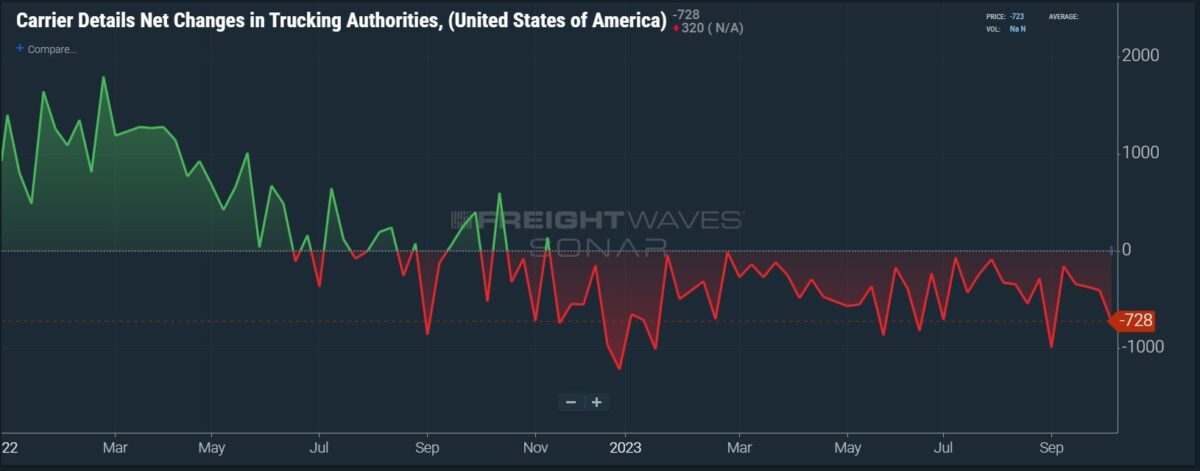
The positive development is less impressive, however, when taking truck population into account. New operating authorities approved by the U.S. Department of Transportation, which can be used as a proxy for freight activity, trended upward during the first quarter of 2022 as carriers looked to take advantage of high freight rates.
But new authorities began trending down during the latter half of the year as the economy, and freight rates, began to slack off, as illustrated by data compiled by FreightWaves SONAR (see below).
Asked to comment, Zach Cahalan, executive director of the Truck Safety Coalition (TSC), which advocates on behalf of truck crash victims, pointed out that the National Highway Traffic Safety Administration is the “agency of record” for documenting large truck fatalities.
“When they next release their estimates, TSC hopes far fewer families suffer from these horrific crashes,” he said, and that “5,700-plus large truck fatalities a year cannot be tolerated.”
While recent NHTSA data has shown declining highway fatalities among all road users, the agency has not broken out data for large trucks since May 2022, when it revealed that crashes involving at least one large truck in 2021 had climbed to a “crisis level” 13%, reversing a declining trend seen in 2020.
Eliminating injuries and deaths resulting from large truck crashes is a goal of DOT’s National Roadway Safety Strategy, unveiled in January 2022. Part of that strategy includes rulemakings by FMCSA to require speed limiters and automatic braking devices on heavy trucks, as well as changes in how carrier safety fitness is determined.
“Upcoming rulemakings such as speed limiters have great potential to drive this figure down substantially and we urge FMCSA to not delay,” Cahalan said.
In April, NHTSA published an Advanced Notice of Proposed Rulemaking to consider mandating side underride guards for trucks as a way to prevent deaths and injuries in crashes involving cars and trucks, but the agency was criticized harshly by safety advocates for underestimating the benefits if such a requirement were to be finalized.


Hello, and welcome to the coolest community in freight! Here you’ll find the latest information on warehouse news, tech developments and all things reefer madness-related. I’m your controller of the thermostat, Mary O’Connell. Thanks for having me!
(Photo: Jim Allen/FreightWaves)
RealCold, backed by Related Fund Management, part of 50-year-old real estate developer and operator Related Companies, announced its new full cold chain logistics firm. RealCold is starting with two facilities, the first a 376,000-square-foot cold storage facility in Lakeland, Florida, and the second in Lockhart, Texas.
According to a CoStar article, “Related, a company that’s undertaken the high-profile development of the mixed-use Hudson Yards in New York City, isn’t the only company jumping on the cold storage bandwagon. About two-fifths of respondents in a CBRE investors survey last year said they were pursuing cold storage assets, up from 22% in 2021, and 7% in 2019.”
RealCold’s facilities will include e-commerce; personalization and gifting programs; marketplace and selling platform integration; each pick, kitting and order fulfillment; and dry ice and freezer pack management.
(Photo: Jim Allen/FreightWaves)
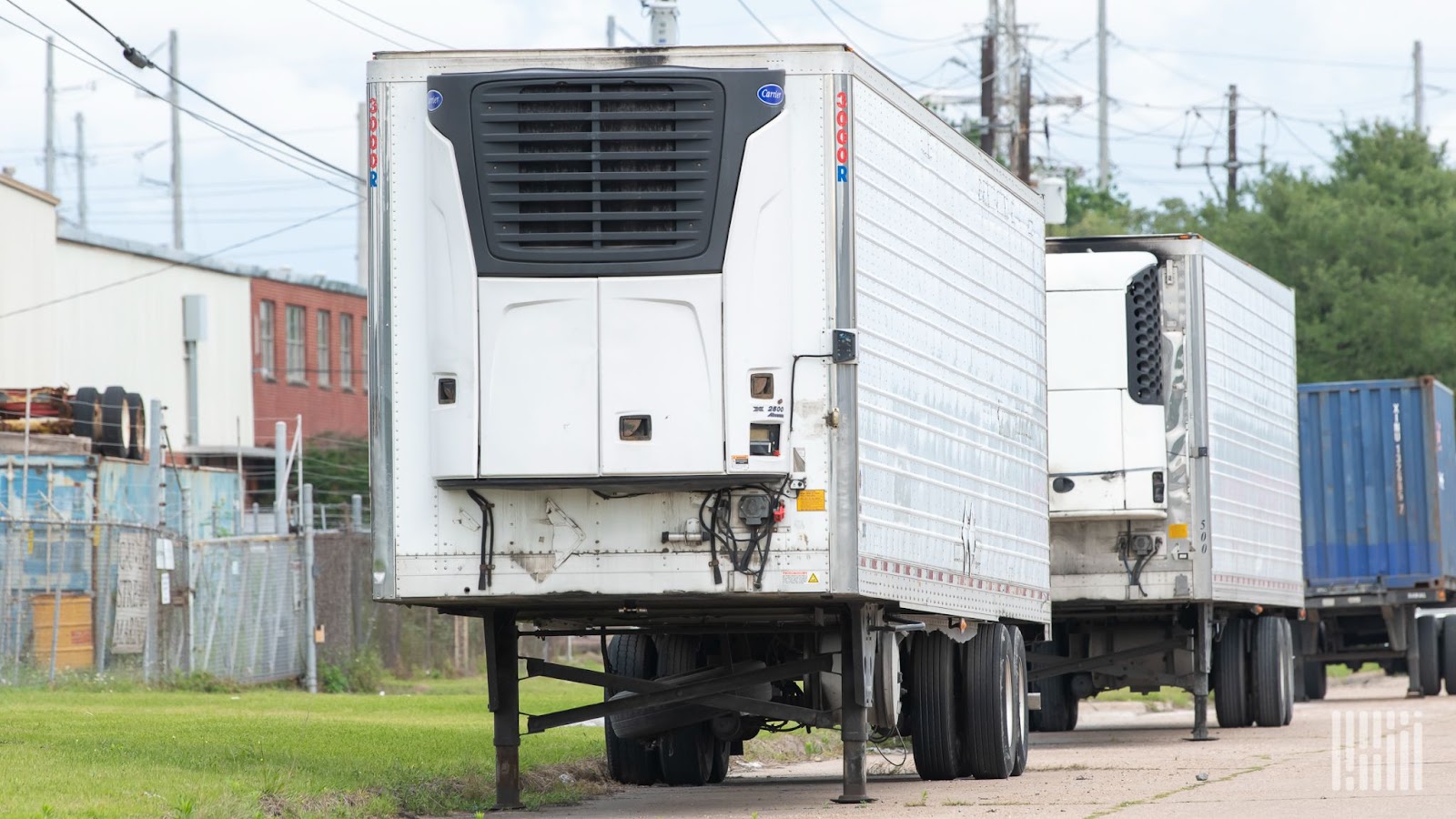
Recycling is not just for cardboard anymore, it’s for energy, more specifically power for reefer trailers. Ecolution Power Co. has entered a partnership with Avalon Wheeler Freight Services (AWFS). Avalon will be the first customer of Ecolution by using recycled power in its fleet of reefer trailers.
Where does the recycling part come in? Ecolution’s Module Active Response System (MARS) uses kinetic energy to recharge the battery while in motion. Not only can this technology be used in the trailer, but it can also be used to heat and cool the tractor’s cabin, which can amount to about $1,000 savings per month. Testing will begin with AWFS in the first quarter of 2024.
With lowered fuel costs, a boost to sustainability initiatives and the added bonus of cutting-edge technology, I can’t wait to learn about the trials in February.

(Photo: Business Wire)
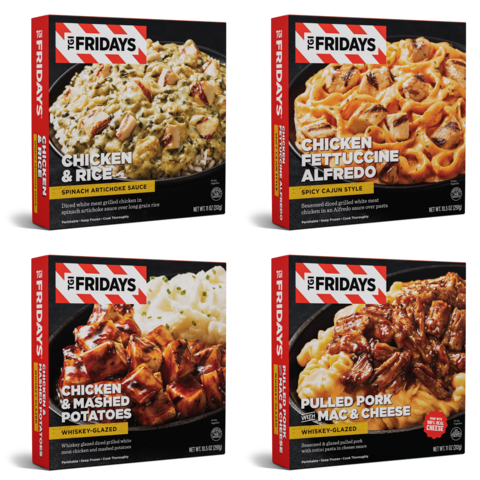
TGI Fridays is bringing more than potato skins and mozzarella sticks to the freezer aisle. The home of Friday Happy Hour has expanded its frozen offerings to include entrees. Spicy Cajun-style chicken fettuccine alfredo, chicken and rice with spinach and artichoke sauce, whiskey-glazed chicken and mashed potatoes, and pulled pork mac and cheese are hitting the freezer aisle at Walmart.
In a news release, Kathleen Schloth, senior vice president of Brand Licensing, said, “We are excited about extending the TGI Fridays brand in the frozen meal category. These new entrées bring restaurant quality and innovation to the frozen aisle, providing convenience and ‘That Fridays Feeling’ to enjoy at home.”
A Market Scale article said: “Recent research has found that shoppers turn to frozen foods to reduce food waste. Because frozen foods have a long shelf life, consumers actually eat what they purchase, which helps extend their food dollar. The frozen food category in the U.S. has seen strong growth over recent years, propelled in part by the pandemic but continuing to grow. Sales have increased by nearly $20 billion since 2018. Today, a $72 billion category at retail.”
(SONAR Tickers: ROTVI.CID, ROTRI.CID)
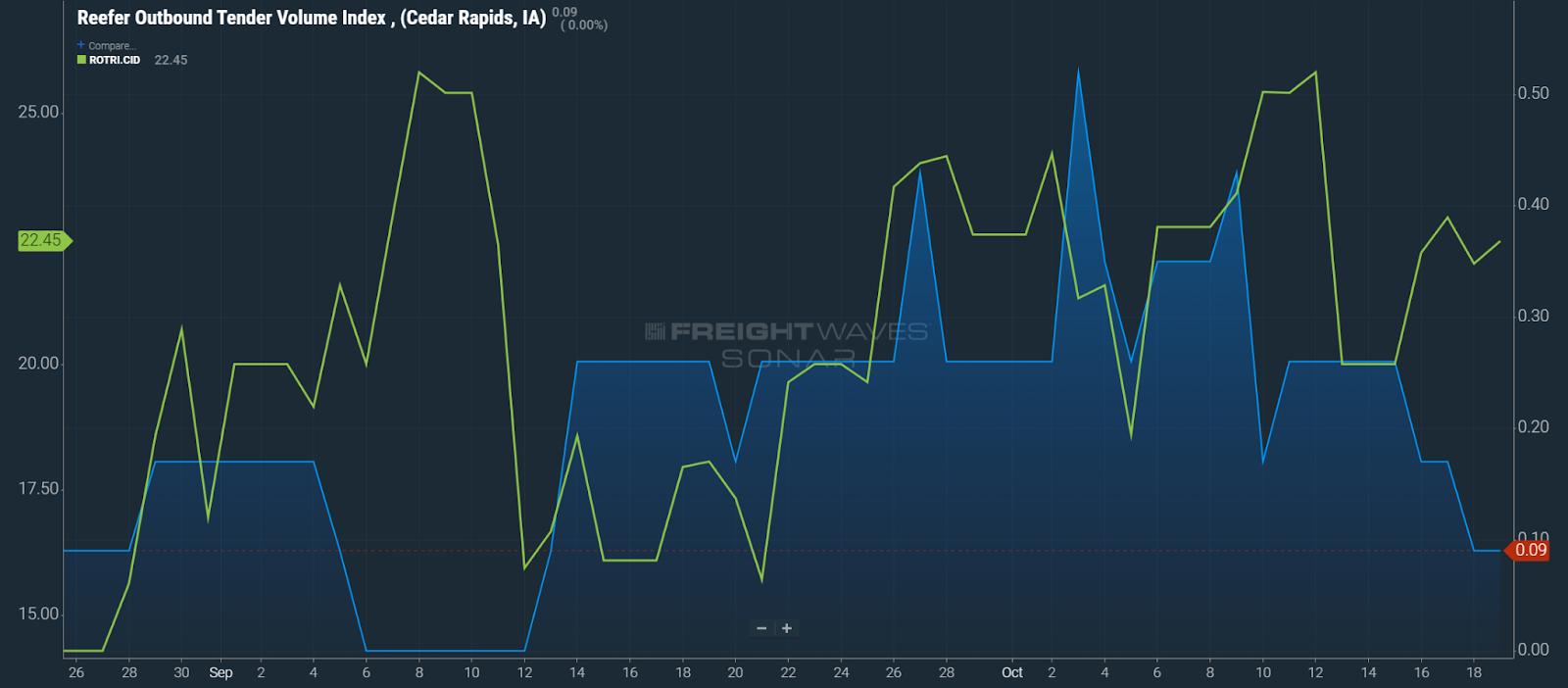
This week’s SONAR reefer market is Cedar Rapids, Iowa. Reefer volumes have started declining over the past week in Cedar Rapids. Outbound tender volumes have risen significantly to 22.45% rejections. There will continue to be significant routing guide disruption through the next few weeks as harvest season comes to a close and capacity returns to the market.
Is SONAR for you? Check it out with a demo!
Chemours and Honeywell announce reclaim and recycling program
Villa Dolce Artisan Desserts Opens Manufacturing and Storage Facility in Arizona
Hy-Vee builds in-store digital media experience with Samsung
The slow climb of multistory warehouses
Wanna chat in the cooler? Shoot me an email with comments, questions or story ideas at moconnell@www.freightwaves.com.
See you on the internet.
Mary
If this newsletter was forwarded to you, you must be pretty chill. Join the coolest community in freight and subscribe for more at www.freightwaves.com/subscribe.

Mack Trucks fired back at the striking United Auto Workers, saying it is “not prepared to jeopardize the company” to meet the union’s new economic demands.
Talks resumed Thursday in the 11-day-old strike by 3,900 workers in Pennsylvania, Maryland and Florida. The union’s new demands did not sit well with the company.
“Unfortunately, the new UAW economic demands are completely unrealistic,” Mack President Stephen Roy said in a news release late Thursday. “We’ve already shown that we’re prepared to provide our employees with significantly improved wages. But we are not prepared to jeopardize the company.”
UAW-represented employees voted 73% against a tentative agreement endorsed by local bargainers and UAW International officials.
The demands “seemingly return to day one of negotiations and ignore three months of good-faith bargaining between the parties,” Roy said.
The strike began Oct. 8 at six Volvo Group facilities. They include the Lower Macungie, Pennsylvania, assembly plant that makes all Mack heavy-duty commercial trucks in North America. Mack is part of Volvo Group North America.
An engine plant in Hagerstown, Maryland, and parts distribution centers in Baltimore and Jacksonville, Florida, also are on strike.
Volvo Trucks North America (VTNA) production in Dublin, Virginia, is so far unaffected. The assembly complex in New River Valley (NRV) makes heavy-duty Volvo VNL and VNR models. The plant also builds the battery-powered VNR Electric day cab.
“Thus far, we’ve managed to minimize the impact to our aftermarket parts support,” Mack spokesperson Kimberly Pupillo said in an email. “The strike has not affected NRV production, but could if it is prolonged.”
A 12-day UAW walkout at Mack in 2019 forced VTNA to halt production because of a lack of engines. The slowing state of Class 8 tractor demand may spare the plant from downtime this time.
“Current weak freight fundamentals and largely sated pent-up tractor market demand make the case for caution,” said Kenny Vieth, ACT Research president and senior analyst.
A nonunion Mack medium-duty truck plant in Roanoke, Virginia, is unaffected by the strike. The company builds Class 6 and 7 MD Series trucks there.
Mack wanted to fly below the radar in its union negotiations and stay clear of a UAW strike against the Detroit Three automakers that began Sept. 15.
Now it appears the union, encouraged by defeated Mack worker and unsuccessful UAW International presidential candidate Will Lehman and a Socialist rank-and-file committee, has intertwined the Mack strike with brinkmanship in Detroit. There are 34,000 of 146,000 UAW members striking selected GM, Ford and Stellantis plants while other plants are operating.
UAW International President Sean Fain visited Local 677 in Pennsylvania last weekend. Lehman, meanwhile, walked picket lines in the Detroit area.
Mack said it looks forward to “more realistic proposals” from the union when the two sides resume talks on Monday.
Mack Trucks and striking UAW resume talks Thursday
UAW employees will strike at Mack Trucks after rejecting contract
Commentary: How Socialist agitating helped tank Mack-UAW deal
Click for more FreightWaves articles by Alan Adler.

On today’s episode of WHAT THE TRUCK?!? Dooner is talking to FreightWaves’ Craig Fuller and John Paul Hampstead, who break down the last days at Convoy and explains what went wrong. We’ll also learn who else may be in trouble and why winter is coming for brokerages.
Edison Motor’s Chace Barber shows off its brand new electric semi truck and explains how it’s going to bring it to market. We’ll learn the story behind this semi that’s built by truckers for truckers.
Metafora’s Ryan Schreiber joins us from TIA’s Technovations conference to share the vibe from the floor, talk about challenges in the FreightTech market and tell us what tech actually has a chance.
Mr. Supply Chain Daniel Stanton shares the latest in supply chain career development and learning.
Plus, Amazon’s warehouse robots scare employees; Flock Freight’s failed ad campaign; how to get a falcon out of your warehouse; and a new way to play basketball.
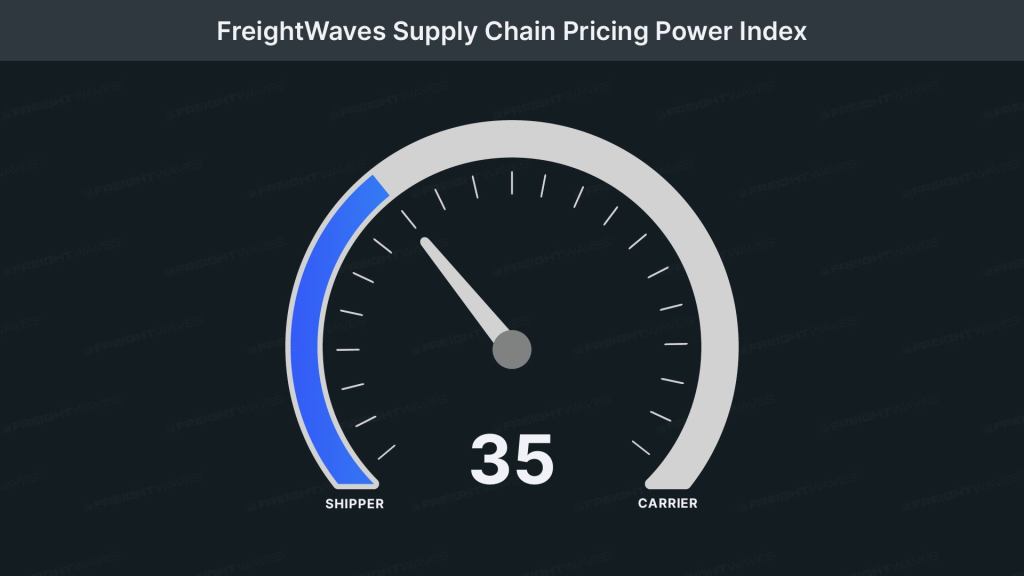
This week’s FreightWaves Supply Chain Pricing Power Index: 35 (Shippers)
Last week’s FreightWaves Supply Chain Pricing Power Index: 35 (Shippers)
Three-month FreightWaves Supply Chain Pricing Power Index Outlook: 35 (Shippers)
The FreightWaves Supply Chain Pricing Power Index uses the analytics and data in FreightWaves SONAR to analyze the market and estimate the negotiating power for rates between shippers and carriers.
This week’s Pricing Power Index is based on the following indicators:
Freight demand is settling deeper into a seasonal slide at the close of October. While not by itself indicative of a failed recovery, this downward trend is doubtlessly painful for those carriers and brokerages still skirting the razor’s edge with thinning margins. Unfortunately, as will be discussed below, there is not much hope for a resurgence in freight volumes in the remainder of this year.
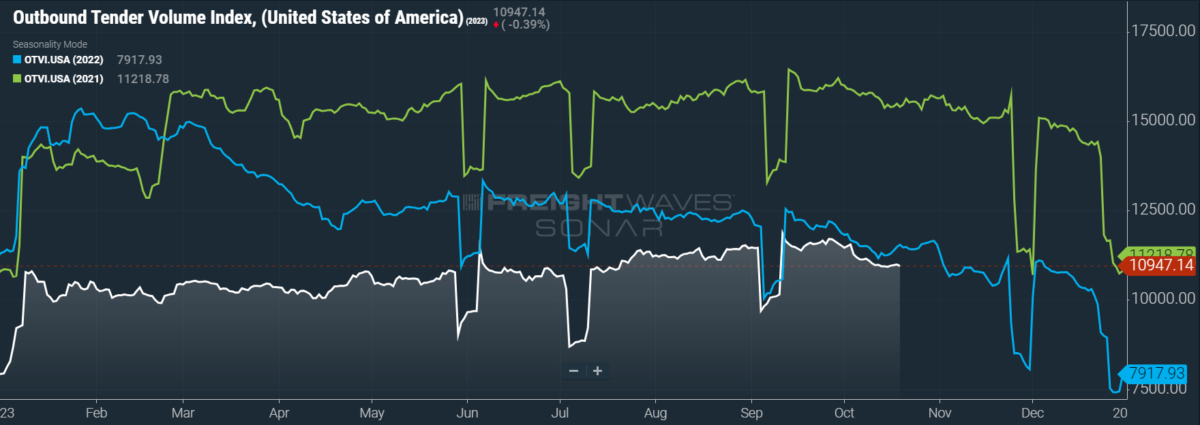
This week, the Outbound Tender Volume Index (OTVI), which measures national freight demand by shippers’ requests for capacity, fell 0.3% week over week (w/w). On a year-over-year (y/y) basis, OTVI is down 4.56%, though such y/y comparisons can be colored by significant shifts in tender rejections. OTVI, which includes both accepted and rejected tenders, can be inflated by an uptick in the Outbound Tender Reject Index (OTRI).
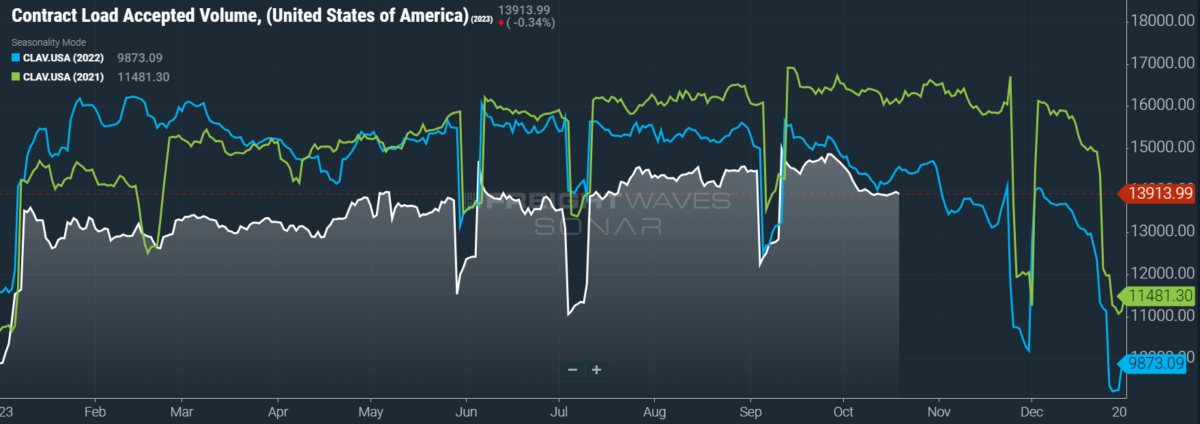
Contract Load Accepted Volume (CLAV) is an index that measures accepted load volumes moving under contracted agreements. In short, it is similar to OTVI but without the rejected tenders. Looking at accepted tender volumes, we see a rise of 0.54% w/w as well as a fall of 3.57% y/y. This narrowing y/y difference implies that actual freight flow is still recovering from this cycle’s bottom.
As this column tends to focus on over-the-road truckload markets, one topic that is not frequently discussed here is maritime demand. Yet it should not be concluded that the ocean market is irrelevant to truckers — far from it, as imports accounted for the bulk of truckload volumes in the 2020-2021 freight market boom. Of course, one key supplier of U.S. maritime imports is China, though the country will see its place diminish in the coming years as re- and nearshoring efforts finally bear fruit.
Until then, however, China is the trade partner to watch. In the first week of October, China halted or significantly slowed operations in its manufacturing and distribution hubs during the country’s celebration of Golden Week. From Sept. 26 to Oct. 6, bookings to the U.S. from all ports — not just China’s — tumbled by more than 37% before recovering from the holiday. Bear in mind that these bookings preceded the vessel’s actual date of departure by roughly nine days, that transit times to the U.S. averaged over 27 days and that delays at either the shipping or receiving ports averaged a little under four days.
Barring any congestion at the ports of discharge, the above numbers imply that Golden Week’s disruption to the flow of U.S. imports will not be truly felt until 40 or more days — approximately six weeks — after the holiday. Assuming little delay with U.S. customs (a dangerous assumption if ever there was one), this 40-day lag leaves those imports with less than a week to move before Thanksgiving Day. In the period between Thanksgiving and Christmas, truckload volumes are sluggish at best. While carriers can gain pricing power here, since last-minute holiday shipments typically command a premium rate, it is not guaranteed: In 2022, spot rates from October’s peak to December’s rose by only 3.7%. In short, the bulk of the recovery will likely be delayed to Q2 2024 at the earliest.
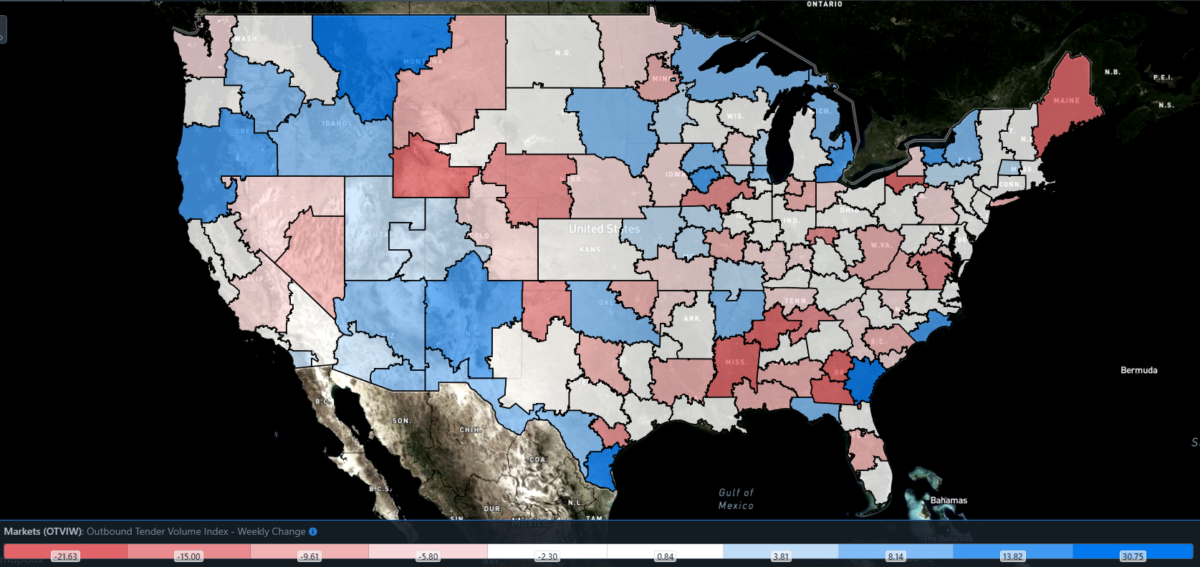
Of the 135 total markets, 64 reported weekly increases in tender volumes, though the hottest markets were small and scattered along the U.S.-Mexico border.
Rejection rates have fallen far from their brief rally at the start of October. Outside of the aforementioned holiday rush periods, the fundamental lack of freight demand will continue to expose the lingering overcapacity in the market. This capacity will be bled out more slowly than in previous cycles, thanks in large part to the intervention of freight brokerages. This trend is a double-edged sword: On the one hand, a small number of tenacious carriers would benefit from supply and demand coming into balance sooner rather than later. On the other hand, this level of subsistence could keep overleveraged carriers around long enough to profit from the next boom.
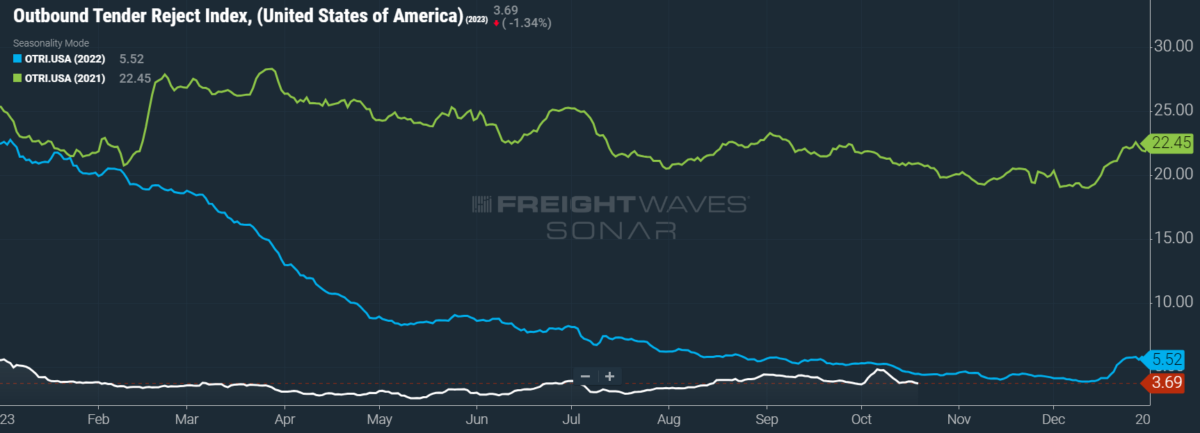
Over the past week, OTRI, which measures relative capacity in the market, fell to 3.69%, a change of 25 basis points from the week prior. OTRI is now 76 bps below year-ago levels, with y/y comparisons becoming more favorable even if OTRI just remains stable.
Subsistence-level trucking is being jeopardized by the potential collapse of freight brokerages, which face their biggest challenges when contract rates lag painfully behind a recovering market — in other words, when the spread between spot and contract rates narrows. The largest domino to fall this week was Convoy, a digital freight brokerage that shuttered within a 48-hour window. The first warning was given with little advance notice on Wednesday, when all of Convoy’s shipments were abruptly canceled and its load board unceremoniously emptied. Yet it was not the industry’s only departure this week, as Certified Freight Logistics — a 95-year-old carrier and brokerage — announced that it would cease operating on Saturday.
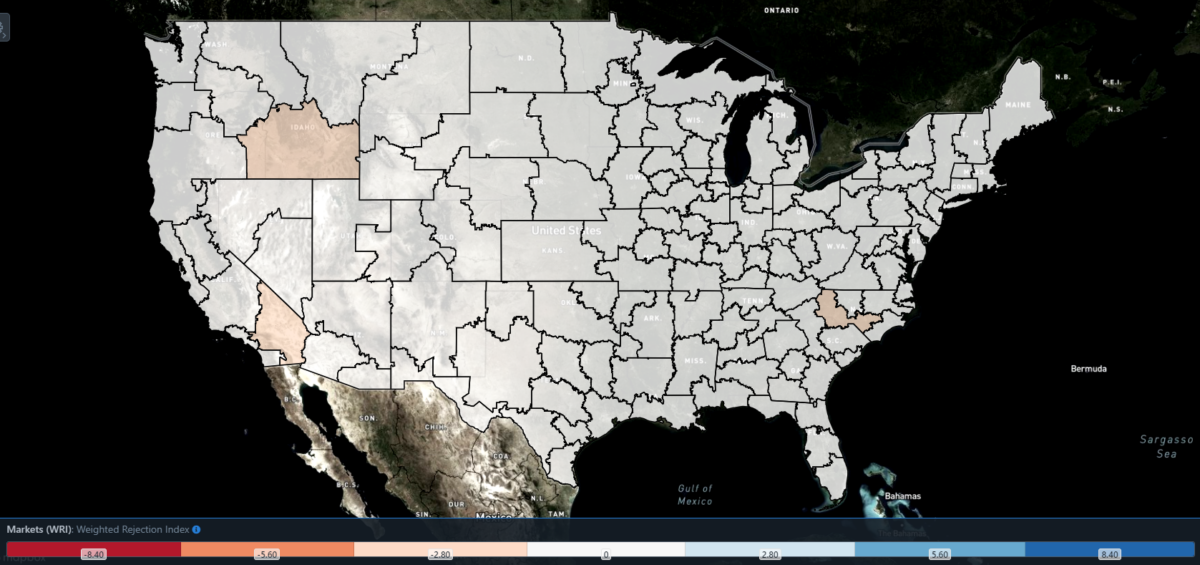
The map above shows the Weighted Rejection Index (WRI), the product of the Outbound Tender Reject Index – Weekly Change and Outbound Tender Market Share, as a way to prioritize rejection rate changes. As capacity is generally finding freight this week, no regions posted blue markets, which are usually the ones to focus on.
Of the 135 markets, 53 reported higher rejection rates over the past week, though 37 of those saw increases of only 100 or fewer bps.
Adding to the list of carrier woes is the recent collapse of the spread between retail and wholesale diesel prices, which nearly halved in just two weeks. This spread is significant for those carriers (typically large, enterprise fleets) that purchase diesel at cheaper wholesale prices and charge shippers — whether directly through contract agreements or indirectly through higher all-in rates — at retail cost. This margin often proves a significant boon during freight market recessions.
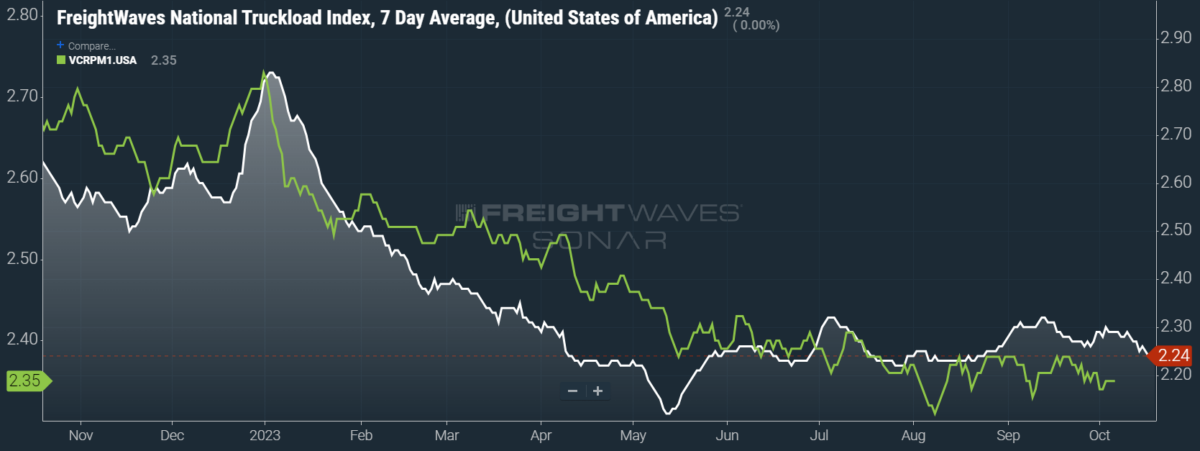
This week, the National Truckload Index (NTI) — which includes fuel surcharges and other accessorials — fell 3 cents per mile to $2.24. Sliding linehaul rates were wholly responsible for this decline, as the linehaul variant of the NTI (NTIL) — which excludes fuel surcharges and other accessorials — fell 3 cents per mile w/w to $1.55.
Contract rates, which are reported on a two-week delay, are not entering Q4 with the boldest of strides. Since the majority of bids are historically conducted between early Q4 and mid-to-late Q2, the tempo of the contract market going into 2024 will not be known for a few weeks yet. For the time being, contract rates — which exclude fuel surcharges and other accessorials like the NTIL — are down 1 cent per mile w/w at $2.35.
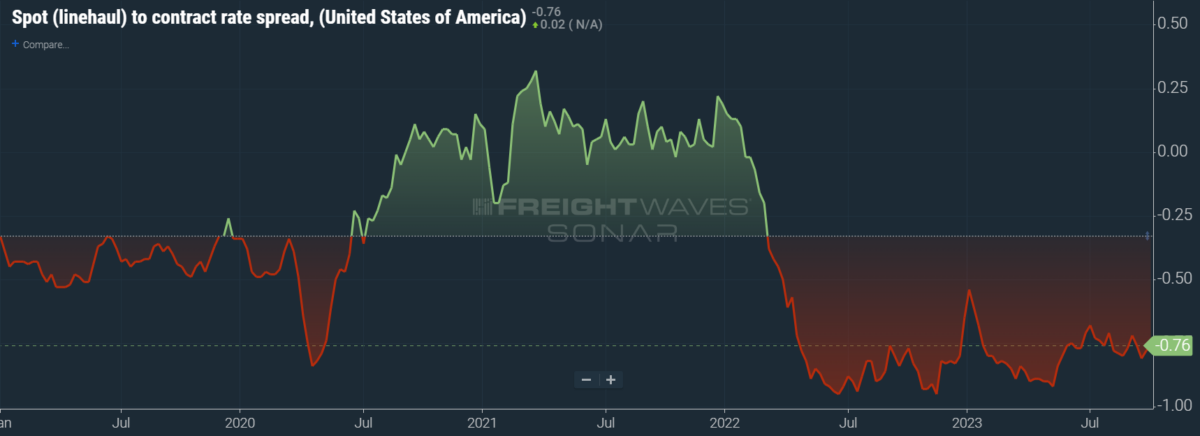
The chart above shows the spread between the NTIL and dry van contract rates, revealing the index has fallen to all-time lows in the data set, which dates to early 2019. Throughout that year, contract rates exceeded spot rates, leading to a record number of bankruptcies in the space. Once COVID-19 spread, spot rates reacted quickly, rising to record highs seemingly weekly, while contract rates slowly crept higher throughout 2021.
Despite this spread narrowing significantly early in the year, tightening by 20 cents per mile in January, it has remained wide throughout most of the year to date. As linehaul spot rates remain 76 cents below contract rates, there is still plenty of room for contract rates to decline — or for spot rates to rise — in the remainder of the year.
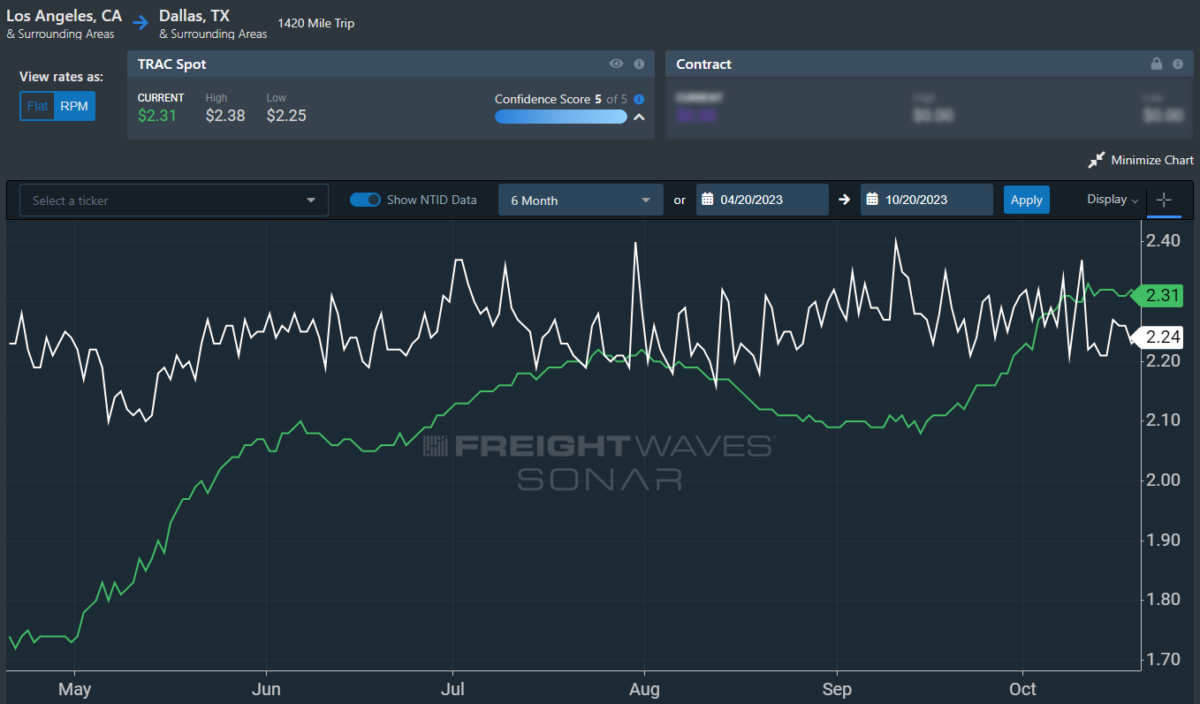
The FreightWaves Trusted Rate Assessment Consortium (TRAC) spot rate from Los Angeles to Dallas, arguably one of the densest freight lanes in the country, is still securing its footing. Over the past week, the TRAC rate was left unchanged at $2.31 per mile — still some distance from its year-to-date high of $2.39. The daily NTI (NTID), which has fallen to $2.24, is finally being outpaced by rates along this lane.
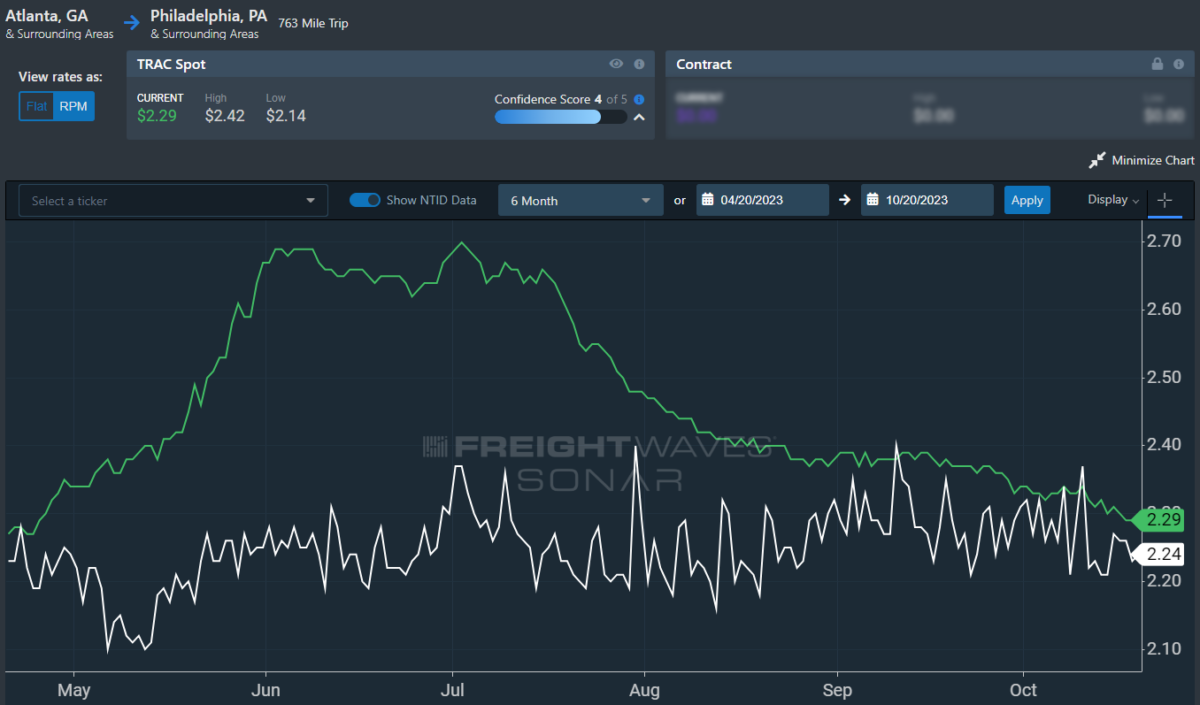
On the East Coast, especially out of Atlanta, rates have come down from July’s early peak but are still outpacing the NTID. The FreightWaves TRAC rate from Atlanta to Philadelphia fell 2 cents per mile to $2.29. After a bull run that started at the end of April, this lane had been plateauing above the national average, which made north-to-south lanes in the East more attractive than West Coast alternatives.
For more information on FreightWaves’ research, please contact Michael Rudolph at mrudolph@www.freightwaves.com or Tony Mulvey at tmulvey@www.freightwaves.com.