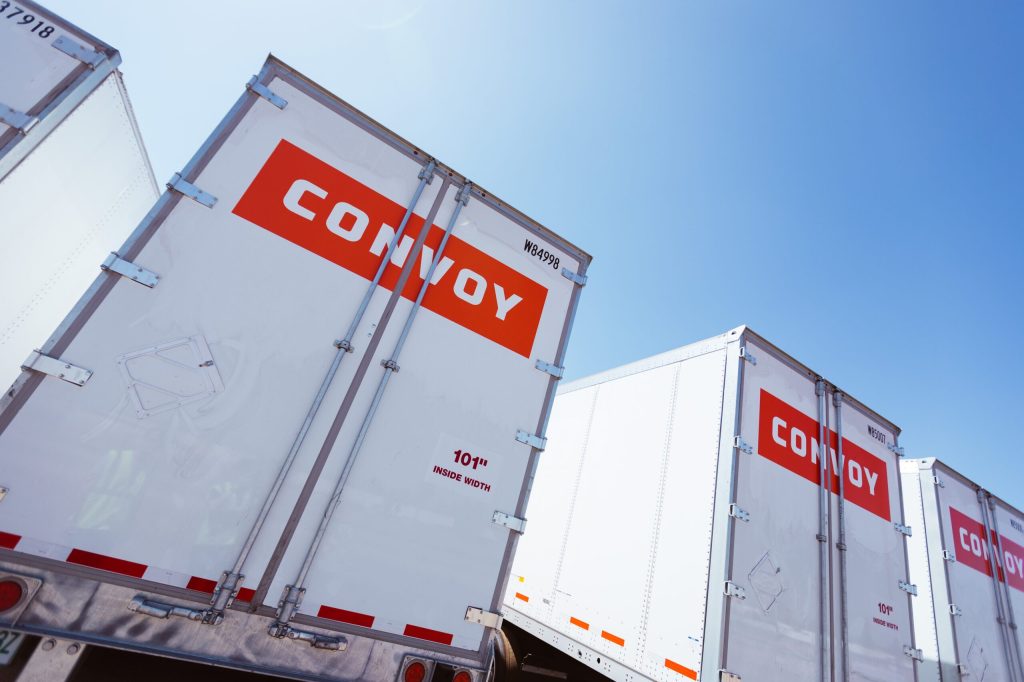
It’s over: Convoy shutting operations, no strategic white knight to the rescue

Convoy Inc. will be “closing down its core business operations,” the company’s employees were starkly told Thursday, roughly one day after its fate was suddenly and publicly thrown into doubt.

In the letter from the Seattle-based digital brokerage’s CEO and co-founder Dan Lewis that followed a companywide phone call, there was no suggestion that Convoy was about to see its digital brokerage operations snatched up by another suitor, as the rumor mill had churned out several names Wednesday. The company will retain a small team that will not only wind down existing operations but “handle … future strategic options.” Beyond that, every other employee was let go.

“We spent over 4 months exhausting all viable strategic options for the business,” Lewis wrote. “However, none of the options ultimately materialized into anything sufficient to keep the company going in its then current form.”

Later in the letter, Lewis added: “Following an exhaustive process, spanning many, many months during which we explored all viable strategic options for the business, the result is where we are today. Convoy is closing the doors on its current core business operations and exploring and evaluating strategic options for what might come next.”

Several employees told FreightWaves on Thursday that they were not offered severance, adding that benefits will be available through the company until the end of the month, then through COBRA until the end of November.

The ultimate blame for the collapse, according to Lewis, is that Convoy found itself in “the middle of a massive freight recession and a contraction in the capital markets. This combination ultimately crushed our progress at the same time that it was crushing our logical strategic acquirer — it was the perfect storm.”

But it wasn’t just the “logical strategic acquirer,” according to Lewis. There has been a drop in merger and acquisition activity in the logistics sector and “most of the logical strategic acquirers of Convoy are also suffering from the freight market collapse, making the deal doing that much harder.”

The identity of the “logical strategic acquirer” was not revealed. But multiple reports did say C.H. Robinson (NASDAQ: CHRW) was in advanced talks about an acquisition of Convoy. C.H. Robinson’s prior CEO, Bob Biesterfeld, was ousted at the start of the year reportedly because of a lagging performance of its technology to compete with digital brokerages like Convoy. C.H. Robinson certainly has undergone “crushing” times: Its stock is down about 10.5% in the last year and about 15% in the last three months. It was trading midday Thursday at about $83, well down from a 52-week high from early February of $108.05. 

C.H. Robinson declined comment on any acquisition discussions with Convoy.

Lewis’ letter pulled no punches. “We moved all business levers possible,” he wrote. “But we were running up the down escalator … and it kept speeding up. So despite your excellent work on our product and service innovation, extensive revenue driving efforts, and the painful and sweeping cost cuts you have had to endure, it was still not enough to get us into the financial position necessary to withstand the increasing pressures of the industry, without the need for outside funding.”

Lewis’ letter praised the company’s workforce several times. This passage was typical: “The work you’ve all done will leave its mark on the freight industry forever. This industry needs to modernize. Shippers want it, carriers want it, and the market wants it. We still believe that this will be the future for this industry.”

He closed the missive by telling his staff, “I think the world of you. You guys rock.”

More articles by John Kingston

Scheduling Standards Consortium releases API tech standard
Convoy releases proprietary fraud detection software

Convoy and OTR Solutions resolve ’misunderstanding’

Pam Transportation feels brunt of downcycle in Q3

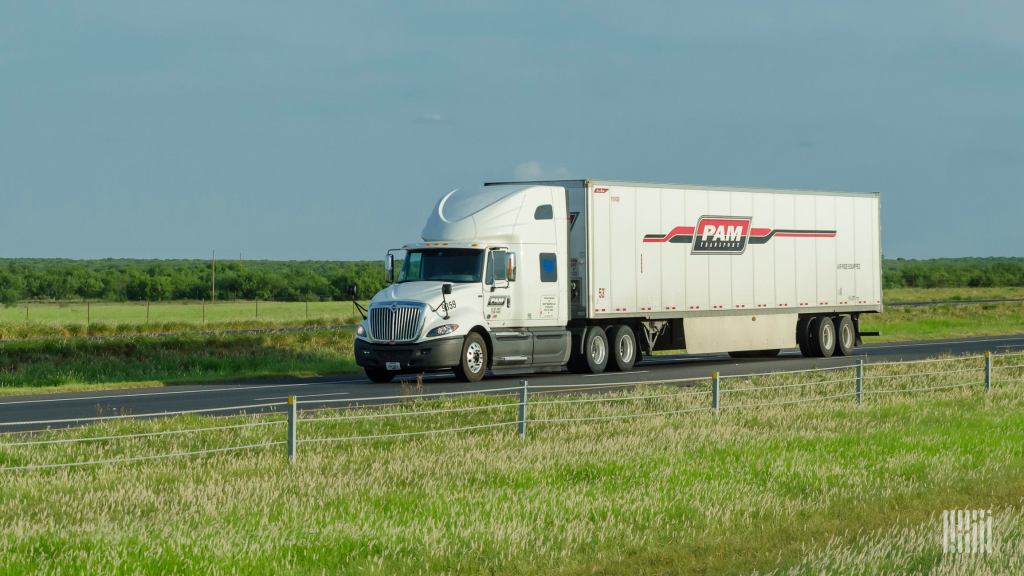
A white Pam tractor pulling a white Pam trailer

Pam Transportation Services’ third quarter produced a big reset from the record highs the company posted just one year ago. The result was also a notable step down from the 2023 second quarter.

Third-quarter revenue of $202 million was down 20% year over year (y/y) and operating income and earnings per share were off approximately 75%. The Tontitown, Arkansas-based carrier recorded EPS of 28 cents compared to $1.09 in the same period last year.

Lower gains on sale were a 3 cent hit and a higher tax rate was a 2 cent headwind compared to the 2022 third quarter. However, a $3.5 million y/y swing in the market value of the company’s equity holdings produced a 12 cent tailwind.

Pam’s (NASDAQ: PTSI) consolidated operating income was down 36% from the 2023 second quarter.

“The third quarter of 2022 was one of the best in our company’s history while the third quarter this year was faced with an unprecedented unfavorable truckload market,” said Joe Vitiritto, president at Pam. “Despite market challenges, we did see improvement in factors that we believe will position the Company favorably when truckload market conditions improve.”

Table: Pam’s key performance indicators

Revenue in the company’s TL segment was off 23% y/y as average trucks in service fell 6% and revenue per truck per week was down 16%. Loaded miles declined 10% and a $2.45 rate per loaded mile (excluding fuel surcharges) was down 14%.

The news release didn’t reference the impact strikes in the auto sector were having on its business. Pam has struggled in the past during production shutdowns. Last year, 31% of its revenue was tied to the sector.

Operating expenses as a percentage of revenue were up y/y across all cost buckets. Salaries, wages and benefits (up 270 basis points), operating supplies (up 200 bps) and rent and purchased transportation (up 200 bps) were the most impacted.

Pam generated a 95.8% operating ratio in its TL segment, which was 1,320 bps worse y/y.

The company’s logistics unit reported a 13% y/y decline in revenue to $62 million. Pam doesn’t provide gross profit margins for the unit or operating metrics like load counts and revenue per load. The unit recorded a 93.3% OR, which was 760 bps worse y/y.

Across most brokerage platforms, both volumes and rates are depressed. J.B. Hunt (NASDAQ: JBHT) reported Tuesday a 48% y/y revenue decline in its brokerage unit during the third quarter, which resulted in a fourth straight operating loss for the division.

Pam generated $94 million in operating cash flow during the first nine months of the year. Liquidity increased $4.7 million from the second quarter to $204 million and outstanding debt continued to step lower, down $2.4 million sequentially to $228 million.

“Looking ahead, we will continue to stay focused on investing in the areas of our business that will help us to consistently grow, increase efficiencies and deliver value to our customers, shareholders and employees,” Vitiritto said.

Shares of PTSI were down 9% at 11:38 a.m. Thursday compared to the S&P 500, which was flat.

More FreightWaves articles by Todd Maiden

Kuehne+Nagel teams up to make airport cargo handling more efficient

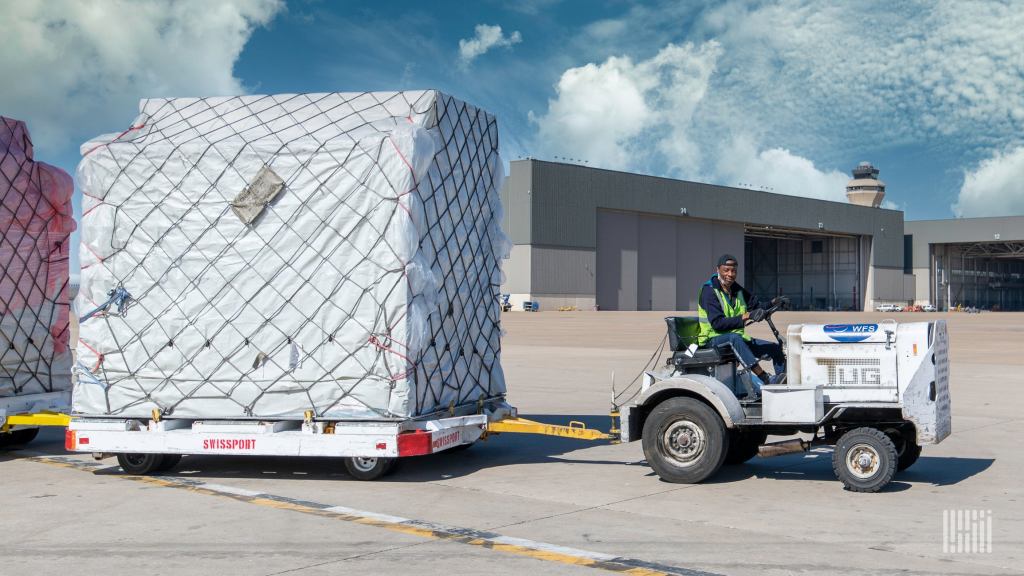
An airport tug pulls a large cargo pallet on a sunny day.

Kuehne+Nagel, the largest airfreight forwarder in the world, has established a strategic partnership with a major airport services company to co-develop better business practices aimed at speeding cargo flows at lower cost in an effort to further differentiate its service proposition from competitors.

The Switzerland-based logistics giant said Tuesday it is working closely with Singapore’s SATS Ltd., which acquired Worldwide Flight Services in April for $1.3 billion, to implement joint learnings at airside cargo warehouses around the world.

Management teams from Kuehne+Nagel and SATS in December created pilot projects on  improving electronic data interchange connectivity and cargo processing speeds for time-sensitive e-commerce shipments and intra-Asia cargo, said Jack Liu, senior vice president of air logistics for Asia-Pacific, in an email message. 

Officials said each proof of concept delivered promising results in terms of time savings, scalability across multiple airport locations and reducing the number of times cargo is physically touched as it moves through the ground handling process.

Enhancing SATS’ operations and data automation backbone will enable K+N to extend its air charter network in Southeast Asia and provide improved shipment visibility from the ramp to the warehouse, said Liu.

Under the new partnership, K+N and SATS will continue to explore further collaboration opportunities with key customers to optimize the handling of goods that require temperature-controlled facilities, he said. 

Airlines will also benefit from SATS’ improved methods for building up smaller shipments into pallets and breaking them down, sorting, pick and pack, labeling and security screening, according to Liu. 

“By leveraging our combined expertise and global footprints we improve our service offering and continue to create value for customers around the world,” Yngve Ruud, who heads air logistics for K+N, said in the announcement.

K+N has a small private airline of chartered freighters, including two new Boeing 747-8 jumbo jets flown on its behalf by Atlas Air. One of the planes operates under the Apex brand. K+N acquired Hong Kong-based Apex Logistics in 2021.

SATS, which stands for Singapore Airport Terminal Services, is the main ground handling and in-flight catering service provider at the country’s Changi Airport. Its acquisition of WFS surprised many because WFS was a bigger company. About 85% of SATS revenue at the time was derived in Singapore, while WFS has an extensive airport footprint in Europe, the United States and other parts of the world. The deal also diversified the SATS business more heavily into cargo.

Click here for more FreightWaves/American Shipper stories by Eric Kulisch.

RECOMMENDED READING:

Big freighter era begins at Birmingham airport in Alabama

Trucking fintech company Tank Payments nets economic empowerment prize

The number of trucking payment companies continues to grow, and one startup has broken through the noise to capture the money and attention of Airbnb and one of Silicon Valley’s “super angels.”

Tank Payments, an Austin, Texas-based startup that creates digital wallets for truckers, was awarded Airbnb’s 2023 Ron Conway Economic Empowerment Award. The award recognizes one Y Combinator company with a business model that provides economic empowerment opportunities in innovative ways. Conway, the founder and co-managing partner of SV Angel, became an investor in Airbnb in 2010.

Brian Chesky, Airbnb’s founder and CEO, said he has seen firsthand the value behind the powerful combination of mentorship and financial support. Tank Payments will receive an award of $100,000 plus a $100,000 personal match by Chesky. Tank Payments’ executives will also receive personal mentorship from both Chesky and Conway.

“Ron has always shared our belief that technology can be an engine for economic empowerment,” Chesky wrote in a 2020 message about the creation of the award. “Ron and I also share a desire to inspire more entrepreneurs to create companies that offer economic opportunities for more people and a commitment to making the tech industry more diverse and inclusive. In the years to come, I plan to take a number of significant steps to help achieve these goals.”

Conway met with Chesky weekly during their mentorship period and coached Chesky on fundraising, building a united and inspiring startup culture as well as product growth.

Chesky said the information was invaluable. “Mentorship from people like Ron was integral to Airbnb’s success, especially in our early days. We created this award to support the next generation of great entrepreneurs, and I’m excited for the opportunity to work with Tank Payments to help them reach their full potential.”

Tank is the second startup to receive the award. The first was Nash, a platform for businesses to organize and manage their deliveries. While Airbnb is not directly involved in the world of freight, both Conway and Chesky are hyperfocused on innovation.

“In my career, I have seen how innovative technologies can have incredible benefits and create a rising tide that lifts all boats,” Conway said. “Tank Payments has the potential to save money for truck drivers, get truckers paid faster and make our supply chain more efficient.”

The Tank platform is designed to simplify the payout process for both truckers and factoring companies to expedite the delivery of payments. According to Tank Payments, based on today’s payment systems, truckers are paid on average 30 days or more after their deliveries.

“Truckers are essential workers and collectively, the logistics industry is 10% of our nation’s GDP,” explained Matt Rybak, COO of Tank Payments. “We’re committed to modernizing the systems that truckers depend on so they can get paid faster.”  

Over time, Tank Payments hopes to provide a broad range of services to support the many unique financial requirements of freight businesses.

“It’s an honor to receive the Ron Conway Economic Empowerment award,” said Dane Cook, CEO of Tank Payments. “Millions of truck drivers work long hours under challenging conditions to keep the U.S. economy moving. While we all expect to receive shipments faster and faster, the time it takes to get paid for that work has not sped up. We started Tank Payments to simplify payments for everyone involved, and ultimately deliver the fastest, cheapest way for trucking companies to get paid.” 

Widespread double brokering wreaks havoc on brokers and carriers in Q2

In Q2 2023, 85% of respondents to a survey — consisting notably of freight brokers and carriers — were impacted by double brokering.

That financial impact to their spend was steep, with nearly 56% of businesses experiencing a loss up to $50,000 and 18% seeing a drain of $50,000 to $150,000. An additional unlucky 10% experienced costs that ranged from $150,000 to $500,000, and 1% saw a loss greater than $500,000.

These results were among the most telling findings in FreightWaves and TriumphPay’s survey of freight brokers, 3PLs and asset-based carriers on the impact of double brokering. The findings, and potential solutions, were reported in depth in the white paper “Freight’s Breaking Point: The Double Brokering Dilemma.” 

Double brokering often works like this: A broker posts a load to a load board and assigns it to a carrier who then re-brokers it to another carrier without informing the other parties involved. The first carrier makes money by double brokering the load for a lower rate. Often, the second carrier is never paid for the load, resulting in a financial loss for the original carrier. 

The impacts of double brokering are felt by carriers and brokers alike, disrupting operations and causing financial and liability risks for everyone involved. It is estimated it affects between $500 million and $700 million in freight annually. 

Because of how widespread and devastating double brokering is, brokers and carriers are alert to warning signs. Respondents ranked the common red flags that they believed were the most reliable potential signals of double brokering. Red flags included:

  1. The inability to contact the carrier or original broker.
  2. Brokers who don’t want to provide their motor carrier numbers.
  3. Brokers/carriers who request unusual payment methods.
  4. Carriers who are unfamiliar with the details of the load.

Carriers and brokers are vigilant about spotting these and other warning signs. Even though more than three-quarters of respondents reported losing money to double brokering last quarter, most respondents feel confident that they can detect the scam. Fifty-seven percent reported a confidence level of 4 out of 5, and 20% reported 5 out of 5, or extreme confidence.

Only 10% of respondents don’t have a systematic way of tracking bad actors. Respondents rely on external databases or industry-shared resources, maintain an internal list of bad actors or have another way of fighting double brokering. One survey respondent said that the company’s process was to “double and triple check paperwork.” While this is a helpful solution at the moment, it’s not a long-term strategy to root out double brokering at scale.

Trust is essential to business relationships in the freight industry, and approximately 72% of respondents agreed that trust is significantly influenced by a broker’s payment process. While “trust but verify” has been the approach for a long time in the industry, transitioning to a “verify-then-trust” approach could be what is needed in an industry fraught with double brokering on load boards.

A verify-then-trust method would ensure a broker’s payment practices were rigorously verified before proceeding with a business transaction.

TriumphPay is a carrier payment platform that connects brokers, shippers, factors and carriers. It has partnered with Highway, a technology provider specializing in carrier identity management. Together, they are enhancing the industry’s fraud detection capabilities through a verify-then-trust approach.

This is made possible through TriumphPay’s vast data on freight spending and Highway’s detailed information on carriers and their equipment. These data sets can help identify carriers handling more freight than their equipment would allow, which is a common indicator of double brokering.

Click here to read “Freight’s Breaking Point: Double Brokering Dilemma” for full survey findings and for more possible solutions.

Family-owned California trucking company ceasing operations after 95 years

A third-generation family-owned trucking company and brokerage — Certified Freight Logistics, headquartered in Santa Maria, California — is ceasing operations on Saturday after 95 years.

Scott Cramer, president of Certified Freight Logistics (CFL), said he notified employees on Aug. 22 that the trucking company and freight brokerage, which employs 157 workers, including 101 linehaul and local truck drivers, would begin layoffs on Saturday with the wind down of the company concluding on or about Nov. 18. 

CFL, which hauled refrigerated food and fresh produce for major retailers throughout the western U.S., also filed a Worker Adjustment and Retraining Notification (WARN) Act notification in August with the California Employment Development Department of the company’s impending closure.

Cramer told FreightWaves he is working with truck dealers about early lease terminations, adding that the “current freight conditions have been pretty difficult.”

“Management has been attempting to maintain profitable operations but current market conditions have made it difficult to operate without a loss,” said Cramer in a statement to FreightWaves. “Pandemic volume demand, equipment availability issues, increased costs followed by falling freight rates and reduced volume put us in a place to have to make this difficult decision.” 

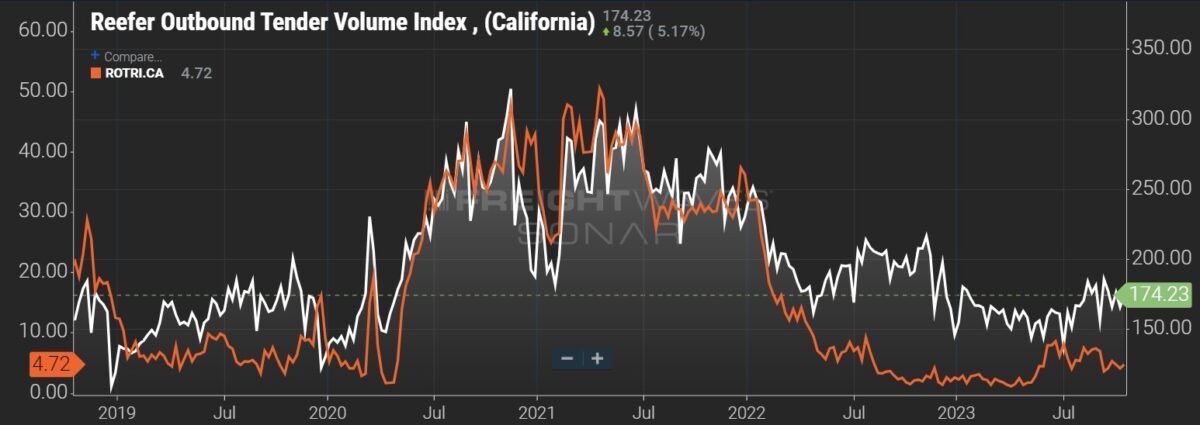
Chart: FreightWaves SONAR

Cramer said the company has arranged transition services for its employees, including many who have been with the company for more than 20 years.

Besides closing its headquarters in Santa Maria, CFL will close its yards in Stockton, California, and Sumner, Washington.

“The company delayed any decision for some time while trying to resolve the fundamental operating issues and is no longer able to viably operate,” Cramer said. 

Do you have a news tip or story to share? Send me an email or message me @cage_writer on X, formerly known as Twitter. Your name will not be used without your permission.

Flock Freight CRO Orlando Baeza departs after 8-month tenure
40-year-old Montana trucking company, freight brokerage shutters operations
Truckers: Shuttered Sunset Logistics still owes final paychecks, escrow
Judge rules TQL owes thousands of former employees overtime pay

Union Pacific’s Q3 net profit declines 19%

Union Pacific’s net profit for the third quarter of 2023 slipped 19% amid a 10% drop in overall revenues, the Western U.S. Class I railroad said Thursday morning.

Third-quarter 2023 net income was $1.53 billion, or $2.51 per diluted share, compared with nearly $1.9 billion, or $3.05 per diluted share, for the third quarter of 2022.

“We faced many challenges in the quarter, including continued inflationary pressures and a drop in carloads,” UP CEO Jim Vena said in Thursday’s earnings release. “Operationally we gained momentum through the quarter, which positions us to provide our customers with great service. Operating and safety metrics are showing solid improvement, as we increase asset utilization. We are aligning the team around our strategy focused on being the best in safety, service, and operational excellence as we drive growth to the railroad. Through our day-to-day actions, we will continue to make improvements as we exit the year.”

Overall operating revenue was $5.9 billion, down 10% year-over-year (y/y). Of that, freight revenue totaled $5.5 billion, which is a 9% decrease compared with the same period in 2022. 

UP (NYSE: UNP) said revenue was lower amid reduced fuel surcharge revenue, lower volumes and business mix, but those were partially offset by core pricing gains. Total revenue carloads slipped 3% y/y.

However, UP reduced operating expenses by 4% in the third quarter to $3.76 billion amid a 25% decrease in fuel expenses and a 6% decrease in compensation and benefits.

Operating income was $2.18 billion in the third quarter, down 17% y/y. Operating ratio, a metric that investors sometimes use to gauge the financial health of a company, rose from 59.9% to 63.4% A lower OR can imply improved financial health. 

Average train length grew 1% to 9,537 feet, while quarterly freight car velocity was 200 daily miles per car, which is “a 5% improvement,” UP said. 

UP said its full-year outlook for 2023 “remains relatively unchanged,” with “year-to-date softness in consumer-related volumes likely [to] drive full year volume expectations below industrial production.” 

Vena said in UP’s Inside Track newsletter, published Thursday, “Team UP, we are making progress to be the best at Safety, Service and Operational Excellence. We closed the third quarter with clearly identified areas we have to improve. We are working to improve safety. We are also moving faster, being more efficient, productive and responsive to our customers and all stakeholders. September alone had some of the best service performance metrics we’ve seen in a while.” 

Subscribe to FreightWaves’ e-newsletters and get the latest insights on freight right in your inbox.

Click here for more FreightWaves articles by Joanna Marsh.

Stord launches vendor delivery consolidation program

Omnichannel fulfillment provider Stord has launched a vendor delivery consolidation program it said will reduce the cost and complexity for smaller merchants shipping into big box retailer distribution nodes.

Under the program, Atlanta-based Stord will arrange consolidated pickups from merchant locations and combine the freight for inbound truckload moves into a dedicated warehouse in Chicago. The goods will be held there until they are released to be delivered to the designated retailer’s appropriate fulfillment centers. 

Merchants will share space aboard the same truck, and in some cases, on the same pallet, Stord said.

The aim of the service is to give merchants access to truckload rates that their volumes would otherwise not justify, said Sean Henry, Stord’s co-founder and CEO.

For growing brands, delivery consolidation fulfillment allows them to adopt new B2B partners without taking on excess freight costs for unused truck space while meeting individual retailers’ shipping requirements, the company said. 

Participating brands can save up to 30% on transportation costs over typical LTL  collect, or prepaid methods, Stord said in a statement. 

The vendor consolidation model is not new. Henry said Stord already offers business-to-business, business-to-consumer and direct-to-consumer services and has added vendor consolidation as another service offering.

Bankrupt Proterra delays auctions of electrification businesses

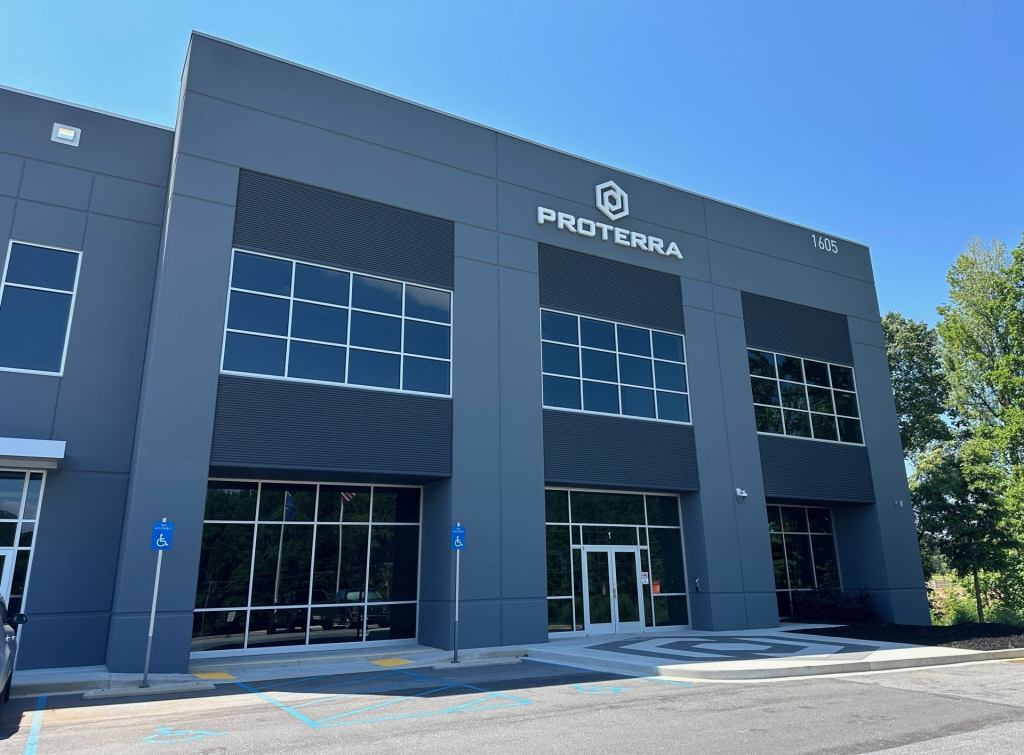
Proterra One

Bankrupt electric bus, battery and infrastructure developer Proterra Inc. has delayed the auction dates for its business units as interested bidders seek more time to explore what they would get.

Meanwhile, the company is continuing to make and deliver battery packs to customers, a spokesperson said.

Proterra has received interest from potential bidders for its three businesses — transit buses, battery packs and infrastructure equipment, the spokesperson said. Proterra filed for Chapter 11 reorganization on Aug. 7.

“We received multiple non-binding bids for each of our product lines at the Indication of Interest deadline on Sept. 26,” the spokesperson said. “Since that time, we’ve been working through the next stage of the due diligence and multiple interested parties have indicated that they would benefit from additional time to go deeper on our product lines, operations, and market potential.”

Such delays are common in bankruptcy reorganizations. 

The new bid deadline for Proterra Transit is Oct. 26, with an auction scheduled for Nov. 13 if necessary. Proterra Energy’s new bid deadline is Nov. 6, with an auction on Nov. 9 if needed.

Burlingame, California-based Proterra filed a notice of going concern in March as part of its 2022 10-K filing with the Securities and Exchange Commission. Such a filing calls into question whether a company would be in business a year from the filing.

Volta Trucks points finger at Proterra in its own bankruptcy filing

Meanwhile, Sweden-based startup Volta Trucks pointed the finger at Proterra for its bankruptcy filing on Tuesday.

Volta said uncertainty over its battery supplier had cut the number of trucks it was able to produce and made it hard to raise sufficient capital.

“Proterra has been and will continue to operate in the ordinary course through the Chapter 11 process,” the spokesperson said without specifically mentioning Volta Trucks.

Another customer counting on Proterra is Nikola Corp., which uses Proterra packs in its Tre fuel cell electric vehicles. Nikola launched regular production of the TRE FCEV in September with customer deliveries starting this quarter.

The FCEV is Nikola’s only current product. It has suspended production of TRE battery electric vehicles (BEVs) amid a safety recall. Nikola will replace the battery packs in 209 Tre BEVs recalled in August. The defective batteries were made by Romeo Power Inc., a since-liquidated Nikola subsidiary.

Who wants a piece or two of Proterra?

EV battery maker Proterra files for Chapter 11 bankruptcy protection

Former Daimler Truck CEO becomes chairman of Proterra

Click for more FreightWaves articles by Alan Adler.

Nikola will replace batteries in fire-prone electric trucks

Line of Nikola Tre BEV trucks

Nikola Corp. is telling customers it will replace the battery packs in its electric trucks, a worst-case scenario following several fires. Nikola is bringing all the trucks back to its Arizona plant but won’t say where or when it will get pack replacements.

In most recalls, the supplier of the part or component involved bears at least some of the cost of the campaign. In Nikola’s case, it owned its since-liquidated former supplier, Romeo Power Inc. It is therefore on the hook for the full cost of the recall.

The recall cost is unknown, but Nikola appears to have accelerated the sale of newly authorized shares to raise money to pay for it. The company declined to answer questions from FreightWaves. It said the recall issue would be covered in its third-quarter earnings call scheduled for Nov. 2. 

Romeo Power purchase results in multiple setbacks

Niklola purchased Romeo in August 2022 as a hedge against the pack maker running out of money and halting supplies. The acquisition has brought a series of headaches:

After initially telling owners the Tre BEVs were safe to drive with certain precautions, Nikola on Oct. 11 said it would pay to bring the trucks back to Coolidge, Arizona, where battery packs would be replaced. The letter said the replacements would take about 60 days depending on when pack replacements become available.

Nikola uses a different pack configuration from Proterra Inc. in its hydrogen-powered Tre fuel cell electric vehicles (FCEVs) now in production. Proterra continues to make and supply battery packs while in bankruptcy reorganization. It is unclear where Nikola will get packs to replace the defective Romeo battery packs. The FCEV uses two battery packs. The Tre BEV uses nine.

Truck-as-a-service startup WattEV ‘couldn’t take the chance’

WattEV, a truck-as-a-service startup using 14 Tre BEVs in its operation in California, reluctantly sent its trucks back to Nikola.

“We couldn’t take the chance,” CEO Salim Youssefzadeh told FreightWaves. “We are taking the battery recall seriously and are waiting for more information from Nikola.”

WattEV is also waiting for more than 80 VNR Electric trucks ordered from Volvo Truck North America. Volvo recalled 173 VNR electric trucks in early August to replace the battery packs following a non-spreading fire inside one pack. Pack supplier Akasol is expected to pay for some of the recall expense.

WattEV has turned to the Freightliner eCascadia from Daimler Truck as a solution, acquiring four trucks so far, Youssefzadeh said.

Nikola accelerates stock sales

Nikola has accelerated the sale of new stock since receiving shareholder authorization to double the number of authorized shares to 1.6 billion on Aug. 3. It has issued $165 million in convertible notes as well as issuing shares to cover debt held by hedge fund Antara Capital.

Between Aug. 1 and Sept. 20, the number of outstanding shares increased by more than 26% to approximately 985 million, according to a post by Henrik Alex on the investor site Seeking Alpha.

Company shares traded 8.4% lower at $1.04 premarket Thursday, continuing a downward trend that began Oct. 11 when the price was $1.41.

Nikola will recall 209 battery-electric trucks following 2 fires

Nikola moves to liquidate battery pack maker Romeo Power

Stock slides into reverse after Nikola share count doubled

Click for more FreightWaves articles by Alan Adler.