Year-on-year gain in J.B. Hunt intermodal volumes highlight of overall weak quarter

(Note: an earlier edition of this story attributed a quote to TD Cowen’s Jason Seidl. It was actually from Amit Mehrotra’s team at Deutsche Bank.)

J.B. Hunt’s intermodal segment, the largest revenue producer in the company, showed year-on-year volume growth in the third quarter ending Sept. 30, a rare sign of upturn in an otherwise tough quarter.

While revenue was down compared to the corresponding quarter in 2022, volumes were up 1% year on year, an increase that received both an internal and external notice in looking for positives in the quarterly earnings.

In a quick email blast after the earnings were released Tuesday, Amit Mehrotra of Deutsche Bank said his team was “encouraged by the return to intermodal volume growth,” but that “we need to see more to offset the pressure on pricing and cost inflation.”

On the earnings call with analysts, Darren Field, the executive vice president of the intermodal division at J.B. Hunt (NASDAQ: JBHT), said the inventory destocking that the company believes is at the root of the freight recession “started to moderate in June.” Volume growth was down 1% in July, up 1% and August and up 4% in September, when Field said the company had “the largest intermodal volume week in our history.”

Volume increases have come in both the company’s transcontinental and Eastern network, Field said. “We believe this is driven by the overall market but also we believe we are taking market share with our strong service that is outperforming the competition.”  

J.B. Hunt President Shelley Simpson echoed Field on the question of destocking. “We see further evidence of this trend,” she said.  

The day after the call, Mehrotra’s team followed up with an observation that “we…are focused on volume, which we consider to be the leading indicator of profits and margin given JBHT’s longer cycle pricing framework. And we are encouraged in this regard. We note JBHT’s volume was up 1.2% year over year and up 3.9% sequentially. While these numbers aren’t spectacular on the surface, they mask increased momentum as the quarter progressed. “

Looking past the growth in intermodal volume, which rose to 521,221 loads from 515,178 loads a year ago, revenue declined 15.3% and revenue per load dropped 16.3% to $2,984 from $3,565.

Intermodal’s revenue was 49% of the company’s total revenue.

Mehrotra called J.B. Hunt’s failure to meet the overall forecast performance a “decent-sized miss,” but said there were “some positive leading indicators that may mute the negative reaction in shares.” He said the company’s earnings per share, excluding a lower tax rate, was close to $1.66 per share, compared to a consensus of $1.80 or more.

As for the company’s bottom line, net earnings were $187.43 million, down from $269.4 million a year ago, a drop of 40.4%. Total revenue, excluding fuel, was $2.69 billion, down 14.9%.  Post-market trading in J.B. Hunt was decidedly negative. At 6:05 p.m. EDT Tuesday, the stock was down $7.51 from the earlier Tuesday close to $188.50, a drop of 3.83%. The price of the company’s stock has been relatively strong. In the last 52 weeks, it is up about 18.2%, and in the last three months, the increase has been near 6.9%. But it is down from its 52-week high of $209.21 recorded Aug. 4.

Seeking Alpha said the $3.16 billion revenue for the quarter at J.B. Hunt — a figure that includes fuel surcharge revenue — missed forecasts by $40 million.

With the intermodal segment turning in an operating ratio of 91.8%, deteriorating from 88.2% a year ago despite the small increase in volume, Field was asked about whether that signals a bottom in the quarter.

Field said the answer to that question “depends on what happens with our customers’ volumes.” 

“But if everything were to remain equal and we can onboard more volume and there’s no economic recession we’re faced with, yes, it can be the bottom. But there’s so many external factors that are going to influence that,” he said. 

But when asked about the signals for the fourth quarter, Field was more bullish. He said the J.B. Hunt intermodal operations “continue to bring equipment out of storage. None has gone back in and demand remains really, really strong, just as it was throughout September.”

It was the company’s brokerage unit, which operates as Integrated Capacity Solutions, that took some of the most significant hits during the quarter. The number of loads handled by ICS dropped to 163,745, down from 262,803, a decline of 37.7%. Revenue per load fell to $1,820 from $2,189, a decline of 16.8%. The gross profit margin fell to 12.8% from 14.2%. 

Operating income fell to a loss of $9.4 million, compared to an operating profit a year ago of $13.4 million. 

Revenue that flowed through J.B. Hunt 360, the company’s digital offering, fell a whopping 56.9%, down to $168.5 million from $391.1 million.

Cutbacks in the company’s brokerage operations, as has been seen in numerous logistics companies, was evident in a head count decline to 680 from 1,002.

Dedicated also was cited by Mehrotra as an underachiever in the quarter though the outright numbers were not particularly weak. Operating income declined to $102.4 million, down from $107.1 million. Revenue declined a relatively modest 4.1%.  

Operating income for all segments was down from a year ago. Intermodal’s operating income fell 41% to $128 million while its operating ratio weakened to 91.8% from 88.2%. Dedicated’s OR stayed flat at 88.5% while its operating income dropped 4.4%. 

Truckload operating income dropped to $7.7 million, down from $14.9 million, while its OR rose to 96.1% from 93.7%.

On other issues, in response to an analyst question, Nick Hobbs, COO and president of contract services, said, “Solid drivers are still hard to find,” though he added that “they’re much more available than they have been.”

Hobbs added, “We still have pockets in different areas that are tight, and the driver wages are not going anywhere. They’re staying up.”

That lack of weakness in driver pay could be seen in the salaries, wages and employee benefits line in the company’s earnings. At $803.2 million, it was down from $887.7 million a year ago. But that expense line was 25.4% of revenue this quarter and just 23.1% a year ago.  

More articles by John Kingston

Once again, California tells a court AB5 isn’t disrupting trucking in the state 

CARB sets up unit to help fleets navigate California’s Clean Fleets rule

California Supreme Court to review rulings on constitutionality of Prop 22

United Airlines’ cargo gain undermined by low rates

Blue-tailed United Airlines planes on the taxiway.

(Editor’s Note: This article was updated at Oct. 20, 2023, 7:30 ET)

United Airlines saw cargo revenue drop 33% year over year in the third quarter to $333 million, as the weak air cargo market continued to take a toll on the top line for freight. 

The contraction in cargo sales was hardly noticed by investors on Tuesday as United punched its way to a $1.1 billion profit ($3.65 earnings per share) on record third-quarter revenue of $14.5 billion, beating analysts’ estimates.

There was a disconnect between United Airlines’ (NASDAQ: UAL) cargo revenue and its volumes. Cargo ton miles – a measure of volume times distance flown that helps set pricing – actually increased 4.5% from the year-ago period to 766 million. And a spokesperson said United carried the most tonnage ever for a third quarter. The deterioration in revenue is most likely explained by the plunge in shipping rates across the sector due to abundant capacity and tepid transport demand in the sector.

United Airlines said cargo revenue was $1.1 billion for the nine-month period through September, a drop of 35.7% from the same period a year ago. 

United’s cargo performance tracked with that of Delta Air Lines, which saw cargo revenue fall 36%. Delta’s cargo revenue was half as much as generated by United for the first three quarters of the year. American Airlines reports earnings on Thursday and is expected to have results similar to Delta and United.

Cargo revenue was better against the $282 million in the third quarter of 2019, prior to the COVID crisis.

The results are in line with an air cargo market that has seen overall volumes fall by 8% to 10% since March 2022, finally hitting bottom in the late summer. Airfreight shipping prices have been 40% to 50% lower than last year for most of the year. Although the market has stopped declining, there are few signs of year-over-year growth at a time that is normally the busiest shipping season of the year. The market was falling last year in the second half and there was no peak season bump.

United operates the largest widebody passenger fleet of any U.S. passenger carrier, giving it plenty of space to market for cargo.

The company said it continued to experience strong travel demand, which produced record profits for international business. During the quarter, United’s pilots ratified a new four-year labor deal, which will increase pilot wages about 40%. The extra labor costs and higher fuel prices could weigh on earnings in the fourth quarter, as could the suspension of flights to Tel Aviv because of the Israel-Hamas war in Gaza.

More FreightWaves/American Shipper stories by Eric Kulisch.

Subscribe to the American Shipper Air newsletter.

RELATED NEWS:

Uptick in airfreight rates creates mirage of market recovery

Delta Air Lines cargo revenue drops 36% on slow freight demand

Shipping line earnings preview: A mix of black, red and very red ink

a photo of a container shipping vessel

The shipping rate rebound that began this summer is over. Financial analysts covering shipping line stocks are slashing their forecasts.

Even so, many liner companies are expected to post at least some profits for the third quarter of this year — and all of them are still sitting on historically large cash hoards. Today’s liner companies are like Powerball winners who’ve just taken big pay cuts at their day jobs.

“Container shipping companies are awash with cash and therefore we think they are under no pressure to cut capacity,” said Deutsche Bank analyst Andy Chu in a research note earlier this month.

“As we see no signs of this changing near term, we think this will likely result in freight rates continuing to be under pressure,” said Chu, who downgraded stocks of Maersk and Hapag Lloyd from “hold” to “sell.” Denmark’s Maersk and Germany’s Hapag-Lloyd are the world’s second- and fifth-largest carriers, respectively.

According to Jefferies analyst Omar Nokta, “Spot freight rates surged across the mainlines in July and August but quickly fell back to loss-making levels in September and have held mostly flat for the past several weeks. Overall earnings are likely to come down,” he said in a third-quarter earnings outlook released Monday.

chart of shipping spot rates
Spot rate in USD per FEU. Blue line: China-East Coast. Green line: China-West Coast. (Chart: FreightWaves SONAR)

Nokta has repeatedly cut his earnings forecast for Israel-based Zim (NYSE: ZIM) as this year has progressed. He still expects Maersk and Hapag-Lloyd to post profits in the third quarter, but he foresees a sea of red for Zim, the world’s 10th-largest ocean carrier.

Nokta now forecasts that Zim will lose $1.83 per share in Q3 2023, equating to an adjusted net loss of $220 million. He expects the company to lose $647 million in full-year 2023, versus the Bloomberg consensus estimate for a full-year loss of $641 million.

Still some positives amid market gloom

Indicators from other ocean carriers are not quite as grim. 

China’s Cosco Group, the world’s fourth largest liner operator, announced preliminary results showing net income of 6.33 billion yuan ($866 million) for Q3 2023. That’s down 44% from second-quarter profits of $1.54 billion, but it’s still six times more than Cosco’s net income in Q3 2019, pre-COVID.

Cosco subsidiary OOCL published its Q3 2023 revenue-per-container statistics this month. While its numbers continue to decline, the pace of that decline has eased.

(Chart: FreightWaves based on OOCL financial filings)

Hong Kong-based OOCL had $2,635 in revenue per forty-foot equivalent unit in the trans-Pacific trade during Q3 2023, relatively flat (down 2%) versus the second quarter.

Globally, OOCL’s revenue per TEU came in at $1,887 per FEU, down 11% from Q2 2023, driven by a 26% plunge in the trans-Atlantic lane. OOCL’s global average revenue per FEU was essentially unchanged (up 2%) versus Q3 2019, pre-COVID.

Taiwan’s Evergreen, the world’s seventh-largest carrier, discloses monthly operating revenues prior to releasing its quarterly financials. It had operating revenues of 72.8 billion New Taiwan dollars ($2.25 billion) in Q3 2023, up 8% from the second quarter of this year.

Evergreen’s Q3 2023 revenues are up 46% versus revenues in the same period in 2019. However, most of that gain is due to a larger fleet. Evergreen’s fleet capacity has increased 31% since Jan. 1, 2020, according to data from Alphaliner.

(Chart: FreightWaves based on Evergreen financial filings)

Hawaii-based niche carrier Matson (NYSE: MATX) is expected to pre-release Q3 results in the coming days. Matson has consistently reported above-market rates for its premium trans-Pacific service and has successfully wooed some shippers away from air cargo. If its stock price is any indication, investors expect Matson to continue to outperform.

Matson’s shares were only a few dollars shy of their 52-week high on Tuesday. According to data from Koyfin, which adjusts share pricing to account for dividends, Matson’s stock is up 45% year to date (YTD).

That is better than most shipping stocks, including those in tanker and gas shipping segments where rates are highly profitable, and is triple the rise of the S&P 500 index. Matson’s share action is the mirror opposite of Zim’s, which is down 44% YTD.

(Chart: Koyfin)

Click for more articles by Greg Miller 

Global Crossing Airlines one of few to make Israel cargo flights

Global X cargo jets with light-blue lettering parked on an open tarmac.

Editor’s Note: Since this story published, FedEx has quietly begun flying its own aircraft to Tel Aviv. A FedEx Boeing 757-200 has made two trips from Athens, Greece to Tel Aviv since Oct. 17, according to aircraft tracking site Flightradar24.)

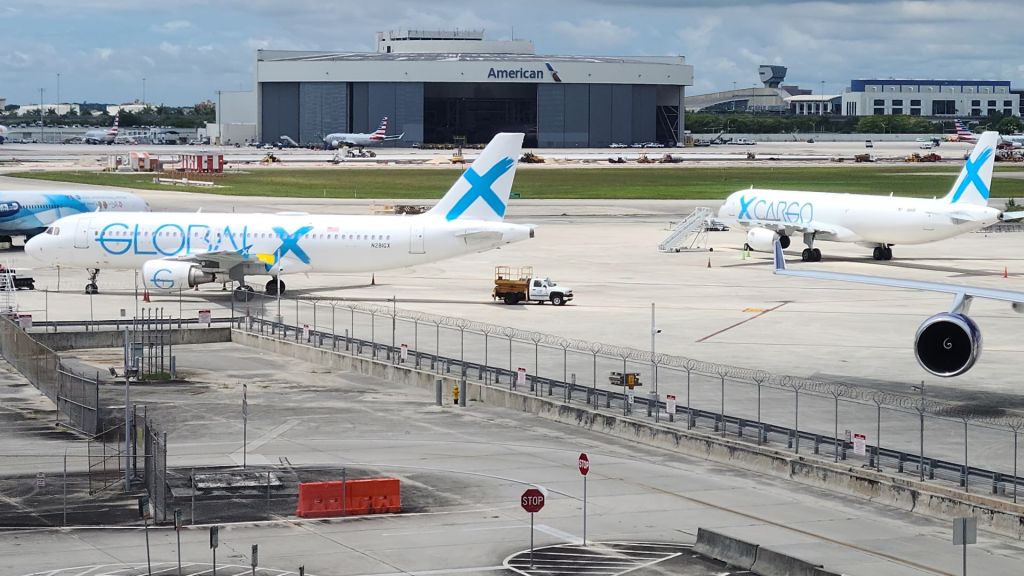
Two freighter aircraft operated by Global Crossing Airlines, a startup charter airline based in Florida, are on their way to Israel with more than 50 tons of relief supplies as the country prepares for war. Global X, in shorthand, is the only known U.S. all-cargo operator and one of only a handful worldwide still operating to the Middle East war zone, where even FedEx and UPS have suspended flights.

The two Airbus A321 converted freighters are hopscotching their way to Tel Aviv, currently en route to  Frankfurt, Germany, according to aircraft tracking site Flightradar24. The flights originated in Tampa and stopped at Portsmouth International Airport in New Hampshire and in Reykjavik, Iceland. The A321 is a narrowbody plane typically used for short-to-medium-haul routes and needs to stop for fuel on a transcontinental flight.

Global Crossing Airlines (USOTC: JETMF) Chairman and CEO Ed Wegel announced the aid flights on LinkedIn Monday evening, and that the two aircraft will carry medical supplies and gear for first responders. A third freighter will soon be dispatched with more supplies for Israel, he said.

“Today, we stand with Israel,” he said.

Company officials declined to provide further details about the mission to Israel, including the customer.

Miami-based Global Crossing entered revenue service two years ago with A320-family passenger jets providing charter flights for airlines, cruise lines, casinos, and hotel and resort destinations. The carrier earlier this year received its first two A321 leased freighters, which spent more than two decades ferrying passengers before being converted for dedicated cargo operations. The planes typically operate in the Caribbean (Miami – Kingston, Jamaica – Port-au-Prince, Haiti) and the Texas-Ohio corridor in the United States.

Global X is the only U.S. airline so far to operate the A321 converted freighter. It’s third aircraft, leased from Air Transport Services Group in Wilmington, Ohio, was delivered a week ago. The cargo jet has not had its operating specifications — the set of rules that an airline agrees to operate by — approved by the Federal Aviation Administration and isn’t authorized to fly yet.

Global X participates in the Defense Department’s commercial airlift program and deployed passenger aircraft to evacuate 1,500 refugees from Afghanistan in August 2021, shortly after receiving its aircraft operating certificate from the Federal Aviation Administration. 

Tel Aviv’s Ben Gurion airport is less than 40 miles from the front lines of Israel’s war with Gaza, and a large majority of international airlines have canceled flights to the city while the country is still under rocket attack. United Airlines, Delta Air LInes and American Airlines have all temporarily paused direct flights to Tel Aviv. The State Department has sponsored charter flights with other carriers to repatriate American citizens who want to leave the country.

Only a handful of cargo airlines are still operating to Tel Aviv. Of the three global express carriers, only DHL is operating once or twice a day to the city from its hub in Leipzig, Germany. FedEx and UPS have suspended flights with their own aircraft, although they are still offering international parcel service by booking shipments on commercial passenger planes and other third-party carriers.

Israel-domiciled airline CAL Cargo Airlines, part of the Challenge Group, is flying regularly to Ben Gurion airport from its European hub in Liege, Belgium, according to the company and flight data.

Other all-cargo operations identified in recent days flying into Tel Aviv include Azerbaijan’s Silk Way West Airlines (Boeing 747-400), Lufthansa Cargo, Poland’s SkyTaxi and Turkey’s MNG Airlines (Airbus A300).

Also identified on the ground at Tel Aviv was a Boeing 777 freighter operated by Michigan-based Kalitta Air. Kalitta Air operates 25 Boeing 747-400 freighters, as well as four 777s. 

But the aircraft in Israel was not part of the regular fleet. It’s a used passenger aircraft that was converted by Israel Aerospace Industries (IAI) to a main-deck cargo configuration and returned for more testing, said Heath Nicholl, Kalitta’s deputy chief operating officer.

IAI is starting its second series of post-conversion evaluation flights as the company works to get its aircraft modification approved by Israeli and U.S. civil aviation authorities so the plane can be certified for commercial flying. IAI has previously indicated it expects to receive the supplemental certificate for changing the original design of the aircraft type later this year.

Israel Aerospace Industries first-ever Boeing 777-300 converted freighter, with a rear cargo door installed in the airframe, makes a test flight. (Photo: IAI)

Kalitta is leasing the aircraft from AerCap, which acquired GE Capital Aviation Services and the 777 freighter program in November 2021. GECAS opted to repurpose older feedstock for cargo and is the launch customer for IAI’s conversion program. Kalitta Air will be the first operator of the 777 converted freighter. The only 777 freighters currently in operation around the world are factory-built by Boeing.

Last month, IAI reached an agreement with Ascent Aviation Services in Marana, Arizona, to set up a conversion site for the 777-300. Ascent is building two widebody hangers to support production, which is expected to start next year. 

Safety risk

One of the steps Israeli authorities have taken to protect aircraft is to change the direction of approach to Ben Gurion airport so they avoid the conflict area near Gaza. Libby Bahat, head of aerial infrastructure for the Israel Civil Aviation Authority, said in a Wall Street Journal video report, that aircraft now take a more northern route than usual, bypassing Haifa. Military and civil air traffic controllers work closely together to ensure that missiles from the country’s Iron Dome defense system don’t impact civilian aircraft when they are intercepting Hamas missiles.

The government has also limited the number of passenger aircraft at the gate loaded with fuel and passengers. And when aircraft are ready to depart they are cleared immediately, with no waiting in line on the runway, according to the WSJ explainer.

Israeli officials insist their airspace is safe to operate in despite concerns from some experts that conditions for an accidental shootdown exist, including from nonstate actors on Israel’s northern border. Air traffic controllers have over 90 seconds to maneuver aircraft when a missile is fired, during which time the aircraft can cover about 10 miles, according to the officials. And Israeli interceptors are technically incapable of mistaking an aircraft, they add.

Other aviation experts have also raised concerns about Hamas using GPS jamming technology to interfere with military communications network, which has the potential to disrupt commercial traffic.

More FreightWaves/American Shipper stories by Eric Kulisch.

Subscribe to the American Shipper Air newsletter.

UPS flights to Israel still suspended, DHL operates

Sichuan Airlines to convert Airbus A321 aircraft for cargo

ATA walks back driver shortage numbers

Welcome to the WHAT THE TRUCK?!? Newsletter presented by AIT. In this issue, ATA revises driver shortage numbers; CEVA gets robots; and record out-of-service orders.

ATA gets it wrong on driver shortage


X

Mythbusters Last month, FreightWaves CEO and founder Craig Fuller published an article dismantling the driver shortage titled “The perpetual truck driver shortage is not real.” In that piece, he pointed out that while operating authority for motor carriers rose by 45% since 2019, truckload demand is only up 11% in the same period. The American Trucking Associations wasn’t happy about it.


X

ATA claps back — It didn’t take the ATA but a day to take notice of Fuller’s article. It wrote, “FreightWaves CEO Craig Fuller calls the truck driver shortage a ‘myth’ in a recent piece of self-promotion, but his assertion collapses under the weight of facts and data.”

ATA’s facts and data? It claimed that driver shortages in Romania and Poland help prove its case about a truck driver shortage in the USA.

Speaking of data, here is some of ATA’s from its 2019 driver shortage report:


X

Narratives The ATA goes on to say: “ATA isn’t in the business of peddling narratives; that’s FreightWaves’ lane.” However, on Monday at the 2023 Management Conference & Exhibition,  American Trucking Associations Chief Economist Bob Costello said that the truck driver shortage has fallen from 80,000 to 60,000 drivers. The ATA’s narrative in 2019 was that we’d be short over 100,000 drivers by 2023.

“The underlying problems of the driver market have not gone away.” — American Trucking Associations Chief Economist Bob Costello


X

Surplus Costello is right that the underlying problems of the driver market have not gone away. Turnover is still a massive issue. The very clear reasons for those issues and complaints by drivers have not gone away either. In fact, looking at ATRI’s latest survey, many of them aren’t even being considered by carriers. 

With outbound tender rejects below 4% and rates in the toilet, it is hard to peddle a narrative about a driver shortage, especially when there isn’t any ice cream melting on the dock.

In addition, if you are looking for drivers, there are thousands on the market now after bankruptcies at places like Yellow and Meadow Lark Transportation


X

P.S. Be nice to the drivers you have because you never know which terminal may snatch them away.

Chart of the day

“Global Ocean Container Rates have just hit a 5-year low! After a brief rise in ocean container rates over the summer, peak season didn’t last long as demand began falling again last month and has driven ocean container rates down to a new YTD and 5-year low (global composite).” — FreightWaves’ Luke Falasca

Record new authorities = record FMCSA OOS orders

In-N-Out John Gallagher reports, “New-entrant out-of-service (OOS) orders issued to carriers will surge to an all-time high in 2023, according to the latest government data, a trend that has mirrored the dramatic increase in new-carrier operating authorities issued since 2020.”

In 2023, 35,000+ carriers are likely to be put out of service. But why?

“It’s simple — there’s not enough money in the market right now to maintain these new drivers.” — Daniel Koors, an owner-operator and council member for CDL Drivers Unlimited

The pandemic trucking gold rush that attracted a record number of entrants did two things: It inflated capacity, which further drove down rates, and it brought in players who were not prepared for a downturn.

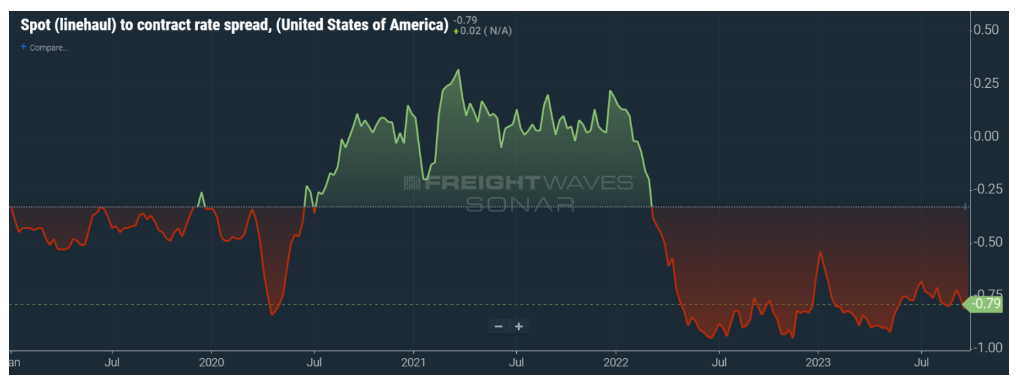
Many new participants in the market used load boards and fed off the spot market, but now there is a 79 cent spread between contract and spot rates. 

Koors said, “They don’t have the back-office support, they don’t have the capital, they jumped in when things were hot, and they didn’t set up the relationships needed to get them through this downturn.” 

The bad news for those trucking companies is those relationships are on the good side of that spread. Want more bad news? There isn’t a driver shortage, there’s a driver surplus.

Release the warehouse hounds

CEVA

Stretch and spot — Dropping off freight is about to get weird as you’ll be greeted by Boston Dynamics Spot robot dogs that patrol CEVA’s new 135,000-square-foot, state-of-the-art transload facility. The Stat reports, “Robots from Boston Dynamics will be used to serve customers at the site located within miles of Port of Long Beach and Port of Los Angeles.”

While Spot robot dogs will monitor the grounds, inside the facility are Boston Dynamics container-unloading bots named Stretch. A press release from CEVA says, “Stretch can reach boxes up to 50 pounds in weight, its vision system enables it to adapt to different stacking configurations, and it does not require any pre-programming.” 

While it isn’t clear how many robots will be deployed, CEVA says, “They expect to process a total of 26,000 floor-loaded containers during the facility’s first year in operation and to double its capacity within three years.”

WTT Wednesday

How to transform a supply chain with Brittain Ladd On Wednesday’s episode of WHAT THE TRUCK?!?, Shatranj Capital Partners’ Brittain Ladd stops by to break down supply chain strategy. Who is making the right moves; where is the money going; what M&A needs to happen now; and what companies are about to become zombies if they don’t change?

FreightWaves’ Thomas Wasson has a new report on ocean rates hitting five-year lows. We’ll break down what’s going on with ocean, rail and intermodal freight. 

FreightWaves’ Justin Martin talks about the ATA’s revised driver shortage numbers; record out-of-service orders; if it is ever appropriate to get a massage during a meeting; and more.

Steam’s Lee Britain explains why his team threw 48 water balloons at Steve Cox. 

Plus, news and weirdness.

Catch new shows live at noon ET Mondays, Wednesdays and Fridays on FreightWaves LinkedIn, Facebook or YouTube or on demand by looking up WHAT THE TRUCK?!? on your favorite podcast player.

Now on demand

Driver shortage myth; ATRI’s top industry issues; how seals work

How to ship a manatee; Flexport cuts 20% of global workforce; and the war in Israel

Tweet @ Dooner

Subscribe to the newsletter

Subscribe to the show

Apple Podcasts

Spotify

YouTube

TikTok

Twitter

Or simply look up WHAT THE TRUCK?!? on your favorite podcast player. 

All FreightWaves podcasts can also be found on one feed by looking up FreightCasts wherever you get your podcasts. 

Don’t be a stranger,

Dooner

Prologis sees demand uncertainty, posts Q3 beat

A white truck at a Prologis loading door

Logistics real estate investment trust Prologis pointed to geopolitical unrest and rising interest rates as factors weighing on customer decisions around investment in warehousing space.

Prologis (NYSE: PLD) beat third-quarter expectations Tuesday, posting core funds from operations (FFO) of $1.30, which was 5 cents ahead of the consensus estimate but 43 cents lower year over year (y/y).

The company expects project completions to outpace net absorptions by 150 million to 250 million square feet over the next three quarters. At that point, however, the trend is expected to reverse with demand outstripping supply by 75 million to 125 million square feet over a three-quarter period. The forecast is rooted in a lack of macroeconomic clarity, which is expected to result in a lower level of development starts over that time frame.  

“Demand is definitely softer — it’s closer to normal, maybe even a little bit below normal at this instant,” co-founder and CEO Hamid Moghadam told analysts on a Tuesday call. He noted “a lot of latent demand” among customers and said that most are reluctant to “pull the trigger.”  

Portfolio occupancy remained high at 97.1% in the quarter but was 60 basis points lower y/y. Net effective rent change (over the entire lease term) increased more than 2,400 bps to 84%. The company said rent growth was the strongest in the Sun Belt, mid-Atlantic and Northern California regions but fell 2% in Southern California as vacancy rates have ticked up in that market.

The company said rent growth continues to stay positive by an amount that is in line with or outpacing inflation. For the full year, rent growth is expected to shake out 7% higher in the U.S., which implies a slight acceleration from a year-to-date mid-6% increase.

Prologis plans to provide more color on future rents at an investor day in December.

Table: Prologis’ key performance indicators

Marking existing leases to current market rents across Prologis’ entire portfolio (over the full lease term) equaled 62% at the end of September.

Prologis commenced leases on 46.4 million square feet of space during the third quarter, which was a 9% y/y decline. It said appraised values on its U.S. properties were down 3% in the period, largely due to changes in interest rates and an overall weakening in the market.

The company had nearly $1 billion in development starts in the period and raised the full-year outlook for starts by $500 million to a range of $3 billion to $3.5 billion. However, it noted that built-to-suits for data centers is driving demand while industrial-related demand is closer to flat.

Management said a loosening market is expected to provide it with more acquisition opportunities in the coming months.

Prologis raised the front end of its guidance range by 2 cents. The new range is $5.58 to $5.60, which brackets the current consensus estimate.

More FreightWaves articles by Todd Maiden

Check Call: Texas takes the top spot

people gathered around a desk of computers. Check Call news and analysis for 3pls and brokers

Welcome to Check Call, our corner of the internet for all things 3PL, freight broker and supply chain. Check Call the podcast comes out every Tuesday at 12:30 p.m. EDT. Catch up on previous episodes here. If this was forwarded to you, sign up for Check Call the newsletter here.

(GIF: GIPHY)

Laredo, Texas, is channeling its best impression of Whitney Houston as it retains for the seventh straight month the top spot among all 450 international gateways for trade in August with a casual $28.6 billion. Coming in on Laredo’s heels is the Port of Los Angeles and Chicago O’Hare International Airport. In a surprise to few, the top imports from Mexico to the U.S. were auto parts, passenger vehicles and commercial trucks. It’s not much of a surprise given automotive manufacturing makes up the majority of what has been nearshored to Mexico. 

It’s the boom before the bust for Laredo. With truckload demand rising dramatically year over year, it’s a matter of time before Laredo comes to be one of the top freight markets, in regard to volume, in the country. 

FreightWaves’ Zach Strickland called it back in August: “Phoenix has experienced a similar developmental boom, becoming a proxy for California’s old warehousing capital in Southern California’s Inland Empire. This shifting demand pattern is changing transportation networks and will subsequently impact future pricing structures.”

(Image: 9GAG)

Increased fraud, double brokering and now an increase in new-entrant out-of-service (OOS) orders — these are not items I had on my 2023 supply chain bingo card. The Federal Motor Carrier Safety Administration started keeping track of new-entrant OOS orders in 2012, and 2022 held the record of 24,363 until this year. As of June, that number has climbed to 25,955, with six months to go in the year. 

A new entrant is classified as “a motor carrier not domiciled in Mexico that applies for a U.S. Department of Transportation identification number in order to initiate operations in interstate commerce” per the FMCSA. 

As of right now, there is no reason behind the surge, but the prevailing theory is that the amount of new entrants to the trucking market has caused a rise in the number of OOS orders. Basically, when a carrier is new to the industry, it is required to get a safety audit within the first 18 months. If the carrier refuses or fails the audit, it is placed OOS. Any carrier that continues to operate faces federal fines and penalties. 

So what does that mean for brokerages? There is some possibility of a reduction of available carriers in the market leading to tightened capacity. It also could lead to carriers requesting higher rates to make money to update and maintain equipment. 

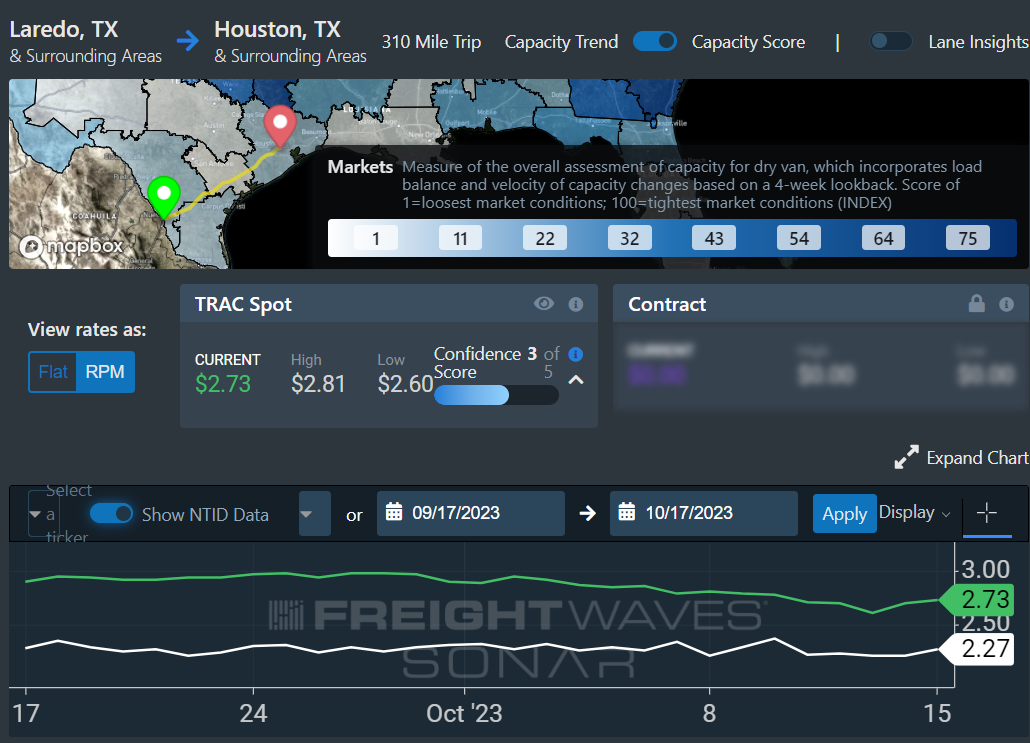
TRAC Tuesday. This week’s TRAC lane goes from Laredo to Houston. Capacity is loosening in Houston, which is putting downward pressure on spot rates. Outbound tender rejections are slowly on the rise but overall the Outbound Tender Rejection Index (OTRI) is at 1.36%, which is extremely high contract compliance for carriers and would make sense given the amount of cross-border freight that typically goes via contract. If there was a load from Laredo to Houston that made it to the spot market at an all-in rate of $846, before margin, this load should be secured with little problems. 

(GIF:GIPHY)

Who’s with whom? It’s the most wonderful time of the year: general rate increase (GRI) season. Coming out of the gate swinging are UPS and FedEx. UPS announced its GRI for the year and, would you look at that, it’s eerily close to FedEx’s. Considering the battle with the Teamsters this year, the GRI could have been worse. 

Although the GRI hovers around 5%-6% for most packages, the exact amount depends on weight. It’s more important than ever to make sure there is a strong audit process for shipments running through the network. There is a chance that some higher accessorial fees could be snuck in and paid unnecessarily. 

FreightWaves’ Mark Solomon wrote in his article: “UPS’ challenge in building its 2024 rate-setting strategy is to balance the need to boost yields with the desire to not alienate shippers whose volumes it is trying to recapture in the wake of the contract negotiations. About 1.1 million daily parcels were diverted to rivals in the weeks and months of often-volatile negotiations.” 

The more you know

Freight recession unlike any other in history 

Flexport CEO Petersen overhauls top management

Roadrunner’s new service waives shipment costs on late deliveries 

Yellow’s equipment may be sold off by auction houses

Revisiting a pointed criticism of FMC leadership

FreightWaves Classics is sponsored by Old Dominion Freight Line — Helping the World Keep Promises. Learn more here.

FreightWaves explores the archives of American Shipper’s nearly 70-year-old collection of shipping and maritime publications to showcase interesting freight stories of long ago.

In this week’s edition, from the September 1978 issue, FreightWaves looks at a strong critique of new leadership at the FMC over communication and rebating.

Karl Bakke lashes out at successor

Former Federal Maritime Commission Chairman Karl E. Bakke, now an FMC Commissioner, blasted the present Chairman, Richard Daschbach, on August 15 for failing to communicate with his fellow agency colleagues since he succeeded Bakke to the post about one year ago.

“Over the past year, I can recall not one single instance where the Chairman has sought, formally or informally, to share, solicit, or even discuss views on any matter of policy or substance concerning Commission business,” Bakke said as he testified before the House Merchant Marine Subcommittee at “oversight” hearings on FMC’s regulatory functions.

“Indeed, communication of any nature at the Chairman’s initiative has been virtually nonexistent, even on informational matters of legitimate interest concerning Commission activity,” Bakke charged.

Stating that “it is difficult for a member (of the Commission) to function effectively in a vacuum,” Bakke said that he only heard of Daschbach’s priority list of FMC goals “for the first time this morning.”

“One might reasonably expect,” Bakke said, “that in preparation for an oversight hearing such as this, a Chairman, purporting to speak for the agency, would coordinate his presentation with other agency members and share with them statistical and factual information and proposed responses developed in anticipation of particular areas or lines of questioning. I was privy to none of this.”

The former FMC chief also revealed that his views “have never been solicited” by Daschbach concerning interagency meetings or discussions with the Legislative Branch of the government that have involved FMC policy matters.

“Nor have I ever been advised of the holding (of such meetings) or the subject matters dealt with in such sessions,” Bakke disclosed.

He said Daschbach’s assignment of FMC Commissioners to oversee internal study projects “is a commendable step in the direction of full utilization of all Commissioners, but realization of that objective will fall far short of its goal until the concept of the Commission as a full five-member body is incorporated into its administration.”

He warned that in order for FMC to function effectively, “open channels of communication between open minds” are needed, “not adversary relationships.”

“I trust that in time the ‘new team’ will come to share this view,” Bakke concluded.

Before the Bakke charges were made, Commissioner Leslie Kanuk told the Subcommittee of communication problems within the agency. She said there were “serious communication problems within the Commission … we do not talk together.”

Daschbach testimony

Daschbach told Subcommittee Counsel Peter N. Kyros he would make “all (the efforts) that are humanly possible” to correct the situation, adding that the “Government in Sunshine Act” might be an impediment to effective communication. (Under the rules of this statute, a notice must be published in the Federal Register any time three or more Commissioners want to meet to discuss anything pertaining to FMC business.)

The present FMC Chairman said that his Managing Director, Arthur Pankopf, and the Maritime Administration’s Deputy Assistant Secretary for Maritime Affairs, Samuel Nemirow, are taking steps to implement the anti-rebating certification requirement contained in MarAd’s appropriations authorization.

He said the Commission will provide an annual statement to MarAd listing carriers that cooperate or refuse to cooperate with FMC in its anti-rebating investigation. (American companies listed as not cooperating stand the chance of losing government subsidies.)

Daschbach and Robert Ellsworth, of FMC’s Bureau of Industry Economics, played down the importance and accuracy of a recent study done for the Department of Transportation by Booz, Allen & Hamilton, which claimed that U.S. exporters pay an average of 32.2% higher freight rates per long ton of cargo than their foreign competitors. Ellsworth said that in the North Atlantic trade “when you look at specific rates and commodities, the disparities vanish.”

The FMC Chairman said “paper disparities frequently turn up, which are meaningless … Our programs now relate to specific shipper complaints.” (On August 10, Daschbach told the same Subcommittee that he had not bothered to read the rate disparity report because FMC staff members felt it was made on a “shaky” basis and filled with “errors.”)

DoJ/FMC rivalry

Concerning the escalating rivalry between FMC and the U.S. Department of Justice, Daschbach. DoJ Lawyers’ Perspective said DoJ lawyers “feel the Sherman and Clayton antitrust acts are overriding policies,” adding that “they haven’t been able to see that Section 15 exemptions override those economic policies. He further contended that DoJ “has never accepted Section 15 (of the 1916 Shipping Act) as an appropriate act of Congress.

FMC Anti-Rebating Campaign: In his August 10 testimony, Daschbach indicated that FMC’s anti-rebating campaign was picking up steam. He said the agency settled claims with 24 shippers and carriers, 12 of these occurring since May 1. The FMC Chairman said his Commission collected fines amounting to $5,272,000 with claims filed against shippers and carriers totaling another $5,147,000.

He told the Subcommittee that if the outstanding claims are concluded, the Commission’s enforcement program will yield over $10.4 million to the U.S. Treasury since January of last year. Daschbach said that amount “exceeds our total agency budget by nearly $1 million.”

“As the snowball effect of shipper and carrier disclosures becomes increasingly evident, the Commission expects substantial increases in the violators uncovered and penalized,” Daschbach said. “We are also confident that mounting disclosures will soon produce a substantial impact upon the illegal activities of foreign flag carriers in our ocean commerce.”

He said FMC’s current anti-rebating program “is just the spearhead” of a broader campaign to obtain adherence to U.S. laws “in all aspects of our ocean commerce, and to ensure the acceptance and credibility of our regulatory powers among those who seek to participate in the carriage of our foreign trade.”

McCloskey not convinced

However, the pace of the Commission’s rebating investigation did not sit well with Rep. Paul N. McCloskey (R-Calif.). Noting that seven subsidized shipping companies are still being investigated since FMC was given stronger authority to deal with rebates 15 months ago, McCloskey said, “I would certainly question the competence of any Commission.” The California republican said that if the U.S. operators are really cooperating, the FMC investigation should have been concluded within 30 days. He said that either the lines are not cooperating “or FMC is not acting.”

McCloskey raised the possibility of the Subcommittee’s staff attorneys examining FMC files to determine if the U.S. operators are being cooperative.

FreightWaves Classics articles look at various aspects of the transportation industry’s history. Click here to subscribe to our newsletter!

Have a topic you want us to cover? Email bjaekel@www.freightwaves.com.

FedEx announces holiday shipping deadlines

FedEx Corp. (NYSE: FDX) disclosed on Tuesday its holiday shipping deadlines for domestic packages that need to arrive on or before Christmas Eve, which this year falls on Sunday.

Customers using FedEx Ground, the company’s U.S. ground delivery business, will need to ship by Dec. 20 if they choose two-day shipping, the company said. Customers using FedEx Home Delivery, the company’s residential delivery operation, will need to ship by Dec. 21 for two-day shipping. Parcels tendered to FedEx Ground for one-day shipping must ship by Dec. 21. For Home Delivery, the deadline is Dec. 22.

For three-day shipping on FedEx Ground, parcels must be shipped by Dec. 19. On Home Delivery, the deadline is Dec. 20.

For FedEx Ground Economy, which operates under the slowest transit times, parcels must be shipped by Dec. 13, FedEx said.

Shipments tendered to FedEx Express, FedEx’s air and international unit, for next-day delivery must ship by Dec. 21, though parcels can be shipped by Dec. 22 if Saturday delivery is requested. Packages moving in second-day delivery services must ship by Dec. 20, FedEx said.

Packages shipped via FedEx Freight, the company’s LTL unit, must ship by Dec. 21 if the customer requests one-day delivery under FedEx Freight’s priority service, which offers more expedited deliveries than the unit’s Economy service. Customers opting for two-day shipping must ship out their parcels by Dec. 21.

Shippers using the unit’s Economy service must arrange for shipping no later than Dec. 12 to ensure deliveries on or before Christmas Eve.

Last week, the U.S. Postal Service announced that holiday shipments using its Ground Advantage two- to five-day delivery service must ship no later than Dec. 16 to arrive by Christmas Eve. Shipments moving under the Postal Service’s Priority Mail two- to three-day delivery service must ship no later than Dec. 18. Customers using Priority Mail Express, the company’s next-day delivery service, must ship parcels no later than Dec. 20, the Postal Service said.

The schedule applies to shipments moving within the lower 48 states, the Postal Service said.

UPS Inc. (NYSE: UPS) has yet to announce its holiday deadline shipping schedule.

Locomotive engineers’ union calls for limiting freight train lengths

The argument over whether the Class I railroads should deploy longer trains continues, with the Brotherhood of Locomotive Engineers and Trainmen (BLET) recently calling on the Federal Railroad Administration to issue an emergency order that would limit the length of freight trains to 7,500 feet.

The Oct. 9 letter to FRA Administrator Amit Bose and signed by BLET President Eddie Hall says FRA should consider an emergency order because developing and issuing a regulatory standard would “take a very long time.”

The union said setting limits of train lengths is necessary because not all locomotive engineers may be trained or experienced enough to handle longer trains, which could have greater in-train force than shorter trains. The railroads’ infrastructure network also might not always accommodate longer trains.

Hall cited two FRA safety advisories in February and April that highlighted the role that train build and makeup may have had in recent train accidents. 

“With train length continuing to expand, the Carriers have implemented the train length growth without training locomotive engineers to handle these monstrous trains properly. Class I Railroads have failed to consider route infrastructure, e.g. passing sidings, crossings at grade, cross-over switches, and public interactions (such as proximity to schools and hospitals) when building and dispatching very long trains. This was never an issue with trains within the 7,500-foot length,” Hall said. He also said the union had sent copies of its letter to all the Class I railroads to urge them to limit their train lengths in the absence of a regulatory standard.

The union attributed the railroads’ use of longer trains to the deployment of precision scheduled railroading, an operational method that seeks to streamline operations. 

“Now, very long trains are the ‘new normal.’ Best practices do not exist. The railroads have responded by simply adding more distributed power locomotives (“DPU”), but this does not solve any problems of very long trains … . When trains are excessively long, train engineers are unable to adjust their operations to accommodate for terrain, which can mask where in-train forces are occurring throughout the train,” Hall said.

The Association of American Railroads (AAR), which represents the Class I railroads, has said that the industry has developed training and technological tools that address operational issues related to longer trains. The industry’s safety record has also been improving over time, AAR said, with the industry’s mainline accident rate falling by 44% since 2000. Others, meanwhile, have said that regulating train lengths could result in an increase in shorter trains blocking rail crossings at higher rates.

AAR President Ian Jefferies responded to BLET’s request for an emergency order in his own letter to FRA dated last Thursday. “Respectfully, there is no emergency. Railroads have safely operated millions of trains in excess of 7,500 feet over the last eight decades. Experience shows that these trains are safe. As such, there is absolutely no safety justification for the extraordinary step of an emergency order,” Jefferies said.

Meanwhile, regulation looking at freight train lengths is still pending before FRA. The agency recently ended a comment period on whether FRA should collect monthly data from the freight railroads on the lengths and weights of trains.

Subscribe to FreightWaves’ e-newsletters and get the latest insights on freight right in your inbox.

Click here for more FreightWaves articles by Joanna Marsh.