Trump extends Jones Act waiver; direct effect “pennies per gallon,” say analysts

President Donald Trump extended the waiver of the Jones Act – the law requiring U.S.-built and -crewed ships carry cargo between U.S. ports – for another 90 days despite criticism of the minimal effect on retail gas prices.

The move by Trump to allow international companies to transport gas, fertilizer and other commodities at market rates has been seen as an effort to generate positive economic news amid rising prices and inflation ahead of the mid-term elections.

But since the waiver began on March 17 – and through its May extension – U.S. pump prices remained elevated. By August 10, the national retail average price had eased to roughly $4.01 per gallon, or about 48 cents per gallon from the late-May level. But analysts do not attribute that decline primarily to the Jones Act waiver, characterizing its direct effect as only pennies per gallon, limited by high international tanker rates and relatively small volumes shipped under the exemption.

Other observers question the waiver’s mixed message to domestic shipping interests, at a time when Trump has made revitalization of U.S.-flag shipping and shipbuilding a centerpiece of his domestic policy proposals.

The waiver appears to have added marginal supply-chain flexibility, especially for Gulf-to-West Coast cargoes, where Argus estimated a savings of just 6.6 cents per gallon versus Jones Act tanker transport.

The controversial law has been attacked by pro-business interests, who claim its protectionist measures artificially inflate prices.

“President Trump’s decision to extend Jones Act relief for another 90 days acknowledges the burden the law has long imposed on U.S. security and commerce, as well as the significant benefits the waiver has delivered,” said analysts Colin Grabow and Scott Lincicome of the libertarian Cato Institute. “Since March, the waiver has unleashed domestic commerce that the Jones Act previously prevented, with more than 54 million barrels of energy products moving between U.S. ports on 200-plus voyages (and counting). In most cases, these voyages took place on vessels with no connection to U.S. adversaries like China and supplied American companies with American energy products that would’ve otherwise been imported at a much higher cost (if at all). 

“These waiver shipments have exposed glaring gaps in the Jones Act fleet, including a lack of appropriate vessels to transport products such as bulk propane and asphalt, while delivering nearly 15 million barrels to the West Coast and enabling extraordinary new flows of American propane to Puerto Rico.”

They termed the waiver a “band-aid,” and said its economic and security benefits would scale from a broad, long-term reform or repeal of the Act.

Read more articles by Stuart Chirls here.

Read more:

Asia-US East Coast box rate hits new high of $9,400

After massive Q1 loss, Maersk returns another service to Suez

Sale of major shipping line in U.S. trade on the rocks: Report

Asia ocean line in $135M expansion of US box terminal

Why 47.5 is a scary number for East Coast ports

Analyst: UPS-Teamsters 2028 showdown will unleash parcel industry tsunami

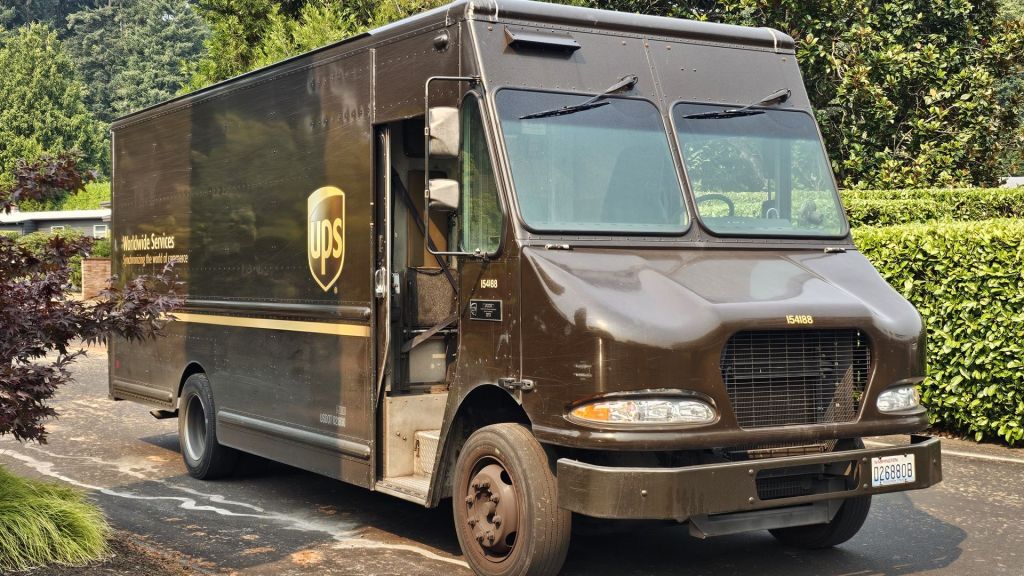
A brown UPS van stops on a neighborhood street to drop a package at a residence.

How United Parcel Service negotiates with unionized parcel drivers and loaders when the current contract reaches its end in two years will trigger a tsunami that either wipes UPS from the last-mile delivery market or severely damages its competitors, creating a more competitive landscape that benefits online retailers and consumers, an influential industry analyst predicted last week.

UPS (NYSE: UPS) needs to convince the Teamsters union that the current Cadillac-wage structure enshrined in the 2023 contract is unsustainable and the vast majority of parcel delivery jobs will disappear as customers flee to cheaper alternatives, said Satish Jindel, the president of ShipMatrix Inc., at a supply chain conference organized by Ohio-based Jarrett Logistics.

As the only unionized private parcel carrier, UPS has a greater challenge than FedEx (NYSE: FDX) in stemming the loss of B2C delivery business to large retailers like Amazon (NASDAQ: AMZN) and Walmart (NASDAQ: WMT), and startup couriers. Teamsters drivers cost about $65 per hour — total compensation when all healthcare and other benefits are included with the $49 hourly rate for senior drivers — compared to FedEx drivers who earn about $35 to $39 per hour on average. UPS’s direct hourly wage is roughly 20% to 28% higher at the experienced-driver level, according to a contract comparison by LJM, a parcel spend management firm.

Regional carriers that heavily rely on contract fleets or gig workers spend about $15 per hour, or less, on last-mile delivery drivers, experts say.

UPS will trigger a massive market reaction in August 2028, whichever way it deals the Teamsters, said Jindel, an outspoken industry observer and former executive at FedEx Ground’s predecessor whose company now tracks shipping data and helps businesses optimize carrier partnerships.

Labor clash looms as inflection point

UPS could end up dominating the market if it takes a hard stand against the powerfulTeamsters, which represents about 330,000 company employees. Conversely, giving in to worker demands and not lowering its cost to serve, would cause the logistics giant’s parcel business to wither away, said Jindel, according to notes of his presentation provided by an attendee at the Cleveland event.

The carrier “will have to offer much lower pay and require them to allow use of the Roadie platform for residential deliveries, or let them strike,” he said. In a November commentary, Jindel urged UPS to adopt a hybrid delivery model in which Roadie handles last-mile delivery of e-commerce shipments from thousands of UPS Stores while Teamster drivers, operating large package vans, provide middle-mile transport from regional sortation hubs to the UPS Store.

UPS acquired Roadie, which uses crowd-sourced drivers who supply their own vehicles, to handle urgent same-day, grocery and oversize shipments from local retailers that don’t move through the traditional automated sorting network. The Teamsters for months have publicly called out UPS for improperly steering shipments to non-union Roadie in violation of its contract. The union alleges Roadie uses UPS labels, tracking and equipment, but provided no concrete evidence Roadie is taking work from Teamster drivers.

“If they strike, UPS should be prepared to replace the drivers with non-union workers hired from FedEx independent contractor base and Amazon delivery service providers, which in turn will drastically reduce the workforce for its two main competitors,” Jindel argued. And it should lean more heavily on the Roadie network and its gig workers to minimize the strike’s impact, he added. “The result will be that UPS can dominate the parcel market like it did in the 1990s.”

In a follow-up phone interview, Jindel said “FedEx and Amazon won’t be able to handle the volume during the disruption and UPS will own the parcel market. But if they extend the contract they will not be able to compete with the others at half the hourly rate, or less, with the gig workers.”

Teamsters boss Sean O’Brien is not the compromising type. He has repeatedly boasted about how he secured an historic contract for members, forcing UPS in 2023 to put $30 billion on the table over the previous contract. And he has taken a hyper-aggressive stance in holding the company accountable to contract terms, such as providing air conditioning for thousands of delivery vans and limiting job losses through voluntary buyouts, saying management is greedy and can’t be trusted by workers.

By 2028, FedEx will be poised to take market share from UPS because it will have completed its Network 2.0 consolidation of delivery stations, which is removing excess capacity and will give it a lower cost structure. FedEx will also need to change how it works with independent service providers to prevent drivers from defecting to UPS and develop, or acquire, an on-demand, gig-worker delivery subsidiary to compete with Roadie and other startup parcel carriers, Jindel said.

Jindel questioned new Postmaster General David Steiner’s decision switching back to provide last-mile delivery for e-commerce retailers and parcel consolidators who bulk drop shipments near their final destination, saying the practice cannibalizes the U.S. Postal Service’s own end-to-end Ground Advantage volume. Predecessor Louis DeJoy worked to maximize the value of the Postal Service’s middle-mile network, pushing e-commerce and logistics companies to sort packages at the regional level and deliver them to upstream distribution centers, where higher rates are charged. Steiner recently inked major deals with Amazon and DHL eCommerce to accept their packages deep in its system and deliver them to individual addresses.

Meanwhile, the Postal Service’s high-cost, unionized workforce will make it increasingly difficult to provide Parcel Select service at a competitive price, Jindel told the Jarrett audience. Parcel Select is a cost-effective, bulk-shipping ground service for high-volume commercial shippers who drop presorted packages directly at destination processing centers to bypass early postal handling, securing the lowest possible rates for last-mile delivery. 

By late 2028, a union-free UPS delivering parcels with Roadie gig workers would be able to reduce its use of Parcel Select. However, Jindel said, the Postal Service can avoid the domino effect if it focuses on parcels that fit in mailboxes and move to delivering on alternate routes every other day of a six-day workweek. 

Amazon, like FedEx, would lose outsourced drivers to a non-unionized UPS by late 2028, according to Jindel’s scenario. “Unless it finds ways to retain those drivers, it would have to go back to using UPS for even more volume than before the recent glide down,” he said.

UPS spent the past 18 months eliminating 50% of Amazon’s volume from its network because moving low-price parcels through its network was uneconomical. Instead, the company is focusing more on high-margin B2B verticals and premium B2C shipments with higher yields. 

Jindel said Walmart, which is insourcing final-mile delivery using a gig-worker model to fulfill orders from its 4,000-plus stores, will be in the best position to withstand the UPS-triggered tidal wave as it becomes less reliant on FedEx and UPS. 

DHL eCommerce, the analyst predicted, will have to switch to an app-based, Uber-style model if it wants to continue achieving its 20% per year growth rate through 2030. 

Nonaffiliated regional and startup delivery companies like On-Trac, Gofo, UniUni, SpeedX, Jitsu and Veho will be impacted by UPS’s labor decision, to some degree, because it will be more difficult to attract independent delivery agents when UPS is offering more pay. Some could end up being acquired by Walmart, Target and other retailers interested in having their own networks, said Jindel. 

Click here for more FreightWaves/American Shipper stories by Eric Kulisch.

Write to Eric Kulisch at ekulisch@freightwaves.com.

DHL outsources last-mile parcel delivery to US Postal Service for $10B

UPS meets deadline for retrofitting delivery vans with air conditioning

UPS to cap driver buyouts at 7,500 after Teamster pushback

Cyberattack on Ceva Logistics warehouses in Europe impacts retailers

Michigan suspends truck driving school amid nationwide CDL crackdown

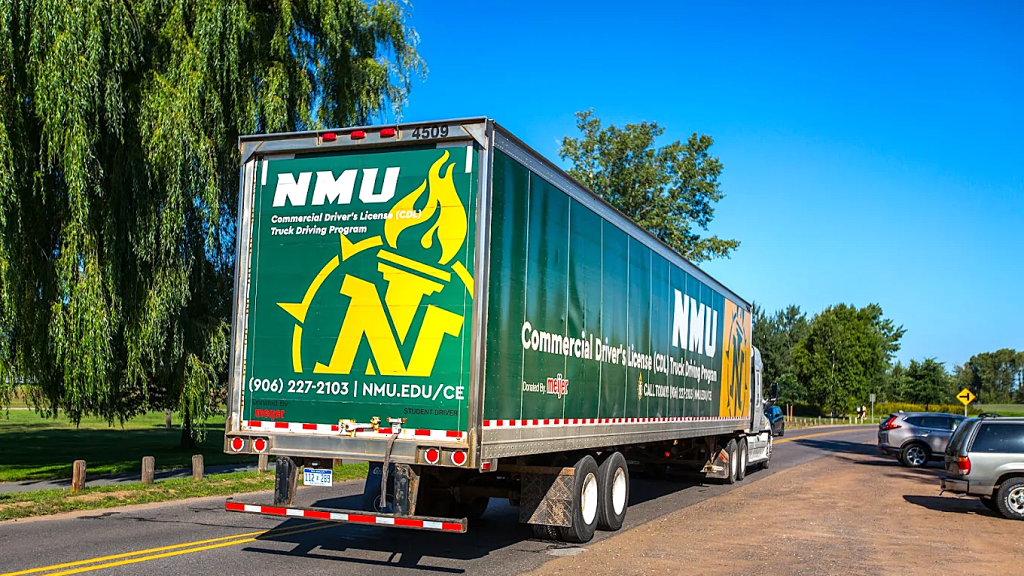
Michigan regulators have suspended a commercial truck driving school in Marquette after an investigation uncovered multiple alleged violations involving student permits, training documents and required records.

The Michigan Department of State said it issued a summary suspension to Northern Michigan University Truck Driving School on Aug. 5 following an initial investigation by the agency’s Driver Education Unit.

Among the most significant allegations, regulators said the school provided behind-the-wheel instruction to students without first verifying that they possessed valid commercial learner’s permits.

The action comes amid heightened state and federal scrutiny of commercial driver training programs and concerns about whether schools are properly preparing and certifying drivers before they obtain commercial driver’s licenses.

Michigan regulators said their investigation found Northern Michigan University’s truck driving program failed to maintain records required by law and failed to maintain required student financial records.

The school also allegedly did not use required written agreements with students before instruction began, kept records somewhere other than its established office and allowed students to sign blank instructional documents that were subsequently completed.

The alleged violations fall under Michigan’s Driver Education Provider and Instructor Act, which governs driver education providers and instructors in the state.

The investigation remains ongoing, according to the Michigan Department of State. The school is prohibited from holding classroom or range instruction while the suspension remains in effect.

Michigan’s action comes less than a month after the Trump administration announced an expanded federal crackdown on suspected fraud involving CDL training schools.

On July 16, the U.S. departments of Transportation and Homeland Security announced a joint operation targeting fraudulent and illegal practices at commercial driver training programs.

The Federal Motor Carrier Safety Administration said it had identified approximately 75 entry-level driver training schools suspected of fraudulent activity, including improper driver certifications, falsified training records and failures to properly train CDL applicants.

Why it matters: The Michigan case comes weeks after the Trump administration announced that FMCSA and Homeland Security Investigations were targeting dozens of CDL schools suspected of fraud.

White Paper: State of the Industry – August 2026

The August 2026 “State of the Industry Report” — presented in affiliation with Ryder — shares an in-depth overview across the trucking, maritime and intermodal markets, as well as what to expect in the coming weeks. The data contained within the report provides breakdowns of capacity, volumes and rates.

In this report, you will find: 

  • Freight demand remains healthy despite seasonal cooling, with spot and rejection rates easing from annual highs but still well above 2025 levels. 
  • Import volumes remain strong as shippers continue pulling freight forward ahead of tariff uncertainty, supporting elevated port and transportation activity. 
  • Intermodal continues to gain share, offering significant cost advantages versus truckload and handling strong demand without major capacity constraints. 
  • Truckload capacity remains tight, with spot rates still well above contract rates and continued upward pressure on future contract pricing.  
  • Inflation showed signs of easing in June, but renewed geopolitical tensions and rising fuel prices could create additional cost pressures in the months ahead. 
  • Manufacturing activity continues to expand, supporting freight demand, although hiring remains subdued and export growth has softened. 
  • Consumer spending remains resilient, but low savings rates, rising delinquencies, and ongoing weakness in housing suggest continued economic uncertainty sentiment remain weak.

Download the complimentary report today to access the full insights.

Asia-US East Coast box rate hits new high of $9,400

Container rates on the benchmark Asia to U.S. trade lanes are rising, amid surprisingly spry consumer demand following an early peak shipping season.

That demand comes as inflationary pressures push up the cost of retail goods and industrial products, and an array of supply chain and geopolitical factors continue to weigh on global ocean shipping.

In the Middle East, the stalemate over control of the Strait of Hormuz shows no sign of abating. As the U.S.-Iran war stretches into its sixth month, President Donald Trump’s command-by-social-media-post has failed to put together the framework of a reasonable exit strategy, leaving Tehran in a position to dictate terms. Iranian leadership this week said they would wait out the remaining two-plus years of Trump’s administration, if necessary.  

Iran’s escalating demands now include a ban on U.S. vessels, transit fees and war reparations. But that hasn’t deterred the global liners CMA CGM, Maersk (OTC: AMKBY) and Mediterranean Shipping Co., from expanding or returning to the Red Sea, despite renewed attacks there.

The United Kingdom Maritime Trade Operations security monitor reported two incidents in the region on Tuesday. A cargo vessel off the coast of Yemen in the southern Red Sea was hit by an unknown projectile, while a container ship was targeted by military forces in the Gulf of Oman. There were no further details.

The SONAR Ocean Booking Index shows steady y/y growth.

Asia-U.S. West Coast container rates increased 11% to $6,826 per forty foot equivalent (FEU) in the latest Freightos Baltic Index.  Asia-U.S. East Coast prices increased 1% to $9,144 per FEU, a new high for the year.

Trans-Pacific rates that had been moving in tandem with Asia-Europe prices since the early peak season start in late May have lately diverged.

“East Coast rates which had been about stable since hitting the $9,000/FEU mark in early July are up to a new high of $9,400/FEU so far this week,” said analyst Judah Levine, chief analyst for Freightos (NASDAQ: CRGO), a contributor to SONAR data. “West Coast prices – which fell through most of July, possibly due more to capacity additions than volume drops in retrospect – have climbed $1,300/FEU since the start of the month to about $7,400/FEU so far this week, though rates are $200/FEU below their July high.”

The surprise surge led the National Retail Federation to revise its outlook for a significant import drop in August and into September, to  more even, elevated demand through September. 

“This shift may reflect some shippers – who had been frontloading ahead of the July tariff deadline – extending their ordering now that a sharp duty hike did not materialize,” Levine said. “Others who may have been cautious with their peak season ordering due to so much economic uncertainty, may be increasing shipments as consumers continue to show resilience despite elevated rates of inflation.” 

Read more articles by Stuart Chirls here.

Read more:

After massive Q1 loss, Maersk returns another service to Suez

Sale of major shipping line in U.S. trade on the rocks: Report

Asia ocean line in $135M expansion of US box terminal

Why 47.5 is a scary number for East Coast ports

Reopening: Strait of Hormuz awaits Iran-Oman agreement

Carrier sued over alleged discrimination against female driver trainees

Federal regulators have sued national trucking company KLLM Transport Services and its driving academy, alleging companywide training policies discriminated against female truck driver trainees.

The U.S. Equal Employment Opportunity Commission announced the lawsuit Thursday against KLLM Transport Services LLC and subsidiary KLLM Driving Academy Inc., which operates driver training academies in Lancaster, Texas, and Jackson, Mississippi.

The lawsuit alleges that KLLM delayed training against female truck driver trainees, withheld pay in certain circumstances and imposed requirements that did not apply to men.

The EEOC alleges the companies violated Title VII of the Civil Rights Act of 1964 through sex-based training and pay practices dating back to at least January 2021.

At the center of the case is KLLM’s handling of male trainers who did not want to train female student drivers.

According to the EEOC, KLLM allowed male trainers to opt out of training women rather than providing separate sleeping accommodations during over-the-road training. The agency alleges that policy resulted in female student drivers having to wait longer than men to begin training.

The lawsuit also takes aim at how trainees were paid while waiting for instructors.

The EEOC alleges KLLM did not pay female student drivers who requested female trainers while they waited for one to become available. Meanwhile, the company allegedly continued paying other student drivers waiting to start training — including male students who requested male trainers.

Federal regulators also allege KLLM imposed an additional requirement exclusively on women who agreed to train with male instructors.

Female student drivers willing to receive instruction from a male trainer were required to notify their spouse or partner before they could begin training, according to the complaint. The EEOC said no comparable requirement was imposed on male trainees.

“Rather than provide the female student driver’s single-sex sleeping quarters that protected their privacy and ensured equal employment opportunity,” acting EEOC General Counsel Catherine Eschbach said in a news release, the company adopted policies that “treated women trainees worse than male trainees.”

EEOC says policies violated federal civil rights law

The agency alleges the practices constitute unlawful sex discrimination under Title VII, which prohibits employers from discriminating based on sex in employment.

The EEOC filed U.S. EEOC v. KLLM Transport Services LLC and KLLM Driving Academy Inc., Case No. 3:26-cv-02590-E, in the U.S. District Court for the Northern District of Texas, Dallas Division.

The lawsuit followed an unsuccessful attempt by the EEOC and KLLM to resolve the allegations through the agency’s administrative conciliation process.

“Under federal law, all workers in the United States have a right to be given a fair opportunity to succeed based on their knowledge, skills and effort, not their sex,” EEOC Dallas District Office Director Travis Nicholson said. “That fundamental principle applies to all aspects of their jobs, including training and other terms and conditions of employment.”

The lawsuit comes as the trucking industry continues to seek ways to recruit and retain more women in a workforce that historically has been overwhelmingly male.

Acting EEOC Dallas Regional Attorney Ronald L. Phillips specifically pointed to that issue in announcing the litigation, saying sex discrimination remains a barrier to women seeking jobs in historically male-dominated industries such as trucking.

Phillips said those industries can offer long-term career opportunities and that the agency intends to ensure women have equal access to those jobs.

The EEOC announcement does not state the amount of monetary damages being sought or provide the number of current or former KLLM trainees allegedly affected by the policies.

FreightWaves reached out to KLLM Transport Services for comment on the lawsuit.

Why it matters: The EEOC lawsuit puts renewed scrutiny on how trucking companies structure over-the-road driver training, particularly policies involving sleeper accommodations, trainer preferences and compensation that can affect women’s ability to enter and advance in the industry.

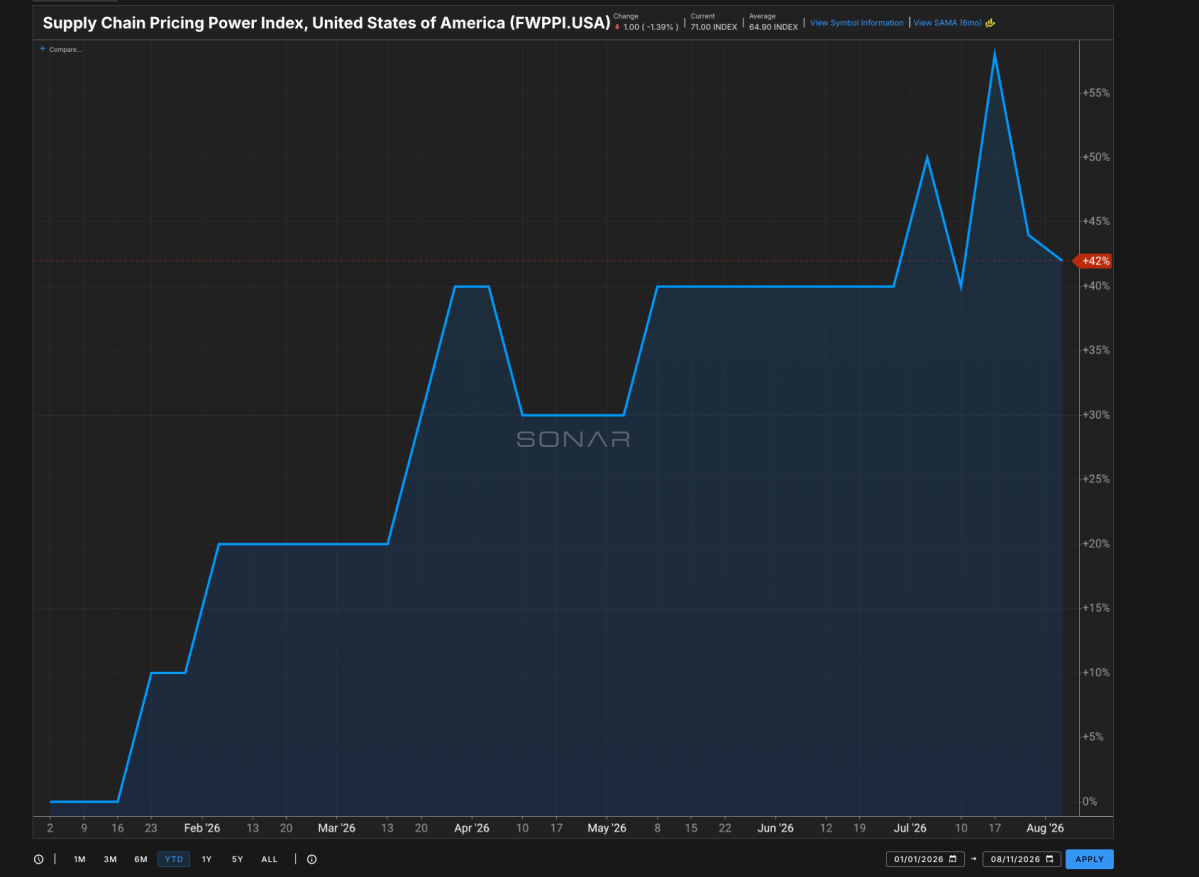
Who Has the Leverage Right Now? SONAR’s Pricing Power Index Has the Answer

Every week, SONAR’s Research team distills the freight market down to a single number: the Pricing Power Index (PPI). It’s a quick answer to the question that shapes procurement strategy, bid timing, and carrier negotiations alike — is pricing power sitting with carriers, or with shippers, right now?

The index isn’t a gut-check or a narrative built after the fact. It’s a direct-weighted, data-driven composite of eight SONAR metrics — tender rejections, accepted volume, rail volume, ocean TEU bookings, spot rates, van contract rates, the spot/contract spread, and intermodal contract rates — each ranked against five years of its own weekly history and combined into a single 0–100 score. A reading of 50 marks a historically balanced market. Above that, leverage tilts toward carriers; below it, toward shippers. A companion three-month outlook applies the same methodology to a 90-day-forward projection, so readers get both where the market stands today and where SONAR’s model expects it to be heading into the next quarter.

What this week’s release shows

The PPI has been on a five-week slide since peaking in mid-July, as capacity has eased and a couple of demand signals that had been running hot — rail volume, ocean import bookings — cooled off. The spot-to-contract spread, which hit a record high just a month ago, has narrowed sharply in recent weeks. The three-month forecast has pulled back too, now converging much closer to the current reading than it was diverging a few weeks ago.

Whether that’s the start of a genuine shift in carrier leverage ahead of peak season, or a seasonal pause before conditions retighten, is exactly the kind of question the PPI is built to help answer — and it’s covered in full in this week’s release.

Where to find it

The Weekly Pricing Power Index publishes every week and is available through two channels:

  • FreightWaves Market Monitor (getfreightdata.com) — full access to the PPI release, at $199/month.
  • SONAR platform Research library — enterprise SONAR customers can pull up every PPI release, along with the full research archive, from the clock icon in the platform’s upper-right menu, under Research (https://sonar.surf/research-library).

Freight markets rarely move on one signal alone. The PPI’s value is in doing the synthesis — consistently, quantitatively, and against real historical context — so readers don’t have to reconcile eight indicators in their head every week to know who’s holding the leverage.

Canadian province removes 20 unsafe trucking companies from roadways

Transportation officials in the Canadian province of Alberta say they have removed 20 unsafe trucking companies from its roads as part of a broader crackdown targeting noncompliant carriers, fraudulent driver-training schools and companies attempting to evade regulators.

Alberta Minister of Transportation and Economic Corridors Devin Dreeshen said the province has issued 443 administrative penalties since October while eliminating the 20 carriers from its roadways. Of those companies, 13 were identified as “chameleon carriers,” according to the province.

Chameleon carriers are trucking companies that attempt to avoid regulatory oversight by changing names, creating new business entities or relocating their operations across jurisdictions.

“Our government is continuing to take tough enforcement action to improve safety across the trucking industry,” Dreeshen said in a statement released Thursday. “We are applying vigilant oversight of carriers and driver training schools through inspections, audits and targeted investigations.”

Alberta said six additional carriers have been removed from the province’s international registration plan over the past year for misrepresenting their jurisdiction.

Fatal crash leads to shutdown of Conquer Transportation

The province highlighted enforcement action taken against Conquer Transportation Inc. in June following a fatal crash in Manitoba.

An investigation found what Alberta officials described as “wilful and sustained non-compliance” that posed an ongoing risk to the public. Authorities also determined the company was engaged in chameleon-carrier practices designed to evade compliance and enforcement.

Alberta assessed $16,500 in administrative penalties against Conquer Transportation and downgraded the carrier’s Safety Fitness Rating to “Unsatisfactory,” effectively shutting down its operations immediately.

Alberta officials said they are working with federal and other provincial and territorial governments to strengthen enforcement against chameleon carriers operating across jurisdictions.

Alberta targets Drivers Inc. model

The province is also stepping up scrutiny of the so-called Drivers Inc. model, in which trucking companies classify drivers as independent contractors rather than employees.

Alberta officials said the arrangement can be used by companies to avoid payroll taxes and employee benefits, while drivers operating under the model can lack proper training, oversight and workplace protections.

A three-day commercial driver status enforcement operation in May found that 20% of the 81 drivers stopped were suspected of being misclassified, including several temporary foreign workers.

Driver-training schools are another focus of Alberta’s enforcement campaign.

The province said it has shut down five fraudulent Class 1 trucking schools. Since April 1, 2025, inspectors have reviewed 53 of Alberta’s 56 licensed Class 1 driver-training schools, representing 95% of the total.

Why it matters: Alberta’s crackdown illustrates growing Canadian efforts to prevent unsafe trucking companies from escaping enforcement by reincorporating or moving across provincial borders, while regulators also increase scrutiny of driver classification and commercial driver training.

CBP finds $1.17M in cocaine after inspecting bell pepper truck at Texas border

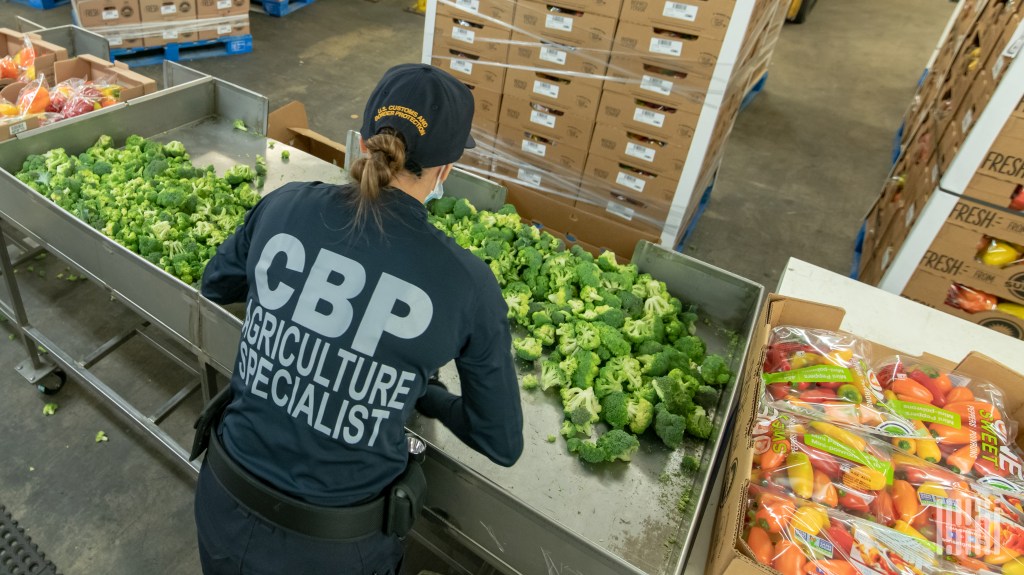
A commercial truck hauling bell peppers crossed into Laredo, Texas, with something else hidden inside the tractor. A U.S. Customs and Border Protection officer selected the Kenworth for further inspection at the World Trade Bridge. A canine team and scanning equipment followed that initial referral. Officers discovered 16 packages containing 37.69 pounds of cocaine, according to the agency.

The July 20 discovery involved a 31-year-old Mexican man driving a 2017 Kenworth. Federal authorities arrested the driver following the inspection. CBP also seized the narcotics and tractor connected with the incident. Homeland Security Investigations opened an investigation into the case.

Second seizure pushes value above $1 million

Two days later, another cocaine seizure occurred at a different Laredo, Texas, border crossing. An officer referred a 2018 Kia Sportage for secondary examination at the Juarez-Lincoln Bridge. A canine and non-intrusive inspection system assisted with that search. Personnel located 22 packages containing 50.37 pounds of cocaine inside the vehicle.

The second incident involved a 37-year-old female Mexican citizen. Federal authorities arrested her following the July 22 discovery. Together, both cases produced 88.06 pounds of seized cocaine. CBP placed the combined street value at $1,175,967.

Port Director Alberto Flores credited officers, technology and canine teams with helping stop the narcotics. He described both discoveries as examples of continued enforcement at the Laredo Port of Entry.

“These significant seizures underscore the dedication and vigilance of our CBP officers in preventing dangerous narcotics from entering our country,” Alberto Flores.

Commercial freight becomes part of investigation

The first case placed an otherwise ordinary produce shipment at the center of a federal drug investigation. Bell peppers moved aboard the trailer while cocaine traveled within the tractor, according to CBP. Authorities did not identify the carrier, shipper, consignee or load origin in their announcement. The agency also provided no information indicating those parties knew about the concealed narcotics.

CBP seized one vehicle, the commercial tractor and all drugs recovered during both encounters. HSI special agents continue investigating the incidents. The federal announcement did not identify either arrested driver by name. Authorities also did not announce criminal charges within the August 5 release. FreightWaves contacted CBP for additional details about the commercial vehicle and whether the two seizures were connected. The agency did not respond before publication.

Why it matters

Commercial freight can become part of a criminal investigation even when legitimate cargo fills the trailer. This case shows why transportation companies need consistent verification around drivers, equipment, routes and cross-border movements.

Click here for more articles on cargo theft and freight fraud by Phil Brink.

Stolen trailer investigation leads police to nearly $800K in cargo and vehicles – FreightWaves

Police: Little Debbie snack fraud scheme involved deliveries that never happened – FreightWaves

CargoNet reports $304.6M in losses, Scott Cornell says Q2 theft drop is no trend yet – FreightWaves

Lawmakers want Postal Service bonuses tied to delivery performance

A USPS mail truck is parked on a residential street with a person standing beside it.

A bipartisan bill barring U.S. Postal Service executives from receiving bonuses until on-time mail delivery levels reach 95% was approved by the Senate Homeland Security and Governmental Affairs Committee last week and could be considered by the full chamber when it returns to work next month.

Before the vote, Postmaster General David Steiner urged senators to reject the bill, saying in a private letter to the committee that freezing bonuses would be counterproductive.

The entire Alabama delegation in the House in late July introduced legislation that ties the postmaster general’s compensation to the Postal Service’s mail delivery and financial performance. 

The No Bonuses for Bad Service Act, sponsored by Sens. Josh Hawley, R-Missouri, and Richard Blumenthal, D-Connecticut, would prohibit the USPS Board of Governors from approving any additional compensation for the postmaster general and his deputy for a fiscal year in which the Postal Service doesn’t meet or exceed the an on-time delivery rate of 95% for all First-class and standard mail.

The Postal Service says it has seen steady improvement in service since aligning staffing to workflow, addressing process improvements and retraining at the facility level, and taking other measures in 2025. A renewed focus on reliability coincided with a reorganization of the regional transportation network, which required loosening of some delivery standards in rural areas and led some to complain of slower mail delivery.

Postmaster General David Steiner said Friday, during a board of governors’ meeting, his organization has increased service performance by better leveraging the network.

On-time mail performance continues to slip. The Postal Service missed its on-time target for all eight mail delivery categories, none of which hit the 95% threshold, in fiscal year 2025, according to the agency’s annual report. It delivered 72.7% of single-piece First-class mail, scheduled for three-to-five day delivery on-time. Marketing mail and periodicals, as well as pre-sort First-Class overnight mail had a 93% score.

In fiscal year 2022, the USPS delivered 91% of First-class mail on time and delivered 93.3% of marketing mail on time, according to a progress report on the agency’s 10-year restructuring and modernization plan.

During the third quarter, ended June 30, 15.7 billion of 16.8 billion letters and flat mail met service standards, adjusted for bad weather and wildfires outside the agency’s control, management reported at Friday’s board meeting. Of 6.8 billion First-class pieces, 6.2 met service standards. The carrier delivered 91.31% of all First-class mail on time compared to 90.6% on time in the prior fiscal year. The average number of days for First-class mail delivery was 2.3 days vs. 2.6 days in the same period last year. Removing the impact of non-controllable events, the USPS delivered 91.3% of all mail on time.

Frustration with late deliveries has mounted along with negative cash flow. The Postal Service has lost $25 billion over the last three years. On Friday, the mail carrier reported a $2.5 billion loss for the third quarter, down from a $3.1 billion loss the prior year. 

Sen. Hawley has been especially aggressive complaining about late mail, taking up the cause for rural citizens who say years of delays and missing mail are creating a financial burden when they don’t receive their bills or paychecks, and jeopardizing their health when prescription medicines are late. In April, a large pile of undelivered mail was discovered in a vacant lot near St. Louis, with many postmarks indicating letters were only going across town, not cross country. 

Hawley challenged Steiner at a June 24 hearing to explain why postmaster generals have received more than $2 million in bonuses over the past 10 years, as delivery and financial performance declined. Steiner, who took office a year ago, has already received a $170,000 bonus.

“Your targets for on time delivery in my state, which were not good to begin with, are just in the 90s, meaning you could miss it 10% of the time and give yourself an A grade. But start looking there in 2024, 2025. You’re hitting your on time delivery targets 76% of the time — maybe. That means fully a quarter of the time, best case scenario, people’s mail in my state is not being delivered to them on time,” Hawley said.

Steiner said those metrics are unacceptable, but countered that the postal operator is producing better service results nationwide.

Hawley has launched an investigation into the systemic delivery failures and abandoned mail in Missouri, suggesting some of the problems could be the result of criminal activity. 

An audit last year by the U.S. Postal Service’s Office of Inspector General found more than 2.5 million delayed mailpieces at the St. Louis Processing and Distribution Center — the largest delayed mail volume ever recorded since it began conducting field operations reviews in 2021. The report blamed systemic issues affecting package scanning, inadequate reporting of delayed mail incidents, and understaffing that caused mail from commercial mailers to not be sorted to the correct route at two processing plants and seven delivery units in the St. Louis area.

Another recent audit for Kansas City found that there were nearly 100,000 delayed pieces of mail over a three-day inspection. 

An October analysis by Postal, a virtual mailbox and compliance service, showed more than 542,000 pieces of mail were reported lost or missing between 2022 and 2024. More than 150,000 reports involved mail going missing “after delivery, nearly 350 incidents per day, suggesting a prevalence of porch piracy.

Steiner tried to head off the anti-bonus bill. “I was fortunate enough to be quite successful in my career in the private sector, so any compensation action you take against me will have little effect,”  but will limit the Postal Service’s ability to attract qualified executives in the future, he wrote in a July 31 letter obtained, and first reported by Axios.

“Picking any single performance metric to punish management would constitute Congress elevating achievement of that metric at the expense of other important metrics. In order to achieve our mandates of providing reliable service in an efficient and cost-effective manner, we must necessarily balance service and cost considerations. In this case service performance is singled out, which would have the near inevitable impact of increasing costs because almost any action to improve service comes with added cost — increasing transportation, work hours, equipment, and people,” Steiner wrote. 

“I would also note that management has a sharp focus on improving service, so the bill is completely unnecessary: our service ‘scores have improved and will continue to improve, and service is already a part of every manager’s annual goals. That said, we are acting prudently to improve service as we leverage the opportunities presented by our new network to not only enhance service reliability, but also our operational precision and efficiency, a process that necessarily takes time,” he explained.

Companion House bill

The PERFORM Act in the House would prohibit a performance-based bonus for the postmaster general if, during the preceding fiscal year, the Postal Service fails to meet nationwide service performance targets, reports a net loss, or receives an adverse opinion or disclaimer in its financial audit.

“The American people don’t get bonuses for failure, and neither should the Postmaster General. The PERFORM Act ends the practice of rewarding poor performance and makes clear that leadership must earn incentive pay by delivering results – not excuses,” said Rep. Dale Strong, R-Alabama, in a news release announcing the proposal.

“If the U.S. Postal Service were a private sector operation, it would have filed for bankruptcy years ago. Further, if a CEO’s tenure saw an average annual net loss of $10 billion while service standards continued to decline, company leadership would be standing in the unemployment line —  not collecting performance bonuses,” Strong added.

Click here for more FreightWaves/American Shipper stories by Eric Kulisch.

Write to Eric Kulisch at ekulisch@freightwaves.com.

New parcel surcharge helps Postal Service reach $20B in revenue

Senate Zip code changes would cause ‘irreparable harm,” postal chief says