Trucking industry stakeholders square off over CDL test flexibility

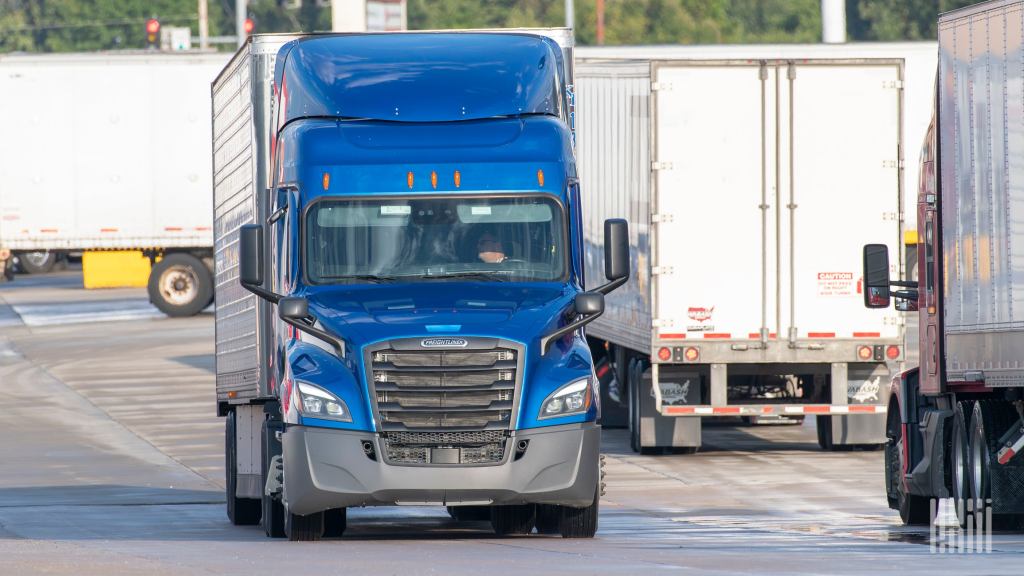
truck in parking lot

WASHINGTON — Regulators received heavy opposition from truck owner-operators and safety advocates on a proposal aimed at making it easier to test and employ new drivers.

The Federal Motor Carrier Safety Administration’s proposed rule, “Increased Flexibility for Testing and for Drivers after Passing the Skills Test,” would loosen current CDL testing regulations by:

  • Allowing commercial learner’s permit (CLP) holders who have passed the CDL skills test to operate a truck without having a CDL holder in the passenger seat.
  • Expanding CDL applicants’ ability to take a skills test in a state other than the state in which they live.
  • Eliminating the requirement that an applicant wait at least 14 days after being issued a CLP to take the CDL skills test.

The proposed changes, which FMCSA published for comment in February, stem from temporary waivers and exemptions issued by FMCSA during and after the pandemic, as well as a petition filed by the American Trucking Associations in 2020. The public comment period ended April 2.

In pushing for the changes, ATA said it considers a streamlined CDL testing process a way to attract more drivers.

“If the industry and broader supply chain doesn’t effectively address the driver shortage, it could reach 160,000 drivers by 2030,” stated ATA’s safety policy director, Brenna Lyles, in comments submitted on the proposed rule.

“Over one million new drivers will be needed to keep up with industry demands and growth alongside driver outflows. ATA believes any reductions in regulatory barriers in the CDL testing and issuance process that encourage and allow new individuals to enter the driving workforce more quickly are urgently needed to fill this critical gap.”

Werner Enterprises said allowing CLP holders to drive while a CDL holder rests in the sleeper berth — as opposed to requiring the CDL holder to observe the CLP driver from the passenger seat — expands team-driving opportunities and will “promote greater productivity and efficiency in freight operations, while helping recruit qualified drivers to timely and safely enter the workforce.”

The Commercial Vehicle Training Association (CVTA), which represents CDL training schools and supports the changes, contends that the revisions to shorten wait times related to license processing and to expand where applicants can take their skills test would reduce costs and bolster tax revenue.

Delays associated with wait-time and test-location requirements “put jobs on hold for 258,744 drivers and resulted in over $1 billion in lost wages for these drivers,” commented CVTA Chairman Danny Bradford, citing data from 2016.

“As a result, federal and state governments missed out on an estimated $234 million in forgone income taxes and $108 million in forgone state and local sales taxes that could have been generated in the absence of skills testing delays.”

Safety taking a back seat?

But owner-operators and safety advocates assert that streamlining CDL testing regulations weakens safety objectives that FMCSA should be promoting.

Regarding allowing CDL holders to rest in the sleeper berth instead of overseeing the learner’s permit holder, FMCSA “fails to explain how the CLP holder will be adequately mentored,” commented Todd Spencer, president and CEO of the Owner-Operator Independent Drivers Association.

“Given the minimum nature of current entry-level driver training (ELDT) standards, inexperienced drivers will face countless conditions, scenarios, and other challenges they had absolutely no training for during their first months and even years on the road. Eliminating [the CDL holder/passenger seat requirement] ignores the fact that well-trained, more experienced drivers have better safety records and can pass their knowledge along to less seasoned drivers.”

Spencer also pointed out that because FMCSA’s ELDT rule, which went into effect in 2022, does not require a minimum number of behind-the-wheel hours, the agency “should not weaken training opportunities by eliminating the 14-day waiting period for CLP holders to take the CDL skills test absent other appropriate agency actions.”

Peter Kurdock, general counsel for Advocates for Highway and Auto Safety, said FMCSA includes no data or analysis in the proposed rule to support the assumption that CDL applicants are being forced to wait long periods to schedule a skills test.

Instead, by allowing a state to administer a skills test to any out-of-state CDL applicant regardless of where the applicant received driver training, it increases the potential for skills test “shopping,” Kurdock argued.

“CDL applicants would be allowed to choose any state in which to test, including those that could be believed or demonstrated to be ‘easier’ or less stringent,” Kurdock stated in comments to FMCSA.

“Moreover, an extensive investigation published by The Boston Globe … revealed the chronic failings by FMCSA to properly oversee and regulate unsafe carriers and drivers. Therefore, it is unlikely that FMCSA would be able to provide adequate oversight of a less rigorous testing regimen that has fewer protocols in place to prevent unqualified individuals from operating CMVs.”

Click for more FreightWaves articles by John Gallagher.

Court upholds EPA’s ability to grant environmental waivers to California

The ability of California to set its own, more stringent environmental and emissions standards — the basis for the state’s Advanced Clean Trucks rule and possibly its Advanced Clean Fleets rule — was upheld Tuesday by the U.S. Court of Appeals for the District of Columbia Circuit.

The case, Ohio vs. EPA, had a plethora of plaintiffs, including 16 states besides Ohio and a group of petroleum-focused trade groups such as the American Fuel & Petrochemical Manufacturers and the National Association of Convenience Stores.

Friend-of-the-court briefs from the trucking industry included filings from the Owner-Operator Independent Drivers Association and the Western States Trucking Association (WSTA). The 17 states that were plaintiffs in the case are Republican-dominated.

At issue is a waiver granted to California to implement its Advanced Clean Cars rule. The request was first made to the Environmental Protection Agency in 2005, and Tuesday’s court decision reviews the back-and-forth of waiver refusals followed by approvals, depending on which party was in the White House. The pingpong ball ultimately landed on the waiver’s being granted by the Biden administration; that led to the suit’s being filed in 2022.

The states that are suing “claim that by granting a waiver to California alone, the EPA violated a constitutional requirement that the federal government treat states equally in terms of their sovereign authority,” the court wrote, summing up the basic argument.

But the “fuel petitioners,” as the court refers to the trade groups, lack standing “to raise their statutory claim.” And the states lack standing to raise a “preemption claim,” the court said, noting that although both groups of plaintiffs sought to restrict or limit the granting of waivers to California so it can impose stiffer environmental regulations than those imposed by the federal government, they were coming at it from different arguments.

The court ruled that the states had standing to present a constitutional challenge to the EPA waiver but rejected their argument that the Constitution would not permit a waiver to be granted to a single state.

“The federal regulations continue to act as the floor for emissions regulations, but California can seek to enact its own more stringent regulatory program above those federal requirements,” the court said. It noted that there are limitations to what the state can do but said they were not exceeded by California’s Advanced Clean Cars rule.

For their part, the trade groups argued the waiver injures them economically because of the zero-emission and low-emission mandates in the state’s Clean Car Act. But the court said the fuel petitioners and the states came up short in showing how a decision by the appeals court blocking the waiver would “redress” the harm they say will result from the California law.

In a statement issued after the release of the decision, the Environmental Defense Fund said California has received more than 75 waivers from the EPA over 57 years.

Impact on Clean Trucks and Clean Fleets rules

The decision could impact the trucking industry in the state through any potential effect on California’s two key regulations on the sector.

California’s Advanced Clean Trucks rule, targeted at companies that build and sell trucks into California, has received a waiver from the EPA. A challenge to it by the WSTA was put on hold in late 2023 by the same court that ruled on Ohio vs. EPA while the outcome of the current case made its way through the courts. The court also said late last year in putting the WSTA case on hold that it was waiting for resolution of a similar case, Texas vs. EPA, which was argued before a different panel of the same court and still awaits a ruling.

The state approved the Advanced Clean Fleets rule — which is aimed at fleet truck purchases to complement the mandates for OEMs in the Clean Trucks rule — without an EPA waiver, claiming it did not need one. But after the California Trucking Association filed suit against the Clean Fleets rule, the state did request a waiver from the EPA that so far has not been granted. 

The California Air Resources Board also put on hold various provisions of the law that were to kick in Jan. 1, including a ban on registering any internal combustion engine drayage trucks with the state’s drayage registry. Despite that, there has been a modest increase in zero-emission vehicles servicing the port of Long Beach.

More articles by John Kingston

Rerouting trucks and ships away from Baltimore: What early data shows

Teamsters, Anheuser Busch reach new 5-year contract

A first for Werner: Small group of workers votes to unionize

Check Call: Baltimore mounts a comeback

people gathered around a desk of computers. Check Call news and analysis for 3pls and brokers

In this edition: The aftermath of the Francis Scott Key Bridge destruction, and UPS and the U.S. Postal Service form a partnership. 

GIF: GIPHY

In the collision heard round the world, the Dali struck the Francis Scott Key Bridge in Baltimore. Two weeks after the collision happened, a lot is still unknown, but the cleanup and rebuilding process is off to a strong start. The crane of all cranes has been brought out to aid in the cleanup so that ships may soon make port in Baltimore. As for when that day comes, well, it might be a few weeks off as ships can’t maneuver around the wreckage.

For now those ships that were bound for the Port of Baltimore have been rerouted to other East Coast ports. Which ones have picked up the most of the volume has yet to be seen. Gautam Jain, the CEO of India-based logistics management platform GoComet, said in an article by FreightWaves’ John Kingston that “Easter may be a part of that. Easter season is over now so after a few weeks volumes will grow and then we have to see where the vessels are being diverted.”

The article adds that some shippers don’t know the status of their goods exported to the U.S. and bound for Baltimore. “So suddenly the shippers who were expecting their shipments to arrive at an inland port have to arrange for truckers at the ports of New York, Norfolk or Savannah,” Jain said. “So this is causing a lot of issues.”

Good news comes in the way of a Federal Motor Carrier Safety Administration hours-of-service waiver. The new waiver adds two hours to the allowed hours of daily driving, making it 13 hours of driving in a 14-hour on-duty limit. The two-hour extension will apply to “commodities rerouted from the port of Baltimore.” But the definition of commodities is broad. It includes most of the key products that had been regularly imported into Baltimore: shipping containers (though Baltimore is a relatively small intermodal port), fuel, and most importantly automobiles and other “roll-on/roll-off” commodities such as farm equipment.

As for the new container fees for dwell times at ports, turns out everyone is bracing for a fight in that arena as well. Carl Bentzel, a member of the Federal Maritime Commission, said in an article by FreightWaves’ John Gallager, “Carriers may deviate to another port where there aren’t as many chassis available, as was the case in Baltimore, so you could have issues on pickup and return of empty containers. These dislocations could result in problems with detention and demurrage. There will be lots of work for the FMC, unfortunately.”

The one commonality is that everything is still very much up in the air and everyone is scrambling to keep goods moving and service customers. As for the future of the bridge? President Joe Biden has said the federal government will step in to rebuild the bridge to protect the jobs impacted by this accident. The insurance payout from the Dali might take awhile, and the bridge can’t wait until that claim is settled.

Also, in case you want a comprehensive breakdown of what went wrong on the cargo ship, this video has one of the best breakdowns I’ve seen.  

SONAR TRAC Market Dashboard

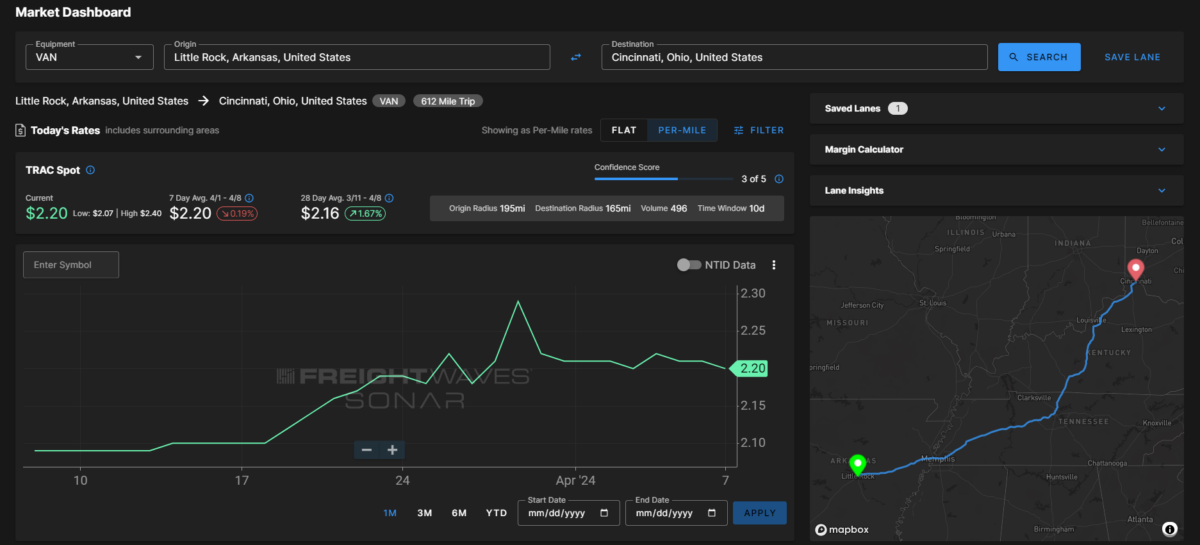
TRAC Tuesday. This week’s TRAC lane is from Little Rock, Arkansas, to Cincinnati. This 612-mile trip has seen some higher-than-average spot rates over the past month. Spot rates are up about 10 cents per mile compared to a few weeks ago. Outbound tender rejections in Little Rock have fallen from 8.01% to 2.96% in the past seven days, which is a 334-basis-point decrease week over week. Cincinnati, on the other hand, has rejections that have fallen from 5.74% to 5.14%, a much smaller 112-basis-point drop w/w. Both markets’ showing falling OTRI levels does explain the decreasing spot rates, as April is well underway.

GIF: GIPHY

Who’s with whom? The small parcel world is made up of essentially three major players: UPS, FedEx and the U.S. Postal Service. Previously the Postal Service was working with FedEx for domestic air transport. But after more than 20 years, the post office has awarded the airfreight business to UPS. While this might seem like a bad day to be FedEx, this deal actually works out for everyone.

FedEx was struggling to run the air mail profitably, but the $1.5 billion-per-year contract should, in theory, help UPS run the goods at a profit. All three organizations are going through massive overhauls. FedEx is looking to shrink its large air network, which, now that the post office contract is gone, should allow the company to do just that.

Satish Jindel, president of parcel shipping consultancy ShipMatrix, said in an article by FreightWaves’ John Kingston that “UPS has been running an integrated air and ground network for over 25 to 30 years. I don’t see them having to add any extra airplanes. So it helps them offset that fixed cost and spread that over another base of packages.”

The more you know 

Weak market or not, truck transportation jobs saw healthy jump in March

Fuel costs show why transportation market is so challenging for providers

Dali owner, manager seek to cap liability in Baltimore bridge collapse

Teamsters out at Southern California trucking company; other votes mixed

Norfolk Southern to pay $600M in Ohio train derailment lawsuit

Minnesota man pleads guilty to embezzling $1.3M from truck dealer

A Minnesota man has pleaded guilty in federal court to embezzling more than $1.3 million from his employer, I-State Truck Centers, in a multiyear scheme. 

Leon Arthur Keener, 55, of Hugo, pleaded guilty last Wednesday in the U.S. District Court for the District of Minnesota to mail fraud after he used his position as manager from 2015 through 2022 to pocket company money. Keener began working for the Minneapolis-based truck dealer and repair shop in 2011, court documents say. 

While working at the Inver Grove Heights location as the body shop and service manager, Keener had the authority to write off repair costs not covered by insurance and to create purchase orders. He misappropriated more than $562,000 in reimbursement checks intended to cover repairs to vehicles and said insurance companies refused to pay the cost, requiring I-State to absorb the loss.

Keener also submitted more than $750,000 in fake vendor requests and swiped the money. He created a shell company called CR Services, which he set up as an approved vendor for I-State, and used the mail to facilitate the fake vendor payments.

The scheme was successful because Keener made fake vendor payments for items such as paint and vehicle repair parts that were difficult to track or inventory. He also falsified records and kept other I-State employees from being involved in the approval process, court records say.

He spent the stolen cash on luxury cars, a boat and a gambling trip to Las Vegas, according to the plea agreement.

Keener hasn’t yet been sentenced.

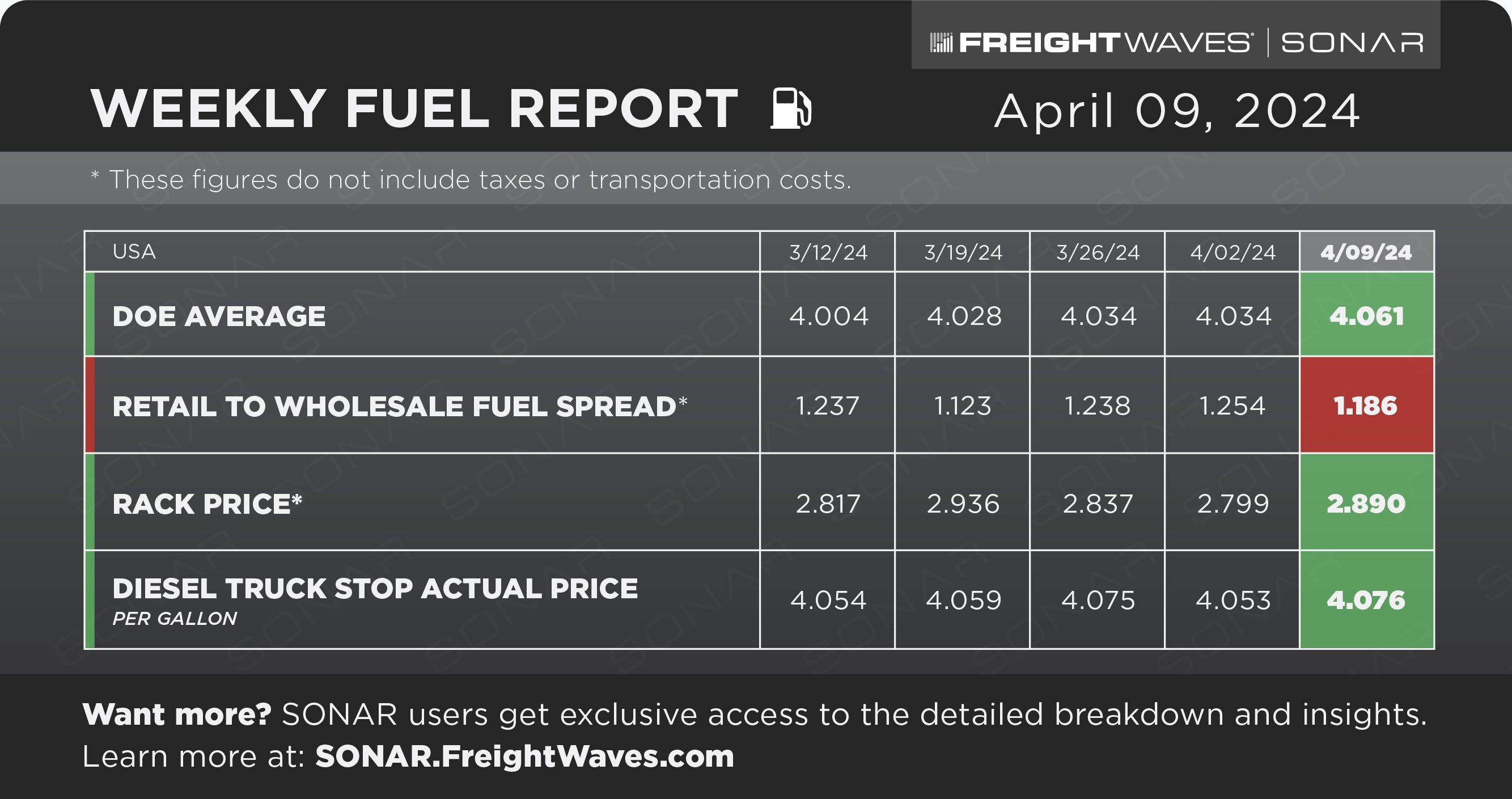
Weekly Fuel Report: April 09, 2024


Learn more at SONAR.FreightWaves.com

How shipping document automation drives profitability

A white semi-truck is traveling down a road with a blue sky in the background.

Over the past several years, the logistics industry has been propelled into the digital age by a powerful combination of consumer expectations, government regulations and technological innovations. Some companies have been eager to adopt these tools, while others remain skeptical about the benefits, effort — and risks — associated with new technologies.

Despite the myriad of high-tech solutions that have been introduced to the logistics industry — from instant load booking to real-time shipment tracking — there have been few holistic updates to the way that shipping documentation is processed.

Both logistics industry leaders and government representatives tend to champion the shift to electronic shipping documents and the use of AI, pointing to opportunities for significant financial gain and more transparent supply chains. This favorable perception has not yet translated into widespread adoption, however.

Research from the International Chamber of Commerce and World Trade Organization revealed that only about 1% of the dozens of documents exchanged during the course of an international shipment are fully digitized. This means that virtually all companies in the global shipping markets still rely heavily on paper-based shipping documents.
Processing paper documents is not only time-consuming, it also creates an environment rife with human error. This process often stalls shipments, causing delivery delays and leading to exorbitant fees. 

Beyond the shipment-level impact, sticking to paper documents prevents transportation and logistics providers from realizing the full potential of artificial intelligence solutions, predictive analytics and machine learning to better understand their processes, eliminate bottlenecks, optimize delivery and provide exceptional service to their customers. This keeps companies trapped in the past.
Achieving universal adoption of fully electronic trade documentation worldwide will take time, but forward-thinking companies do not need to wait around for their less tech-savvy counterparts. They can leverage intelligent document processing and automation today in order to seize opportunities and secure a competitive edge in a swiftly evolving shipping landscape.

How intelligent document processing (IDP) contributes to operational resilience


By automating the extraction, processing and analysis of shipping documents, emerging technology ushers in a new era of operational resilience. It minimizes manual errors, reduces processing times, and ensures consistent and accurate data handling. In an industry where time is of the essence, the precision of AI-driven IDP elevates efficiency to new heights, ensuring a robust operational foundation.

Applying AI-powered IDP means:

  • Utilizing skilled resources for higher-value tasks than data keying.
  • Staying clear of liabilities and delays at customs clearance.
  • Processing orders faster and getting goods to the customer in time.
  • Serving more customers faster.
  • Getting the right data into the right system without human intervention.
  • Unveiling trends and bottlenecks and identifying opportunities to improve.
  • Initiating the billing process while the driver is still on the road.
  • Providing end-to-end transparency and traceability of deliveries.

Getting results from the beginning

Purpose-built, pre-trained AI models can be designed to understand the complexity of shipping documents — including commercial invoices, arrival notices, packing lists, waybills and bills of lading, certificates, and delivery notes. This is the key to seeing an immediate return on investment.

A purpose-built  IDP platform, such as ABBYY Vantage, understands shipping documents and extracts data from even the most challenging forms with minimal setup and stand-out straight-through processing rates. With ABBYY, human-in-the-loop (HITL) manual review is now reserved for exceptions only.

Agility and adaptability


The landscape of global trade is in constant flux, demanding adaptability at every turn. A low-code IDP platform offers this agility by swiftly adjusting to changing regulations, document formats and compliance standards. Developers are in control of the automation and can immediately react to industry dynamics, effortlessly incorporating updates and alterations.

This agility allows logistics companies to stay ahead of the curve, adapting swiftly to regulatory shifts, market fluctuations and customer demands, while maintaining compliance and operational fluidity.

Additionally, ABBYY’s platform is plug-and-play for most users, seamlessly working with transportation management, customs filing and warehouse management systems. This makes adoption low-stress and accessible.

Customer satisfaction through expedited processes

In a customer-centric industry, swift and error-free documentation translates into enhanced customer satisfaction. Mobile capture — on the road, in the truck cabin or at the dock — paired with highly accurate IDP expedites the documentation process, reducing turnaround times for shipments and ensuring accuracy.

Delays due to paperwork and errors can become a problem of the past, fostering trust and loyalty among clients. The ability to provide real-time updates on shipment status adds a layer of transparency, further elevating customer satisfaction.

The integration of highly optimized, AI-driven IDP software into the transportation and logistics industry is not merely a technological upgrade; it is a catalyst for transforming business outcomes. Embracing this technology is a strategic imperative for companies aspiring to thrive in a landscape where efficiency and adaptability are key.

AI hype vs. reality 

AI has dominated much of the innovation conversation in recent years. Despite the increased attention, however, many logistics companies remain hesitant to adopt emerging technologies that utilize AI.

This hesitancy is likely rooted in a combination of skepticism and fear. Industry leaders view promises of skyrocketing efficiency as “too good to be true” while simultaneously worrying about the impact AI could have on human workers.

Companies on the leading edge of adoption — like those partnering with ABBYY — have seen the benefits of AI firsthand. The reality is that modern technology not only lives up to the hype in terms of operational gains, it also strengthens human employees instead of undercutting their importance.

Industry use cases for AI and IDP

Customs clearance — CustomsTrack and Portumna Pastry

Ireland-based pastry supplier Portumna Pastry was regularly experiencing significant customs clearance delays following Brexit.

ABBYY utilized its IDP solution to help CustomsTrack and Portumna Pastry automate the customs declaration process and reduce clearance time by more than 90%. After partnering with ABBYY, CustomsTrack saw average customs clearance time drop from one hour to five minutes. 

AP automation — DHL

DHL is the world’s leading logistics provider, generating over $89 billion in revenue in 2023. Despite the company’s size, it has historically treated invoice processing as a largely manual process. This required dedicating dozens of employees to simply processing invoices.

In 2021, DHL partnered with ABBYY to roll out intelligent automation solutions across several departments, resulting in a 70% increase in overall efficiency. The company was able to automatically process thousands of invoices from over 120 vendors, reducing errors and increasing productivity. 

Order processing and delivery — Carlsberg

Carlsberg is one of the world’s leading brewery groups. A couple years ago, the company saw a need to overhaul its order processing and delivery model in order to accelerate its time to market and improve customer satisfaction.

Before partnering with ABBYY in 2022, Carlsberg often received orders via email. The company then relied on employees to manually enter this order information into its system, leading to delays and errors. The company’s delivery registration process also relied on manual inputs from employees.

Carlsberg was able to cut out these manual tasks by integrating ABBYY’s IDP solutions, achieving a touchless order processing rate of 92% and saving its employees a combined 140-plus hours per month.

Freight audit and payment — AFS

AFS is a leader in transportation cost management. As a result, the company processes over 70,000,000 invoices each year for customers. AFS has always been tech-savvy, adopting electronic data interchange solutions earlier than much of the industry. Despite this, the company was still manually processing millions of invoices every year before partnering with ABBYY.

AFS has been utilizing ABBYY FlexiCapture since 2014, enabling the company to process invoices in half the time without adding significant head count. Additionally, the solution allows AFS to capture significantly more information than ever, analyzing 46 fields as opposed to only 18.

Customer service — East Midlands Railway

East Midlands Railway receives thousands of emails a day. Historically, the company has handled these messages manually, eating up untold hours of employee time and delaying important responses. To rectify this, ABBYY worked with East Midlands Railway and its partner Engeneum to integrate an email classification system that works without manual input.

Implementing ABBYY’s IDP with advanced classification automated the email process by capturing key data from text on emails and document attachments, which is then automatically routed to the company’s customer relationship management solution. This email solution allows East Midlands Railway to process 65,000 emails each year while saving time, increasing productivity and improving customer service.

Click here to learn more about how ABBYY partners with transportation and logistics companies to future-proof their shipping operations and keep their goods moving via intelligent automation.

Ocean freight rates steady despite Baltimore bridge collapse

The East Coast has navigated recent freight disruptions with grace. But potential headwinds loom later in the year. (Photo: Jim Allen/FreightWaves)

The March 26 collapse of the Francis Scott Key Bridge in Baltimore has significantly disrupted U.S. East Coast supply chains. However, ocean freight container shipping rates have remained relatively stable, according to Xeneta, an ocean freight rate benchmarking and intelligence platform.

Xeneta’s data reveals that average spot rates from the Far East to the East Coast, including Baltimore, have fallen by 1% since the bridge collapse, standing at $5,421 per forty-foot equivalent unit. When considering other U.S. East Coast ports, such as New York/New Jersey, rates from the Far East have decreased by 3% in the same period. Similarly, average spot rates from Northern Europe to the East Coast have fallen by 8% to $2,357 per FEU, with a 4% decrease when including other U.S. East Coast ports.

“Spot rates have not reacted but that doesn’t mean shippers with cargo heading to Baltimore are not affected,” said Peter Sand, chief analyst at Xeneta, in a blog post. “On the contrary they are seeing containers arriving at ports they were not expecting.”

The majority of containers will now be handled at New York/New Jersey, Sand said, as many ships originally bound for Baltimore would have been stopping there anyway. This could be a reason why rates have not significantly increased.

Despite the stability in ocean freight rates, the bridge collapse adds to the numerous challenges shippers face currently, including ongoing diversions in the Red Sea region and drought in the Panama Canal.

Truck rerouting and ship diversions

The logistics industry has quickly adapted to the new reality. Telematics company Trimble reported significant shifts in truck routes around Baltimore, with the Fort McHenry Tunnel on Interstate 95 experiencing the largest diversion. The Baltimore Harbor Tunnel saw less uptake due to its narrower configuration.

While these rerouting efforts demonstrate the industry’s adaptability, they also introduce challenges such as extended travel times and potential bottlenecks. Hazmat transports, in particular, face more pronounced adjustments, with an additional 15 to 20 minutes added to their journeys as they divert to the western side of Baltimore on Interstate 695.

On the maritime front, initial data has not yet revealed significant shifts in ship routing or port calls, according to logistics management platform GoComet. Seasonal variations in maritime shipping further compound the ambiguity about how deep the impact really is.

Impact on East Coast ports and future outlook

The Port of Baltimore issued an update on Friday, stating that it expects to open a 280-foot-wide and 35-foot-deep federal navigation channel by the end of April, followed by the reopening of the permanent 700-foot-wide and 50-foot-deep channel by the end of May, restoring port access to normal capacity.

While this timeline for reopening maritime lanes is welcome news for shippers, Sand believes that importers into the U.S. East Coast could face further disruptions in 2024 due to labor negotiations. The contract between the International Longshoremen’s Association and the United States Maritime Alliance expires Sept. 31, and no new agreement has been reached.

“The threat of labor strikes on the East Coast has the potential to cause far more disruption to ocean freight shipping than the collapse of the Francis Scott Key Bridge,” Sand said.

If the two don’t reach an agreement, there could be significant and widespread disruption at East Coast ports, Sand added, likely leading to increased ocean freight container service rates and potentially prompting some shippers to reroute to the U.S. West Coast or Mexico for imports.

Teamsters out at Southern California trucking company; other votes mixed

The Teamsters have been pushed out from their representation of employees at Dependable Highway Express, an LTL and truckload carrier based in Southern California that’s been in business since 1950.

Rank-and-file workers at Dependable never had an opportunity to vote on rejecting the representation. Instead, employee John Cwiek filed a union decertification petition last month with the National Labor Relations Board asking for a vote that would end the Teamsters’ representation. The number of workers in the union, Teamsters Local 63, was not immediately available.

But before the NLRB could rule on the decertification request, the Teamsters filed a Disclaimer of Interest with the agency, effectively giving up any opportunity to fight the effort and ending the representation.

Like many who have led decertification efforts aimed at the Teamsters and other unions, Cwiek had the backing of the National Right to Work Foundation, which has supported other decertification efforts that have sometimes resulted in Teamsters decertification. 

The decertification vote at Dependable Express is just one of several union representation votes in the past six weeks that in some cases resulted in workers choosing to be represented by a union and in others rejecting representation. The Teamsters won one of those elections and lost another, according to NLRB reports of unionization elections:

  • A small group of drivers at LTL carrier Hot Line Freight Systems’ facility in Milwaukee voted 5-0 on March 21 to be represented by the Teamsters.

Other logistics-focused union representation elections have been mostly losses for organized labor. Per the NLRB, here are some recent election results:

  • An Ohio company, Exel Inc., which does business as DHL Supply Chain, saw a group of workers overwhelmingly reject representation by the United Food and Commercial Workers Union Local 75. There were 183 eligible workers for the March 28 vote; 113 voted against the union.
  • A group of drivers working out of the BNSF terminal in Thayer, Missouri, unanimously voted against representation on March 27. The employer is RailCrew Express LLC. The union seeking to represent them was the International Association of Machinists and Aerospace Workers.

What’s notable about the votes is how many representation elections deal with such a small number of workers. While the Exel vote had 183 eligible voters, the Teamsters win at Hot Line Freight Systems in Milwaukee had five.

A spokeswoman for the Teamsters declined comment on the Dependable Highway vote.

Although the size of the workforce represented by the Teamsters at Dependable was not immediately available, a statement released by the National Right to Work Foundation said the petition to the NLRB organized by Cwiek had signatures from about two-thirds of the employees. Signatures totaling 30% of the workforce are needed for the NLRB to declare a decertification vote.

The statement by the foundation recapped conflict between the union and Cwiek. “Teamsters union officials stirred tension in the workplace by threatening Cwiek, who in January sent letters to his coworkers containing publicly-available Department of Labor data on Teamsters bosses’ salaries,” the foundation said. “In retaliation for Cwiek sending the letters, a union official appeared at Cwiek’s workplace the next day, made accusations against him, and threatened that Cwiek wouldn’t be working at Dependable Highway Express by the next contract period.”

That letter that had the pay levels of some Teamsters officials said the current three-year contract at Dependable was set to expire May 31.

More articles by John Kingston

Teamsters, Anheuser Busch reach new 5-year contract

A first for Werner: Small group of workers votes to unionize

Teamsters celebrate NLRB decision on STG Logistics, see path to greater unionization

Norfolk Southern to pay $600M in Ohio train derailment lawsuit

Norfolk Southern announced Tuesday that it has agreed to pay $600 million to settle a class-action lawsuit after a 2023 train derailment in East Palestine, Ohio, caused a fire and spilled chemicals.

The agreement, if approved by a court, will resolve all class-action claims within a 20-mile radius of the derailment site and personal injury claims within 10 miles of the site, a news release from the railroad said. The company said the settlement is not an admission of liability or wrongdoing.

In February 2023, a Norfolk Southern train derailed in East Palestine, a village near the Pennsylvania border that is home to about 4,800 people. Thirty-eight of the general merchandise train’s railcars, including 11 tank cars carrying hazardous chemicals that caught fire, derailed, a preliminary National Transportation Safety Board investigation found. Up to 2,000 residents were evacuated.

“This resolution comes shortly after the one-year anniversary of the disaster and will provide substantial compensation to all affected residents, property owners, employees and businesses residing, owning or otherwise having a legal interest in property, working, owning or operating a business for damages resulting from the derailment and release of chemicals,” attorneys for plaintiffs said in a statement.

Hazardous substances including vinyl chloride, phosgene and hydrogen chloride were released, the Environmental Protection Agency reported. Despite residents’ fears of long-term health issues, the EPA didn’t declare a public health emergency. No deaths or injuries were reported.

Norfolk Southern has also paid $104 million in community assistance to East Palestine and the surrounding areas, including $25 million for a regional safety training center, $25 million for East Palestine park improvements, $21 million to residents and $9 million to first responders. 
The NTSB plans to release its final findings on the derailment this summer. The agency has said an overheating wheel bearing on one of the railcars likely caused the crash.

Flow of trade always prevails

In the world of news, disasters and wars garner headlines for a while, which fuels anxiety and, as a result, increases supply chain uncertainty and freight rates. But after a certain point, once the news cycle exhausts the angles and the disruption is part of the norm, it becomes part of the background noise. Society moves on and the world of logistics provides certainty in the continuous movement of trade and the new norm. This takes time, but in the end the agnostic flow of trade does, and will, prevail.

Companies’ logistics decision-makers have faced unprecedented hairballs in the pipes of trade since COVID. These new supply chain challenges are both man-made (war and the numerous labor strifes and strikes), and natural (Mother Nature’s logistical smack down on the Panama Canal). The pipes of the supply chain are connected, and the ripple effects of these supply chain shocks are felt throughout as world logistics decision-makers try to find the easiest way to move. Just when logistics managers thought a Suez Canal diversion would be an answer to the Panama Canal, Hamas started to attack the freedom of navigation in the Red Sea. Challenges can create opportunity. Innovation in services and customer relations will separate the winners and losers. In the TEU battle, it boils down to service.

The pivoting needed to effectively manage the changing logistical infrastructure is trial and error. You saw this in real time with the ocean carriers deciding on diversions in the Red Sea. Some were more indecisive than others. The pingponging of the if-they/will-they only added to the uncertainty. Now that the Cape of Good Hope trade route is established, the planning of a longer transit has been baked into the supply chain and prices have gone down.

Trade has settled into a new rhythm and the predictability and flexibility of the logistical supply chain only reinforce the fact that the participants in trade will find a way. According to the latest data by Sea-Intelligence, the normalcy was evident in the February 2024 global schedule reliability score. It improved by 1.7 percentage points M/M to 53.3%.

“The average delay for late vessel arrivals also improved to 5.46 days, roughly the same level as pre-crisis, which means that the increase due to the crisis has reverted,” said Alan Murphy, CEO, Sea-Intelligence.

But when you review the flow of trade versus last year, the disruption is still there. We are now just going with the flow. Schedule reliability is 6.9 percentage points lower. Hapag-Lloyd, one of the earliest carriers to announce diversions, had the best reliability of 54.9%. On a month-to-month-improvement basis, Hapag-Lloyd’s schedule reliability rose by 9.7%.

The recent deadly disaster at the Port of Baltimore is the latest trade/supply chain obstacle to grab headlines and generate outrage and uncertainty. But after a solid week of news coverage coupled with the vessel diversions and new rail services moving the diverted containers, this tragedy and the aftermath of the bridge destruction have become part of the everyday noise. Now we watch to see whether the harbor reopening will happen on the timeline promised. The swiftness of the CSX/Ports America service to move the diverted containers from New York/New Jersey to Baltimore is an example. See what assets you have and what you can do to address a problem with those assets.

The lesson we have learned since COVID is the simple fact that trade takes people, and participants in trade will always find a way to keep freight moving. What needs to be highlighted is that even when the supply chain fades from the headlines, that does not mean the hard work to sustain that resiliency has disappeared.