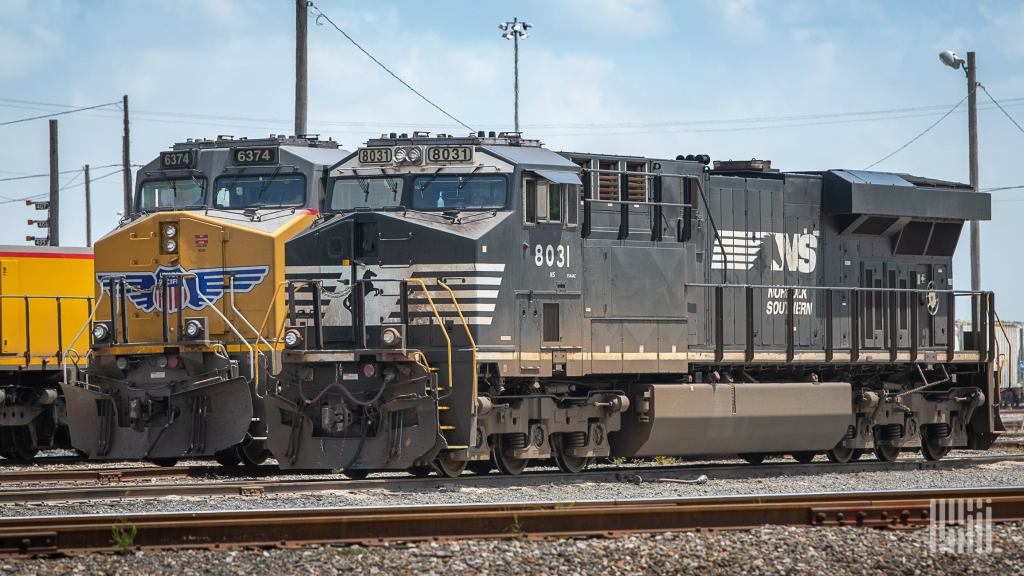
Amid debate over rail safety concerns, another Norfolk Southern train derails

Editor’s note: This story has been updated to include a statement from Norfolk Southern.

With a Norfolk Southern derailment in Pennsylvania on Saturday that sent diesel fuel into a Lehigh Valley River, the already heated battle over control of the railroad with safety issues as a backdrop got even hotter. 

The derailment came after two days of charges, countercharges and missives flying back and forth over the safety records of both Norfolk Southern and Union Pacific, with leading government officials that regulate the rails leveling separate heavy criticism at the two companies. 

And while it hasn’t yet provoked any government response, the issue of safety and levels of employment could also be triggered by Friday’s news that BNSF had implemented a significant number of furloughs. 

In the proxy battle roiling Norfolk Southern, the activist investor group Ancora is recommending the replacement of eight new directors to the Norfolk Southern board. It also wants to replace CEO Alan Shaw with former UPS executive Jim Barber and name Jamie Boychuk, a former executive at CSX, to replace current COO Paul Duncan.

That fight now has the Pennsylvania derailment as part of the battle, and Ancora wasted no time Saturday coming out with a statement over the incident.

“Our proposed slate and management team are unanimous in their view that Norfolk Southern must become a safer and more reliable railroad before it can ever reach its full potential,” Ancora said in the statement. “Following this latest derailment, we call for the immediate termination of CEO Alan Shaw and stand ready to engage with the Company about an orderly reconstitution of the Board and a transition to capable management with a track record of actually delivering on safety commitments.”

The statement went on to say that “an incident like this, which is drawing national news coverage and resulting in more embarrassment for the railroad, should put an end to the Board’s unsustainable efforts to save a tainted CEO with no long-term future.3 How can anyone defend this?”

What happened?

According to news reports, the derailment took place in Lower Saucon Township, which is near the Allentown-Bethlehem area. There were no reports of injuries, although diesel fuel being carried in a tank car did spill, there were no reports of contamination or evacuations. Plastic pellets also spilled, according to the news reports. 

In a statement provided to FreightWaves on Sunday, a spokesperson said: “Norfolk Southern crews and contractors remain at the derailment site. Members of the NTSB have arrived and are investigating. Once they have completed their investigation of the scene, we will continue with site cleanup and begin work to restore the track. The area where the locomotives were in the water will remain contained with booms until any residual sheen has been removed.”

Saturday’s derailment comes after two days of back-and-forth over two of the U.S.-based Class 1 railroads that left heads spinning. The scorecard for the criticism and the responses went like this:

— Martin Oberman, chairman of the Surface Transportation Board, ripped into Ancora Associates for its proxy battle over Norfolk Southern (NYSE: NSC) railroad. Oberman spoke to the Southeast Association of Rail Shippers 2024 Spring Meeting in Atlanta on Thursday, where he said Ancora “has nothing to say about what it could do better” than current management in running Norfolk Southern, adding, “I think we can assume that if Ancora succeeds in its bid to control NS, its next move will be to put the Brooklyn Bridge on the market.”

— Ancora didn’t have any public response to Oberman’s comments, but on Friday, it sent a letter to the Norfolk Southern board, just a few days after the railroad released its 2024 proxy statement. The proxy revealed that in 2023 — the year when Norfolk Southern labored under the fallout from the derailment in East Palestine, Ohio — NS CEO Alan Shaw had total compensation of $13.41 million, compared to $9.78 million a year before.

— The second blast from a government official aimed at a railroad came from Amit Bose, the administrator of the Federal Railroad Administration. In a letter addressed to UP CEO Jim Vena,

Bose criticized recent furloughs implemented at Union Pacific (NYSE: UNP). “It is imperative that UP prioritizes safety above all else and takes immediate steps to address this issue, an issue disproportionately affecting UP workers since your railroad continues to furlough employees at a rate, based on available data, far outpacing that of any of your Class I peers.” Bose wrote.

— Union Pacific quickly responded to Bose’s comments with a letter from Vena, which said the FRA head was portraying an “inaccurate correlation between natural workforce fluctuations and safety.”

Oberman was harsh in his assessment of Ancora’s motives. “Several weeks ago, Ancora wrote me a letter,” Oberman said, according to a transcript released by the STB. “The essence of their message was that they had taken a $1 billion dollar stake in NS in order for it — quote — ‘to become a safer railroad.’ Really? What hedge fund raises $1 billion to promote safety anywhere?”

Oberman, as he has done before, criticized railroad focus on its operating ratio (OR), with the STB head expressing concern that a goal to reduce OR can come at the expense of both safety and performance. 

“Ancora principally and repeatedly focuses on a rapid lowering of the OR to drive cash payouts and raise its stock price, harshly criticizing present NS management for not making a lower OR the objective,” Oberman said. “We now know that this is wrong-headed thinking. Making OR the corporate objective is what led to elimination of thousands of workers which caused the service crisis.” 

The reference to the service crisis was from earlier in his speech when he recapped STB actions to force service improvements during the enormous system backups of 2022. 

Ancora’s Friday letter was addressed to Amy Miles, the non-executive chair of the NS board.  The letter said that Ancora — which as an activist investor has previously trained its sights on Forward Air (NASDAQ: FWRD) and C.H. Robinson (NASDAQ: CHRW) — said Shaw has “presided over industry-worst operating results, sustained share price underperformance and an ineffective and tone-deaf response to the preventable derailment in East Palestine.” It said Anchor had “offered viable solutions in the form of exceptional people with a strategic vision.”

Norfolk Southern’s stock price in the last 52 weeks is up about 14%. During that time, its fierce rival for business east of the Mississippi, CSX (NASDAQ: CSX), is up about 23.7% while Union Pacific is up 21.5%.

Focusing in on Shaw’s pay package from 2023

On the issue of Shaw’s pay, the Ancora letter said shareholders were “baffled” at the decision to give the CEO a raise in the same year as the East Palestine derailment and the fallout from it. 

“We challenge the Board’s determination that it had to adjust executive compensation in 2023 to

‘retain key talent,’” Ancora said, quoting a board statement. “We do not see how the Board could have actually viewed Mr. Shaw as a flight risk. In addition to being a more than 30-year insider at Norfolk Southern, he was a relatively new, unproven CEO off to an extremely rocky start. The fact that this decision was made suggests deference to management and a lack of respect for shareholders and stakeholders.”

UP furloughs at issue

In the back-and-forth surrounding Union Pacific, Bose said UP’s decision to furlough some worker is a sign that the railroad “has again chosen to prioritize cost-cutting measures over ensuring safe operations, jeopardizing the well-being of both UP’s workers and the public.”

“Furloughing maintenance of equipment workers puts a strain on workers across the railroad, leading to fatigue and potential errors that could have severe ramifications for both workers and the public,” Bose wrote. 

In a letter signed by Vena, UP responded to Bose’s criticism with several key rebuttals.

— It cited several statistical points about derailments, that “serious” derailments were down 26% in 2023 from 2019 levels, track-related derailments had declined 28% in the past 10 years, and that UP had recorded an 8.7% improvement in mainline derailments in 2023 versus 2021.

— The Vena letter said “fluctuations in workforce needs are a natural component of operating the railroad … normal, cyclical and vary from year to year based on business needs, capital projects and weather.”

To support its criticism that Bose was not making distinctions among types of workers and railroad needs, Vena’s response said the Bose letter “combines different types of workers (Mechanical employees and Engineering employees) and work done on the railroad (equipment maintenance and capital projects), and therefore paints an incorrect and incomplete picture of the natural role workforce fluctuations play in operating a railroad year-round.”

“We’ve already begun seeing an increase in demand and have more employees working in January and February of this year,” Vena wrote.

The letter also said workers impacted by furloughs and layoffs can apply for other positions at Union Pacific. 

More articles by John Kingston

If truckers haul bread and cakes, is their business baking or trucking?

Deadline near for filings as Werner seeks review of nuclear verdict

Live on stage: The complex relationship between a trucking job and life
Borderlands Mexico: Texas-based customs broker expands cross-border footprint

Borderlands is a weekly rundown of developments in the world of United States-Mexico cross-border trucking and trade. This week: Texas-based customs broker expands cross-border footprint; Pennsylvania-based mushroom grower expands production into Mexico; Impilo expands distribution network with Phoenix warehouse; and TT Electronics opens factory along US-Mexico border.

Texas-based customs broker expands cross-border footprint

In 1991, Eduardo Lozano started his cross-border freight forwarding business with a $2,000 loan from his parents because he saw opportunities in trade between the U.S. and Mexico.

“I started basically from scratch, not really knowing how it would end up,” Lozano said.

Today, Lozano is CEO and president of the firm he founded, Eduardo E. Lozano & Co. Inc. (EELCO), which has over 33 years of U.S.-Mexico border customs experience. The Laredo, Texas-based company has offices in Texas, Foreign Trade Zone warehouse in Miami Florida and offices in Nuevo Laredo, Mexico. EELCO handled over 114,000 customs transactions for clients in 2023.

“Our core service is white glove U.S. Customs clearances and providing value-added counsel and advice on customs compliance,” Lozano said. ”We provide a wide variety of logistic support services including customs clearance, cross docking, freight forwarding, warehousing, distribution, and Foreign Trade Zone services.”

Lozano, who was born and raised in Laredo, said growing up near the border gave him a unique insight into the trade community between the two countries.

“I know a few things about the border that most people don’t know that want to come to Laredo to explore, it’s never the same unless you are born and raised and live through many changes from NAFTA to today’s USMCA at the southern border,” Lozano said.

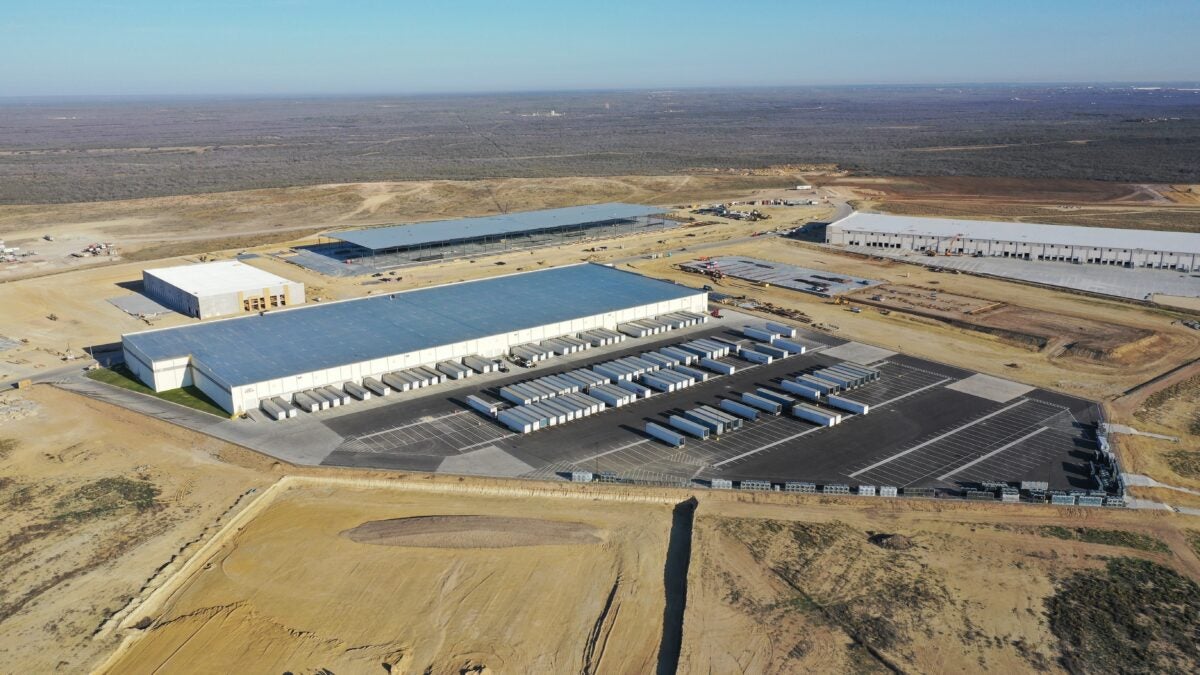
EELCO is expanding with a new 250,000-square-foot logistics warehouse in North Laredo. The facility, which opened on Friday, features 47 dock doors, four ramp doors, 247 trailer spaces and over 40,000-square-feet designated for foreign trade zone warehousing.

Eduardo E. Lozano & Co. Inc.’s new warehouse is located in North Laredo, Texas, adjacent to Interstate 35. (Photo: EELCO)

Mexico was the top overall U.S. trading partner in 2023, with trade between the two countries totaling $798 billion and Laredo is crossing more than 18,000 trucks daily into and out of the United States.

Last year, the port of entry in Laredo was the No. 1-ranked international trade gateway in the U.S., totaling $320 billion. It was the first time Laredo was the nation’s No. 1 overall trade port for the year. In January, Laredo started the year as the No. 1 port in the country in cargo volume, followed by the ports of Long Beach and Los Angeles.

“The primary reason behind our expansion was due to the high demand we have from customers in cross docking and storage,” Lozano said. “Importers are finding it more cost effective to load a Mexican dry van in Monterrey, Mexico, dray it to the border to clear customs in Laredo, and take it to our facility where a U.S. truck is waiting to cross dock and pick up the load, taking it to its final destination.”

EELCO’s new warehouse facility is a consolidation of the company’s two existing warehouses in Laredo. The new warehouse is located in North Laredo, adjacent to Interstate-35 and is compliant with customs-trade partnership against terrorism (CTPAT) regulations.

“The Laredo real estate market for warehousing is growing and finding a facility was not difficult with the addition of several new industrial parks developing around the city,” Lozano said. “Laredo has seen a large growth in the past 3 years, where 250,000-square-foot warehouses are becoming very common. It’s not difficult to find real estate in Laredo, but buyers are having to pay premium prices compared to past years.”

Lozano predicts big things for the U.S.-Mexico trade market this year.

“We are blessed to say EELCO, as well as our colleagues in Port Laredo, are reporting record volumes for customs and logistics operations,” Lozano said. “Forecasts predict that this upward trend is expected to continue in years to come and this is only the beginning.”

Pennsylvania-based mushroom grower expands production into Mexico

Mushroom grower South Mill Champs has entered into a partnership with Mexican private investment company Grupo APAL.

The partnership, which will be a 50-50 Mexican joint venture called Royal Champs, will build a mushroom growing farm and packing operation on a 257-acre site near Queretaro, Mexico.

In addition to the facility in Queretaro, the partnership aims to eventually expand growing operations in multiple sites across Mexico primarily for import into the U.S. and Canada, according to a news release.

“The partnership with Grupo APAL will allow us to focus on our expansive expertise of mushroom production and supply chain management,” Mike Pia Jr., South Mill Champs’ vice president of business growth, said in a statement. “The Mexican expansion demonstrates our commitment to modernizing and leading innovation in the mushroom industry across North America.”

South Mill Champs is a Kennett Square, Pennsylvania-based grower and supplier of North American fresh mushrooms and functional mushroom foods. The company has growing and processing operations in Canada and the U.S. The company’s network includes cold chain distribution centers in nine U.S. cities

Grupo APAL is the private investment company of Paredes Arroyo, a dairy producer, supplier and shareholder of Alpura, a dairy products company based in Mexico City.

Impilo expands distribution network with Phoenix warehouse

Technology firm Impilo recently opened a distribution center in Phoenix aimed at bolstering the company’s ability to cater to the growing demand for remote patient monitoring (RPM) services in the western parts of the U.S.

The temperature-controlled distribution center includes storage, kitting, refurbishment and receiving capabilities. The facility is located near the Phoenix Sky Harbor International Airport airport and several major carriers’ facilities, according to a news release.

“This expansion marks a significant milestone for Impilo as we strive to enhance logistics efficiency, reduce shipping costs and expedite shipping times for our customers,” Josh Stein, CEO and founder, said in a statement.

Founded in 2020, Impilo is based in Philadelphia. The company provides logistic and data solutions for healthcare companies and providers to scale their remote patient monitoring programs.

TT Electronics opens factory along US-Mexico border

TT Electronics, a provider of global manufacturing solutions and engineered technologies, recently opened a new manufacturing facility in Mexicali, Mexico. 

The 75,000-square-foot facility allows the company to meet the increasing demand for electronics manufacturing solutions in North America, according to a news release.

“This strategic investment reinforces our commitment to deliver increased value, a world-class service and the capacity to enable our customer’s growth,” Michael Leahan, COO of TT Electronics, said in a statement. 

Mexicali is the state capital of Baja California and is located along the California-Mexico border. 

The new factory is situated next to the company’s existing plant in Mexicali, which manufactures sensor technologies. The new facility will provide fully integrated electronics manufacturing solutions with capacity for up to six high-speed surface-mount technology lines, product integration and assembly.

TT Electronics is based near London, England, and employs more than 1,200 workers in Mexicali and Juarez, Mexico. 

More articles by Noi Mahoney

Shifting supply chains boost trade in California-Baja mega-region

Mass furloughs reported at BNSF Railway operations in 4 states

Texas, Louisiana ports’ January cargo volumes a mixed bag

Is the rate roller coaster about to turn?

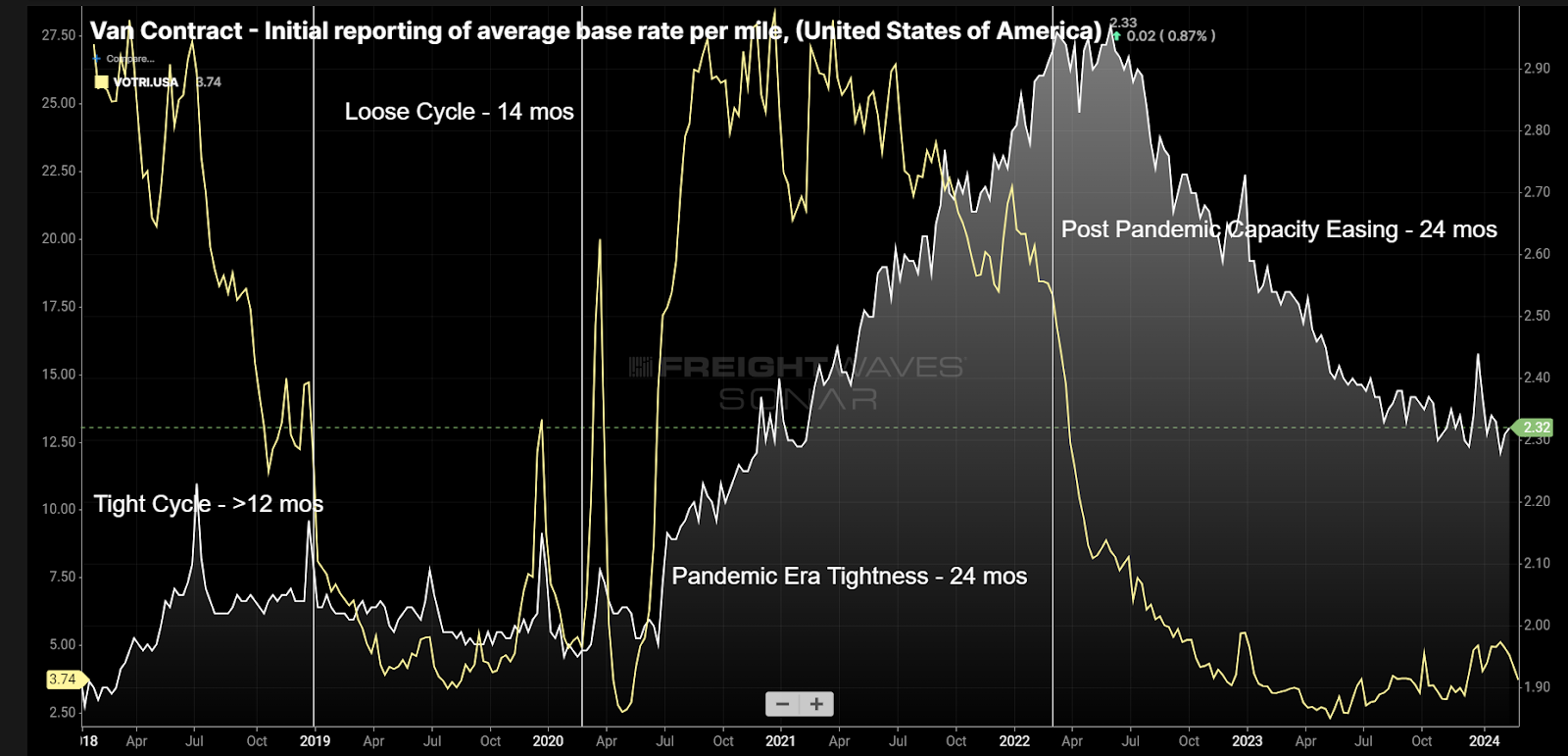
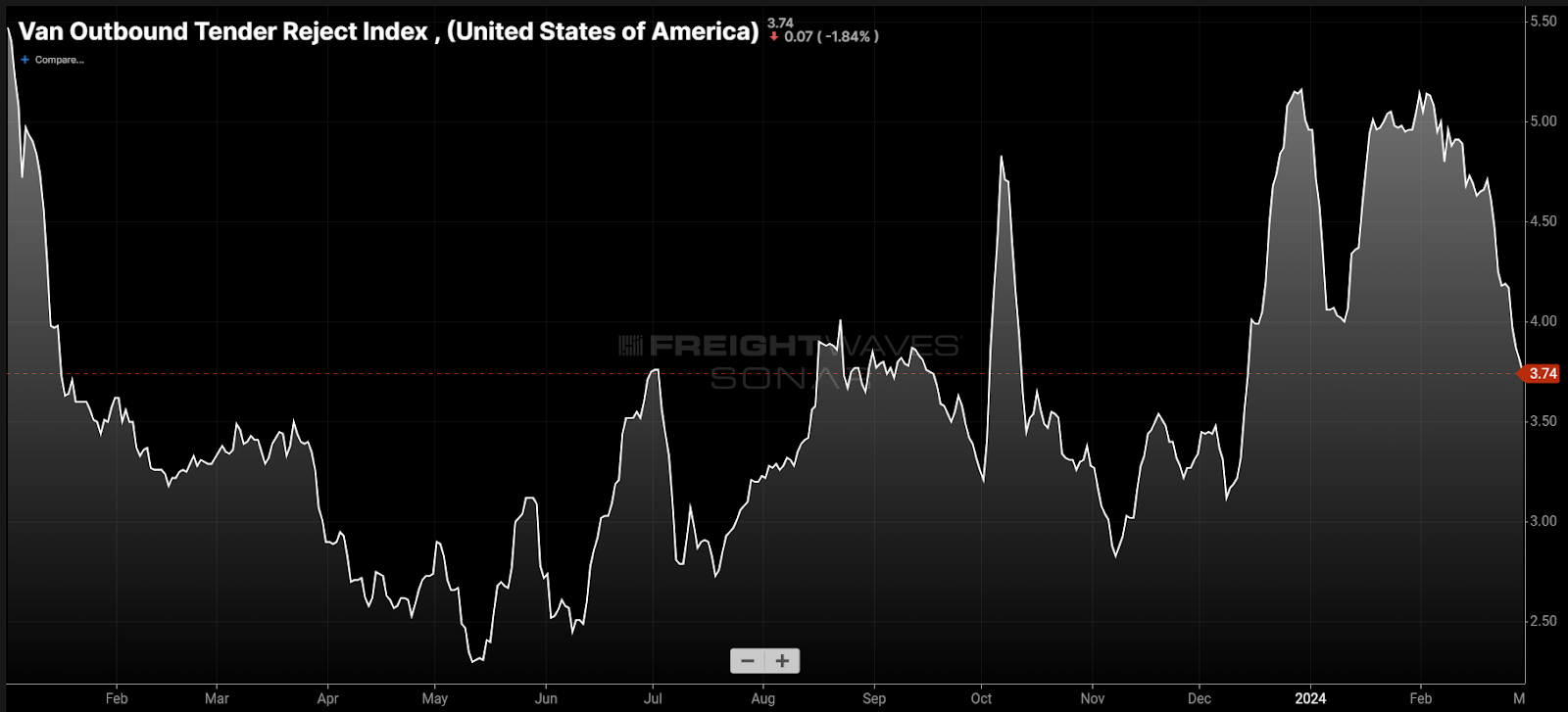
Chart of the Week: Van Contract initial report of average base cost per mile, Van Outbound Tender Rejection Index – USA  SONAR: VCRPM1.USA, VOTRI.USA

The post-pandemic trend of pricing long-term or contract rates to the floor is not over, but the data shows this is slowly ending.

Looking at the past six years of dry van contract rates (VCRPM1) and van tender rejection rates (VOTRI), we can see a lagging correlation between the two. Rejection rates tend to lead the slower-to-move contract rates.

What’s a tender rejection rate?

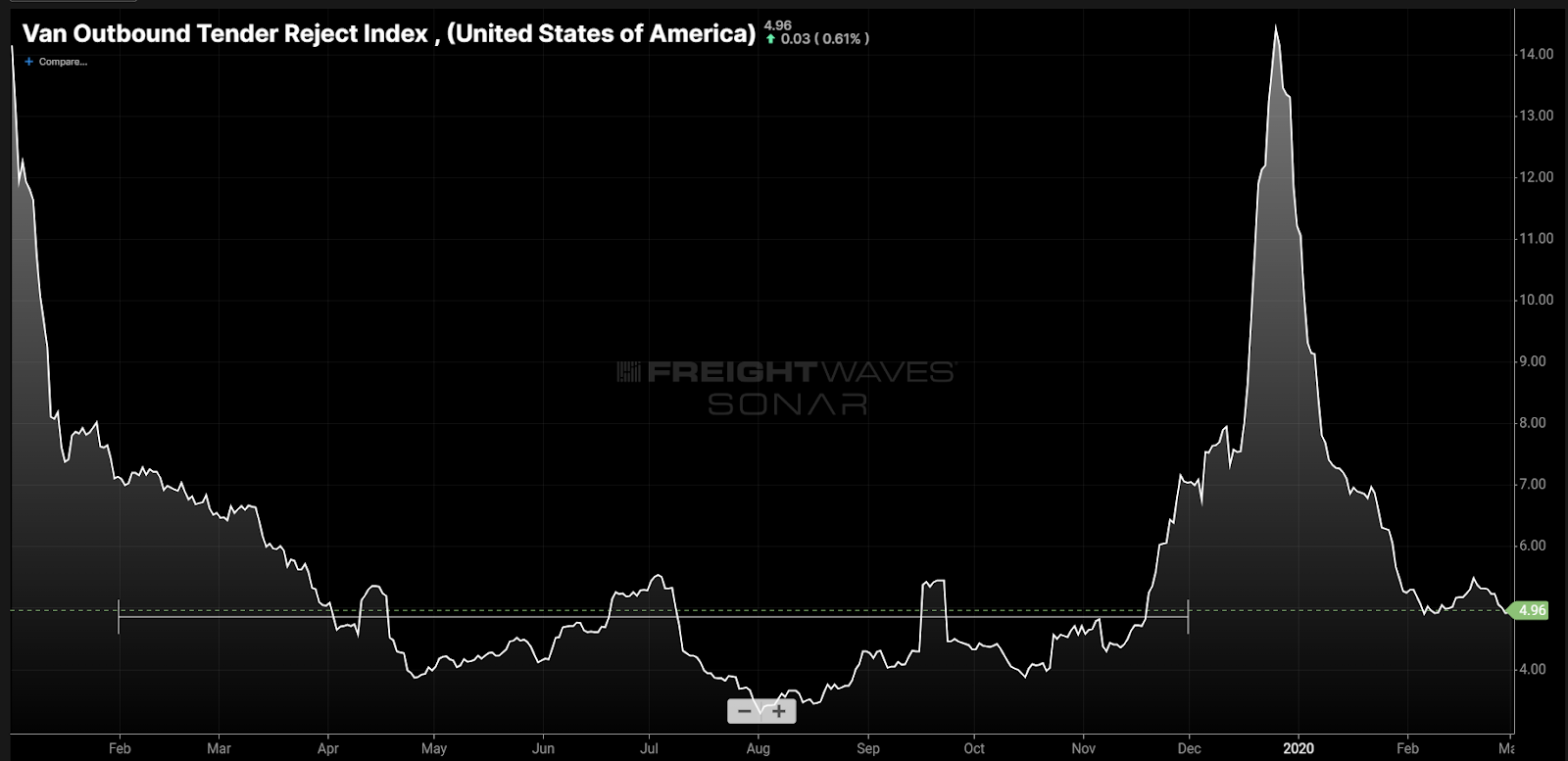
Tender rejections are a measure of carrier compliance or adherence to covering freight under a previously agreed-upon price. Load tenders are electronic requests sent from a shipper to a transportation service provider asking if it can cover a truckload move. The service provider accepts or rejects the load.

The tender rejection rate is the percentage of tenders the transportation provider declines to cover. The higher the number, the tighter the market. Historically, national figures below 5% have indicated that contract rates will fall as there is more carrier capacity than demand for freight. When the OTRI is above 7%-8%, rates tend to increase. 

It should be noted that FreightWaves SONAR’s tender and contract rate data biases toward large shipper-to-carrier contract agreements, which represent the baseline and majority of the freight market.

Which era is trucking in?

There have been four general cycles of the transportation market over the past six years, when the tender data history started in 2018. That cycle began in 2017, but we only have history for the past 12 months. This market was characterized by rejection rates averaging above 17% and a strong single upward trend in contract prices that stabilized.

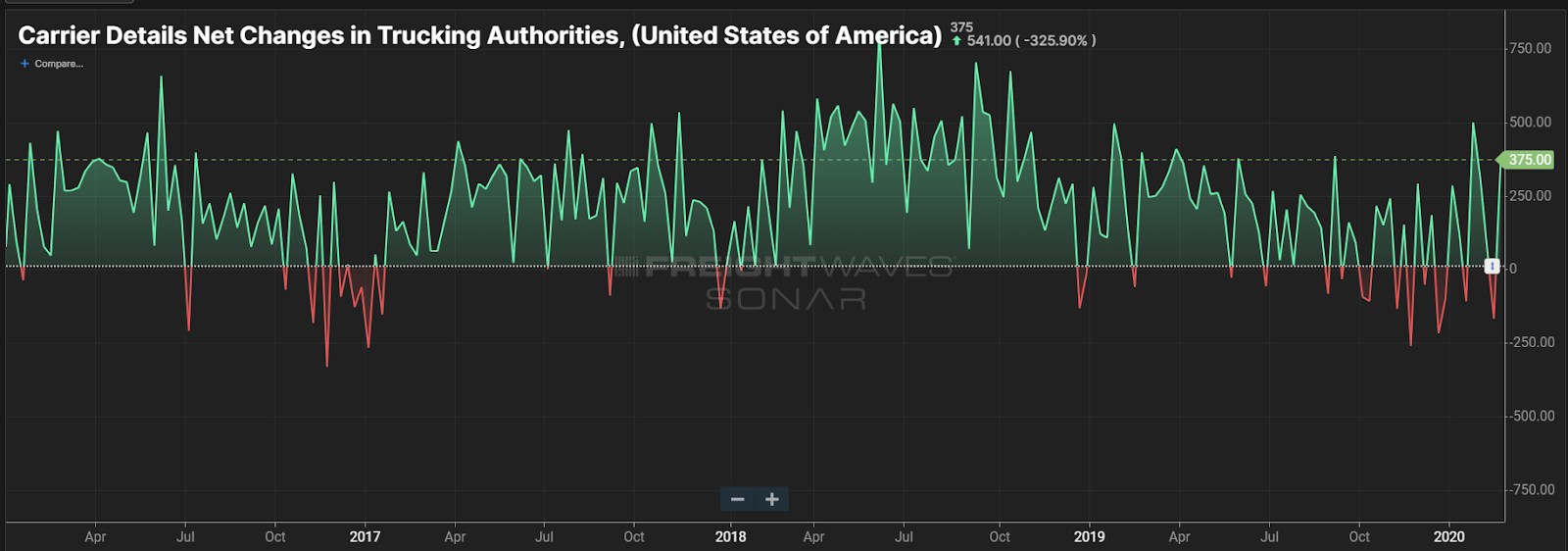
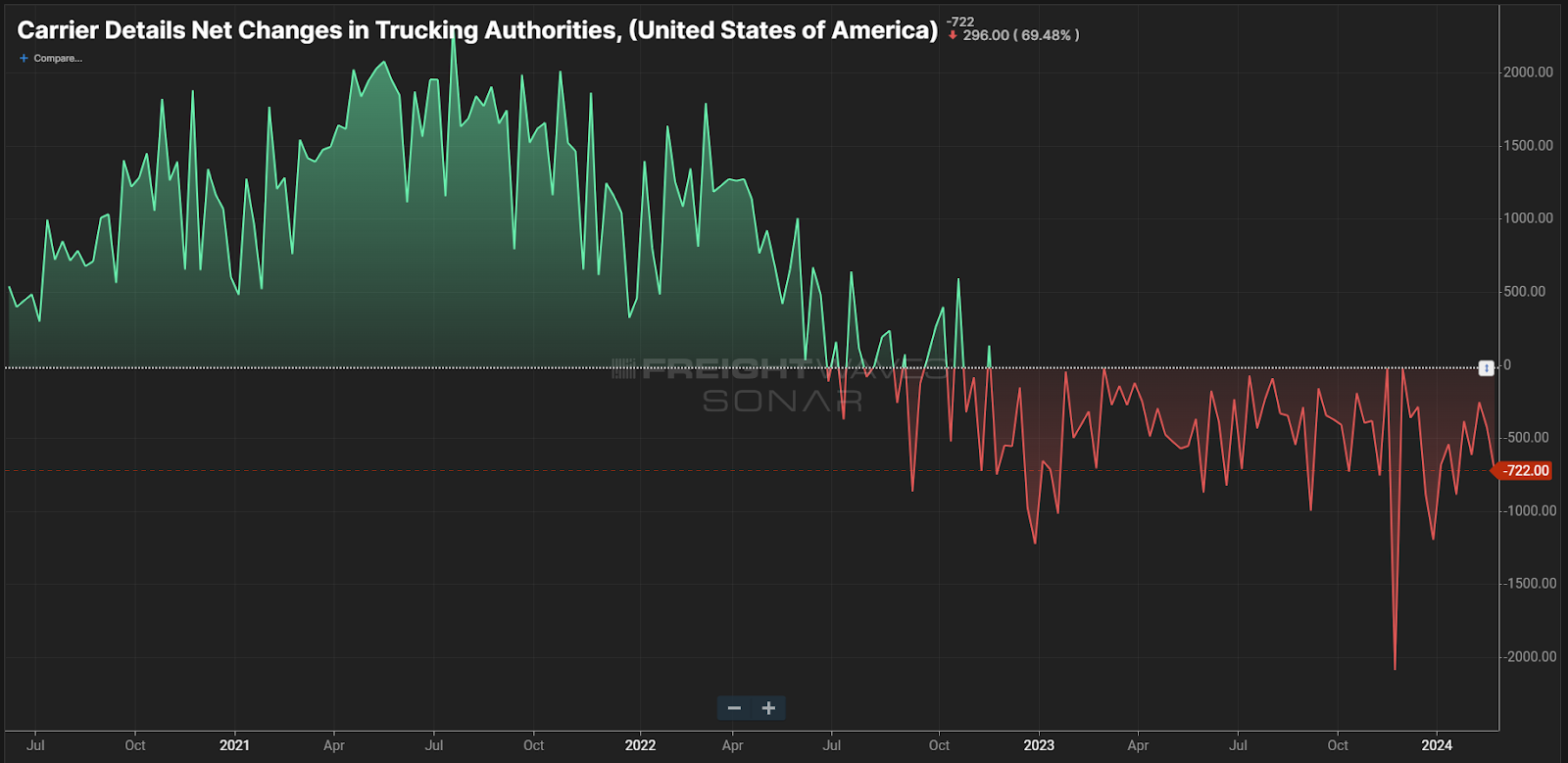
The 2019 market was characterized by a rebalancing of capacity after an overheated capacity growth period in 2018. The above chart shows net changes in active motor carrier of property operating authorities registered to the Federal Motor Carrier Safety Administration. It is not a pure measure of capacity since an authority can represent any number of trucks. It also biases toward growth. Periods of deterioration (in red) are not as common as growth (green). 

Rejection rates averaged just below 5% from February to December in 2019, with the market bottoming in August at 3.2%. This cycle lasted 14 months before COVID hit the U.S. in March 2020. There were signs that capacity was tightening before the black swan pandemic event hit, however. Holiday season rejection rates spiked above 14% that year.

The pandemic era was characterized by overwhelming demand and lasted roughly two years, with rejection rates averaging above 20% and rates increasing 50%. The capacity growth was subsequently historic as operators flooded the market, many leaving larger fleets to start their own ventures.

Unfortunately that growth proved to be an unsustainable bubble and began bursting in 2022. Contract rates fell rapidly from July 2022 to the spring of 2023 but have slowed since.

Rejection rates bottomed in May of last year around 2.5% and have been slowly trending higher since. While tender rejections are still hovering in deflationary territory, the indication is that they could move above the 5% threshold sustainably sometime in the next year. 

What to do?

For carriers it is a game of survival. For shippers it is an exercise in risk management. For brokers/3PLs it is a balance of both. Shippers have the least sense of urgency but the most control. As with all freight markets, success is determined by how much preparation was made in the previous cycle. The controlling party has to prepare before its turn ends.

Shippers can do the most to control their destiny at this point. Maintaining service should be the goal for any bids implemented moving forward. Some lanes will be harder to cover in a tight market. Diversified route guides and not having rock-bottom rates compared to the market will be crucial.

Service providers need to be vigilant. Watching the market closely for signs of disruption is the easiest action but sometimes hard to do if only looking internally. Targeting customers who are willing to take the above approach is easier said than done, but it is certainly more attainable than in the pre-COVID world.

The timing of a cycle turning has been impossible to predict with precision, but there have been signals that it is approaching. Let’s end this one with a timeless quote from Louis Pasteur, which has become somewhat cliche: “Fortune favors the prepared mind.”

About the Chart of the Week

The FreightWaves Chart of the Week is a chart selection from SONAR that provides an interesting data point to describe the state of the freight markets. A chart is chosen from thousands of potential charts on SONAR to help participants visualize the freight market in real time. Each week a Market Expert will post a chart, along with commentary, live on the front page. After that, the Chart of the Week will be archived on FreightWaves.com for future reference.

SONAR aggregates data from hundreds of sources, presenting the data in charts and maps and providing commentary on what freight market experts want to know about the industry in real time.

The FreightWaves data science and product teams are releasing new datasets each week and enhancing the client experience.

To request a SONAR demo, click here.

Kuehne+Nagel operating profit cut 50% in 2023

A model plane with Kuehne+Nagel brand on it resting in an office

Global logistics powerhouse Kuehne+Nagel suffered substantial revenue and profit erosion in 2023, including the final quarter, as excess air and ocean capacity combined with a post-COVID slow down in trade lowered rate levels, hurting bottom lines across the freight transportation sector.

Executives said they are seeing some stabilization in demand , but don’t expect a huge improvement this year. 

In conjunction with Friday’s quarterly results, Kuehne+Nagel announced an agreement to acquire City Zone Express, a Malaysia-based trucking company that operates across borders throughout Southeast Asia. The motor carrier has 260 vehicles, 500 employees and 860,000 square feet of warehouse space. Completion of the deal is expected later this year.

Although the peak shipping season partially returned to form, coming out of a 15-month trough, the fourth quarter was only marginally better than prior periods for the Switzerland-based supply chain manager. 

“Demand for global logistics services remains subdued and we don’t expect a material change to this situation. Sea freight and air freight did not see a broad-based peak season in 2023,” said CFO Markus Blanka-Graff in remarks to analysts.

Revenue at K+N, the largest ocean and air freight forwarder, fell 35% during the fourth quarter to $6.4 billion. For the full year, revenue declined 40% to $26.9 billion. Operating income for the three months and entire year was halved compared to 2022. 

Inflation, more geopolitical hotspots and feeble economic growth in Europe contributed to weaker shipping demand in 2023.

For context, though, revenues were still 13% higher than in 2019 and operating income was 79% higher than pre-COVID.

Management said it instituted more cost controls over the course of the year to help maintain margins. The company is more than 40% through a staff reduction of 1,300 persons, which will save more than $120 million – double the amount of severance benefits paid. 

Ocean freight forwarding was the biggest drag on results, with quarterly and annual revenue each down 54% year over year. Container volume totaled 4.3 million forty-foot equivalent units, dipping 1.1%, but grew in the second half of the year — an indication that weak rates were the primary culprit behind the revenue change. Inflation also increased operating costs. Segment profit actually worsened in the fourth quarter — down 55% versus 50% for the entire year. 

Executives said volume would have actually increased 1% were it not for the decision to discontinue handling certain commodity goods in the fourth quarter and focus on products with higher yields. The decrease in volume was less than the 3% decline for the industry as a whole. 

K+N’s air logistics division recorded a 27% drop in fourth-quarter revenue, which was an improvement from the 41% decline for the full year. Earnings before interest and taxes were off 61% for 2023 and 52% in the quarter. Air volumes fell 11.2% while rates fell 32% but the decline eased as the year progressed. Demand improved 6% from the third to the fourth quarter, and only down 4% year over year. The company handled nearly 2 million tons of airfreight during the year, with e-commerce and perishable shipments performing the best. 

Global air cargo demand was down 2% last year from 2022 and would have been lower without a stronger-than-expected surge of e-commerce shipments out of China in the final months, according to various market researchers.

CEO Stefan Paul said the rerouting of ships past the Red Sea has raised interest in other options, such as sea-air movements, but has not resulted in any material increase for air cargo. 

A highlight for the year was putting into service the last two 747-8 freighters ever produced by Boeing. The planes are chartered from Atlas Air and now carry machinery, automotive components, pharmaceuticals and other goods for K+N customers. 

Expansion moves

In November, K+N completed the acquisition of Morgan Cargo, a freight forwarder based in South Africa that is strong in the perishables trade and fits with the company’s strategy for tuck-in acquisitions around the world.

Last week, the mega-forwarder expanded its container freight station near John F. Kennedy International Airport in New York with a 4,500-square-foot temperature-controlled zone, specifically designed for healthcare and perishable products, as well as an additional 10,000 square feet of warehouse space. 

In December, relocated a spare parts distribution facility from Des Plaines, Illinois, to near Dallas Fort Worth International Airport to better support aircraft maintenance and overhaul firm MHI RJ Aviation Group

K+N is expected to complete the acquisition of Ontario, Canada-based customs broker Farrow by the end of the month. 

Performance declines at the company’s contract logistics and trucking divisions were much less severe than in air and ocean.

Kuehne+Nagel was not alone among logistics providers having disappointing results last year. Denmark’s DSV saw revenue fall 29% for the fourth quarter and 36% for the full year. Seattle-based Expeditors reported a 34% contraction in revenue and 40% lower operating income year over year. 

Click here for more FreightWaves/American Shipper stories by Eric Kulisch.

Twitter: @ericreports / LinkedIn: Eric Kulisch / ekulisch@www.freightwaves.com

Air cargo growth to start the year less than meets the eye

Red sea disruptions among critical supply chain risks in 2024

By Glenn Riggs, Chief Strategy Officer of Odyssey Logistics

The views expressed here are solely those of the author and do not necessarily represent the views of FreightWaves or its affiliates.

The continued fragility of the post-pandemic supply chain has been brought into high relief by recent disruptions. Perhaps most prominent in the public imagination: Houthi attacks on merchant ships in the Red Sea have led to the diversion of over $80 billion in cargo, leading to massive logistics efforts to have that cargo still arrive at its intended destination within a reasonable time frame. 

Adding to the complexity: Events like these never occur in isolation. The supply chain is a dynamic and intimately interconnected global apparatus. Touch a thread in one corner of the globe, and you will feel tremors in the opposite corner. 

This interconnectedness makes forecasting extremely valuable — but also extremely difficult. How can anyone predict events that are so tightly bound up in others? As such, what follows is not a pure forecast, per se, but rather a set of possibilities — some of the most critical supply chain risks that companies are likely to face in 2024, as well as some strategies to make your logistics operation more resilient to these risks. 

Houthis on the move

The Houthis will likely continue to be a thorn in the side of shippers in 2024. Emboldened by the conflict between Israel and the Palestinians, the Houthi authorities, a rebel group in Yemen suspected to be funded by Iran, began a series of raids last year against cargo ships in the Red Sea west of Sanaa. The resultant chaos has caused understandable skittishness for those accessing through the Suez Canal, causing laborious rerouting around the Cape of Good Hope in many cases. Downstream of this disruption aren’t merely delays, but surges in goods inflation (with some estimates saying up to 2% increases could be attributed to the raids).

Attacks by the U.S. and the U.K. on the Houthis have shown little sign of curbing the piracy, and so supply chain pros would do well to continue to keep a close eye on the Red Sea and all the effects spinning out from the instability there. 

Lunar New Year

The Lunar New Year, also called the Chinese New Year, is a reliable but still remarkable source of supply chain disruption each year. While of course every country has unique slowdowns related to various cultural practices and values, China’s outsize importance in the global economy takes the Lunar New Year beyond the scope of a typical holiday slowdown. 

The seven-day holiday results in massive migration, as well as a total halt to factory and production work in China as workers go on holiday and spend time with family. Often, the festivities can extend well beyond the typical seven days, and production and shipping can be disrupted for several weeks, causing a rush of goods before and after.

Panama Canal drought

Seasonal droughts are not new for the Panama Canal. But extreme drought has made their severity unpredictable. In January, authorities reported that a recent historic drought had forced them to slash traffic by a third, with Panama Canal Administrator Ricaurte Vásquez saying the drought could cost Panama as much as $700 million in 2024. That figure has worsened considerably over time, with previous estimates running closer to $200 million.

With routing problems such as those at the Red Sea already straining the supply chain, the disruptions at the Panama Canal could not have come at a worse time, compromising the two most important canals in world trade. And, as the problem implicates broader climatological problems, an easy solution seems nowhere in reach. 

Impending ILA strike

Labor issues will continue to affect the supply chain in 2024. Most pressingly, the U.S.’s International Longshoremen’s Association (ILA), which represents over 70,000 dockworkers’ interests across the East Coast and all the way to Houston, has made it clear that they intend to strike in 2024 if concerns they have raised with the United States Maritime Alliance (USMX) go unremediated. Their grievances largely pertain to pay issues as well as automation concerns. Their president, Ray Daggett, has indicated that members should prepare for a strike this fall.

Of course, it’s possible that USMX and ILA will come to an agreement, but currently this doesn’t seem likely, with both sides digging in and Daggett preparing his members for action long in advance. Not helping matters is that the strike is planned to occur shortly before the U.S. presidential election, which itself may contribute to further supply chain instability. 

The election and other geopolitical risks

The election itself, which will doubtless be hotly contested and controversial, could trigger serious global repercussions, which themselves could trigger supply chain disruptions. And this is only one of many geopolitical powder kegs. Others include the China-Taiwan situation, the ongoing conflict in Ukraine and the Israel-Palestinian conflict. All of these are volatile political situations in which many global players are either implicitly or explicitly bound up. Should any spiral out of control, it could trigger massive logistics disruptions. Not to mention the annual weather cycles and impacts of hurricane season and extreme weather events.

What’s to be done?

In surveying the supply chain landscape in 2024, I’m reminded of a passage from Homer’s “Odyssey.” Odysseus has to choose to chart his ship between two great perils — the whirlpool monster Charbydis and the many-headed sea monster Scylla. No matter what he does, he’s going to lose something. A similar “damned-no-matter-what-you-do” feeling seems to be on the horizon for many of my colleagues. But I think clinging to a basic set of best practices can help mitigate the worst of the headaches and hopefully insulate professionals from the more severe setbacks.

The first and most obvious strategy is to spend even more time than usual preparing alternate sources of supply and alternate transport routing possibilities. The best supply chains are those built on options, and having only one way to get your freight from A to B, in 2024’s climate of route closures and ricochet effects, is a recipe for unmitigated disaster. Make sure your contingency plan has a contingency plan.

It’s also more important than ever to have a clear priority structure for your freight. You have to have a hierarchy of what you’re shipping, and know what you’re willing to pay a premium on and what can afford to sit a little longer in logistics limbo. Obviously, nobody likes the idea of having to set priorities like this — but doing so on the front end of your shipping efforts will ensure that you aren’t scrambling to invent them when disruptions inevitably hit. 

My last piece of advice: Diversify your partners and your shipping options. Risk is best handled when it’s distributed, preferably across the wide network of a built-out 3PL or 4PL partner. The volatility of 2024 means it’s not the time to rely on a unimodal solution. You need to build as many options for yourself as possible so that when disruption strikes, you can hop your freight nimbly to the next best bet. Good 3PL partners can take care of these headaches for you and usually have already built out a strong carrier infrastructure. I’ll say it again: The strongest supply chain is one built on options — a rope is stronger than a single thread. 

Weathering 2024

2024 looks like it will be another rough year for the supply chain, and with so many possible risks and disruptions, it will be interesting to come up for air at the end of the year and see what companies weathered the storm best. I have a feeling those that will thrive didn’t put all their eggs in one basket. Risk is proliferating, and so should your strategies to circumvent it. 

Running on Ice: Barbie comes to the freezer aisle

Blue Truck on a sheet of ice over a blue background and Running on Ice Logo

All thawed out 

(Photo: Jim Allen/FreightWaves)

A key part of the Research Triangle, Raleigh, North Carolina, has become home to the next great partnership in health care. Q-linea, a company that develops instruments and systems for in vitro diagnosis of infectious diseases, has partnered with Uniphar Logistics, a crucial move in Sweden-based Q-linea’s commercial launch in the U.S.

According to a news release, “ASTar, Q-linea’s groundbreaking automated instrument, is revolutionizing healthcare by swiftly providing sensitivity profiles from positive blood cultures. This innovation empowers healthcare providers with rapid, precise solutions for diagnosing and treating infectious diseases, significantly reducing time to care.”

Uniphar specializes in temperature-controlled and medtech distribution. This is a huge leap for health care organizations looking for stronger diagnostic solutions. 

Temperature checks

(Photo: Jim Allen/FreightWaves)

Big Expansion news in Surprise, Arizona. Rinchem, a global chemical supply chain management company, has expanded its Arizona presence with a custom-built hazmat warehouse. The new 123,500-square-foot facility has 16,000 pallet positions and a 103,000-square-foot storage yard with 432 spaces for ISO shipping containers. It also has a dedicated gas pad with 48 storage bays and temperature-controlled storage for flammable and corrosive materials.

“We’re confident it will play a crucial role in supporting the growth of the local semiconductor industry and contributing to the region’s economic prosperity,” Rinchem CEO Chris Easter said in a press release.

The Surprise warehouse opening follows Rinchem’s successful launch of two other hazmat warehouses in 2023, located in Cornelius, Oregon, and Penang, Malaysia. Rinchem’s second Phoenix-area warehouse further solidifies its position as a partner for leading companies in the semiconductor industry.

Food and drugs

(Photo: The Frozen Farmer)

The year of Barbie didn’t end in 2023; it’s just moving to the freezer aisle. The Frozen Farmer has debuted a line of Barbie-themed “Freezer Squeezers” to celebrate Barbie’s 65th anniversary. The frozen treat is a strawberry lemonade sorbet in a tube. 

The Frozen Farmer originally started as a way to reduce food waste by using misfit fruit from the family farm.

Katey Evans, founder of The Frozen Farmer, said in a news release, “What started as a way to use produce that looks unique has become our mission … . Barbie is a brand that celebrates the differences of all children that make them uniquely themselves — and as a mom, I love that as much as my daughters love all things Barbie.”

Cold chain lanes

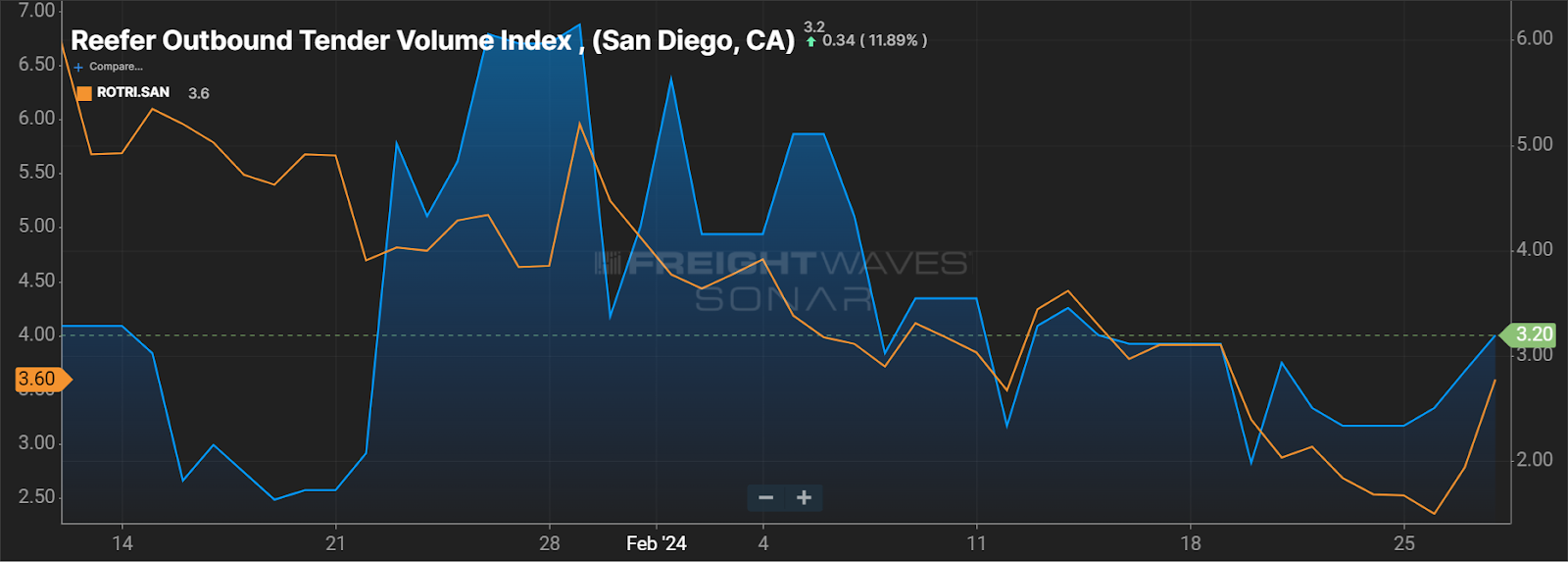
(SONAR Tickers: ROTVI.SAN, ROTRI.SAN)

This week’s SONAR market heads to Southern California. Capacity in San Diego is staying relatively flat despite rising reefer outbound tender rejection and volume levels. Reefer outbound tender rejections have risen 72 basis points week over week to come in at a rate of 3.6%. Reefer outbound tender volumes are also rising to levels that match the middle of the month. Ultimately there will be little impact on spot rates as long as outbound tender volumes continue to rise alongside outbound tender rejections. Should rejections pass 7%, San Diego could become a hotbed for spot rates that start becoming inflated.

Is SONAR for you? Check it out with a demo!

Shelf life

USADA adopts Ember LifeSciences cold chain technology for human specimen transport

Put your pallet in a parka

Vertical Cold Storage picks second DFW facility

PR: Biocair looks to the future of drug development and distribution with a new process for risk mitigation in supply chains

How can this energy-intensive sector improve its green credentials?

Wanna chat in the cooler? Shoot me an email with comments, questions or story ideas at moconnell@www.freightwaves.com.

See you on the internet.

Mary

If this newsletter was forwarded to you, you must be pretty chill. Join the coolest community in freight and subscribe for more at www.freightwaves.com/subscribe.

Beware the false spring

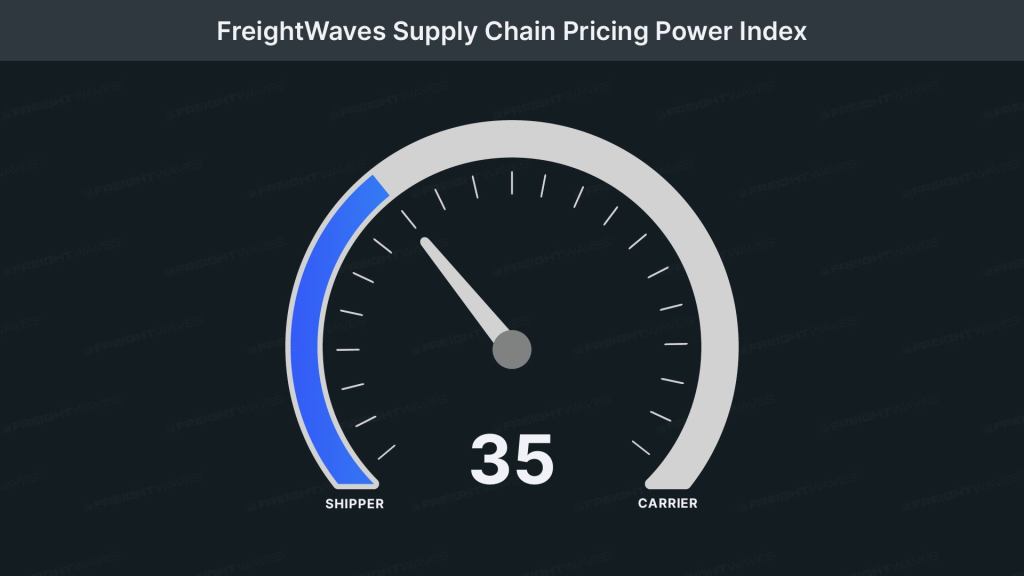
This week’s FreightWaves Supply Chain Pricing Power Index: 35 (Shippers)

Last week’s FreightWaves Supply Chain Pricing Power Index: 40 (Shippers)

Three-month FreightWaves Supply Chain Pricing Power Index Outlook: 40 (Shippers)

The FreightWaves Supply Chain Pricing Power Index uses the analytics and data in FreightWaves SONAR to analyze the market and estimate the negotiating power for rates between shippers and carriers.

This week’s Pricing Power Index is based on the following indicators:

A break in the clouds

After an eventful January in which carriers benefitted from unseasonal tightness caused by severe winter storms, I argued that freight markets were showing signs of a lasting recovery. I took pains to clarify that this recovery was not going to be a roller coaster of unstoppable growth, that it was instead a gradual rebalancing of market dynamics. Even with that caveat, the recent performance of tender rejections and spot rates has been more disappointing than I expected — as will be discussed below.

But before moving onto the doom and gloom, I want to restate my bull case for the coming months. Even as carriers’ pricing power deteriorated, freight demand was consistently robust throughout February. Looking forward to the months ahead, there is still significant room for growth as Chinese imports hit the West Coast in the coming weeks. The early stages of produce season are forecast to see yearly growth in Texas and Florida, helped in part by El Niño’s weather patterns. Activity in the construction sector will be aided by federal funds allocated to manufacturing, transportation infrastructure and energy infrastructure, while homebuilders project an even better year ahead than the already-busy 2023.

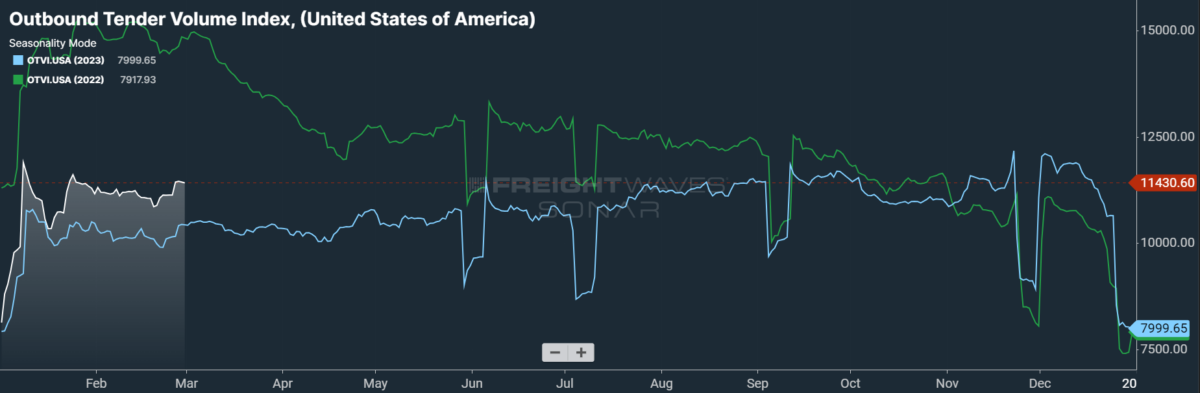
Tender volumes sustain momentum into March:
SONAR: OTVI.USA: 2024 (white), 2023 (blue) and 2022 (green)
To learn more about FreightWaves SONAR, click here.

This week, the Outbound Tender Volume Index (OTVI), which measures national freight demand by shippers’ requests for capacity, is up 3.38% week over week (w/w). On a year-over-year (y/y) basis, OTVI is up 11.71%, though such y/y comparisons can be colored by significant shifts in tender rejections. OTVI, which includes both accepted and rejected tenders, can be inflated by an uptick in the Outbound Tender Reject Index (OTRI).

Accepted volumes are well above last year:
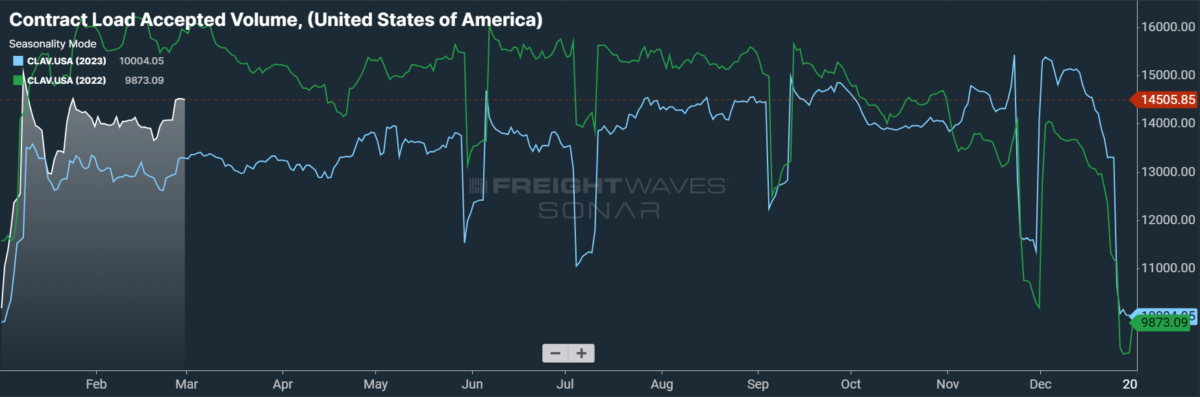
SONAR: CLAV.USA: 2024 (white), 2023 (blue) and 2022 (green)
To learn more about FreightWaves SONAR, click here.

Contract Load Accepted Volume (CLAV) is an index that measures accepted load volumes moving under contracted agreements. In short, it is similar to OTVI but without the rejected tenders. Looking at accepted tender volumes, we see a rise of 4.09% w/w as well as one of 9.15% y/y. This positive y/y difference implies that actual freight flow is recovering from this cycle’s bottom.

As stated above, there are many reasons to be hopeful about the near-term future of truckload demand. Freight activity was sustained in late January and February by high import volumes. The Port of New York and New Jersey recently reported that January 2024 was the third-busiest start to the year on record, lagging behind only the incredible growth of 2021 and ’22. Meanwhile, on the opposite coast, the Port of Los Angeles — the busiest port in the U.S. — saw its second-best January this year, surpassed only by 2022. 

Couple this growth with the fact that import bookings from China to the U.S. set record highs in the first two weeks of February (that is, in the run up to Lunar New Year) and that these bookings were made roughly 42 days before the shipments arrive on U.S. shores, late March and early April should be incredible months for truckload markets near West Coast ports.

There are other positive signs for activity beyond maritime volumes, however. Bank of America’s Truckload Demand Indicator for shippers hit its second-highest level in 80 weeks at the end of February, up 13% y/y. This particular index surveys demand over the next three months, though shippers are even more bullish over the next six to 12 months. That said, many of the shippers surveyed note that they have yet to see “the exodus of trucking companies” normally witnessed at this point in the cycle, with excess capacity remaining a headwind towards rebalancing the market.

Finally, flatbed demand in particular should be buoyed by growth in construction and manufacturing. The S&P Global US Manufacturing PMI saw its headline index rise from 50.7 in January to 52.2 in February, indicating more rapid expansion. S&P Global stated that manufacturers saw the steepest growth in new orders since May 2022, with demand rising from customers both foreign and domestic. “After a long spell of reducing inventories to cut costs,” wrote Chris Williamson, chief business economist at S&P Global Market Intelligence, “factories are now increasingly rebuilding warehouse stock levels, driving up demand for inputs and pushing production higher at a pace not seen since early 2022.”

Meanwhile, homebuilders are notably optimistic about their lots in 2024. Economists speaking at the National Association of Home Builders’ recent International Builders’ Show stated consensus expectations of 5% y/y growth in single-family housing starts, forecasting two or three Federal Reserve rate cuts of 25 basis points each in the latter half of the year. Bank of America analysis is even more bullish, expecting a 20% y/y rise in single-family starts over the first quarter and a 9% y/y gain for 2024 in total.

Where have all the truckers gone?

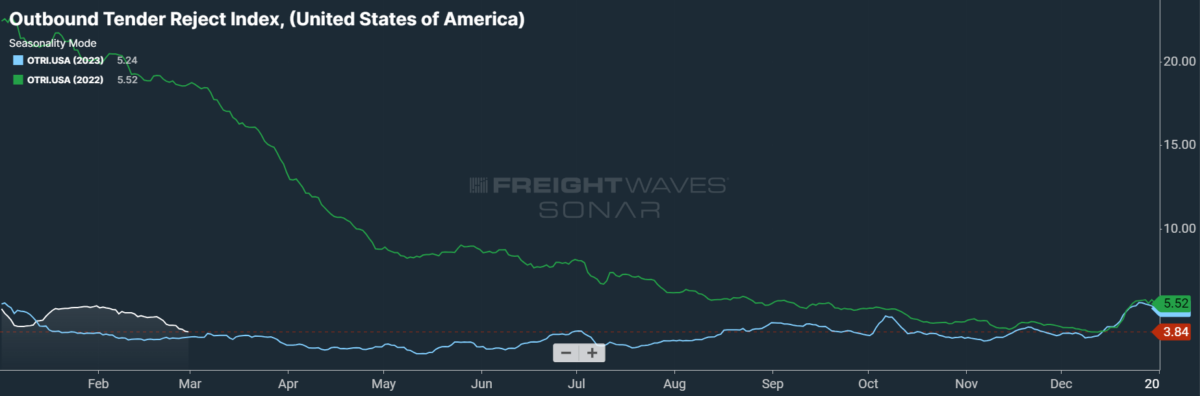
There are good reasons to feel hopeful about the future of freight demand in 2024, but the Pricing Power Index did not fall to 35 this week without cause. After treading above 5% for much of January and some of February, OTRI has since depreciated to sub-4% levels. While these movements are relatively minor on the grand scale of things, the direction is key here. A rising OTRI can be an inflationary force to spot rates if it tracks above 7% — give or take — or if it makes rapid gains over a short period of time. But while OTRI was indicative of capacity trickling out of the market, it is no longer.

OTRI reveals overabundance of capacity in the market:
SONAR: OTRI.USA: 2024 (white), 2023 (blue) and 2022 (green)
To learn more about FreightWaves SONARclick here.

Perhaps the strangest thing about capacity in this cycle is how it differs from the data. Many economists have noted the apparent discrepancy between government data on the labor market, which is incredibly strong, and the numerous reports of mass layoffs reaching a number of industries. 

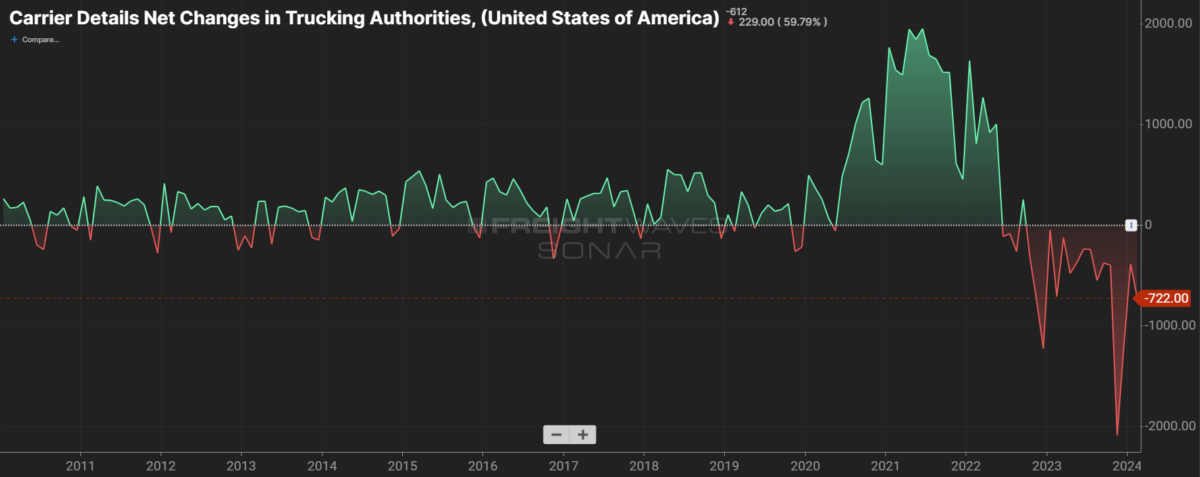
Yet the trucking industry not only has its fair share of newsworthy layoffs and bankruptcies, it also has the data tracking carriers leaving the market. Federal Motor Carrier Safety Administration data on the net changes of carrier authorities (below) shows that a greater number of carriers have left the industry than have entered in every month since October 2022 — despite the fact that many owner-operators tend to let their authorities quietly expire rather than bother with official revocation.

More authorities are leaving the industry than entering:
SONAR: CDNCA.USA
To learn more about FreightWaves SONARclick here.

The net losses of authorities are not insignificant, either: Before the current cycle, the month in which the largest number of carriers left the industry without replacement was November 2016, which saw a net loss of 329 authorities. More than six times that number vanished in November 2023, which posted a net loss of 2,087 authorities. 

As stated previously, this data does not even capture the full scope of the capacity runoff taking place. FMCSA requirements state that interstate carriers must renew their authorities every two years. Since it is not uncommon for carriers to exit the industry only temporarily — that is, only until the next upturn occurs — many of those leaving don’t bother with official revocation. Instead, they either renew their authorities if the industry is booming or else let it expire quietly. This behavior implies a lag of up to two years for the FMCSA to effectively measure the amount of capacity runoff.

The longest shortest month

February was simply abysmal for small carriers primarily exposed to the spot market. Over the course of the month, fuel-inclusive spot rates fell by a national average of 21 cents per mile. Many of the nation’s largest carriers have also weighed in on 2024’s bid season for contract rates: Werner Enterprises, with understatement characteristic of corporate businesses, said that this year’s round of contract negotiations was “very competitive.” That said, some shippers have stated that their new rates will not go into effect until as late as April, while other contract rates are indexed to data from the broader economy — such as the inflation-tracking Consumer Price Index — and so are less vulnerable to market dynamics of the trucking industry.

Spot rates are in free fall:
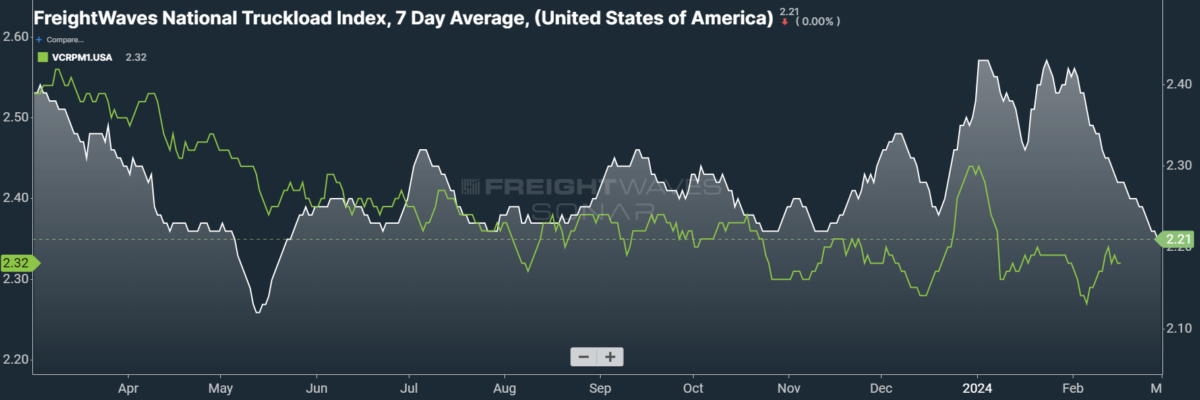
SONAR: National Truckload Index, 7-day average (white; right axis) and dry van contract rate (green; left axis).
To learn more about FreightWaves SONAR, click here.

This week, the National Truckload Index (NTI) — which includes fuel surcharges and other accessorials — fell 4 cents per mile to $2.21. Sliding linehaul rates were wholly responsible for this week’s loss, as the linehaul variant of the NTI (NTIL) — which excludes fuel surcharges and other accessorials — fell 4 cents per mile to $1.58.

Contract rates, which are reported on a two-week delay, have recovered somewhat from a dip in early February. Nevertheless, they are tracking close to 2021 levels from before the rate bonanza of this current cycle. By the start of Q2, there will be a more definite answer as to how this bid season impacted carriers. For the time being, contract rates — which exclude fuel surcharges and other accessorials like the NTIL — are unchanged on a weekly basis at $2.33 per mile.

SONAR: RATES.USA
To learn more about FreightWaves SONAR, click here.

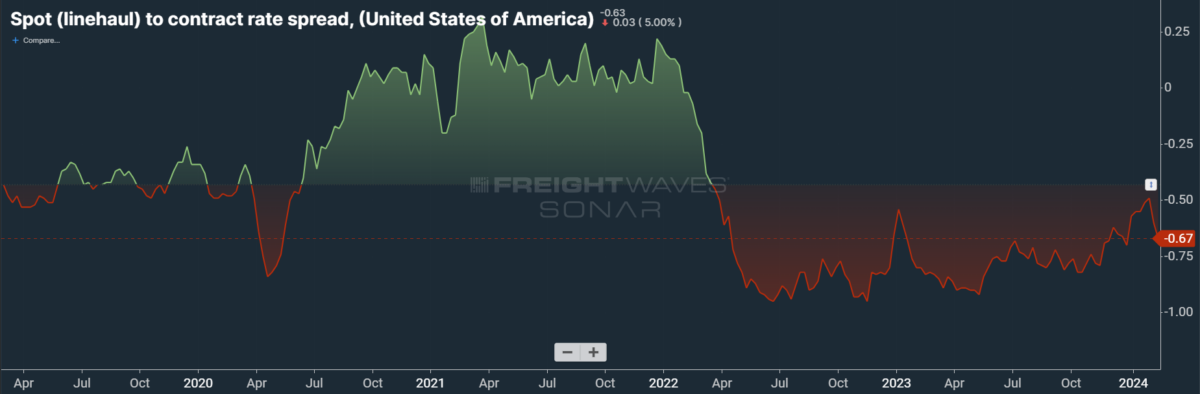
The chart above shows the spread between the NTIL and dry van contract rates, revealing the index has fallen to all-time lows in the data set, which dates to early 2019. Throughout that year, contract rates exceeded spot rates, leading to a record number of bankruptcies in the space. Once COVID-19 spread, spot rates reacted quickly, rising to record highs seemingly weekly, while contract rates slowly crept higher throughout 2021.

Over the course of 2023, this spread averaged 10 cents lower than in 2022, indicating that contract rates had yet to come into balance with the market’s fundamentals of carriers’ supply and shippers’ demand. These lopsided fundamentals were more appropriately reflected in spot rates, which are highly reactive to shifting market conditions. As linehaul spot rates remain 67 cents below contract rates, marked signs of rebalancing are beginning to appear, though there is still room for contract rates to decline — or for spot rates to rise — in the first half of 2024.

For more information on FreightWaves Research, please contact Michael Rudolph at mrudolph@www.freightwaves.com or Tony Mulvey at tmulvey@www.freightwaves.com.

Logistics of pickleball at sea; $4M Kardashian caper; J.B. Hunt’s new CEO – WTT

On episode 688 of WHAT THE TRUCK?!? Dooner is talking to Via Croatia President Zvonimir Androić about their crazy idea to play pickleball at sea. How does that even work? We’ll learn all about the logistics behind the experience.

32 Truckers a Day is a charitable organization that focuses on truck driver mental health. The group gets its name from the statistic that 32 truck drivers a day either contemplate or commit suicide. We’ll meet their founders and learn how drivers can get help.

Yard Management Solutions’ Colin Mansfield discusses trends in yard management, why RFID is on the way out, bad WMS and the Kourtney Kardashian caper.

E2open’s Pawan Joshi breaks down the data driving ocean shipping and manufacturing. Is an uptick in freight headed to our shores?

Plus, J.B. Hunt names Shelley Simpson CEO; Donner pass buried in snow; WHAT THE TRUCK?!? heads to SiriusXM and more.

Watch on YouTube

Subscribe to the WTT newsletter

Apple Podcasts

Spotify

More FreightWaves Podcasts

Mass furloughs reported at BNSF Railway operations in 4 states

BNSF Railway, one of the largest freight railroads in the U.S., has reportedly furloughed hundreds of employees in Kansas, Montana, Nebraska and Texas.

The furloughs were announced Tuesday, with 362 workers reportedly losing their jobs, according to the Transportation Trades Department (TTD) with the AFL-CIO, the transportation labor federation representing U.S. rail unions and workers.

“BNSF Railway callously announced it has furloughed over 362 mechanical department positions at numerous locations across their system,” Greg Regan, president of the TTD AFL-CIO, said in a letter obtained by FreightWaves. “BNSF has said that the slashing of these positions was necessary to realign with their business operations and to respond to business decline.”

Workers at BNSF terminals were reportedly furloughed at rail terminals in Kansas, Montana, Nebraska and Texas, according to posts on social media. While TTD AFL-CIO said the furloughs were in the mechanical department, social media posts indicated positions such as clerks, carmen, pipe fitters and laborers were also affected.

Fort Worth, Texas-based BNSF, whose total revenue in 2023 declined 8% year over year to $23.8 billion, said it is offering transfers and retraining for affected workers.

BNSF representatives issued a statement to FreightWaves about the furloughs:

“While the underlying economy currently lacks clarity, BNSF is pursuing and capturing growth in several areas. We have an imbalance of employees where growth is occurring among some of our mechanical work groups.

“We have team members in locations on the network where there isn’t sufficient work and simultaneously not enough team members where the growth is occurring. Work groups must be readjusted to ensure we have the right people in the right place at the right time to best serve our customers’ current transportation needs and be positioned for future growth.

“BNSF has offered location transfers with incentives targeted to those locations where there are open positions. BNSF has also offered craft transfers for mechanical employees to be retrained for other open positions on the BNSF network. There are currently several hundred open mechanical and engineering positions on our network. Our hope is that we can reallocate personnel through these incentive programs, so BNSF continues to grow with our customers.”

Regan said BNSF has notified the union that 150 mechanical jobs will be made available across the country for furloughed workers to reapply but could require workers to relocate and accept lower pay.

“If mechanical employees were to switch crafts they would be forfeiting their established seniority … by transferring to new locations, different mechanical crafts or the maintenance of way department positions,” Regan said. “They would be effectively starting their railroad careers over, as seniority is the cornerstone of work opportunities within the railroad industry.”

In the wake of the furloughs, the TTD AFL-CIO demanded immediate federal inspections of BNSF locomotives and rail cars.

“We urge the Federal Railroad Administration to immediately conduct unannounced focused inspections of all BNSF owned and leased locomotives and rail cars … and further issue non-compliance orders requiring BNSF to repair any defects before being permitted to utilize their locomotives and rail cars,” Regan wrote. “We have long-held concerns about numerous defects that are intentionally being ignored and neglected by BNSF because managers … are under pressure to perform work with an inadequate number of workers. These problems will only be exacerbated by the extreme mechanical department cuts that were carried out by BNSF.”

BNSF has over 40,000 employees and operates 32,500 miles of rail across the U.S.

More articles by Noi Mahoney

Shifting supply chains boost trade in California-Baja mega-region

Trump-supporting truckers boycott loads to New York City

573 layoffs hit logistics firms in California, Illinois and Michigan

Women truckers photo collection heads to MATS, powered by Uber Freight

In partnership with Uber Freight, the photo collection Sisters of the Road by photographer Anne Marie Michel begins its U.S. tour on Friday outside San Francisco, honoring the women’s trucking community for Women’s History Month. 

Deb Desiderato photo from Sisters of the Road collection. (Photo: Anne Marie Michel)

Sisters of the Road dives into the lives of female truckers across the U.S., highlighting their struggles, industry improvements and the need for ongoing progress. Michel found inspiration in the resilience and independence of these women. Her interest was sparked by her mother’s journey post-divorce, driving Michel and her sisters across the country. The book’s subjects advocate for equity measures such as attractive salaries for female trainers and same-sex training options, aiming to foster a more inclusive industry.

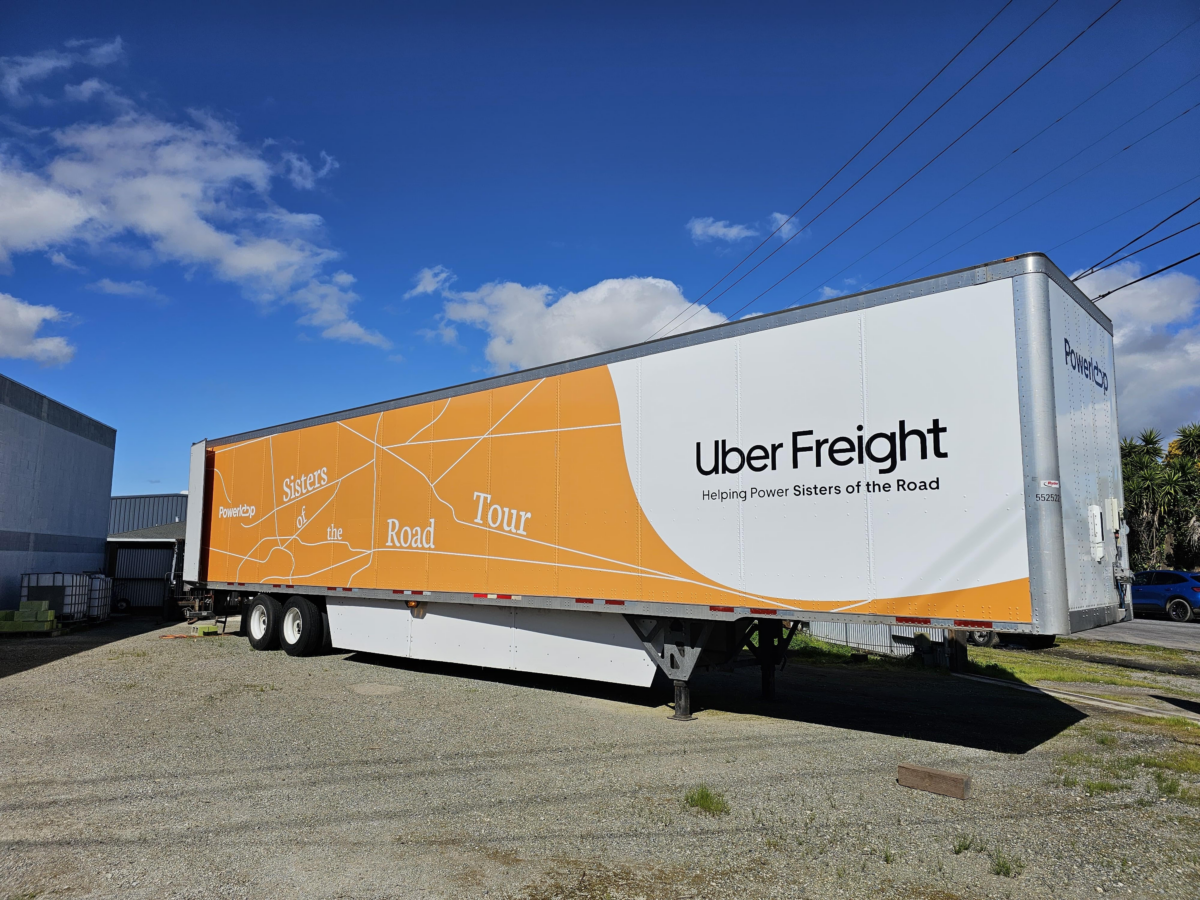
The collection will make its way across the country and be displayed in an Uber Freight trailer provided by the company’s Powerloop offering.

After Friday, the gallery will be picked up by trucker Deb Desiderato, who was also featured in the series, and will make its way to three stops throughout March with a convoy of women drivers trailing along.

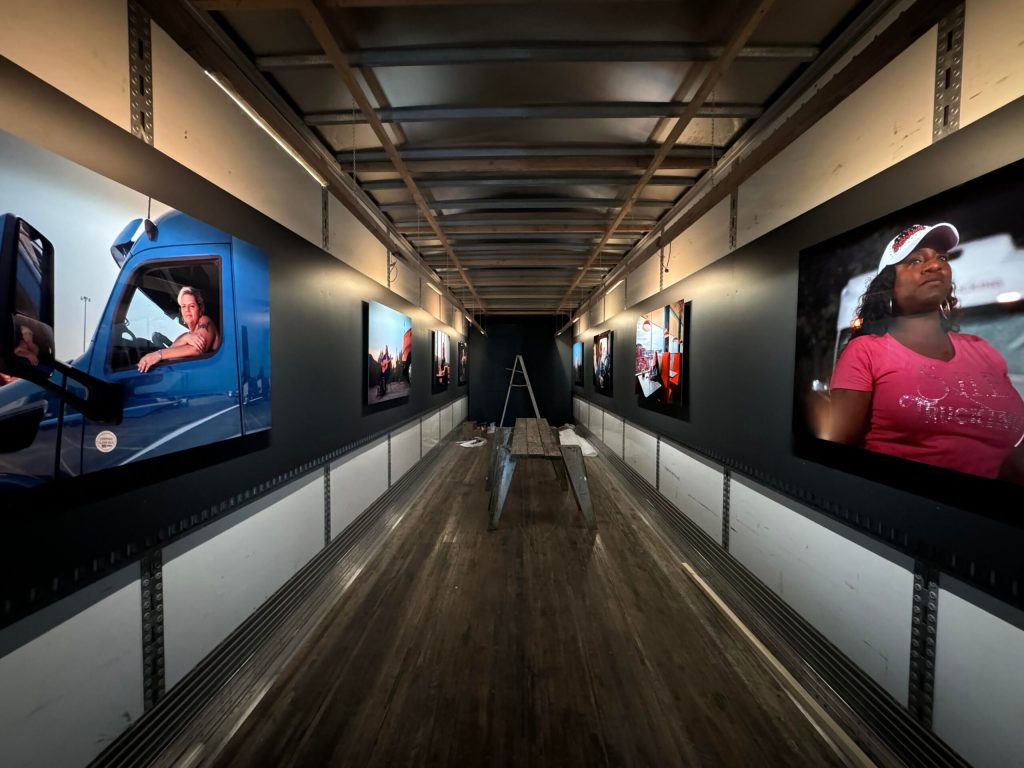
“Deb will be hauling the semitruck and the gallery is inside of it. In the actual book, there is 40 women, their stories and the landscapes that they travel through. The gallery inside the semitruck will showcase eight metal prints of the 40 in the book,” said Michel.

The first stop will be in Houston on March 8 for International Women’s Day at the international photography festival FotoFest. Next up, the convoy will roll into Little Rock, Arkansas, on March 17, making a special stop at Idella Hansen’s Petro Truck Stop. Hansen is a highlighted driver in the collection. The convoy will conclude its journey at the Mid-America Trucking Show (MATS) in Louisville, Kentucky from March 21-23.

Sisters of the Road photo of Idella Hansen. (Photo: Anne Marie Michel)

“I think its really cool what [Michel] is doing. I know some of the other women in the book, like Idella, who has been trucking for 57 years. She is my trucking hero. She’s never going to quit and I hope I never quit either,” Desiderato said,

Desiderato said she is also excited to be followed by a convoy of women truckers, who will all be sporting yellow gold bandannas throughout the trip.

Uber Freight’s Powerloop trailer will be hauled by Desiderato for the tour. (Photo: Uber Freight)

“We are actually starting the tour in Point Richmond [a city just outside San Fransico] which is where the Rosie the Riveter Memorial is. She is a cultural icon of women trailblazers in male-dominated industries. We have yellow gold bandannas, which match Rosie’s iconic bandanna and the color of the book and the truck. We will be handing them out along the tour and at MATS as a sign of solidarity and sisterhood among trucker women,” said Michel.

Uber Freight and the Powerloop team will assist women drivers interested in joining the convoy in finding loads that will let them link up with the group during the entire tour.


CNBC supply chain reporter, daughter pen book on family histories of slaves

3 things the logistics industry can learn from Brad Jacobs’ new book

TruckParkingClub.com unveils real-time parking availability in 8 states