




The Hualapai, Arizona Post Office serves ZIP Code 86412. Photo by Jimmy Emerson, some rights reserved. Photo shared under the Creative Commons License.
Hualapai Post Office
3880 Thompson Ave
Kingman, AZ 86409
Location at Google Maps

The Hualapai, Arizona Post Office serves ZIP Code 86412. Photo by Jimmy Emerson, some rights reserved. Photo shared under the Creative Commons License.
Hualapai Post Office
3880 Thompson Ave
Kingman, AZ 86409
Location at Google Maps

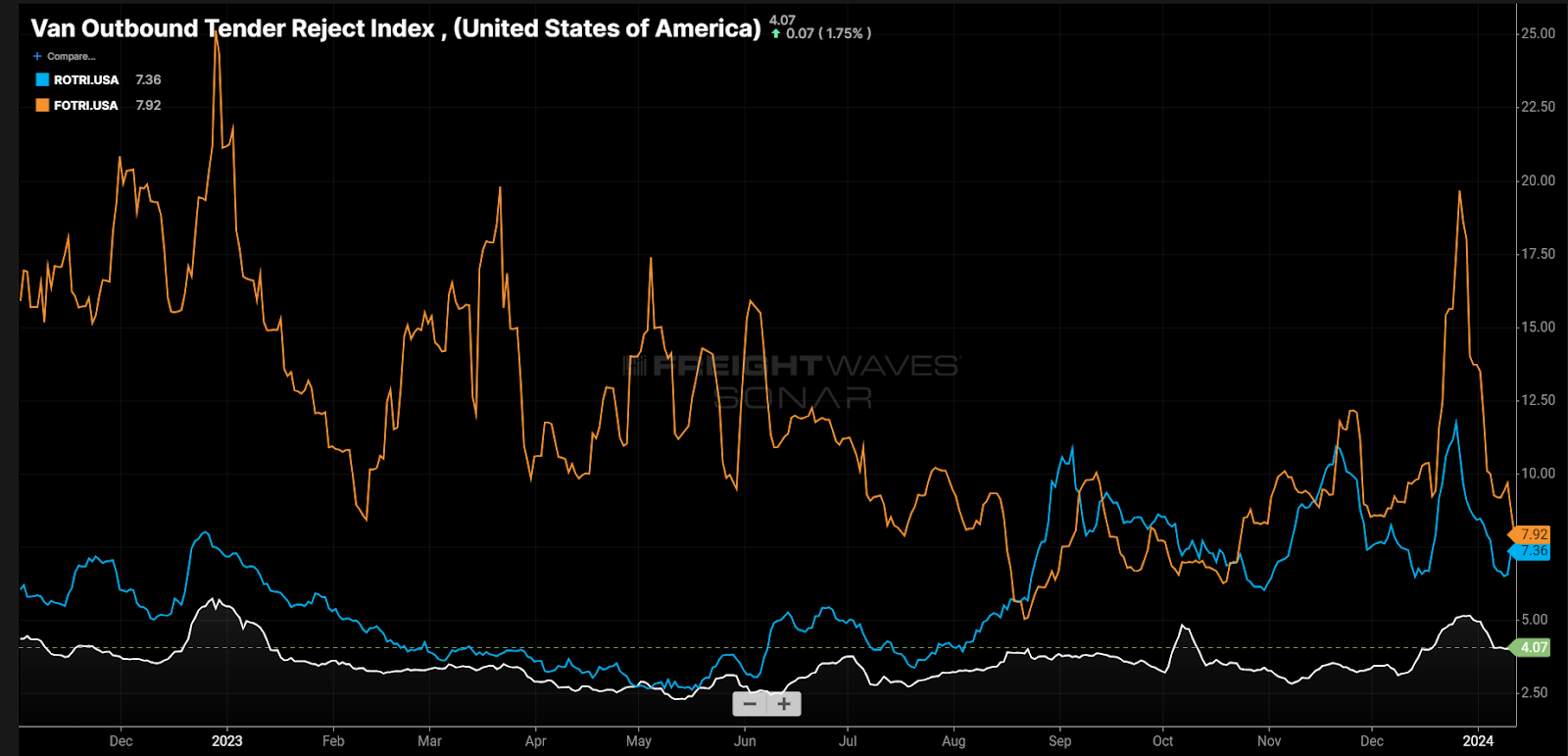
Chart of the Week: Outbound Tender Rejection Index – Van, Reefer, Flatbed SONAR: VOTRI.USA, ROTRI.USA, FOTRI.USA
Tender rejection rates for the three main trailer types all spiked as they seasonally do around Christmas. The aggregate read is that the market remains oversupplied with capacity, but that statement does not apply evenly.
Let’s take a look at the less-served equipment types of flatbed and refrigerated (reefer) and read the data to see what 2024 may hold for each.
Flatbed flattening
The flatbed space has been less stable than its dry van and refrigerated counterparts since the freight market collapsed in March 2022. Flatbed is more closely tied to manufacturing, energy and construction. Each of those sectors was handicapped during the pandemic thanks in large part to supply chain issues and quarantining. As a result, less attention was given to the space and therefore less capacity was added.
This is evidenced by an average tender rejection rate above 10% in 2023 compared to about 6% for reefer and about 3.3% for van. Some of the elevation is due to a much lower volume of representation inside the tender data, but flatbed rejection rates averaged lower than the other two trailer types in 2020-H1 of 2021 — a highly unusual development.
The general direction for national flatbed rejection rates was lower in 2023, averaging 9% in the second half of the year versus 13% in the first six months.
Flatbed activity tends to slow in the winter months due to the nature of the freight and weather conditions, but that is not an absolute and it does not mean the space loosens necessarily as capacity naturally declines because of this expectation.
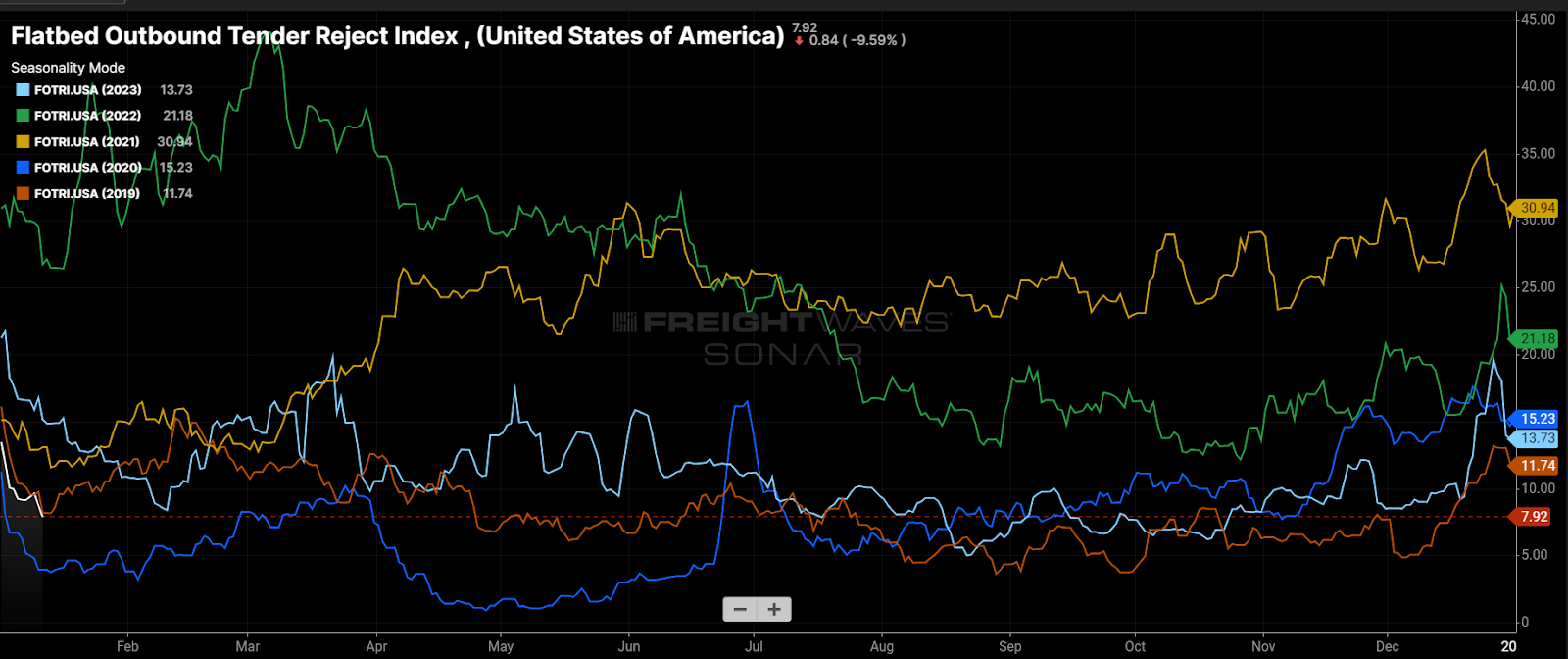
Flatbed rejection rates topped out just under 20% this year — its third-highest holiday value of the past five years, but below 2022. The read is that the flatbed market is stabilizing but still exposed to wild swings and nowhere nearly as stable as its closed-deck siblings.
Reefer madness
The refrigerated/reefer sector was the hottest trailer type in 2020-21 but became as easy to attain as the more common dry van counterpart in 2022 and through the first half of 2023.
Since May, however, the reefer space has started to perk up a bit, with rejection rates pulling off their floor values and sustaining at a level above van. After hitting a floor value of 2.7% and falling into perfect alignment with the Van Outbound Tender Reject Index (VOTRI) in May, the Reefer Outbound Tender Reject Index (ROTRI) topped 10% three times in the back half of the year.
Each of these peaks occurred around the three main holidays of the second half, but the main takeaway is that they were all higher than their 2022 values around the same time.
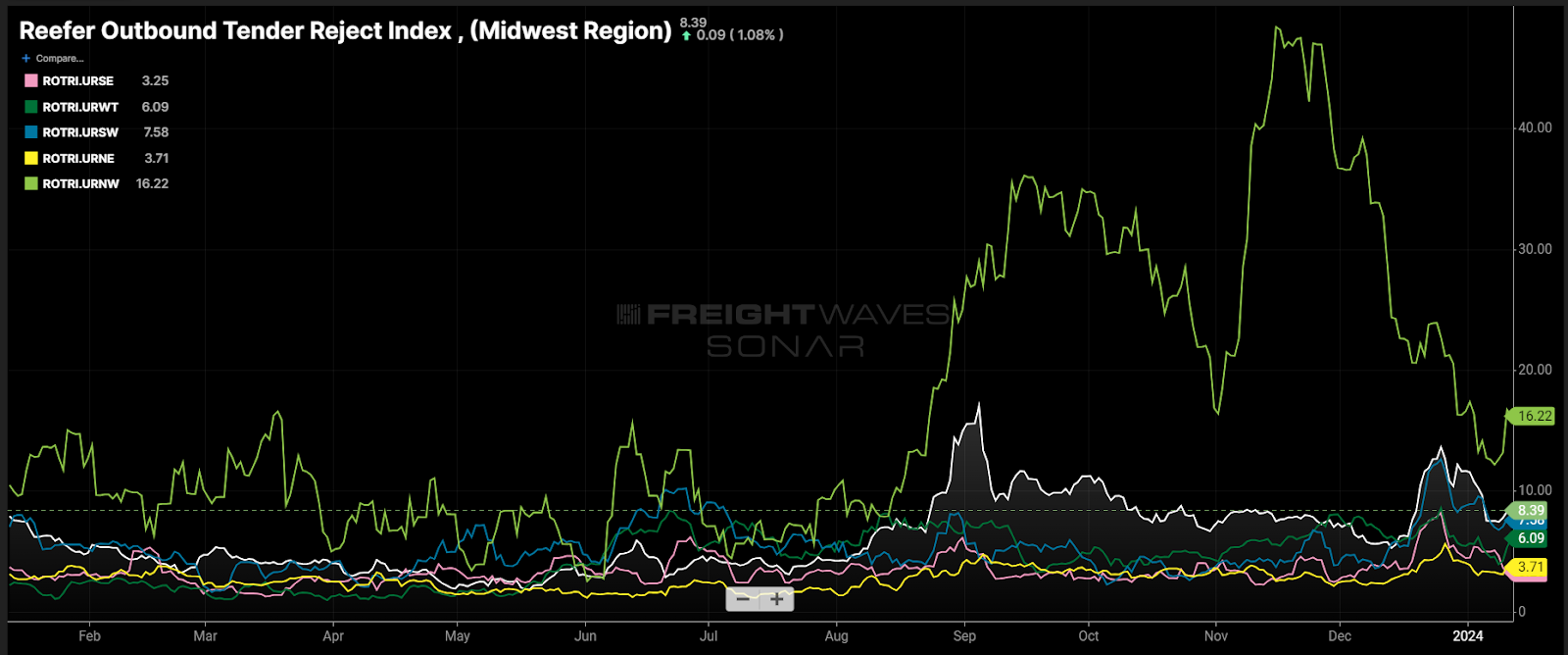
Looking at the ROTRI broken down by region, the main drivers of the increasing rejection rates occurred in the North and Midwestern regions. The Pacific Northwest has two major seasonal periods driven by harvests and Christmas trees.
Normally this area of the country is extremely well supplied, with carriers avoiding too much inbound freight as they have extreme challenges getting back out of the area. The terrain is also treacherous and weather can be a large disruption.
Erratic demand has always been a challenge, but the fact that it seems more of a factor tells us that the market has had a more impactful reduction in capacity this year than the van side. The late-year rejection rate trend, which may be more exacerbated by region, is for tightening to continue with the floor in the rearview.
The FreightWaves Chart of the Week is a chart selection from SONAR that provides an interesting data point to describe the state of the freight markets. A chart is chosen from thousands of potential charts on SONAR to help participants visualize the freight market in real time. Each week a Market Expert will post a chart, along with commentary, live on the front page. After that, the Chart of the Week will be archived on FreightWaves.com for future reference.
SONAR aggregates data from hundreds of sources, presenting the data in charts and maps and providing commentary on what freight market experts want to know about the industry in real time.
The FreightWaves data science and product teams are releasing new datasets each week and enhancing the client experience.
To request a SONAR demo, click here.

WASHINGTON — Federal regulators are providing a rare glimpse into information they may consider for a significant rule affecting how carriers are considered fit to be operating.
The Federal Motor Carrier Safety Administration published on Friday a “notice of data availability” — or “NODA” — to alert the public about a set of studies it could rely on to develop a proposed or final rule that will be used to determine a carrier’s safety fitness rating.
“This NODA is necessary to disclose such possible reliance and to provide the interested public an opportunity to comment on the accuracy and relevance of the information,” FMCSA stated.
P. Sean Garney, a motor carrier regulations expert and co-director of Scopelitis Transportation Consulting, pointed out that it’s the first such notice to be published by the agency since its inception more than 20 years ago, based on a search of Federal Register documents.
“What’s more interesting to me are the research titles listed and what they could mean for rulemaking,” Garney told FreightWaves. He noted that of six reports listed in Friday’s Federal Register notice, three are related to the effectiveness of driver-assist types of technology. A fourth study that is not listed in the Federal Register but has been added to the rulemaking docket relates to the effectiveness of front-crash prevention systems in reducing large truck crash rates.
All four cited a positive correlation between technology and safety.
“Could FMCSA be suggesting they’re considering crediting carriers who go beyond compliance by adopting safety technology?” Garney asked.
FMCSA posed that question — whether its current safety fitness determination (SFD) regulations consider motor carriers’ adoption and use of safety technologies in a carrier’s safety rating — in an advance notice of proposed rulemaking (ANPRM) issued last year.
The OOIDA Foundation, an affiliate of the Owner-Operator Independent Drivers Association, is reviewing the studies mentioned in the notice, an OOIDA spokesman told FreightWaves.
In comments filed on the ANPRM, OOIDA, which represents small-business truckers, maintained that installing safety technologies does not ensure improved safety.
“We believe rewarding carriers that simply adopt safety technologies without improving actual safety performance would only benefit motor carriers who can afford costly new technologies,” OOIDA stated. “If these motor carriers are rewarded with better safety ratings, then smaller carriers would likely see their safety rating downgraded without any actual change in their safety performance.
“We would also note that CMVs equipped with safety technologies today still end up in crashes. Driver training, experience, and safety performance must still be valued … over the mere installation of safety technologies.”
The Commercial Vehicle Safety Alliance (CVSA) sided with OOIDA in opposing FMCSA formulating a rule that would consider a carrier’s use of safety technology into the SFD.
In comments filed on the ANPRM, CVSA asserted that if a motor carrier that proactively deploys safety technology intended to prevent or mitigate the severity of crashes ends up receiving an “unfit” designation from FMCSA, the technology is not having its intended benefit.
“Either the technology has been purchased but is not being used properly, or the motor carrier’s other safety management processes are so insufficient that their poor performance offsets the safety benefit of the technology,” CVSA stated.
“Either way, the end result is that the SFD methodology has identified patterns of unsafe behavior that could, if deemed accurate, justify removing the motor carrier from operations. That determination should not be masked by adjustments to the SFD methodology in an attempt to reward carriers for deploying safety technology unsuccessfully.”
Reports and studies that FMCSA may consider in formulating a new safety rule:
Related articles:

The Supervisory Board of Daimler Truck AG has named Eva Scherer as its new chief financial officer and a member of the board of management following the death of former CFO Jochen Goetz from a reaction to a wasp sting in August.
Scherer was an executive vice president and global head of investor relations for German multinational technology conglomerate Siemens AG. She is the first female to lead finance and controlling at the leading German truck maker. Scherer begins work April 1 and has a three-year contract through March 31, 2027.
“The position of chief financial officer has tragically become vacant. Following an intensive selection process, the supervisory board has now filled the position,” Joe Kaeser, Daimler Truck supervisory board chair, said in a news release.
“In addition to professional expertise, we placed particular emphasis on open-mindedness, diversity, potential and enthusiasm to drive change. Eva Scherer has shown these attributes in a convincing manner.”
Scherer began her professional career in 2003 as a Siemens trainee. She held various management positions in purchasing, finance and controlling in Germany and Switzerland.
“With her broad financial experience she has gained in a large corporate group in a similar industry, she can provide important impulses that will benefit Daimler Truck on its path of transformation,” said Martin Daum, board of management chair. Daum had filled in as CFO since Goetz’s passing.
Separately, the company in December reappointed Andreas Gorbach as a member of the board of management, adding five years to his contract that expires on June 30. He has been responsible for truck technology since Dec. 1, 2021.
Daimler Truck CEO will take on finance role temporarily

Invoicing platform Navix announced it has entered into a partnership with top 10 U.S. brokerage Echo Global Logistics to provide support for Echo’s back-office automation goals.
“[Echo] felt that we had a solution that was an industry game changer and supplemented the direction of their technology roadmap,” Eric Krueger, co-founder and president of Navix, said on Tuesday. “Ultimately this allowed them to find opportunities within their workflows, processes, and even some instances where they were looking to improve their processes across the entire organization.”
Navix’s unique position in the market positions Echo to leverage the platform to manage exceptions and find invoice discrepancies before invoicing customers.
“We chose Navix because of its unique approach to connectivity with carriers and technology, which allows us to easily identify the root cause of the exception, and customized business rules which allow us to resolve that in a far more efficient manner for our carriers and clients,” said Pete Rogers, chief financial officer of Echo Global Logistics, in the release.
Evolving past current back-office technology, Krueger explained that Navix uses multiple points of freight intelligence, like pickup and drop-off locations, to quickly find inconsistencies.
“Maybe it is the first time or the 100th time [a logistics provider] has ever shipped to a specific location,” said Krueger. “Navix can use location data and knows that it is highly likely going to need a residential delivery because we have audited multiple bills with the same delivery address before.”
Having this knowledge supports operations in many ways. Among them: The customer will get a correct invoice and a better customer experience, there is no hassle with short payments in the accounting department, and the credit department will have an updated and accurate balance to work with.
While Echo will already have these capabilities, as the market does eventually turn, these are all operational hazards that need to be watched as brokers open themselves up to business growth and the hurdles that come with that.
“Solving back-office problems should be about proactive versus reactive,” said Krueger of the pain points that are often overlooked at scaling freight brokerages. “It’s structured as a reactive function of their business yet if you want to have better customer service experiences you need to be proactive about finding and solving these problems.”
While brokerages are currently watching their spending and how they approach technology investments, Krueger believes this is the time to execute these expenditures to prepare for scale as the market turns.
“I think it is a really good time to double down and invest in a solution that can immediately improve cash flow,” he said. “As soon as this market begins to tick upwards, the next question is, how are you going to support it? If you add that next client, or millions of dollars in business, do you have the back-office platform to support it?”
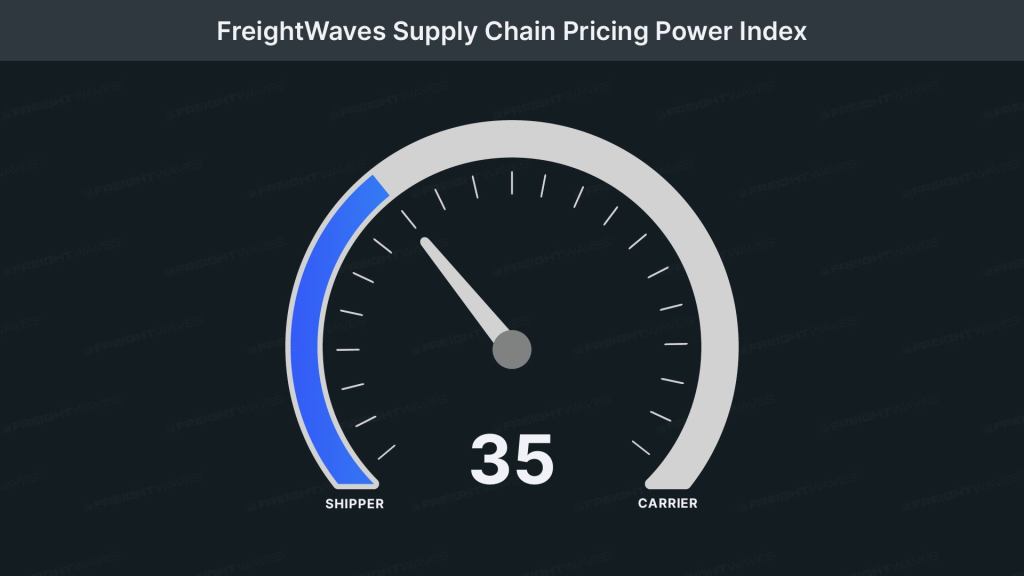
This week’s FreightWaves Supply Chain Pricing Power Index: 35 (Shippers)
Last week’s FreightWaves Supply Chain Pricing Power Index: 35 (Shippers)
Three-month FreightWaves Supply Chain Pricing Power Index Outlook: 35 (Shippers)
The FreightWaves Supply Chain Pricing Power Index uses the analytics and data in FreightWaves SONAR to analyze the market and estimate the negotiating power for rates between shippers and carriers.
This week’s Pricing Power Index is based on the following indicators:
Freight demand has returned with a vengeance, as the flow of accepted volumes is outpaced even the booming years of 2021 and 2022 (the latter of which saw an unseasonably active Q1 before heralding the current downturn and recovery). Great news but, before any champagne gets popped, numerous caveats must be made.
First, as will be discussed in more detail below, tender rejections are languishing at substandard levels. When I write that shippers have been energetic in the first two weeks of 2024, carriers and brokers will likely scratch their heads — and rightfully so. The sustained imbalance between supply and demand has yet to be corrected, such that only an unprecedented tidal wave of demand could satisfy the current amount of capacity in the national freight economy. To hope for anything beyond precedent after these wild past few years is reckless, to say the least.
Second, we have only now shaken off the holiday lull that curbed truckload activity, so it would be hasty to draw any far-reaching conclusions just yet. Finally, although there are many positive signs for domestic freight demand in the not-too-distant future, there are also numerous headwinds varying in strength for 2024.
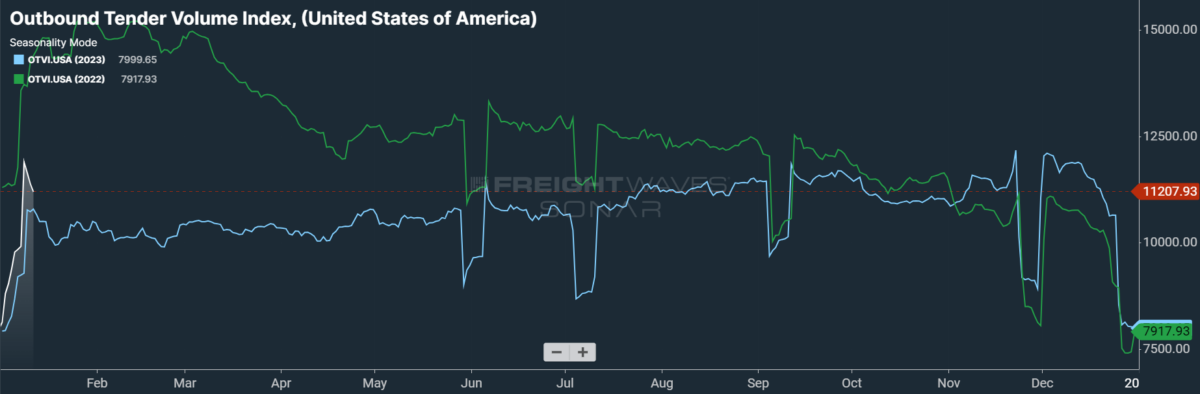
This week, the Outbound Tender Volume Index (OTVI), which measures national freight demand by shippers’ requests for capacity, rose 5% year over year (y/y). Weekly comps are not extremely informative at present, given the battery of winter holidays over the past few weeks. That said, y/y comparisons can be colored by significant shifts in tender rejections. OTVI, which includes both accepted and rejected tenders, can be inflated by an uptick in the Outbound Tender Reject Index (OTRI).
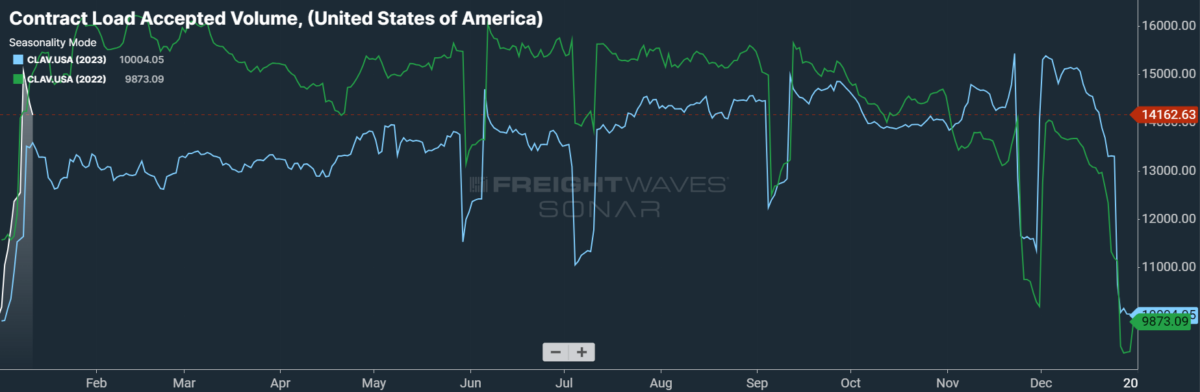
Contract Load Accepted Volume is an index that measures accepted load volumes moving under contracted agreements. In short, it is similar to OTVI but without the rejected tenders. Looking at accepted tender volumes, we see a rise of 6.88% y/y. This positive y/y difference implies that actual freight flow is recovering from this cycle’s bottom.
With August 2022’s signing of the Inflation Reduction Act as well as the CHIPS and Science Act, manufacturing firms have been offered over $250 billion worth of tax credits and other incentives to catalyze reshoring operations. Yet while there is a bevy of such projects fueled by government spending near at hand, the industrial sector has been slow to recover from its current depression. According to data from the Institute for Supply Management, December marked 14 consecutive months of contraction in the manufacturing sector.
In a similarly conflicting vein, the December jobs report revealed a labor market that was far hotter than consensus expectations, casting doubt on the possibility of near-term interest rate cuts from the Federal Reserve. In December, the U.S. added a staggering 216,000 jobs, far above both the consensus growth forecast of 175,000 and even the high-end estimates of 190,000. Still, the month secured easy comps against October and November, both months for which initial payroll readings were revised substantially lower.
Confusion mounts, however, when turning to the report’s Household Survey, which tracks the number of newly employed persons rather than newly created positions. According to December’s Household Survey, the number of employed workers tumbled by 683,000 — the largest monthly drop since April 2020, when the global economy grappled with unprecedented lockdowns. That December was a weak month for job growth is not surprising in itself, since the month consistently ranks as the second-most popular month for job cuts. But the question that remains unanswered is how the Fed will interpret this report at its next meeting in late January, and whether it will walk back some of its previously dovish messaging.
Inflation data from last month will likely persuade the Fed to consider pivoting back to a default hawkishness. The headline consumer price index (CPI) came in slightly hotter than expected, rising 0.3% month over month (m/m) and 3.4% y/y against consensus forecasts of 0.2% m/m and 3.2% y/y gains. On the other hand, the core CPI — which excludes goods with volatile pricing like food and energy — posted a gain of less than 4% y/y for the first time since May 2021. And while energy prices (down 2% y/y) continued to tumble from previous highs, food prices (up 2.7% y/y) rose steadily, a trend particularly acute in prices for food away from home (up 5.2% y/y).
When looking to make heads or tails of this data, perhaps the single deciding factor is “supercore” inflation, or core services less housing. In its protracted fight against inflation, the Federal Reserve has consistently named supercore inflation as its most valued metric. Last month, supercore inflation spiraled 0.4% m/m and 4.1% y/y. At the start of December, the Fed broadcast unambiguously dovish signals, leading some analysts to believe that rate cuts could take effect as soon as March. The Fed has since retreated from this naked dovishness to its more familiar stance of intentional inscrutability. December’s supercore inflation data will likely persuade the Fed to hold its cards even closer to the chest in the coming weeks.
By mode: Reefer demand is relatively stagnant at the start of January, trending only slightly above 2023 levels. Yet reefer volumes could soon ignite as winter storms threaten much of the Great Plains and upper Pacific Northwest, since reefers are commonly used to insulate freight against severe temperatures. One of the greatest periods for reefer demand in recent history was late February and early March 2021, when a severe cold wave swept across North America, causing power outages and damaging infrastructure. While we cannot hope for a repeat of such a catastrophic storm, it serves to illustrate the point that reefer demand benefits from cold weather. For the time being, however, the Reefer Outbound Tender Volume Index is up a slim 1.88% y/y.
Van volumes, on the other hand, face slightly easier comps but are positioned to fail even those in the coming weeks. The Van Outbound Tender Volume Index (VOTVI) shot up in the second week of January but has been falling precipitously over the past two days. At the time of writing, VOTVI is still up 3.01% y/y.
There is not much left to say about tender rejections that has not been said already. OTRI kicked off 2024 below even the dismal levels of the previous year and has flatlined in the days since. While the transportation sector suffered a loss of 22,600 jobs in December, this figure was almost entirely caused by the 32,300 positions lost among couriers and messengers (a category that includes parcel delivery services). Amazingly, the truck transportation subsector gained 3,300 jobs in the month. It is a sad fact that bears repeating: The market will not rebalance until capacity is shed.
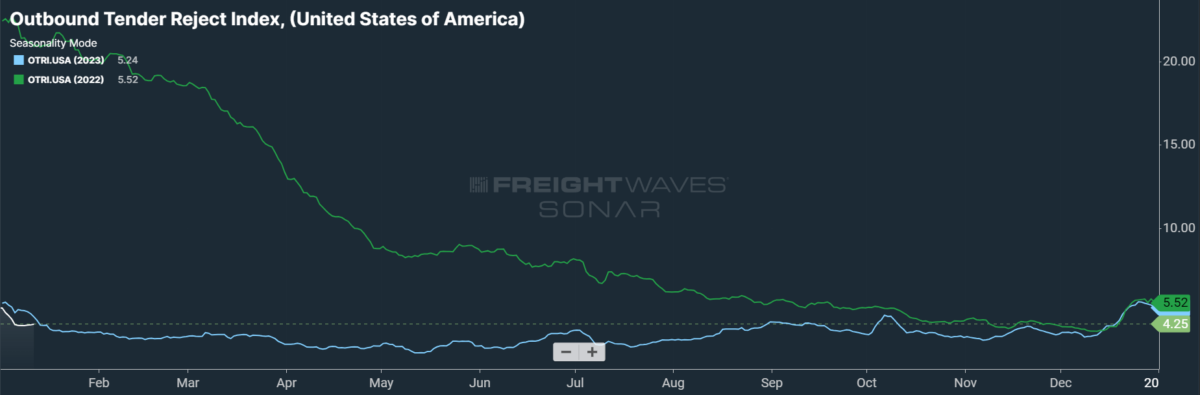
Over the past week, OTRI, which measures relative capacity in the market, fell to 4.25%, a change of 30 basis points from the week prior. OTRI is now 44 bps below year-ago levels, despite facing incredibly easy comps.
The Department of Labor has finally released its formal update on a contentious rule that could reclassify certain independent owner-operators as company drivers: that is, as employees of the carriers that hire them. If reclassified as employees, such owner-operators would be entitled to benefits like health insurance, but could also face restrictions on their operational autonomy. Ultimately, the new update brings little clarity to the issue, alternately favoring employee status and independent contractor status throughout. Clarity will be found when the issue is brought before the courts, which will use the DOL regulation as one precedent among many.
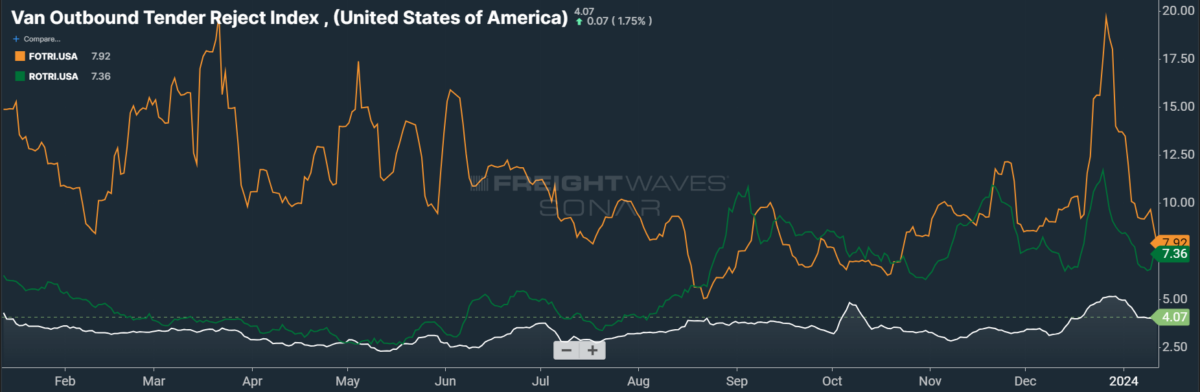
By mode: Flatbed rejection rates have fallen dramatically from their recent peak, at which point flatbed carriers were rejecting nearly one in five loads. The construction sector has broadcast encouraging signals for future demand, as housing starts rose a blistering 14.8% m/m in November. This surge was driven almost exclusively by rising single-family housing starts, which soared 18% m/m. Although the average rate on a 30-year fixed mortgage has come down from October’s high of 7.79%, it has begun to tick up throughout 2024 so far, currently sitting at an ominous 6.66%. The Flatbed Outbound Tender Reject Index, meanwhile, has fallen 202 bps to 7.92% since last week.
Despite relative stagnation in reefer demand, reefer rejection rates are beginning to rise once more, implying that the holiday bump is no longer in play. Instead, cold winter weather is likely to drive organic growth among reefer rejection rates over the next few weeks. At present, the Reefer Outbound Tender Reject Index is down 37 bps since last week at 7.36%, but is trending distinctly upward.
Spot rates are sustaining their holiday momentum with surprising tenacity. In the first 11 days of 2023, spot rates had fallen 9 cents per mile from their early peak for a loss of 3.2%. So far into 2024, spot rates have only declined 2% or 5 cents per mile from their year-to-date high. While the difference is not staggering, it is nevertheless a positive sign that the market is in recovery — however slow and agonizing it might be. Furthermore, diesel prices have continued to follow oil prices downward in 2024, more than 70 cents per gallon lower than they were at this time last year.
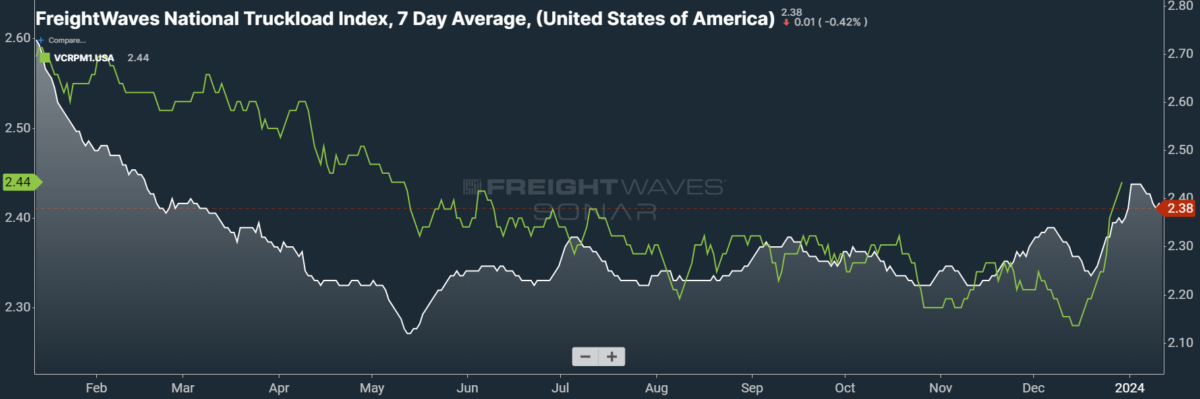
This week, the National Truckload Index (NTI) — which includes fuel surcharges and other accessorials — fell 5 cents per mile to $2.38. Declining diesel prices were partially responsible for this week’s loss, as the linehaul variant of the NTI (NTIL) — which excludes fuel surcharges and other accessorials — fell 4 cents per mile to $1.77.
Contract rates, which are reported on a two-week delay, are showing massive gains made at the end of 2023, albeit ones that failed to match year-ago highs. The quickness with which contract rates lose their holiday momentum will be an early indication of the pricing power that shippers exercised in the ongoing bid cycle. For the time being, contract rates — which exclude fuel surcharges and other accessorials like the NTIL — are up 10 cents per mile on a weekly basis at $2.44.
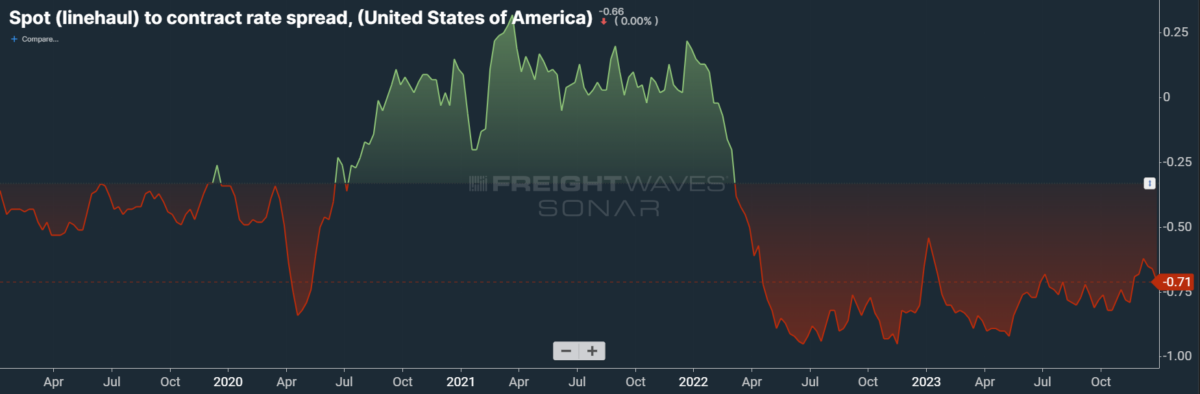
The chart above shows the spread between the NTIL and dry van contract rates, revealing the index has fallen to all-time lows in the data set, which dates to early 2019. Throughout that year, contract rates exceeded spot rates, leading to a record number of bankruptcies in the space. Once COVID-19 spread, spot rates reacted quickly, rising to record highs seemingly weekly, while contract rates slowly crept higher throughout 2021.
Over the course of 2023, this spread averaged 10 cents lower than in 2022, indicating that contract rates had yet to come into balance with the market’s fundamentals of carriers’ supply and shippers’ demand. These lopsided fundamentals were more appropriately reflected in spot rates, which are highly reactive to shifting market conditions. As linehaul spot rates remain 71 cents below contract rates, there is plenty of room for contract rates to decline — or for spot rates to rise — in the first half of 2024.
For more information on the FreightWaves Passport, please contact Michael Rudolph at mrudolph@www.freightwaves.com or Tony Mulvey at tmulvey@www.freightwaves.com.

A Delaware bankruptcy court blessed the sale of 23 of bankrupt less-than-truckload carrier Yellow’s leased service centers on Friday. The second round of terminal sales will fetch $83 million, according to court filings.
A Dec. 20 filing with the court originally showed the results from the two-day auction that began on Dec. 18. The latest transactions were said to represent “the highest or otherwise best offer” for the assets.
A hearing scheduled for Friday was canceled as all objections to the sales had been resolved. In recent weeks, numerous landlords had filed objections with the court, claiming that cost-to-cure estimates provided by Yellow showed amounts much smaller than those actually due for repairs and back rent. Some of the property owners also wanted additional time to vet their new LTL tenants.
The first round of terminal sales included 130 terminals, most of which were owned, and raked in nearly $1.9 billion.
FedEx Freight (NYSE: FDX) was a newcomer to the proceedings with a winning bid for one terminal near Reno, Nevada, valued at $22.5 million. The nation’s largest LTL carrier undertook a plan last spring to unload 29 terminals, predominately in the Midwest, in efforts to right-size its national network.
The rest of the winning bids in the second auction were from five other carriers that were also active in the first round.
Estes had the largest bid at $35.3 million for five properties. It previously landed 24 terminals valued at $248.7 million.
Greenwood Motor Lines (R+L Carriers) won three terminals with a $9 million bid. It took home eight in the first round for $211.5 million through its real estate arm Ramar Land Corp.
The filing showed that Saia (NASDAQ: SAIA), ArcBest (NASDAQ: ARCB) and Knight-Swift (NYSE: KNX) will again add some of Yellow’s real estate to their networks.
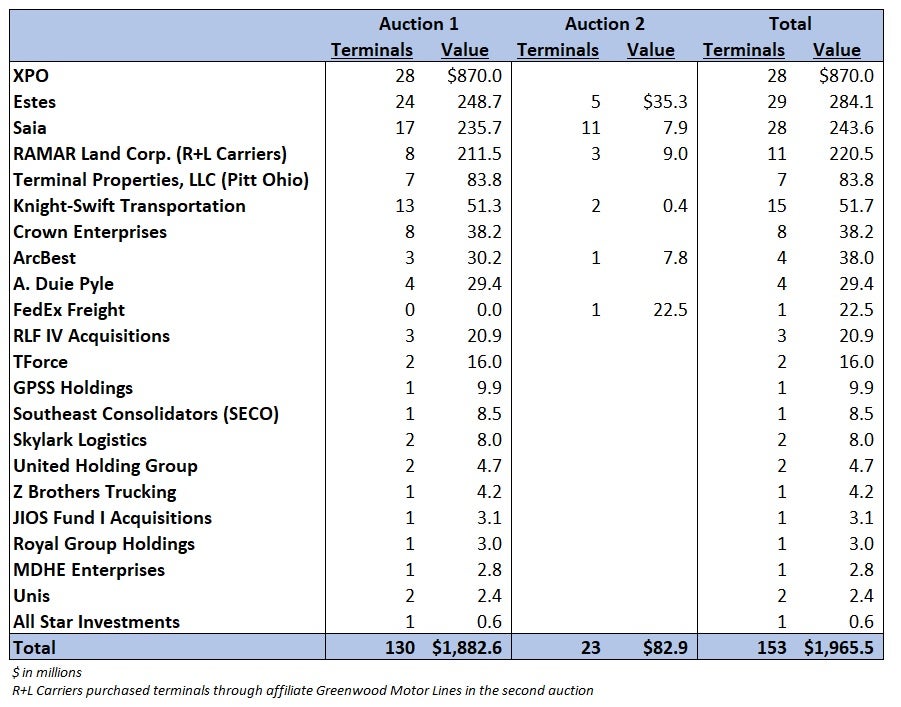
Prior court filings showed the estate still needs to unwind 118 leased properties and 46 owned terminals. No update was provided on that auction process. In total, the estate has moved close to half of the company’s nonrolling stock at a price tag of nearly $2 billion.
A separate liquidation of Yellow’s 12,000 tractors and 35,000 trailers remains ongoing.
The court is expected to soon hear arguments regarding Yellow’s potential withdrawal liability claims from multiemployer pension funds that filings have shown could exceed $7 billion. However, bankruptcy experts have communicated to FreightWaves that the claims are likely to settle for just a fraction of that amount.
Other outstanding claims to the estate include more than 200 personal injury claims and payouts due, if any, for failure to timely comply with Worker Adjustment and Retraining Notification Act guidelines.
More FreightWaves articles by Todd Maiden

FreightWaves Classics is sponsored by Old Dominion Freight Line — Helping the World Keep Promises. Learn more here.
FreightWaves explores the archives of American Shipper’s nearly 70-year-old collection of shipping and maritime publications to showcase interesting freight stories of long ago.
In this week’s edition, from the December 1986 issue, the Federal Maritime Commission put an end to a six-month legal battle with the conclusion that one party was trying to “bluff” its way into a contract.
After six months of legal haggling, the Federal Maritime Commission closed the door for good on a complaint brought by Container Distribution, Inc., a Los Angeles-based NVOCC, against Neptune Orient Line, Ltd. for allegedly refusing to enter into a service contract with the NVO.
A look at the record in the case convinced FMC administrative law judge Charles E. Morgan that Container Distribution was in effect trying to bluff its way into a service contract with NOL through its legal maneuvering at the Commission.
The FMC law judge took note of the fact that despite attempts by the agency to accommodate the complaining NVO, the firm failed to show up at a mid-July prehearing conference and also failed to respond to discovery requests. Judge Morgan, in effect, said that while NOL (as the defendant in the case) followed FMC legal procedures, Container Distribution’s failure to follow through on its complaint was simply nothing more than “an abuse of process.”
While not going through NOL’s long list of examples of how Container Distribution used the FMC forum as a tool to worm its way into a service contract, Judge Morgan noted “many” examples cited by the Singapore-based carrier to achieve such a result.
In late August, Container Distribution sought to have its complaint dismissed, but with the stipulation that the NVO would have the right to resurrect the action. This is where Judge Morgan drew the line. Container Distribution, he said, on the basis of its conduct in the case, “has forfeited any right it may have had to reinstitute its complaint.”
In a paper filed with the Commission, NOL attorneys Richard K. Bank and Eliot J. Halperin noted that “there were several contacts” between the two parties from the time the NVO requested a contract back in February 1986. It was further noted that CDI sent copies of all communications to NOL, including a March 12,1986, telex in which the NVO threatened the shipping line with an FMC proceeding, complaints to Congressional committees, and to various government officials.
The NOL attorneys summarized CDI’s conduct which shows various degrees of pressure, including negative press publicity. In the words of the NOL lawyers, here is how the whole case unfolded:
“On April 8,1986, CDI transmitted to NOL a ‘complaint’ which purported to begin a Commission proceeding. Assuming that document to be a valid complaint requiring NOL to spend effort and money to defend, in fear of FMC sanctions, CDI contacted NOL by letter of April 24 seeking to increase the pressure. CDI again sought a contract, resulting from NOL’s negative reply of May 7.
Upon learning from the Commission that its initial “complaint” was inadequate, CDI filed a corrected document April 28. Then on May 21, after the complaint was served on NOL, CDI’s representative telephoned NOL’s San Francisco office and said that NOL could avoid the already negative publicity in the press by entering into a contract with CDI because CDI would then withdraw its complaint. CDI’s representative even offered to visit NOL’s home office in Singapore. NOL again declined CDI’s request but agreed to inform NOL’s Singapore office of the desired visit. NOL confirmed this position by letter of May 23.
On May 24, CDI sent a letter to NOL, again agreeing to withdraw the complaint in exchange for a contract. CDI also requested a meeting in Singapore. CDI’s representative went to Singapore and met with NOL personnel on June 17. At the meeting, CDI was informed that NOL would not discuss the Commission case since it was in the hands of NOL’s lawyers. NOL also repeated a statement it had already made to CDI. CDI was told that NOL will always be willing to discuss and negotiate with any shipper concerning a service contract. When CDI proposed terms to NOL, NOL declined those terms based upon market conditions and business judgment.
CDI’s efforts did not end there, however, and CDI persisted in trying to persuade NOL to enter into a contract on the promise that CDI would withdraw its complaint. In a telephone conversation of August 12, the day before the prehearing conference (at the FMC) which CDI did not attend, CDI’s attorney offered to withdraw the complaint if NOL would agree to a contract. The reasons were again negative, and CDI then put NOL to the greatest expense that it could, without CDI having to do anything further: CDI forced NOL to attend the prehearing conference and reply to CDI’s discovery requests when CDI knew full well that it would not attend the conference and would not reply to NOL’s discovery requests.”
Referring to the above sequence of events, attorneys for NOL concluded: “CDI’s sole initial purpose was to frighten NOL into agreeing to a contract; and when the attempt failed, CDI’s objective was to force NOL to incur the maximum possible litigative costs without CDI having to incur any. As CDI’s actions demonstrate, CDI dragged this proceeding as long as it could, by instructing its attorney to continue seeking baseless postponements of the prehearing conference, without any intention to send its attorney to Washington, or to respond to NOL’s discovery requests.”
“Having engaged in abusive conduct toward the Commission and Respondent, and having misused Commission complaint procedures solely as a means of harassment, CDI has forfeited its right to reinstitute its complaint,” the NOL attorneys said. The FMC law judge apparently agreed with them for he put an end to the case by dismissing it “with prejudice,” which means CDI will not be permitted to have the case reopened.
FreightWaves Classics articles look at various aspects of the transportation industry’s history. Subscribe to our newsletter!
Have a topic you want us to cover? Email bjaekel@www.freightwaves.com.
Delta Air Lines on Friday reported that cargo revenue during the fourth quarter fell 24% year over year to $188 million, but the result represented an improvement from the rest of 2023.
As the first publicly traded airline to report earnings each quarter, Atlanta-based Delta (NYSE: DAL) serves as a harbinger of what to expect across the industry. Delta’s cargo results suggest it caught a bit of a tailwind during the fourth quarter, when a mini-surge of demand for e-commerce and other shipments pulled the market into positive territory for the first time in nearly 18 months.
Delta recorded year-over-year declines in cargo revenue ranging from 28% to 37% in the prior three quarters. For the full year, Delta’s cargo sales were down 31% to $723 million. The fourth quarter is typically the strongest period for air logistics companies because of seasonal shipping patterns leading up to big holiday shopping events.
The first quarter is normally slower for air cargo carriers, but disruption of shipping through the Red Sea could benefit air carriers this year.
Delta Cargo informed customers that it will not accept most specialty shipments in Chicago from noon on Friday until noon on Saturday because of a blizzard in the area. Weather conditions are also limiting some types of shipments at its facilities in Detroit and Dallas-Fort Worth, it said.
Delta said fourth-quarter revenue across the enterprise rose 6% to a record $14.2 billion, ahead of expectations by $420 million, on strong holiday travel demand, a 25% jump in international travel year over year and accelerating corporate sales. It posted net income of $2 billion, up from $828 million a year ago. But a slight lowering of earnings projections for the first quarter sent shares down on Wall Street.
Delta also announced it will buy 20 A350-1000 passenger aircraft from Airbus and take options for 20 more of the long-haul jetliners. The company already operates the smaller A350-900.
Click here for more FreightWaves/American Shipper articles by Eric Kulisch.
Contact reporter: ekulisch@www.freightwaves.com
Air cargo market: From ‘doom mongering’ to stability
Delta Air Lines cargo revenue drops 36% on slow freight demand

On today’s episode of WHAT THE TRUCK?!?, Dooner is talking to NASA pilots David Nils Larson and James Less about the agency’s new super quiet supersonic jet. NASA, in collaboration with Lockheed Martin, is unveiling the X59 supersonic plane Friday, and we’re going to bring you up to speed on this jet set to dampen sonic booms.
Global trade is at war as U.S. military forces and the United Kingdom along with support from Australia, Bahrain, Canada and the Netherlands launch strikes against Houthi targets. Sal Mercogliano talks about the impacts this will have on global trade as the conflict escalates.
Plus, Uber Freight slashes jobs; GXO shuts down Memphis facility; Maersk starts using rail to bypass Panama Canal; the challenges with onboarding; worst of CES; and the logistics of playground safety inspectors.