Lawsuit could launch different type of legal battle between FedEx Ground, contractors
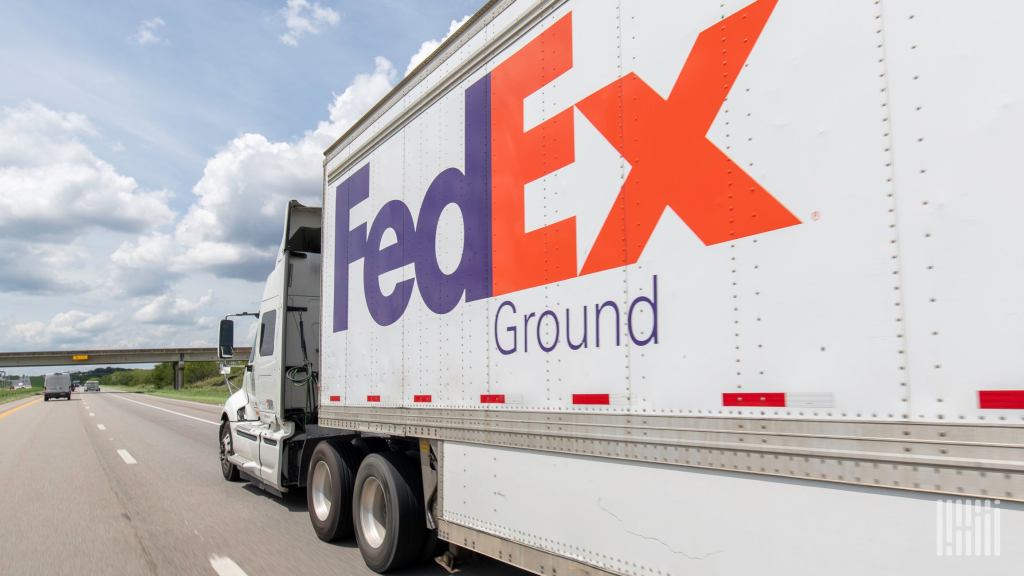
In 2015 and 2016, FedEx Ground paid more than $450 million to settle multiple lawsuits alleging that the FedEx Corp. ground delivery unit classified its delivery driver workforce as independent contractors when in reality they functioned as employees entitled to the benefits that come with that status.
The matter lay dormant until mid-November, when PYNQ Logistics Services Inc., a former FedEx Ground contractor that operated on the California-Oregon border, sued the unit on grounds that it violated the Racketeer Influenced and Corrupt Organizations Act (RICO) by fraudulently inducing the company to enter into a contract with the understanding that it would be independent but was instead subject to controls that required it to function like an employee.
The 99-page lawsuit, filed Nov. 14 in U.S. District Court for the Northern District of California, could open up a new legal frontier for the FedEx unit (NYSE: FDX) and its nearly 7,000 driver contractors, especially if the case evolves into a class action as PYNQ said it reserves the right to ask for.
In the pleading, PYNQ’s attorneys said the unit requires its contractors to “represent they are each” independent contractors but then implements policies and procedures to exercise the “same level of control over the operations of the contractors and their employees an employer would. The system integrates the contractors into the FedEx Ground system with very little practical distinction” between the operations of the unit and its contractors.
The suit alleges that FedEx Ground can change business policies and requirements without having to compensate contractors for any losses as a result of the policy changes. FedEx Ground also intentionally limits the operations, growth and size of its contractors, which constitutes an illegal restraint of trade, the suit alleges.
FedEx Ground did not respond to a request for comment.
A person familiar with the matter said the strategy of suing under the RICO statute has the effect of setting aside certain provisions of the contract that could be interpreted as unfavorable to contractors. Under the contracts, contractors waive the right to seek class-action status. The contracts also limit a contractor’s monetary damages to the prior 12 months of profitability, which could vary significantly from contractor to contractor. In addition, disputes are subject to mandatory arbitration, which means that a case cannot be heard in front of a jury and the outcome be kept confidential, the person said.
A plaintiff that prevails under the RICO statute could be entitled to significant monetary damages, including possible disgorgement of profits from the defendant, the latter being particularly devastating.
The case was filed in a jurisdiction regarded as friendly to labor and worker interests.
Around the time of the earlier settlements, FedEx Ground changed its operating structure so it would no longer deal directly with drivers but would insert a layer of Independent Service Providers that would hire and fire drivers and be responsible for investing in and managing their respective businesses. Since that time, however, contractors have been subject to a broader and more demanding litany of company requirements that put them even deeper under FedEx Ground’s control, the person said.
FedEx Ground’s contractors, all of whom are nonunion, are awarded routes that they are able to sell at a time of their choosing. Contractors are required by their contractors to maintain certain levels of performance standards.
Is the freight market in recovery; smuggling Santa Clauses; drones take flight – WTT
On today’s episode of WHAT THE TRUCK?!? Dooner is talking to FreightWaves’ Donny Gilbert about what the data in SONAR has to say about the freight market. Are we seeing signs of a recovery? Why are wait times up if freight is down? What do ocean containers tell us about Q1?
Freight Ninja is on a mission to fix truck parking. With only one parking spot for every 11 trucks, this issue costs drivers an estimated $5,900 a year. John Borsellino and Chris Lantz tell us all about their solution to this problem.
Urban drone delivery is Matternet’s goal. We’ll find out from Will Urban and Andreas Raptopoulos how they’re delivering in this highly regulated market and we’ll learn when drones will really take off.
Simply Trade Podcast’s Lalo Solorzano and Andy Shiles wonder if Santa Claus is a smuggler in the eyes of customs. We’ll look at how shippers and Santa make sure your presents make it out of an intensive exam.
Plus, a strike at DHL; trucker Barbie gains traction; Mack gets ready for Christmas; and what it’s like on a container ship in the Red Sea.
Trailer side-guard rule likely delayed until at least October 2024
WASHINGTON — A proposed rule to mandate equipment aimed at preventing deaths in collisions between trucks and passenger cars — if such a rule is forthcoming at all — likely will not see action until at least October 2024.
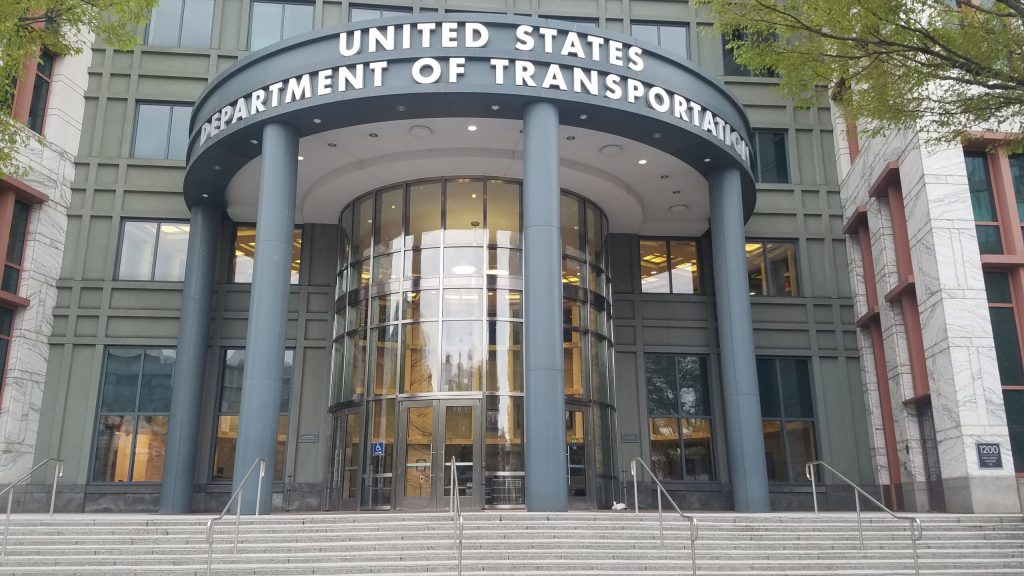
The National Highway Traffic Safety Administration’s rulemaking on side underride guards on trailers and semitrailers will be in an “analyzing comments” stage for the next 10 months, according to the U.S. Department of Transportation’s fall regulatory agenda submitted this week to the White House’s Office of Management and Budget.
The public comments were filed over a 90-day period immediately following an advance notice of proposed rulemaking (ANPRM) published by NHTSA in April.
While rule timelines set in agency agendas can change as administration priorities change, they typically will be pushed back, not speeded up. That means if NHTSA decides to move to the next stage in the rulemaking process — a formal notice of proposed rulemaking (NPRM) — for side underride guards, it could be at least a year away.
NHTSA has been under pressure to either significantly revise the proposal before formally issuing a rulemaking, or shelve it entirely, after receiving feedback from both truck safety advocates and truck industry lobbying groups.
The agency estimates that requiring guards along the sides of trailers to prevent passenger cars from sliding underneath in a collision would boost the cost of a new trailer by approximately $3,740 to $4,630, with total annual cost projected at $970 million to $1.2 billion.
But safety and insurance groups argue that NHTSA’s determination of approximately 17 lives saved and 69 serious injuries prevented each year if underride guards were mandated is significantly underestimated.
FMCSA: Driver seizure disorders, sexual harassment
OMB’s latest agenda also lists two first-time rules to be published by the Federal Motor Carrier Safety Administration in 2024.
An ANPRM on the minimum training requirements for entry-level commercial motor vehicle operators will “seek information from stakeholders regarding ways in which FMCSA can enhance the physical safety of women truck drivers and trainees and address the negative impacts of workplace sexual harassment,” according to an abstract of the advance rule, which is scheduled to publish in June 2024.
It notes that the ANPRM would also seek information from commenters on ways FMCSA “can enhance the safety of vulnerable road users, such as pedestrians and bicyclists.”
FMCSA plans to publish an NPRM on a driver seizure standard in July 2024, according to the agenda, that would update driver qualification standards for operating a commercial truck for those with epilepsy or other conditions that can cause loss of consciousness while driving.
“FMCSA proposes to reduce the burden on individuals who have experienced a seizure, or who have been prescribed antiseizure medication provided certain criteria are satisfied,” the rule summary says.
“The criteria would mirror those used for the Agency’s Seizure Exemption Program, including a requirement for the drivers to obtain documentation from the treating neurologist that the individual has been seizure free for a period of several years.”
Unique ID rulemaking gone
A controversial proposal to require all trucks to be outfitted with a unique identification number has apparently been canceled.
The ANPRM, which received over 2,000 comments after it was published in November 2022 and which would have overhauled roadside inspections, was rejected by much of the trucking industry while supported by truck safety groups.
FMCSA had scheduled a full NPRM for the proposal in November, according to DOT’s spring agenda, but the proposal was dropped from the latest agenda.
Running on Ice: Cold acquisitions to close out the year
Hello, and welcome to the coolest community in freight! Here you’ll find the latest information on warehouse news, tech developments and all things reefer madness-related. I’m your controller of the thermostat, Mary O’Connell. Thanks for having me!
All thawed out
(Photo: Jim Allen/FreightWaves)
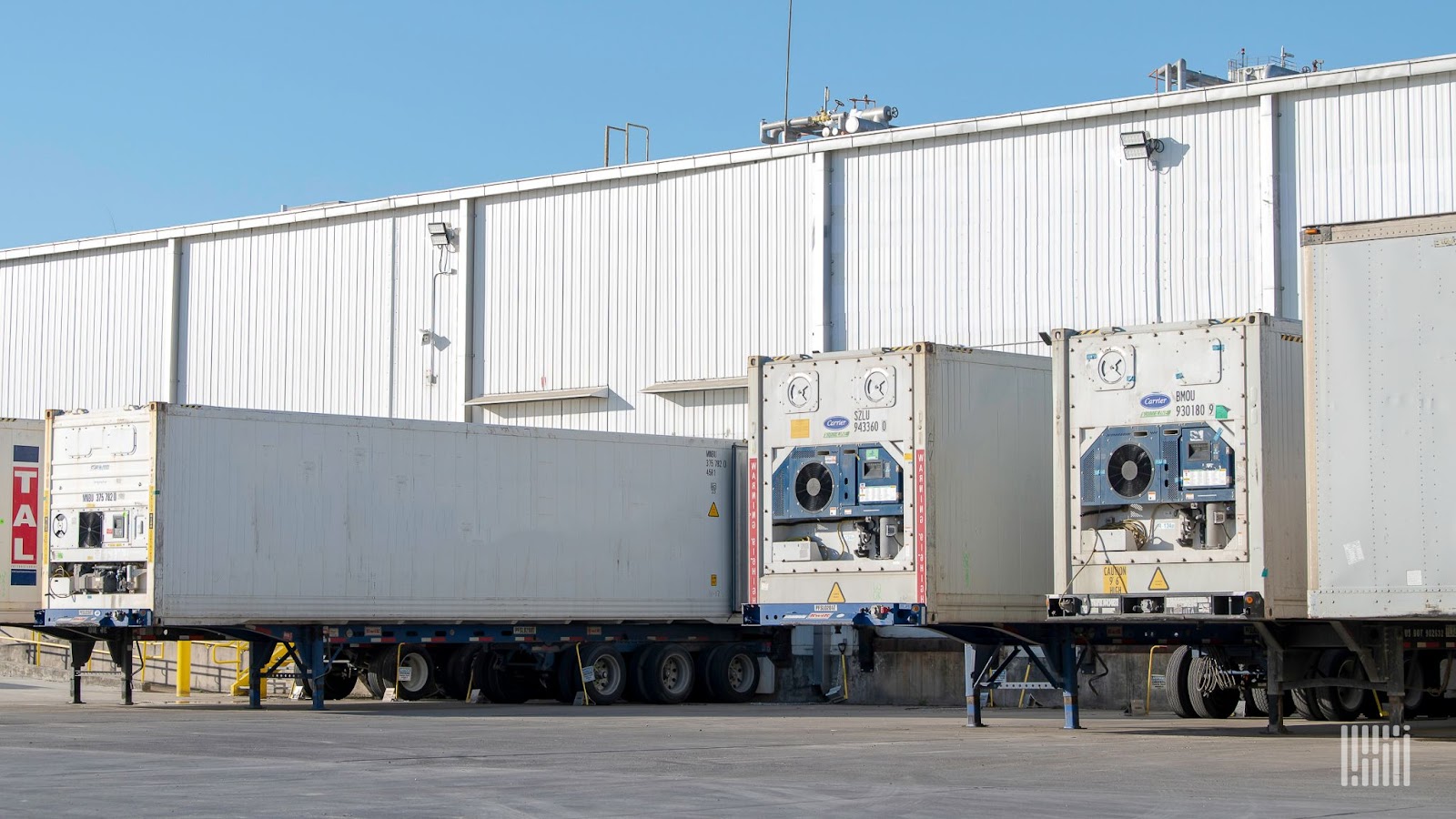
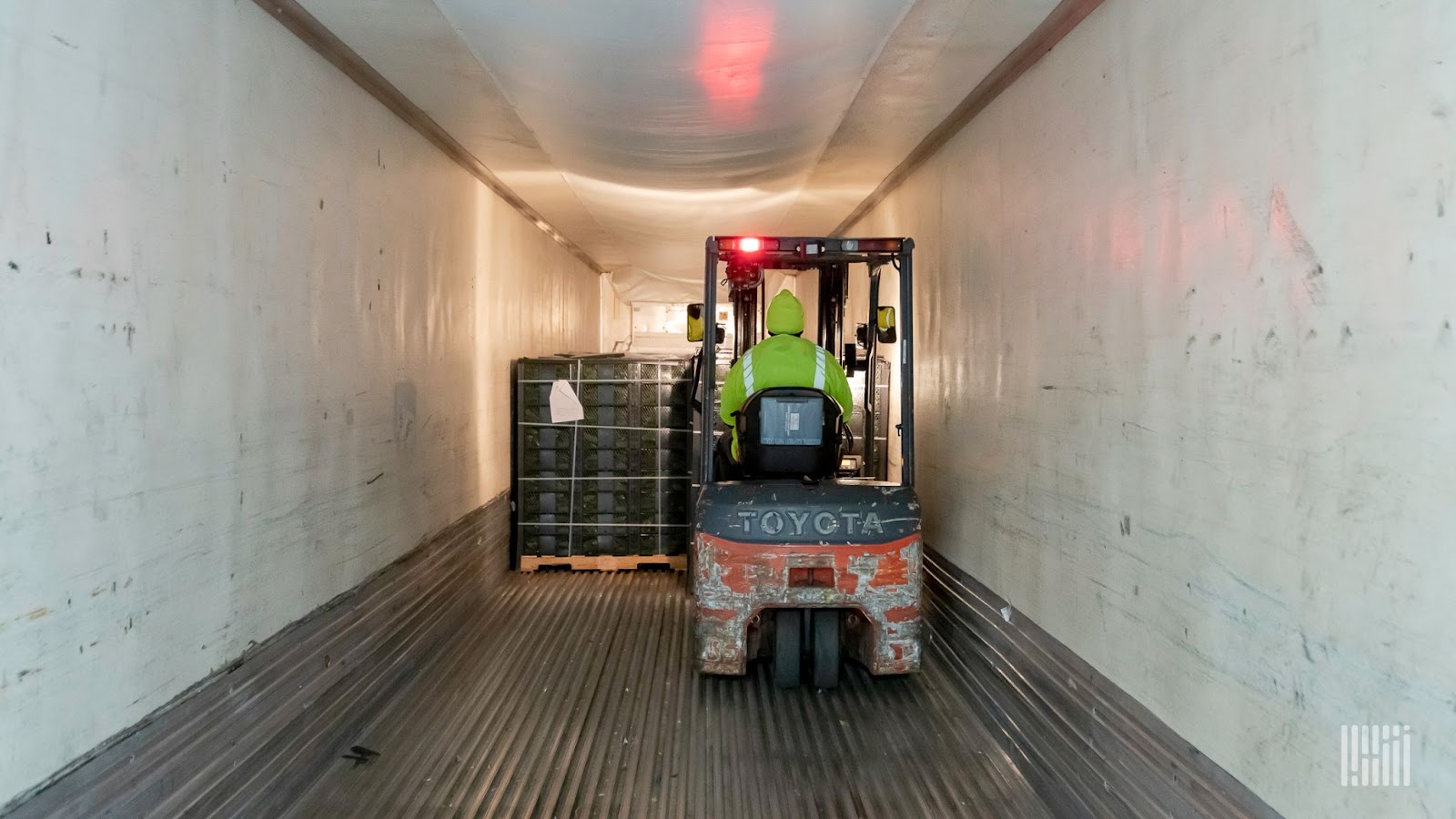
Florida-based RealCold is making moves yet again as it has acquired Forte Frozen. The acquisition gives RealCold five currently operational, high-throughput facilities in strategic markets in Dallas; Ormond Beach, Florida; Clearfield, Utah; Clackamas, Oregon; and Colton, California. Terms of the deal were not disclosed.
Dan Forte, CEO of Forte Frozen, said in the Valdosta Daily Times: “RealCold and Forte Frozen have a shared vision of what cold storage can look like in the future. It is one in which value added services like DTC play a critical role in the supply chain. We are excited that this transaction will allow us to execute this vision on a grand scale, as it provides resilience, innovation, and robust demonstrability, all grounded in an uncompromising customer-centric mindset.”
Temperature checks
(Photo: Jim Allen/FreightWaves)
Lineage has joined a coalition of cold storage providers for “Join the Move to -15C.” The campaign will explore the potential transition to new, greener standards to help reduce carbon emissions in the sector on a global scale. The “Join the Move to -15 C” initiative involves reassessing the long-standing international temperature standard of minus 18 degrees Celsius. With new research that came out indicating that frozen foods are still safely frozen at minus 15 C instead of minus 18 C, this type of initiative should become much more commonplace.
In a Tullahoma News article, Greg Lehmkuhl, president and CEO of Lineage, said, “Aligned with our purpose of transforming the food supply chain to eliminate waste and help feed the world, we are thrilled to be among the first coalition participants in furthering a collective industry effort with the potential to combat climate change and mitigate the carbon emissions impact of the cold chain industry.”
Food and drugs
(Photo: Jim Allen/FreightWaves)
Talk about big goals for 2024, McDonald’s is taking that to heart. The home of the best fast food fries is looking to add 10,000 new stores over the next three years and double revenue from its loyalty program. The place with the best fast food sodas (the secret is in the straw) is doubling down on the beverage game with a new concept restaurant called CosMc’s.
CosMc’s will sell cold beverages, including flavored iced teas and slushes. The first location, naturally, will be right outside McDonald’s headquarters in Bolingbrook, Illinois. A Food Market article highlights that the stores are based on “McDonald’s alien character CosMc, which appeared in a series of advertisements in the 1980s and 90s.”
The game plan for McDonald’s is to compete with Starbucks and Dutch Bros with these new stores. The additional stores are expected to be throughout Texas. If someone finds one in real life, I’m going to need a full report of what it’s like.
Cold chain lanes
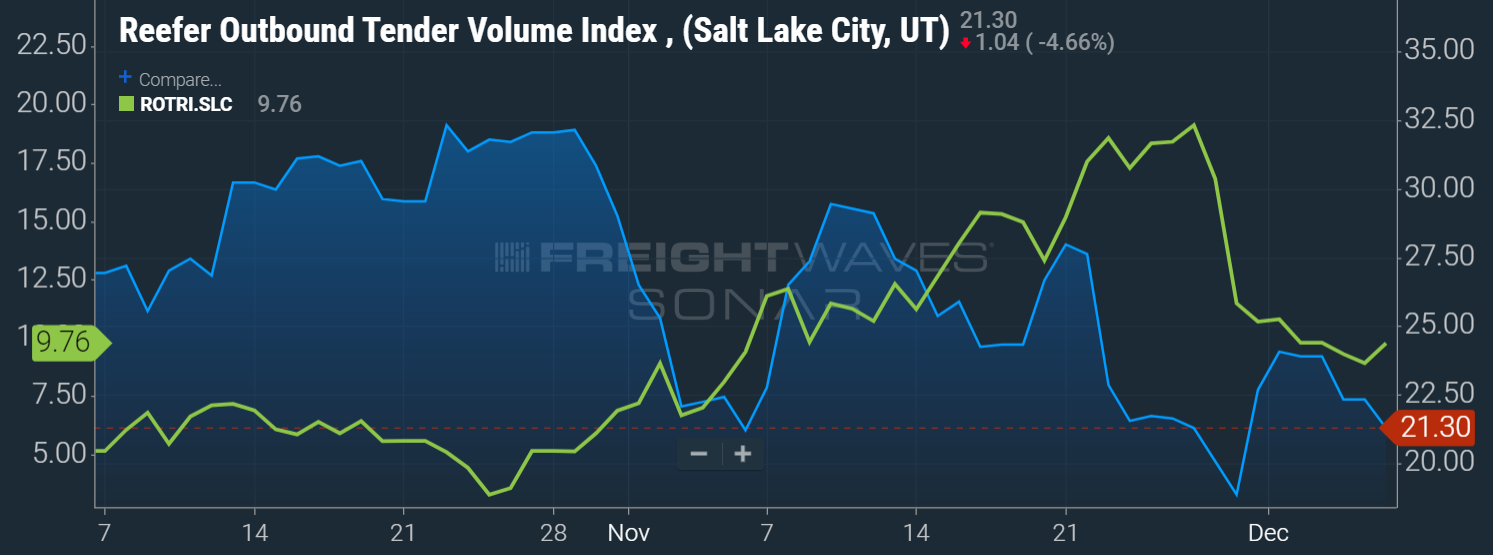
SONAR Tickers: ROTVI.SLC, ROTRI.SLC
This week’s SONAR reefer market is Salt Lake City. Reefer rejection rates in Salt Lake are returning to normal following Thanksgiving. Rejection rates are still elevated at 9.76% compared to the 5-7% rejections in the middle of November. On the other hand, reefer outbound tender volumes leave a lot to be desired as a strong rebound following Thanksgiving never happened. Although reefer outbound tender volumes are up 12.82% week over week, it’s still not to the pre-holiday levels. We can expect to see lackluster volumes at the beginning of next year as well.
Wanna chat in the cooler? Shoot me an email with comments, questions or story ideas at moconnell@www.freightwaves.com.
See you on the internet.
Mary
If this newsletter was forwarded to you, you must be pretty chill. Join the coolest community in freight and subscribe for more at www.freightwaves.com/subscribe.
FedEx Ground, the ground-delivery arm of FedEx Corp., has raised its diesel fuel surcharge by 100 basis points to 16%, exceeding the fuel levy assessed earlier this month by rival UPS Inc.
The increase takes effect Monday. FedEx’s fuel surcharges apply to its base rates and to any add-on charges known as accessorials.
UPS had hiked its levy 50 basis points to 15.25% but will reduce them to 15% effective this Monday. The carriers’ levies are based on the on-highway diesel prices set each week by the Department of Energy’s Energy Information Administration.
UPS (NYSE: UPS) and FedEx (NYSE: FDX) index their diesel levies to a band of prices established the week before by the EIA. FedEx Ground adjusts its surcharges for every 9 cents-a-gallon move in the EIA diesel price. For example, FedEx’s upcoming levy is based on an EIA-established price that is at least $4.09 a gallon but less than $4.18 a gallon. As of last Monday, the national price for diesel stood at $4.092 per gallon.
FedEx’s recent move comes amid an ongoing downward move in diesel pump prices. The most recent weekly on-highway diesel price was more than 11 cents a gallon higher nearly three weeks ago and more than 87 cents a gallon higher than a year ago.
In addition, FedEx will hike the fuel levy to 16.75% from 16.25% on domestic U.S. shipments moved by its FedEX Express air and international unit. The increase will also apply to FedEx Express shipments from the U.S. to Puerto Rico. U.S. air import and export levies will each decline by 50 basis points from the week before.
UPS, FedEx and other parcel delivery carriers have wide latitude as to when they adjust diesel and jet fuel surcharges. In recent years, surcharges have remained elevated despite world price fluctuations that have headed south. Analysts who follow the fuel surcharge market have said that surcharge levels stay higher long after prices have dropped, thus allowing the carriers to reap additional revenue on each transaction.
Investors pummel Nikola shares after new stock and debt sales
Investors dumped Nikola stock Friday after the electric truck maker priced the sale of 133.3 million new shares and sought to issue $175 million in new debt with an annual interest rate of 8.25%.
The new stock sale would raise to nearly 1 billion the number of outstanding shares in the company. Shareholders voted in August to double the number of authorized shares to 1.6 billion from 800 million, effectively agreeing to dilute the value of their holdings as new shares are issued.
The company already has a notice of going concern on file with the Securities and Exchange Commission. It said in a Feb. 23 filing that it may run out of money in the next 12 months and have to “modify or terminate” its business.
Cash needed for recall and scaling fuel cell trucks
The Phoenix-based company had cash and equivalents of $362.8 million as of Sept. 30. The money is sufficient to cover the recall expense and run the business into 2024, former CFO Stasy Pasterick said on a Nov. 2 call with analysts. Pasterick resigned from Nikola effective Dec. 1. Her duties are being handled by CEO Steve Girsky in the interim.
Nikola set aside $61.8 million to replace battery packs in 209 electric trucks recalled in August because of several underhood fires.
The company also needs money to scale its hydrogen fuel cell electric truck business while trying to attract customers to purchase or lease the loss-making trucks that sell for $450,000 before the cost of expensive and scarce hydrogen fuel.
Shares tumble with pricing of new stock and debt
Nikola shares fell 22% on Thursday as the follow-on stock offering and senior unsecured debt offerings were announced. Shares dropped from 98 cents to close Thursday at 76 cents. They closed at 71 cents Friday on the Nasdaq. The new debt in the form of green convertible senior bonds would pay 8.25% interest with a 2026 maturity date.
The hammering of the stock quickly brought the price closer to and then below the 75 cent offering price of the new shares. Henrik Alex, a frequent poster on Nikola on the investor site Seeking Alpha, said in a Dec. 1 post that he sees little hope for Nikola’s survival.
“Given ongoing, massive funding needs, outsized dilution for common shareholders is likely to continue for the time being,” Alex wrote. “With further disappointment likely ahead next year, investors should sell existing positions and move on.”
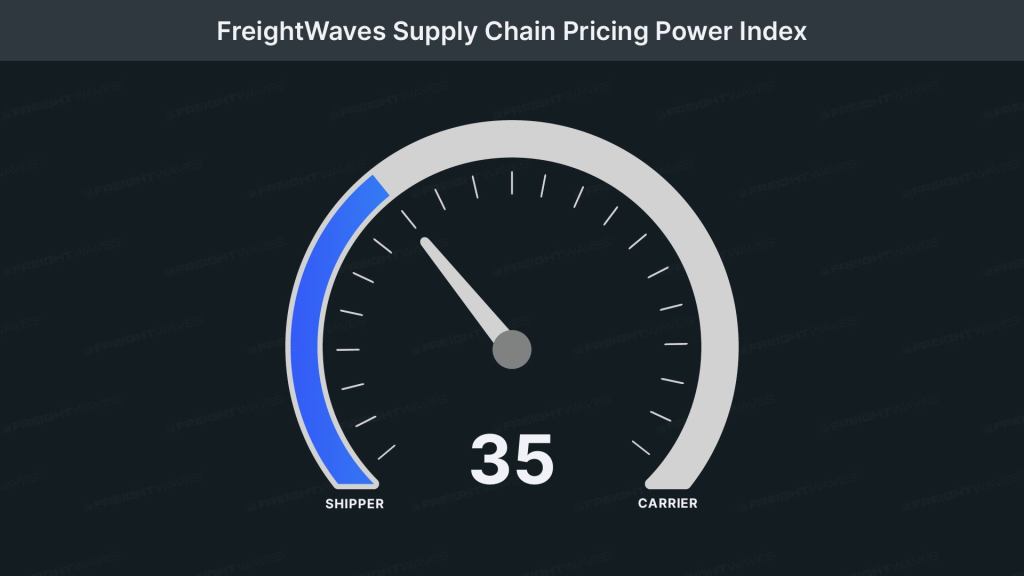
This week’s FreightWaves Supply Chain Pricing Power Index: 35 (Shippers)
Last week’s FreightWaves Supply Chain Pricing Power Index:35 (Shippers)
Three-month FreightWaves Supply Chain Pricing Power Index Outlook: 35 (Shippers)
The FreightWaves Supply Chain Pricing Power Index uses the analytics and data in FreightWavesSONAR to analyze the market and estimate the negotiating power for rates between shippers and carriers.
This week’s Pricing Power Index is based on the following indicators:
Even-keeled
Volumes are leveling out at the start of December, delaying the seasonal dip that ordinarily occurs at this time of the year. Consequently, freight demand is outpacing trends from 2022 and 2019 alike, though market activity is still sluggish compared to the barn-burning years of 2020 and 2021. While the rest of the year should not hold too many surprises in terms of tender volumes, carriers will have a chance to gain pricing power when capacity tightens around the holidays.
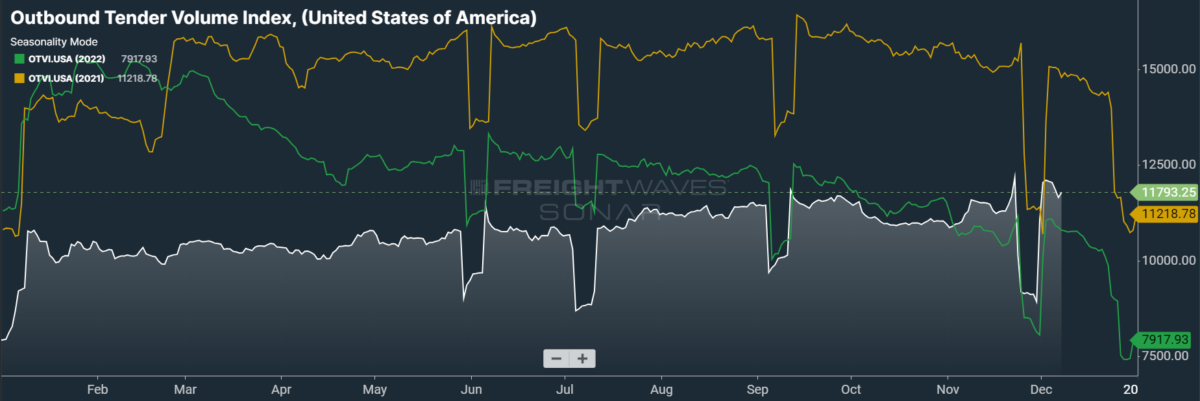
Tender volumes are finally above year-ago levels: SONAR: OTVI.USA: 2023 (white), 2022 (green) and 2021 (orange) To learn more about FreightWaves SONAR,click here.
This week, the Outbound Tender Volume Index (OTVI), which measures national freight demand by shippers’ requests for capacity, is up 6.51% week over week (w/w). On a year-over-year (y/y) basis, OTVI is up 9.33%, though such y/y comparisons can be colored by significant shifts in tender rejections. OTVI, which includes both accepted and rejected tenders, can be inflated by an uptick in the Outbound Tender Reject Index (OTRI).
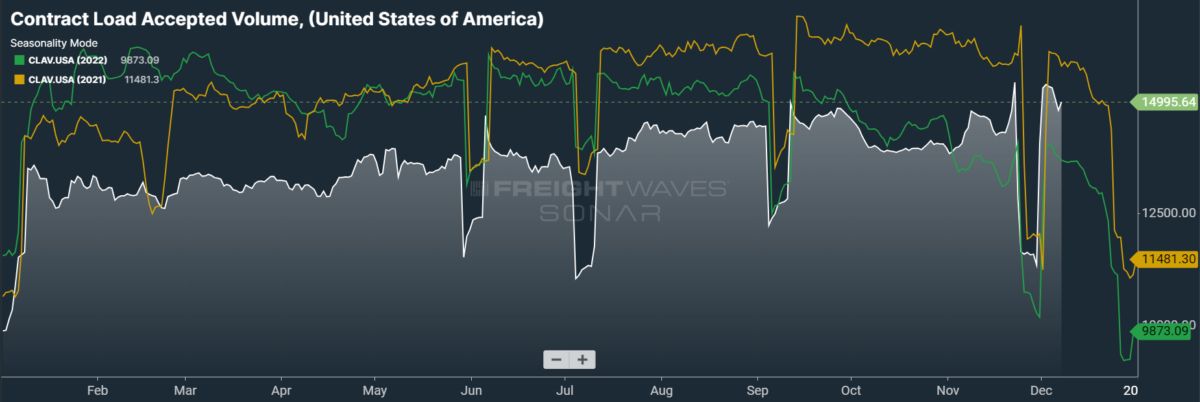
Accepted volumes are outpacing those of 2022: SONAR: CLAV.USA: 2023 (white), 2022 (green) and 2021 (orange) To learn more about FreightWaves SONAR,click here.
Contract Load Accepted Volume is an index that measures accepted load volumes moving under contracted agreements. In short, it is similar to OTVI but without the rejected tenders. Looking at accepted tender volumes, we see a rise of both 30.41% w/w and of 7.51% y/y. Gaining distance over the previous year implies that actual freight flow is recovering from this cycle’s bottom.
For their part, shippers are exposing themselves to seasonality after years of struggling to insulate themselves against it. While the latest print of the Logistics Managers’ Index did see the headline index slip back into contraction following a three-month period of growth, it did so primarily because shippers are burning through their inventories. This signal is one of potential health for the coming year as shippers rely increasingly on just-in-time inventory strategies.
According to data from Adobe Analytics, consumer spending on Cyber Monday was up 9.6% over 2022 at $12.4 billion, as the top-selling categories included televisions, small kitchen appliances and beauty products. That said, Bank of America reports that clothing and department store spending was markedly negative on a yearly basis in the week of Black Friday, suggesting that consumers were more drawn to big-ticket items than smaller purchases. This trend might be a double-edged sword since, as Adobe Analytics reported, use of “buy now, pay later” programs was up a staggering 42.5% over 2022, which could be indicative of waning consumer health in the months to come.
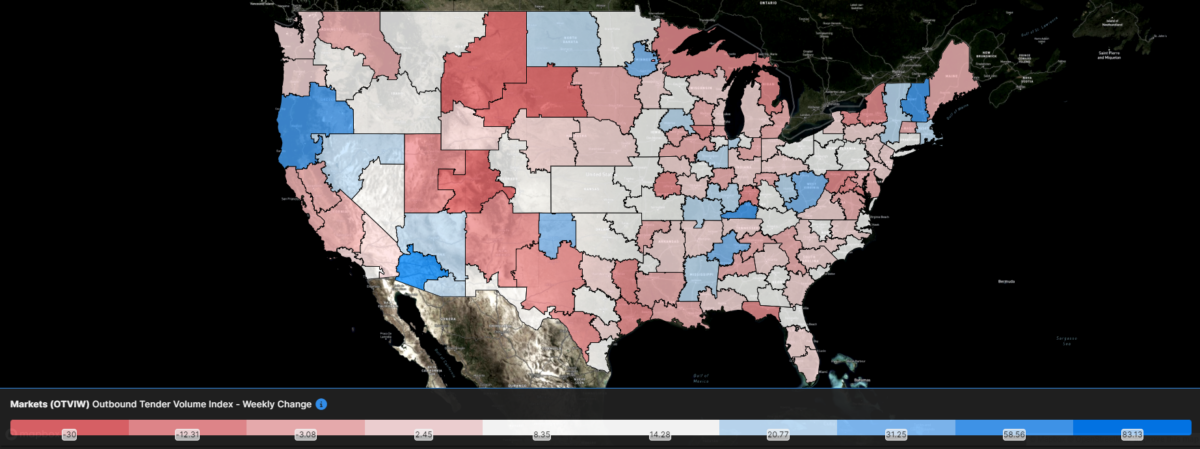
Markets see steady growth across the board: SONAR: Outbound Tender Volume Index – Weekly Change (OTVIW). To learn more about FreightWaves SONAR, click here.
Of the 135 total markets, 101 reported weekly increases in tender volumes, with gains seen in markets along the Rust Belt, the mid-Atlantic and the Gulf Coast.
Plenty of diesel on demand
In last week’s column, the chaos of global oil markets was briefly summarized. In short, the Saudi-led OPEC+ revealed a potential disunity among members at their most recent meeting, jeopardizing the cartel’s ability to control oil prices. This void introduced by the production cuts of OPEC+ members is, surprisingly, being filled by domestic production. While U.S. producers have long declared their commitments to fiscal discipline and shareholder returns, the U.S. is once again shaping up to be a swing producer that sets the tone for markets. Crude exports from the U.S. are at all-time highs, headed to Europe and Asia alike.
Accordingly, oil prices are headed for their seventh consecutive weekly loss, with domestic prices slipping below $70 per barrel on Thursday. September’s threat of $100-per-barrel oil seems very distant indeed. Stocks of distillate fuels, including diesel, are trending slightly higher than forecast but are nevertheless below their five-year averages. With a warmer-than-average winter forecast for New England, it is unlikely that the region will run into any supply shocks that would spike diesel prices in the coming months.
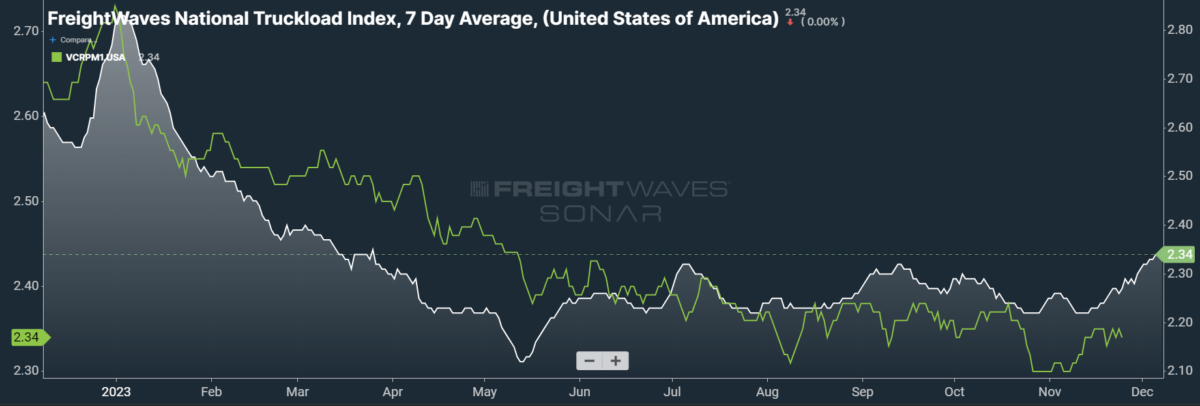
Contract rates seesaw in late November: SONAR: National Truckload Index, 7-day average (white; right axis) and dry van contract rate (green; left axis). To learn more about FreightWaves SONAR, click here.
This week, the National Truckload Index (NTI) — which includes fuel surcharges and other accessorials — rose 3 cents per mile to $2.34. Rising linehaul rates were wholly responsible for this week’s gains, as the linehaul variant of the NTI (NTIL) — which excludes fuel surcharges and other accessorials — rose 3 cents per mile w/w to $1.69.
Contract rates, which are reported on a two-week delay, did not see much activity in the week of Thanksgiving, remaining more or less where they have been for several weeks. As contract rate data extends into December, we should see a slight, stepwise decline before the holiday boost. Bid season is still ongoing, however, and shippers do possess plenty of unused pricing power. For the time being, contract rates — which exclude fuel surcharges and other accessorials like the NTIL — are down 1 cent per mile w/w at $2.34.
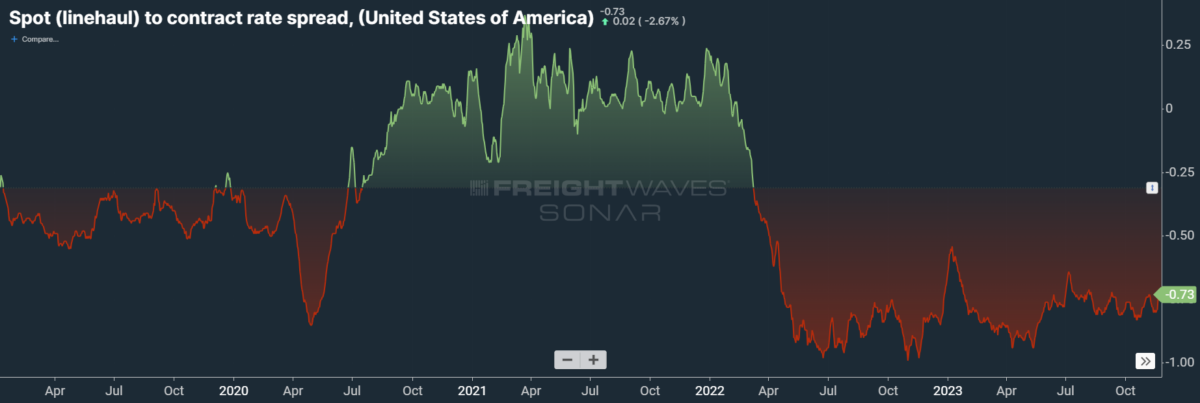
SONAR: RATES.USA To learn more about FreightWaves SONAR, click here.
The chart above shows the spread between the NTIL and dry van contract rates, revealing the index has fallen to all-time lows in the data set, which dates to early 2019. Throughout that year, contract rates exceeded spot rates, leading to a record number of bankruptcies in the space. Once COVID-19 spread, spot rates reacted quickly, rising to record highs seemingly weekly, while contract rates slowly crept higher throughout 2021.
Despite this spread narrowing significantly early in the year, tightening by 20 cents per mile in January, it has remained wide throughout most of 2023. As linehaul spot rates remain 73 cents below contract rates, there is plenty of room for contract rates to decline — or for spot rates to rise — in the coming months.
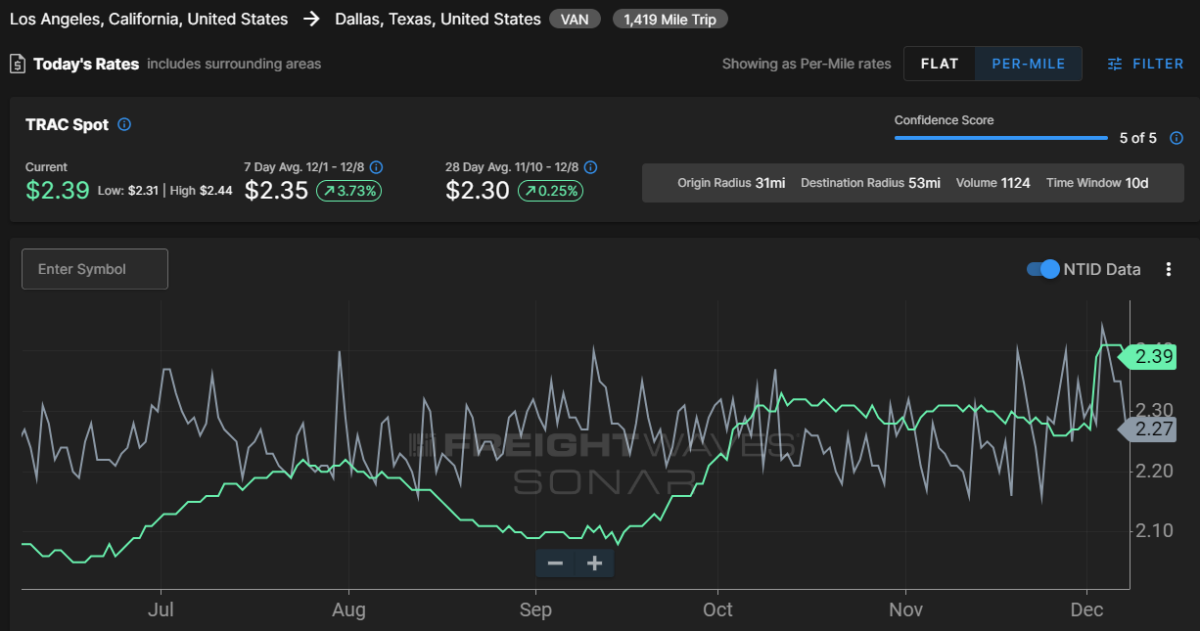
SONAR: FreightWaves TRAC rate from Los Angeles to Dallas. To learn more about FreightWaves TRAC, click here.
The FreightWaves Trusted Rate Assessment Consortium (TRAC) spot rate from Los Angeles to Dallas, arguably one of the densest freight lanes in the country, found a spring in its step to start the month. Over the past week, the TRAC rate rose 11 cents per mile w/w to $2.39 — setting a new year-to-date high of $2.41 earlier in the week. The daily NTI (NTID), which has fallen to $2.27, is again being outpaced by rates along this lane.
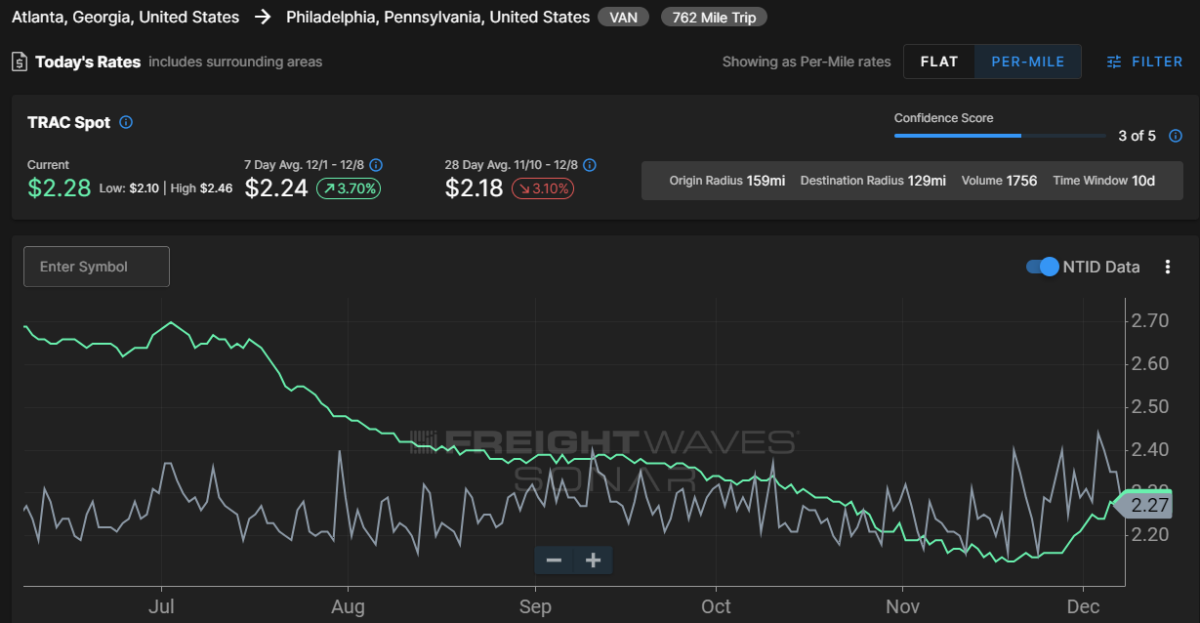
SONAR: FreightWaves TRAC rate from Atlanta to Philadelphia. To learn more about FreightWaves TRAC, click here.
On the East Coast, especially out of Atlanta, rates saw a stark reversal of November’s losses but are still well below their Q3 average. The FreightWaves TRAC rate from Atlanta to Philadelphia shot up 7 cents per mile to $2.28. After plateauing well above the national average during the summer, rates along this lane declined sharply at the end of July, lacking any positive momentum until recently.
FRA doles out $8B in grants advancing passenger rail
The Federal Railroad Administration is awarding $8.2 billion in grants for high-speed passenger rail projects as well as projects supporting capital improvements in existing rail corridors.
While the Class I railroads generally fund their own track improvements, freight rail service can benefit from passenger rail grants because there are parts of the U.S. rail network where passenger rail and freight rail share track. Projects awarded with grant funding may be seeking to separate passenger rail traffic and freight rail traffic or they may go toward track improvements that will ultimately improve both passenger and freight rail service.
The $8.2 billion will go toward 10 projects in nine states, including the creation of two new high-speed rail corridors — one in California’s Central Valley and one between Las Vegas and Southern California.
This latest funding round is in addition to $16.4 billion announced last month for 25 passenger rail-related projects along the U.S. Northeast corridor, according to a Friday news release.
The projects where freight rail could also benefit, according to an FRA fact sheet, include the following:
Alaska Railroad Corp. (ARRC) received an $8.2 million grant to replace a bridge at milepost 190.5 on ARRC’s North Corridor main line, which is used by freight and passenger trains. The new bridge will remove existing rail car load weight restrictions to allow for 286,000-pound freight cars. ARRC will provide 20% in matching funds.
California High-Speed Rail Authority received $3.07 billion to support activities related to advancing high-speed rail between Merced and Bakersfield. These activities include separating passenger rail service from the mainlines of BNSF and Union Pacific.
Northern New England Passenger Rail Authority received $27.5 million for track improvements on the Downeaster Corridor between Brunswick, Maine, and the Massachusetts state line to improve existing service and support future expansion. The line is also a mainline of CSX. CSX will provide 20% in matching funds.
Amtrak received $14.9 million for track and infrastructure improvements on BNSF tracks where Amtrak’s Empire Builder service operates in Malta, Montana. Amtrak and BNSF will also be providing 20% in matching funds.
Virginia Passenger Rail Authority will receive $729 million to expand passenger rail capacity along 12 miles of a rail corridor that goes between Washington and Richmond, Virgina. Project improvements will include developing infrastructure to separate passenger rail traffic and freight rail traffic.
FRA also said Friday that it has identified 69 corridors in 44 states that could benefit in federal funding for capital improvements or new construction in support of passenger rail. This new planning program, Corridor ID, was also the result of the bipartisan infrastructure law. The corridors named in this program include upgrades to 15 existing rail projects, added or extended service on 47 new routes and the advancement of seven new high-speed rail projects, FRA said.
“President Biden’s Bipartisan Infrastructure Law gave us a once-in-a-generation opportunity to think smart and think big about the future of rail in America, and we are taking full advantage of the resources we have to advance world-class passenger rail services nationwide,” FRA Administrator Amit Bose said in a Friday news release.
“Today’s announcement is another step forward as we advance transformative projects that will carry Americans for decades to come and provide them with convenient, climate-friendly alternatives to congested roads and airports.”
Monthly trucking employment report: Steady after lots of volatility
After several months of significant swings in truck transportation employment, the Bureau of Labor Statistics reported November jobs numbers that reflected moderate changes.
The seasonally adjusted truck transportation jobs total for last month was 1,581,300, an increase of 700 jobs. But it comes after a four-month stretch in which July jobs dropped 6,900; August jobs fell 30,700 (fueled by the closure of Yellow Corp.); September jobs climbed 14,000 positions as some of the Yellow loss reversed itself at other carriers; and October recorded a drop of 3,600 jobs.
The 700-job increase reported Friday morning reflected a market of reasonable stability that was also evident in the data for not seasonally adjusted jobs. Labor economists generally look at seasonally adjusted numbers as more indicative of labor market strength or weakness but caution that not seasonally adjusted numbers should not be ignored.
Those figures were even more stable than the seasonally adjusted numbers. Not seasonally adjusted jobs dropped 100 positions to 1,591,800 jobs. There were revisions to the October numbers but they were relatively minor as well. Along with September revisions, the report showed that on a not seasonally adjusted basis, November jobs stood at 2,100 jobs more than September.
Mazen Danaf, an economist at Uber Freight (NYSE: UBER), said the numbers, though only a small change, “continued to defy expectations.”
“We usually expect trucking employment to fall in the last few months of the year, something that did not happen in 2023,” he said in an email to FreightWaves.
“Aside from Yellow’s bankruptcy, we haven’t seen any significant reduction in capacity,” Danaf added. “On the contrary, Yellow’s ex-drivers have likely flooded adjacent sectors such as truckload and specialized freight, keeping these markets saturated.”
David Spencer ofArrive Logistics noted the small movement in the numbers and said in an email to FreightWaves that “there is reason to believe employment declines will be more gradual than previously anticipated.”
Spencer said he earlier had believed carriers that normally ramp up at this time of year in anticipation of a Christmas rush “may have taken a step back from the normal hiring ramp up and are comfortable handling the seasonal demand surges with the staff already in place.” He added that the stable numbers he sees in the data are a sign of “relative stability.”
The most notable numbers in the report continue to be in warehousing and storage as the great pandemic hiring binge of 2020 and 2021 reverses itself.
Warehouse jobs declined 8,100 jobs. That is less than in October, when, after revisions, the decline from September was 13,000 jobs. Warehouse and storage jobs have now fallen 16 of the past 17 months. In the one month they didn’t decline, they were flat.
Warehouse jobs peaked at 1,960,300 in June 2022. At 1,861,000 jobs in November, that is a decline of 99,000 jobs. However, in March 2020, right as the pandemic was hitting, warehouse jobs stood at 1,342,000. Even with the declines of the last 17 months, warehouse is a sector that has added huge levels of employment.
In other data from the report:
Rail employment declined. And although the numbers were small, the industry has been under such pressure to replenish its ranks and build a bigger workforce that the move is significant. On a seasonally adjusted basis, jobs in rail slipped below the 150,000-job level after declining 300 jobs, but October was revised downward also. It puts rail jobs at 149,600, just 1,200 jobs above last November.
Average weekly hours in truck transportation for production and nonsupervisory workers continued to bounce along in a range of 40.4 to 40.8, coming in at 40.6. It’s been in that range for four straight months and seven of the last nine. But what’s notable is how much lower that is from the high-water mark of 343.4 hours posted in August 2021.
The national unemployment rate came in at 3.7%. But for transportation and warehousing, it was 4.5%. That is down 300 basis points but is still way above the June mark of 3.3%.
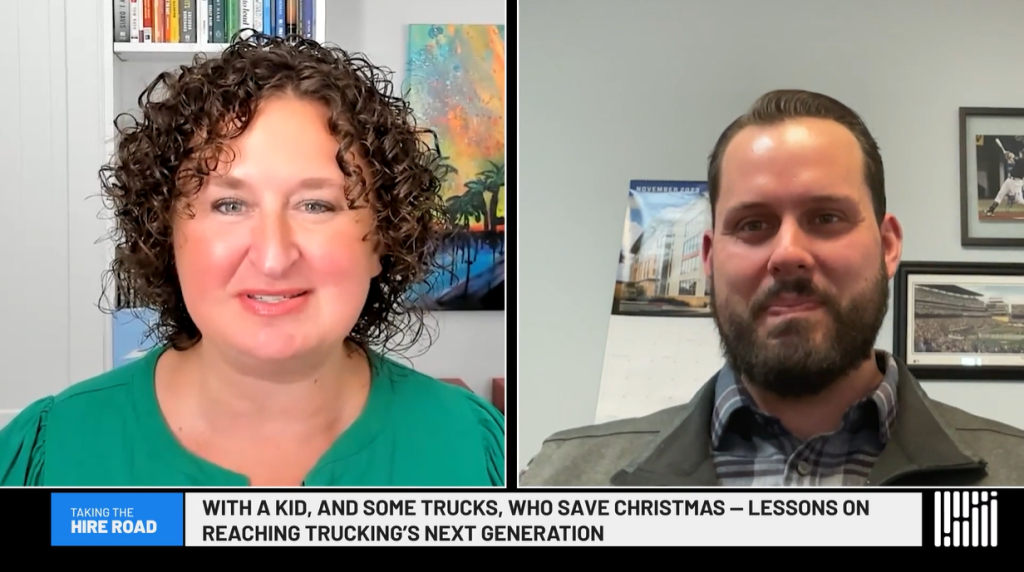
Lessons on reaching trucking’s next generation — Taking the Hire Road
On this week’s episode of Taking the Hire Road, guest host Leah Shaver, president and CEO of the National Transportation Institute, is joined by Anthony Book, VP of sales and marketing at Long Haul Trucking.
While serving as the director of sales and marketing might imply a customer-facing role, Book devotes much of his attention to leading driver recruitment and retention programs at his company.
At Long Haul Trucking, “we always say that we have two sets of clients: We have our drivers and we have our customers that pay us to haul their freight,” Book related.
“You need to keep both parties happy if you want to find success.”
Accordingly, Book and his colleagues have redoubled their efforts around internal marketing, which can range from employee advocacy to promoting the company’s mission to its drivers.
To sustain a company culture that puts employees first, that vision has to start from the top. “It starts with our CEO and CFO, who lead our management team, and we all have shared values about what we want Long Haul to stand for,” Book said.
“It really comes down to being a driver-first company.”
Of course, it doesn’t hurt that many within Long Haul’s management team have firsthand experience with the responsibilities of the job.
“Our CEO and our VP of fleet — both former drivers — do a wonderful job of empathizing with our drivers when they talk about the ups and downs of our industry,” Book noted.
Yet talk is cheap if it is not reinforced with action. “We have a constant focus to ensure we are doing everything we can,” Book stressed, “to keep pushing every single day to bring in as much work for our drivers as possible.”
Work is only one aspect of Long Haul’s driver-first mission, however.
“We take so much pride in giving our drivers the time at home that they need,” Book stated, “giving them that work-life balance that’s so important to our drivers.
“All of these personal and very important factors to having a long-term successful driving career,” he continued, “add up to our drivers wanting to be with us for many, many years.”
This unwavering focus on drivers’ health and quality of life, if anything, is the secret sauce to driver retention.
But retention is half the battle. Recruiting the younger generations to the industry has proved a struggle, despite overlap with their core values and the possibilities offered by trucking.
In his time on social media, Book has found that young people increasingly prioritize freelance gigs that allow them to travel the country. “They might live out of their van, they might even live out of their car.
“I always wonder to myself: Why don’t you just live out of a beautiful semi?
“You can work on the roads and wake up in a different town every day. There’s a real spirit of adventure that comes with trucking,” Book mused. “Maybe this next generation will find their desire for that adventure.”