Benchmark diesel price down again as OPEC+ meeting looms this week
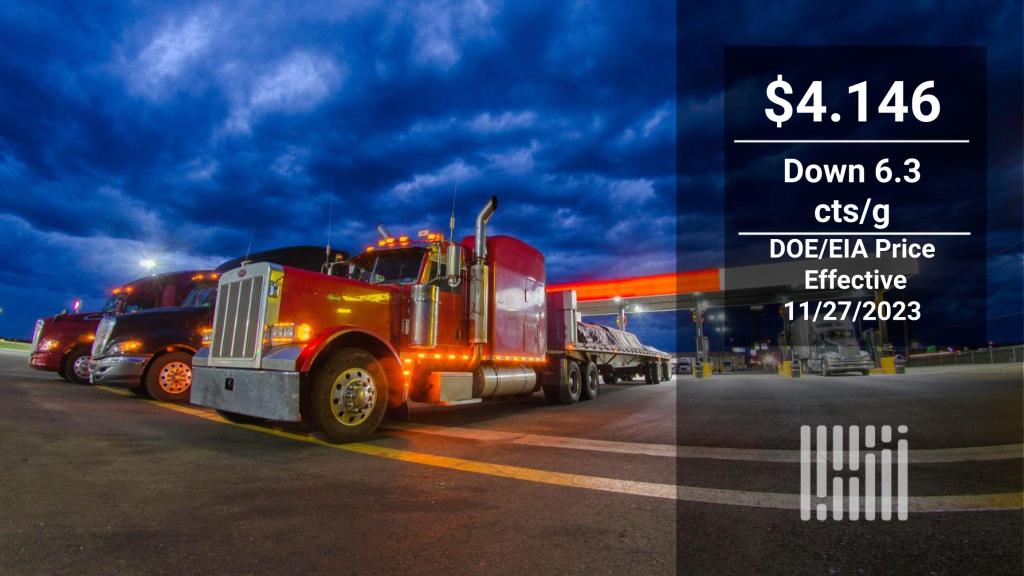
For the eighth time in the past 10 weeks, the Department of Energy/Energy Information Administration benchmark diesel price fell.
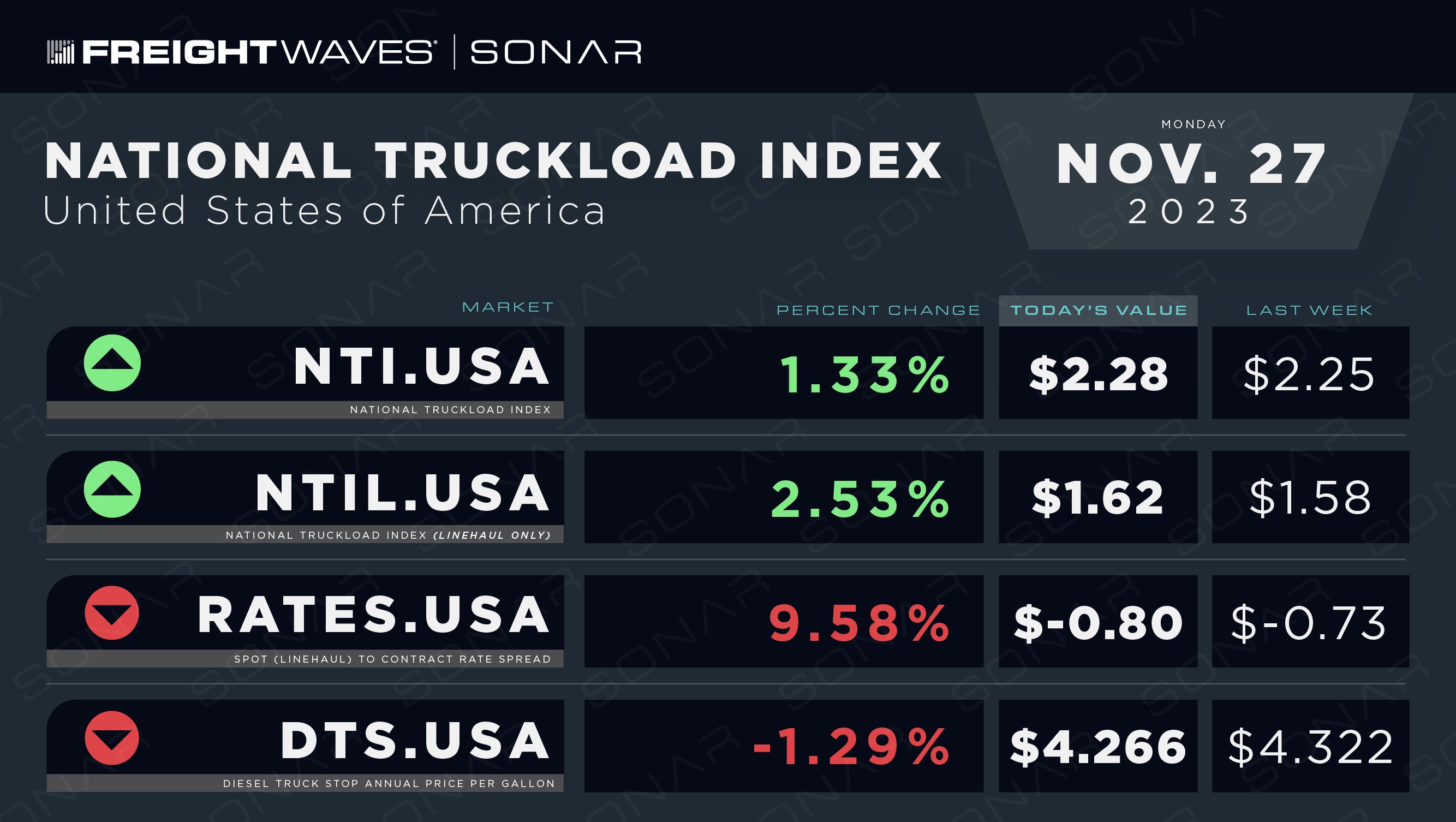
The latest average weekly retail diesel price is $4.146 a gallon, down 6.3 cents from the prior week. This week’s price, the benchmark for most fuel surcharges, is the lowest since July 31. It’s been down five consecutive weeks. Since Sept. 18, when the price began its streak of eight declines in 10 weeks, it’s down 44.7 cents.
Crude prices have been declining most of the month. The global crude benchmark, Brent, settled on Nov. 1 at $84.63/barrel. It had settled as low as $77.42 a barrel on Nov. 16 before a slight rebound. But the market has dropped the past three days, and Monday’s 74-cents-per-barrel decline put the price back under $80, to a settlement of $79.98.
The backdrop in the market the past week has been the upcoming meeting in Vienna of the OPEC+ member nations. That meeting was to take place Sunday; its delay until Thursday has been seen by much of the market as a sign that the group, facing declining prices and supply/demand models into 2024 that project out to more weakness, cannot decide which course of action to take.
A headline on a Bloomberg story from Vienna summed up the dilemma the group faces: “Saudi Arabia Seeks OPEC+ Oil Quota Cuts While Some Members Resist.”
“The OPEC+ leader has been making a largely unilateral supply cutback of 1 million barrels a day since July, and is now seeking further support from across the Organization of Petroleum Exporting Countries and its partners,” the Bloomberg article said. The 1 million-barrel-a-day cut refers to the reduction implemented by Saudi Arabia in July on top of the 1.16 million-barrel-a-day reduction that the larger OPEC+ group put in place in May.
One notable trend in recent days is that diesel futures prices have begun to rise again relative to crude. On a straight front-month-to-front-month basis, with Brent prices converted to gallons, the spread of ultra low sulfur diesel on CME settled Monday at 93.36 cents a gallon. While that was slightly below the more than 96-cents-a-gallon price of last Tuesday, that spread was less than 90 cents a gallon fairly consistently between Nov. 7 and early last week. It was more than $1 a gallon in mid-October.
On Monday, the 74-cents-per-barrel decline in Brent was accompanied by a small increase of 22 basis points in ultra low sulfur diesel on the CME commodity exchange, settling at $2.8379 a gallon. The most recent low settlement was $2.7191 per gallon on Nov. 9. That difference in direction moved the diesel/crude spread higher.
A possible cause: Even in the middle of a market that is mostly dealing with growing surpluses of crude, diesel inventories in the U.S. have continued to tighten. In the most recent weekly EIA report, for the week ended Nov. 17, inventories of ultra low sulfur diesel were less than 87% of the seven-year average for that week. (While comparisons have historically been compared to a five-year average, a seven-year average smooths out distortions created by the pandemic.)
One voice on why the market has been sliding, or at least has seen a slide accelerate, came Monday from the weekly report of energy economist Philip Verleger.
His report noted the impact of the options market, where oil users looking to protect themselves against rising prices will purchase call options — giving them the right but not the obligation to purchase oil at a specified price — while sellers purchase puts. A put is the opposite: It gives the owner of the put the right but not the obligation to sell oil at a given price.
Verleger notes that the sellers of crude oil puts and calls need to regularly buy or sell crude oil contracts on the main commodity exchange to stay balanced within their positions, depending on whether prices are rising or falling.
“Hedging has a critical seasonal pattern in which a large percentage of options written during the year expires at year-end,” Verleger wrote. “This means that between October and mid-December, the banks and insurance companies writing options will be selling or buying futures, which adds extreme seasonal pressure to prices.”
Declines in the price of oil the past three years have been accelerated by that liquidation of hedges in a falling market, according to Verleger. “These decreases were not caused by speculation but rather by options writers closing long positions to cover the risk of having to perform on contracts with strike prices of $90 or $100 per barrel,” he said.
Pointing out that Saudi officials have blamed the recent price decline on “speculators,” Verleger notes that “these sales were not ‘speculation’ but customary trading practice. The call writers’ computers followed the geeks’ instructions, buying and selling futures to protect their institutions.”
Projected 2024 industry trends position rail as optimal shipping option
With the holiday season in full swing, shippers are looking ahead to 2024. Many companies are busy finalizing their transportation partnerships for the new year, and rail may be a more attractive option than in years past.
Next year’s transportation environment is expected to be colored by gains in three significant areas: service, sustainability and technology. Rail has been making serious gains across all three, making it a viable and affordable option for shippers.
“The environmental advantages of rail, greater supply chain transparency and new service solutions will all support growth in the rail market share versus trucking,” according to CSX Executive Vice President and Chief Commercial Officer Kevin Boone. “Although soft truck rates have muted conversion opportunities, the environment is improving for shippers to evaluate opportunities to achieve favorable supply chain economics with rail.”
Continued service improvements
Service levels are expected to improve throughout 2024 due to a combination of economic factors and new solutions being introduced to the market. Pandemic-related supply chain congestion has dissipated. At the same time, innovative transportation companies like CSX have ramped up their service offerings.
Service improvements in rail, specifically, have opened up new opportunities for shippers that have historically opted for other modes of transportation due to perceived inefficiencies in the more cost-effective rail space.
“Customers have long expressed a desire to increase their use of rail as a more cost-effective transportation solution,” Boone said. “As rail provides better service — including improved customer service platforms and more attractive service options — the past obstacles for shippers to take full advantage of rail economics are being overcome.”
CSX, specifically, has seen service gains over the past couple years, with improvements approaching record levels at the end of 2023. Those improvements include the introduction of innovative service solutions to provide shippers with valued-added services and dock-to-dock transportation products.
Sustainability gains
Environmental stewardship is expected to be top of mind for shippers in 2024. Companies will be working to meet their own sustainability goals, align with updated government-issued guidelines and meet the demands of their increasingly climate-conscious customer bases.
Transportation emissions are one of the biggest challenges standing between shippers and their environmental goals. This makes rail an attractive alternative to trucking, as it is naturally a cleaner way to move goods.
“Increased sustainability concerns across all industries have greatly strengthened the value proposition of rail, which is far more fuel-efficient than trucking,” according to Boone.
“At CSX, sustainability is the way we manage and operate our business to best serve our customers, care for the environment, secure profits and drive long-term prosperity,” according to the company’s sustainability statement.
Technology growth
Service and sustainability improvements have both been fueled by technology growth. Strong tech investments make it possible to run a more efficient — and cleaner — operation while simultaneously increasing supply chain transparency.
This forward-looking approach to technology and innovation will ensure rail continues to be a viable — and increasingly attractive — transportation option for shippers of all shapes and sizes in the years to come.
Shippers across the board are also looking beyond 2024 in order to plan and enact long-term growth strategies. Many companies planning new facilities or substantially expanding existing operations are making a strategic choice to seek out rail-served sites.
CSX has developed a robust and flexible site search and evaluation platform — CSX Select Site — to assist companies in finding rail-served sites that meet a wide range of selection criteria in addition to rail access. These industrial development efforts have already succeeded in attracting many major projects to CSX-served sites and created a strong pipeline of future projects that will drive rail growth for many years.
White House gives Flexport shoutout for sustainable aviation fuel
Freight forwarder Flexport picked up a surprising endorsement from the White House during this month’s Asia-Pacific Economic Cooperation (APEC) forum for its new initiative to help customers reduce their supply chain emissions for airfreight shipments.
The Biden administration highlighted efforts to decarbonize aviation at the meeting in San Francisco, where world leaders pledged continued cooperation on addressing climate change, in the process giving visibility to a company headquartered in the same city for a program similar to ones previously undertaken by a number of airlines and cargo partners.
A fact sheet outlined more than $50 billion of U.S. private-sector investments into APEC economies related to trade, sustainability and other goals, including an announcement by Boeing that it will work with Asia-Pacific nations and U.S. government to advance development of sustainable aviation fuel (SAF) and promote its use by the region’s airlines. And it said Flexport is partnering with Norway-based Chooose to offer air cargo customers a way to purchase SAF certificates that can be applied against freight movements with any vendor.
The APEC communique also mentioned Flexport’s September announcement of an omnichannel capability for small and midsize enterprises that allows them one-click ability to create a single pool of inventory and import, warehouse, sort and deliver goods directly to stores or consumers for orders placed on more than 20 e-commerce marketplaces.
“American businesses — significantly represented here in this auditorium — are the largest source of foreign direct investment into APEC economies. In fact, if we take just the U.S. companies represented here at this summit and look at their new investments [into] APEC economies in the calendar year, it totaled more than $50 billion so far. … Investments announced today from companies like Boeing, Apple, Flexport, and the Pepsi company — to make our economies greener and more sustainable,” he said
A Flexport spokesperson said the company shared the announcements with White House staff organizing the APEC event as an example of how its service gives small businesses the technology and capital to grow sustainably.
The Flexport listings are only indirectly connected to $50 billion APEC investment theme and don’t have any specific price tags associated with them. Neither program is specifically focused on the Asia-Pacific region, although in reality the self-service global trade solution could apply because that is where e-commerce retail goods are mostly produced and where Flexport has some logistics infrastructure. And the SAF program applies to freight movement anywhere in the world, not just on the trans-Pacific corridor.
Green credits
Flexport controls the use of three Boeing 747-400 freighter aircraft and arranges shipments with other cargo and passenger airlines, but its SAF program functions independently from the physical flow of goods in its system while allowing customers to purchase the environmental benefits through a practice called book-and-claim.
The book-and-claim model for air cargo is not unique to Flexport. European logistics powers Kuehne+Nagel, DB Schenker and DSV, among others, offer virtual SAF purchases through their reservation channels.
Distributing SAF to a specific airport or flight is difficult because of limited fuel availability and infrastructure. Under aviation’s book-and-claim model, SAF isn’t dropped into the flight of the company covering the fuel premium. Instead, the volume of SAF that is produced and pumped into planes is tracked and verified, after which related carbon emissions are calculated and allotted to the business that “booked” the purchase of SAF. The customer paying the premium receives a SAF certificate to lay “claim” to the environmental benefits, which it can apply to reduce its indirect carbon footprint.
Using this method means SAF can be sourced for flights with airlines or out of airports that do not have SAF supply available. It’s a similar approach to buying renewable energy credits because consumers can’t physically control where their electricity comes from.
Flexport’s program is enabled by Chooose, a software-as-a-service platform that helps businesses integrate climate programs directly into their online sales offerings, and is available through a digital connection with the Flexport trade portal.
“This means democratized access to SAF through the book and claim chain-of-custody model, which allows Flexport customers to reduce their emissions for any air freight shipment on any trade lane with any carrier,” Flexport said in a statement. “When clients purchase a SAF certificate, book and claim ensures that a proportional volume of fuel is used somewhere within the aviation sector resulting in a net-reduction. For our clients, this flexibility ensures that consignees of any size can contribute to emissions reduction without having to arrange for large fuel offtake agreements directly with air carriers or fuel suppliers.”
Kuehne+Nagel two years ago became the first air logistics provider to offer customers the option to purchase SAF for each shipment regardless of airlines used, origin or destination. Pricing is tied to the actual weight of a shipment. After booking confirmation, the equivalent volume of SAF is credited from 3.4 million gallons of SAF available to Kuehne+Nagel while the customer receives an authorized certificate confirming the emissions saving for environmental reporting.
Aviation accounts for an estimated 2%-3% of global carbon emissions but is one of the most difficult sectors to decarbonize because of technological hurdles and the heavy investment required. SAF, which proponents say reduces earth-warming emissions by 70% and costs three to four times as much as conventional jet fuel, is considered a bridge to a hydrogen or electric future. It amounts to just 0.2% of total global jet fuel consumption. The International Air Transport Association says demand signals from airlines should spur governments and energy producers to heavily invest in production and distribution infrastructure. Much more SAF needs to be produced to meet current demand and the airline industry’s commitment to net-zero carbon emissions by 2050.
SAF can be produced from a number of sources, including waste fats, oils and greases, municipal solid waste, agricultural and forestry residues, and nonfood crops. They can also be produced synthetically via a process that captures carbon directly from the air. About 10 facilities currently produce SAF, but more than 150 projects in 35 countries are being explored for SAF production by 2029. Some analysis shows that up to 25 million tons of SAF could be produced by the next decade, according to the cross-sector Air Transport Action Group.
It should be noted that SAF still produces some carbon emissions in flight but generally releases less carbon dioxide during the production and refining phase than fossil fuels.
Airlines have entered into forward purchase agreements for SAF worth about $45 billion, well in excess of today’s SAF availability, IATA says. Fifty airlines representing over 40% of global air traffic have committed to more than 5% of their own fuel use being SAF in 2030, with many setting higher goals.
And logistics companies are increasingly partnering with airlines to directly subsidize the cost of SAF purchases.
As part of a multipronged decarbonization effort, Air France-KLM Group three years ago launched a SAF program that now includes more than 50 companies. Chicago-based AIT Worldwide Logistics recently joined the program and agreed to purchase 460 metric tons of SAF from Air France-KLM-Martinair Cargo for 2023, with even higher volumes committed for 2024. In October, the group’s cargo division introduced goSAF, which allows customers to reduce their carbon emissions per booked shipment by making a direct investment in SAF. In the first week after the feature was introduced, a SAF contribution was added to more than 1,000 bookings.
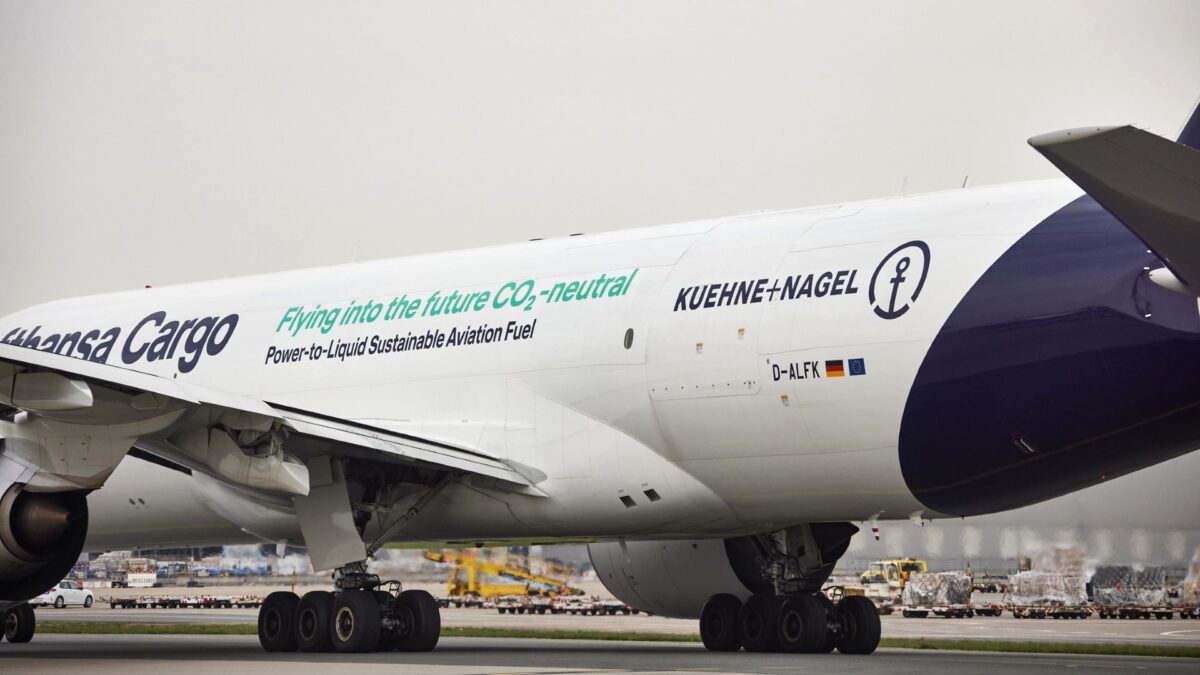
Lufthansa Cargo has also been out front reducing carbon pollution and promoting the use of SAF. The airline and Kuehne+Nagel jointly committed to support the world’s first production site for synthetic crude oil in Germany and are already buying small quantities from a nonprofit called Atmosfair. The partnership built on K+N’s existing agreement to help subsidize purchases of SAF fuel made from biowaste.
Synthetic kerosene, also known as power-to-liquid fuel, is produced from regeneratively generated electricity, water and CO2. Power-based fuels are still in the development stage but are considered a long-term alternative to conventional jet fuel or bio-generated SAF because they can theoretically be produced without availability limits.
In February, Lufthansa Cargo parent company Deutsche Lufthansa signed a memorandum of understanding with European energy company Varo to supply SAF. Varo plans to produce 86 million gallons per year from 2026 with a long-term target of 165 million gallons annually. The company in September announced plans to build a major SAF manufacturing facility in Rotterdam, Netherlands.
Lufthansa Cargo and Kuehne+Nagel are partnering to increase purchases of sustainable aviation fuel. (Photo: Lufthansa Cargo)
German logistics giant DB Schenker and Lufthansa Cargo in 2021 started regular full charter flights between Frankfurt and Shanghai that are 100% covered by sustainable aviation fuel made from renewable waste and residue raw materials such as used cooking oils. That means Lufthansa blends in the same amount of SAF on flights throughout its network to equalize the amount of fuel used on the charter flight. Computer hardware maker Lenovo has regularly booked space on the flights.
Last November, DB Schenker began giving customers the option of choosing SAF for their air transport to any location in the world — independent of the type of aircraft or airline used. Shippers pay a premium for virtual allocation of SAF for an air cargo shipment and receive certification for the amount of greenhouse gases avoided. The actual physical insertion of SAF might occur on flights different from the one carrying the freight. DB Schenker has also purchased SAF credits from Singapore Airlines.
Denmark-based logistics power DSV last year similarly struck an agreement with Etihad Cargo, the cargo division of Etihad Airways in Abu Dhabi, to purchase SAF to offset the carbon emissions of its shipments utilizing a book-and-claim system.
Japanese freight forwarder Kintetsu World Express in 2022 committed to use SAF on Lufthansa Cargo flights for one year, reducing by 5% its total CO2 footprint for shipments transported by the airline.
Korean Air last week announced logistics company LX Pantos as the inaugural partner for its new SAF program for cargo customers. LX Pantos will purchase SAF for Korean Air’s cargo operations and the airline will share the amount of carbon emissions reduced accordingly. Last year, the airline signed an agreement with Shell to purchase SAF at major airports in Asia and the Middle East from 2026 to 2031.
A number of airlines have even committed equity and risk capital into SAF projects. United Airlines, for example, this year started a $200 million fund to help support startups developing sustainable aviation fuel. Air Canada, JetBlue and Hawaiian Airlines are also contributing.
London Heathrow Airport will offer $89 million of incentives to airlines in 2024 in an effort to boost SAF to 2.5% of total fuel usage. The scheme, now in its second year, cuts the price gap between kerosene and its greener alternative by about half. The airport aims for 11% SAF usage by 2030, scaling up the incentive each year.
Meanwhile, Virgin Atlantic has received approval from the U.K. Civil Aviation Authority to use 100% sustainable aviation fuel for the first-ever long-haul test flight across the Atlantic Ocean, from London to New York, on Tuesday.
Renewed commitments at UN meeting
Governments have recognized the importance of SAF in making aviation more environmentally sustainable. The European Parliament has mandated the incremental use of SAF from 2025 onward, while the U.S. government has created incentive programs to help scale up SAF production over the next decade. Critics say more governmental support is needed to lower costs, increase production and de-risk private investment in alternative fuels.
A UN gathering of more than 100 countries in Dubai on Friday agreed to an interim goal of 5% carbon reduction in aviation by 2030 through a transition to SAF by using less carbon intensive aviation fuels. The aviation sector’s long-term goal is for net-zero carbon emissions by 2050.
Lower carbon aviation fuels are fossil fuels that are produced with improved production techniques to reduce their life cycle CO2 emissions compared to traditionally produced fossil fuels. They can be around 10% less carbon intensive and could provide a good interim measure until SAF can be scaled up.
A large majority of the International Civil Aviation Organization’s (ICAO) members also agreed on a global framework for cleaner fuels, which includes capacity building for less developed nations and giving airlines benefits against decarbonization obligations based on uniform SAF accounting principles.
Stakeholders agreed to work together to increase global production of SAF and other cleaner fuels, as well as improve standards, regulatory frameworks, infrastructure and engine technology to support the shift to alternative fuels. They said the interim goal would help bring in investors.
“A shift towards a replacement of fossil fuels by SAF will require significant investment. The agreement today helps to provide another layer of certainty to unlock the trillions in capital needed,” said Haldane Dodd, executive director of the Air Transport Action Group, in a statement. “Aviation has provided a near-term objective and the global framework. Now it is up to the finance community and energy sector to support the necessary infrastructure and start delivering SAF in ever increasing quantities.
“A global average goal allows some parts of the world to move fast and develop their existing base of SAF deployment whilst leaving room for other states to build up the capabilities needed for SAF production and use,” said Dodd.
During the event, ICAO and Airbus signed a declaration of intent to explore the feasibility of SAF development and deployment in South America, initially focusing on three countries.
Dubai-based Emirates on Wednesday became the first airline to operate an A380 flight using 100% SAF in one of its four engines, demonstrating its potential as a drop-in replacement for jet fuel on commercial flights. Earlier this year, Emirates successfully completed the first 100% SAF-powered demonstration flight in the region on a GE90-powered Boeing 777-300 Extended Range. The airline recently expanded its partnership with Neste for the supply of over 3 million gallons of blended SAF in 2024 and 2025 for flights departing from Amsterdam Schiphol and Singapore Changi airports. It currently uplifts SAF in Norway and France.
Zim container ships divert as threat to Israel-linked vessels mounts
Following three attacks on vessels linked to Israel, a container ship operated by Israeli ocean carrier Zim has changed course and is taking the long way around Africa rather than transiting the Suez Canal and passing through the Bab el-Mandeb Strait off Yemen.
Ship position data from MarineTraffic shows that the Zim Europe, en route from Boston to Port Klang, Malaysia, passed through the Strait of Gibraltar and entered the Mediterranean on Friday. It continued due east until it was between Oran, Algeria, and Cartagena, Spain, then did an about-face on Saturday afternoon.
The container ship — which has a capacity of 5,618 twenty-foot equivalent units — headed back out to the Atlantic and down the west coast of Africa. As of Monday, it had passed Casablanca, Morocco, and was headed south at 16 knots.
Ship position data on the Zim Europe over recent days. (Map: MarineTraffic)
The voyage from the Strait of Gibraltar to Port Klang via the Cape of Good Hope is 56% longer than via the Suez Canal.
“In light of the threat to safe transit of global trade in the Arabian and Red Seas, Zim is taking temporary proactive measures to ensure the safety of its crews, vessels, and customers’ cargo by rerouting some of its vessels,” the company confirmed on Monday.
“As a result of these measures, longer transit times in the relevant Zim services are anticipated, though every effort is being made to minimize disruptions.”
US Navy intervenes to rescue tanker
On Saturday, the product tanker Central Park was ordered by Yemen’s Houthi rebels to divert to Yemen’s port in Hodeida. The Central Park is managed by Zodiac Maritime, a company headed by Israeli shipping magnate Eyal Ofer.
The Central Park was told by the U.S. Navy destroyer USS Thomas Hudner to ignore the demand and continue its voyage, according to security company Ambrey.
U.S. Central Command (CENTCOM) confirmed that on Sunday, the U.S. Navy destroyer USS Mason received a distress call from the Central Park, saying it was under attack.
“Upon arrival, coalition elements demanded release of the vessel,” said CENTCOM. “Subsequently, five armed individuals debarked the ship and attempted to flee via their small boat. The Mason pursued the attackers, resulting in their eventual surrender.”
Early on Monday, “two ballistic missiles were fired from the Houthi-controlled areas in Yemen toward the general location of the USS Mason and Central Park,” said CENTCOM. “The missiles landed in the Gulf of Aden approximately 10 nautical miles from the ships.”
This implies that either Somali pirates coincidentally hijacked a ship that was simultaneously being targeted by the Houthis due to its Israeli ties — or there is some other explanation, the most likely being that the Somali pirates planned to deliver the ship to the Houthis.
3 attacks so far
The boarding of the Central Park followed two other recent attacks on Israeli-linked vessels.
On Friday, the 15,264-TEU CMA CGM Symi was hit by an Iranian “kamikaze” drone in the Indian Ocean. A U.S. official told The Associated Press that there was damage to the ship but no injuries. The vessel is leased by French ocean carrier CMA CGM from Eastern Pacific, a company controlled by Israeli shipping billionaire Idan Ofer, Eyal Ofer’s brother.
The Galaxy Leader’s ownership is linked to Israeli businessman Abraham “Rami” Ungar. The ship’s 25 crewmembers — who are mainly Filipino — remain detained. Two other car carriers operated by Ungar’s Ray Shipping diverted their voyages after the Galaxy Leader hijacking, according to MarineTraffic.
Threat to Zim
On Saturday, the same day the Zim Europe changed course and headed around Africa, Saree posted a cryptic one-word tweet: “ZIM.”
Zim (NYSE: ZIM), whose stock hit a new all-time low Monday, is the most visible of the Israeli shipping companies and the most closely connected with the government. The government of Israel has a “golden share” or “special state share” in the company that ensures the government’s access to Zim’s fleet “in a time of emergency or for national security purposes.”
Social media and the Arab press have featured numerous false reports of Houthi attacks on Zim vessels over recent days. “We have seen several fake reports on social media. All Zim vessels are safe and accounted for,” Zim spokesperson Avner Shats told FreightWaves.
The Israeli liner operator has three services that transit the Bab el-Mandeb Strait: ZIM India Israel (ZII), ZIM India Turkiye (ZIT) and ZIM Mediterranean Premium Service (ZMP).
The ZII service uses space aboard vessels of Mediterranean Shipping Company (MSC). The ZIT service also uses space aboard MSC vessels, plus one CMA CGM ship.
The ZMP service is more problematic from a security perspective, as it uses multiple vessels with the word “ZIM” painted on the hull, including the Zim Europe. The ZMP service also uses chartered vessels that are not as easily identifiable as Zim tonnage, including one that was in the Red Sea and heading for the Bab el-Mandeb Strait on Monday.
On today’s episode of WHAT THE TRUCK?!? Dooner has the retail rundown on Black Friday and Cyber Monday spending. Will it be enough to move freight markets?
Darryn Garson, chief growth officer at Remcoda, talks about the logistics behind holiday stocking stuffers. We’ll find out how Remcoda/BluZen products, including massage guns, migraine head wraps, essential oils and more, are headed to over 8,000 Walgreens locations, 2,000 T.J. Maxx stores and various other retail checkout counters nationwide.
Jay Gustafson, EVP of brokerage operations at Echo Global Logistics, talks about reducing freight spend through partial quoting.
Emmanuel Carrillo, CEO at Talon Logistics, shares his strategy on how shippers should be thinking about freight in 2024.
Jakub Felinski, chief technology officer at Rand McNally, talks about the evolution of the company from the paper maps era through the digital age.
Plus, wooden Cybertrucks; how to strap a Christmas tree; escape rooms; guys being dudes; and more.
ISO aims for standardized service metrics across supply chains
Benchmarking is vital for all industries, supporting continuous improvement and strategic decision-making. This approach helps organizations gain a competitive advantage, manage risk and improve customer satisfaction. Beyond internal growth, benchmarking extends to supplier and partner relations, fostering collaboration and strengthening supply chain relationships.
While benchmarking empowers industries to adapt and excel in a competitive environment, Isometric Technologies’ (ISO) co-founders, Chief Operating Officer John Stauffer and CEO Brian Cristol, found the shipping industry lacked the innovation for shippers and other industry stakeholders to understand how their supply chain relations really compared to others.
“Shippers get solicited by a couple hundred different trucking companies and brokers every week, and yet there is no way to evaluate these partners and we thought that was remarkable,” Stauffer told FreightWaves.
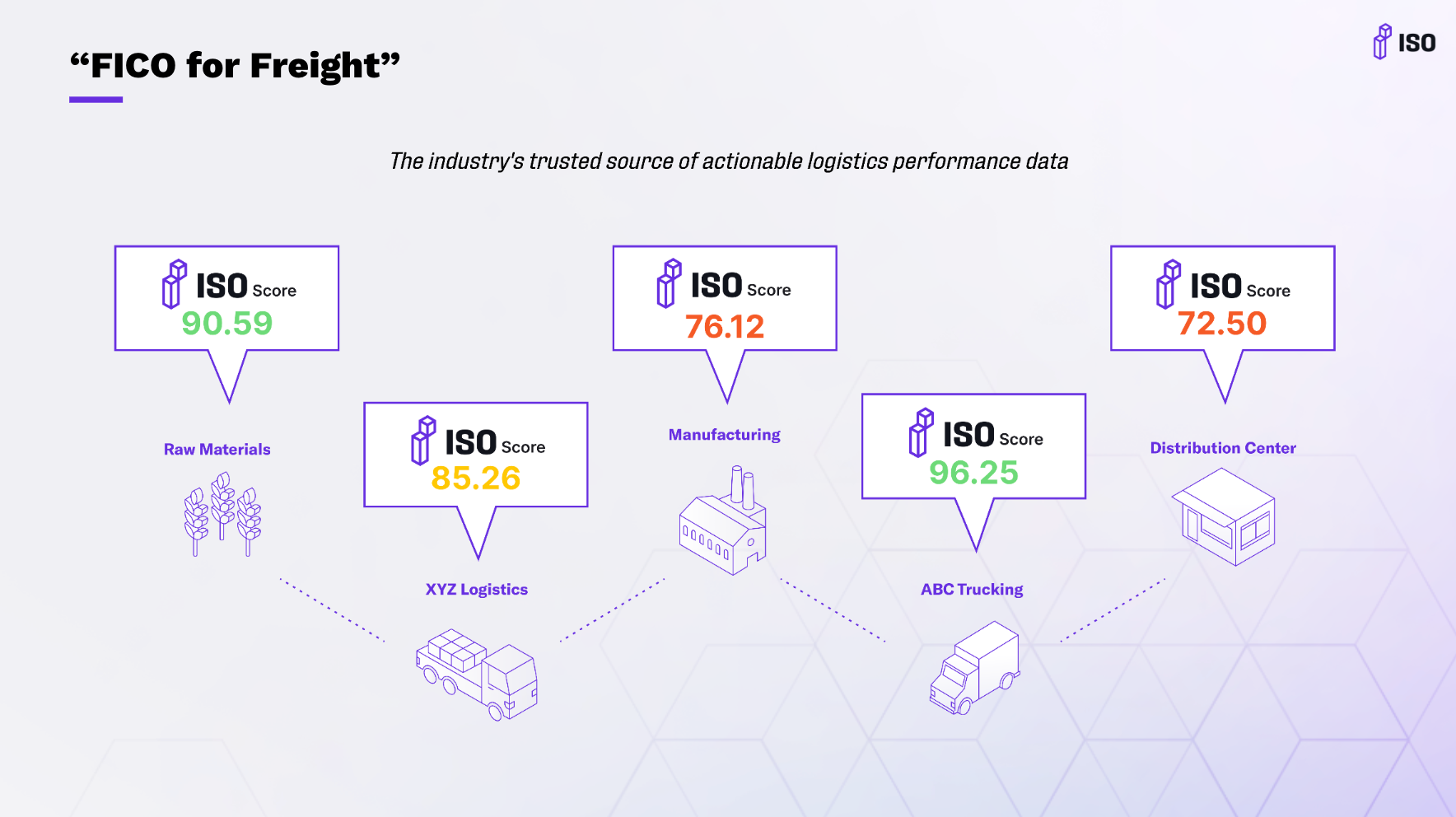
“We are missing a piece of the whole equation. Pricing is very well served by technology and is a well-understood component of the market whereas service is a total black box with so much fragmentation, we think that there is a great opportunity to bring some clarity and eliminate a lot of waste by introducing service standards or what we call the FICO score for freight,” he said.
The benchmarking facilitator is currently selling its product to shippers and brokers, helping both parties not just get a full picture of their networks’ service quality but validate their data and create an industry standard.
“Our products solve a big pain point around data reconciliation between shippers, brokers and their transportation networks. Aligning this data appropriately helps them understand the root cause of supply chain inefficiencies. Now they are able to understand bottlenecks while also measuring the cost of service,” said Stauffer.
He explained how the broker tool particularly not only helps with service improvement but also helps shipper and carrier sales teams focus on what they are good at and where carrier networks can improve.
“A core value driver for brokers is leveraging the benchmarking from a sales perspective and helping you sell objectively with data into prospective customers and existing customers. Better understanding your carrier selection and being data-driven with how you source and procure for carrier selection, while also holding your network accountable for [service level agreements] helps brokers become more scientific and data-driven with how they are actually securing capacity,” Stauffer said.
ISO products recently earned a spot on FreightWaves’ FreightTech 25, coming in at No. 22.
Managing risk
While ISO’s primary goal is to help customers better understand their networks’ service capabilities, the company also focuses on providing risk assessments to avoid future service disruptions.
ISO recently partnered with carrier identity provider Highway to improve shipper and broker carrier selection and onboarding processes.
“With this partnership, we start to unlock some real powerful automation from a procurement standpoint. As you think about the decisions that a carrier rep is making when they are looking for a truck to source a load, Highway does the front-end vetting to make sure they are safe to work with. From there we make sure that the service requirements are met on the back end and that the carrier can deliver at the highest performance level,” said Stauffer.
FICO for supply chains
ISO is currently working with customers servicing all types of industries, including consumer packaged goods, food and beverage, manufacturing, and raw materials, giving the company a large pool of shipper, receiver, broker and carrier data to build a neutral benchmarking product.
As the company grows, its goal is to offer a standardized performance measurement that extends to the entire supply chain of products.
ISO sees its future in providing FICO scores for freight. (Photo: ISO)
“We understand that carriers are probably baking in costs when they know they are going to have to deliver at a receiver that is going to detain their driver for six hours. But to have a score that is understood and accepted by the industry to help inform pricing decisions like that will ultimately incentivize every supply chain actor to improve efficiencies, eliminate waste and raise the bar for the entire ecosystem,” said Stauffer.
Postal Service seeks Operation Santa volunteers to deliver gifts to needy families
The U.S. Postal Service is seeking helpers to ensure needy children and families have gifts under the tree on Christmas morning through its Operation Santa program.
The Operation Santa program has been around for 111 years, since the agency started allowing postal employees and volunteers to respond to letters from children writing to Santa. The program allows volunteers to give back by “adopting” deserving children and families in the United States, Puerto Rico and the U.S. Virgin Islands online.
“Letter volume and the number of adopters increase every year and this year is no exception,” Sue Brennan, senior public relations specialist for the Postal Service, told FreightWaves.
According to the Operation Santa website, Dec. 18 is the last day for Secret Santas to choose letters from individuals and families. It also recommends sending packages by this date to arrive by Christmas Day.
It’s still early in the letter-writing season and new letters to Santa will be uploaded to the website as they are received. In 2022, more than 18,000 letters were adopted by Secret Santas.
Letters on the site this year include one from a family, which includes Liviey, who is 18 months old. Her favorite color is yellow. She needs diapers (size 4) and wipes, 2T clothing and pajamas and a toddler bed with bedding. Oliviana asked for a front-facing car seat and a pack-and-play and wears 24-month clothing. Larry, who is 12, wants Harry Potter bedding, wears size 13 men’s shoes and wants a blanket. Payton is 10, loves the color red and wants a drum set, a weighted blanket and a pair of new Nike tennis shoes (size 10). Pewee is 8 years old and would like a new bed set and a lava lamp for Christmas.
Companies are also encouraged to adopt a child or a family, the Postal Service said.
In his letter, Nathan, who is 12, said his grades are better this year and his brothers are good “60% of the time.” He said this year has been hard on his mom, who has been struggling with car problems and medical bills. Nathan wants a “Fast and Furious” 1970 Dodge Charger Lego set and a light-up football, Cameron, 14, wants Bluetooth portable speakers and black earbuds. Charles, 9, wants an inflatable snow tube and a double-sided remote control stunt car.
“I hope you feel merry and bright,” Nathan wrote in his letter to Santa. “Have a good Christmas.”
The views expressed here are solely those of the author and do not necessarily represent the views of FreightWaves or its affiliates.
With the holiday season upon us, retailers are gearing up for the annual rush, both online and in-store.
The 2023 holiday season will pose many challenges due to changed consumer demand, the uncertain economy, ever-increasing delivery charges and unreliable delivery service in part caused by a lack of warehouse labor.
During this festive, yet highly complex frenzy, supply chain visibility emerges as a critical factor that can make or break the holiday success for retailers. Real-time item level visibility (RTILV) supported by technologies such as radio-frequency identification (RFID) and advanced traceability software play a pivotal role in achieving this visibility goal.
Here are a few compelling reasons why retailers should make supply chain visibility a top priority, especially during the holiday peak season.
One of the primary challenges during the holiday season is managing inventory effectively. Visibility platforms enable real-time tracking of products as they traverse the supply chain with sensor and RFID technology, allowing retailers to move beyond traditional bar code scanning. This technology provides a comprehensive view of inventory levels, locations and even product conditions. Retailers can thus maintain precise control over their stock, ensuring that popular items are readily available and reducing the risk of overstock or stockouts.
Holiday shoppers expect swift and reliable order fulfillment. RTILV allows retailers to monitor the progress of orders in real time. By optimizing order processing speed, retailers can meet customer expectations for timely deliveries and elevate their overall shopping experience.
By tracking the movement of goods in real time and providing key insights based on the collected data, retailers can pinpoint delays or inefficiencies in the visibility platform, allowing for swift intervention and resolution. This proactive approach minimizes the impact of disruptions, ensuring a smoother supply chain operation during the critical holiday period.
Consumer expectations continuously increase and even more during holiday peak season, making an exceptional in-store experience paramount. Smart shelves and real-time pricing adjustments become possible, providing customers with accurate product information and reducing the likelihood of frustration due to inaccurate stock levels or pricing discrepancies. This also creates efficiencies for in-store employees, improving their jobs and allowing them to focus more on the in-store shopper.
Supply chain visibility platforms generate a wealth of valuable data providing retailers with real-time insights that can be turned into real-time decisions. Retailers can leverage this data to gain insights into consumer behavior, supply chain performance and overall operational efficiency. By applying artificial intelligence and machine learning on this data, retailers can make more real-time, faster, better informed, data-driven decisions that extend beyond the holiday season.
Retail profitability is significantly impacted by supply chain visibility in several ways. When retailers have a clear and real-time understanding of their supply chain processes, it enables them to make informed decisions, reduce operational costs, enhance efficiency and ultimately improve their overall profitability. Clear visibility further enables retailers to minimize holding costs associated with excess inventory. This includes costs related to storage, insurance and potential obsolescence. Reduction in holding costs directly contributes to higher profit margins.
Improved visibility also facilitates better decision-making in order fulfillment processes. Retailers can choose the most cost-effective shipping methods, warehouse locations and distribution strategies, leading to cost savings and increased profitability.
Finally, supply chain visibility helps minimize stockouts by providing insights into inventory levels and demand fluctuations. This prevents lost sales opportunities and ensures that retailers can meet customer demand, positively impacting overall revenue and profitability.
The holiday peak season presents both challenges and opportunities for retailers. By embracing supply chain visibility, retailers can ensure seamless operations during the holiday rush while establishing a foundation for long-term success. Supply chain visibility allows retailers not only to meet but to exceed customer expectations during the most crucial time of the retail calendar.
About the author
Bart De Muynck is an industry thought leader with more than 30 years of supply chain and logistics experience. He has worked for major international companies, including EY, GE Capital, Penske Logistics and PepsiCo, as well as several tech companies. He also spent eight years as a vice president of research at Gartner and, most recently, served as chief industry officer at project44. He is a member of the Forbes Technology Council and CSCMP’s Executive Inner Circle.
CSX eyes wheel bearing as cause of Kentucky derailment
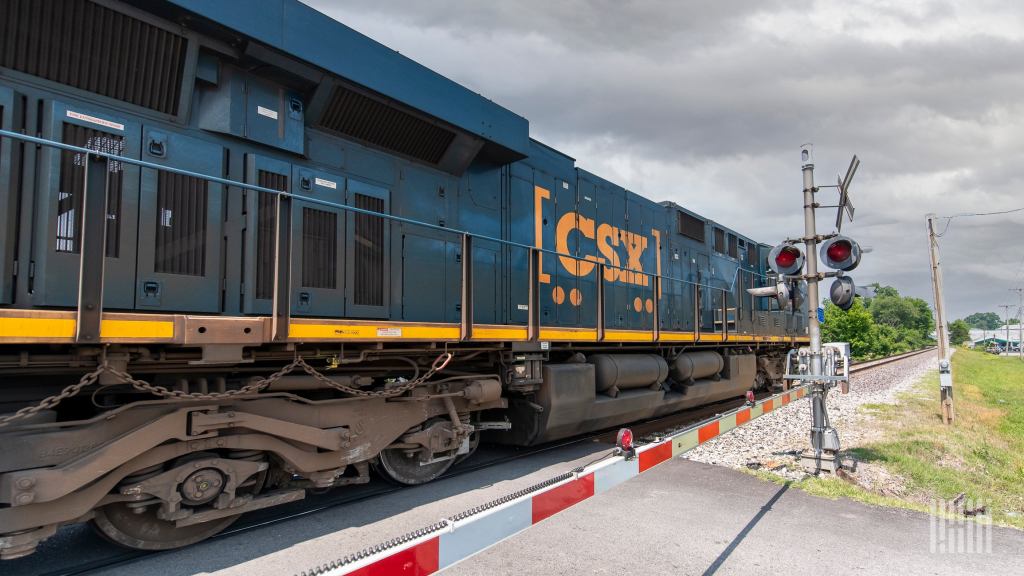
A company investigation has led CSX to believe that a failed wheel bearing may be the cause of last week’s derailment of a CSX train in east Kentucky.
The derailment, which occurred at 2:33 p.m EST on Wednesday just north of Livingston, Kentucky, in Rockcastle County, involved 16 rail cars, two of which spilled molten sulfur. The derailment also caused a fire, which CSX and emergency responders subsequently extinguished.
Because of concerns about the release of the molten sulfur, public officials issued a voluntary evacuation order, which was later rescinded. Kentucky Gov. Andy Beshear also declared a state of emergency to provide the local area with access to additional resources, including help from Kentucky Emergency Management and the Kentucky National Guard.
CSX (NASDAQ: CSX) said it removed the 16 rail cars as of Saturday afternoon and has been in close coordination with local authorities and the U.S. Environmental Protection Agency to clean up and restore the site, according to an update on the company’s website.
On Sunday morning, crews “successfully removed all of the released product and approximately 2,500 tons of impacted soil and replaced it with clean material,” CSX said. The rail carrier also expected to restore service on the main line on Sunday after repairs to the tracks.
Last week, CSX said the derailment included two rail cars carrying magnesium hydroxide, a hazardous material, although there was no indication that those cars were breached. Other cars that had derailed were either empty or carrying nonhazardous products, such as grain or plastic.