In 2024 FreightTech 25, top companies survive year of struggles
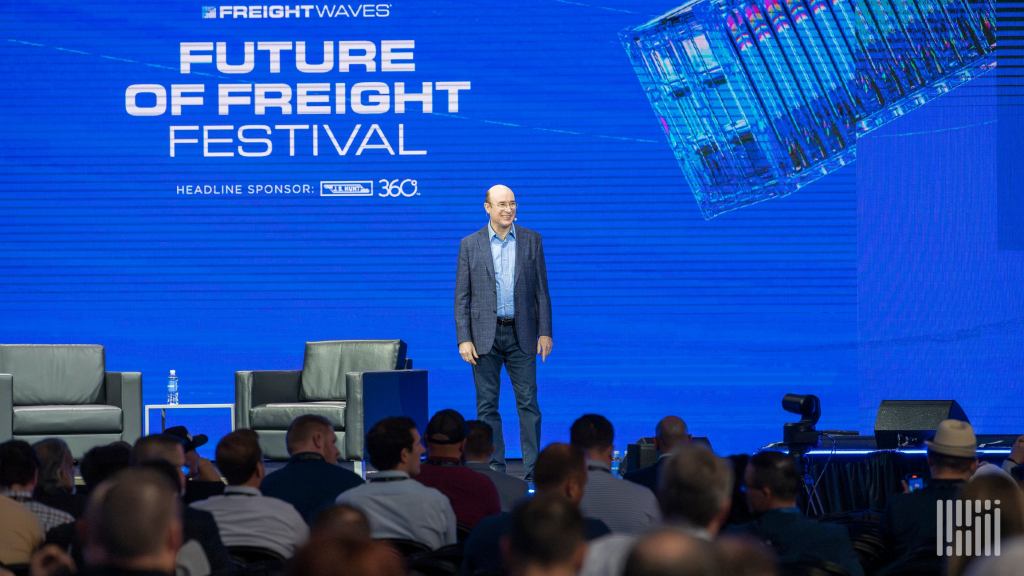
FreightWaves unveiled the winners of its 2024 FreightTech 25 awards on the final day of the F3: Future of Freight Festival. This sixth iteration of the award series was full of surprises.
The 2024 list honors industry veterans and newcomers that have found a way to hang on in one of the most difficult environments for technology companies in recent memory. In light of that, this year’s edition is probably best defined as a shake-up.
Seventeen companies are newcomers. Meanwhile, many previous mainstays fell off the list entirely. Amazon Freight (1), FourKites (12) and J.B. Hunt (15) are now the only companies that have appeared on every FreightTech 25 list.
FreightWaves CEO Craig Fuller, Senior Meteorologist Kaylee Nix and HHM Senior Accountant Becca Denison presented the awards Thursday. Fuller noted several times just how unusual it was to see so many changes over a single year.
“This was the most disrupted list I’ve ever seen,” Fuller said. “If you think about the venture cycle from 2015 to 2022 in freight for that first stage, we’re largely past that. What’s interesting about this list is how different it is than past years. A lot of new names — and a lot of names that have been on the list for many years did not make the list this year.”
Chattanooga, Tennessee-based accounting and auditing firm HHM administered the vote. A simple points system, based on voters’ rankings, determined the FreightTech 25. A company scored 25 points for each first-place vote, with descending points through to the 25th place, which received one point. The companies were then ranked by their total points.
This scoring method mirrors that of the USA Today Sports College Football Coaches Poll, The Associated Press Pro32 rankings and the AP Top 25 for college basketball.
The FreightTech 25 recognizes the most innovative and disruptive companies in the freight technology sector. This list is a special testament to resilience, as FreightTech startups have faced a funding squeeze over the past 12 months, compounded by Federal Reserve rate hikes that have tightened credit and recalibrated investor expectations.
Venture capital, once abundant, is now meting out funds more conservatively, with investors like Chris Stallman from Fontinalis Partners acknowledging a likely continuation of this trend into 2024.
The economic belt-tightening in 2023 has not only pushed valuations lower but also imposed stringent performance metrics for companies in their nascent stages. The sector’s valuation contraction is stark, with revenue multiples dropping significantly since their 2021 highs. High-profile setbacks in the industry, such as Convoy’s shuttering and Transfix’s down rounds, have further dampened investment fervor.
But opportunities still exist. Stallman noted sustained vigor in early-stage funding, with credible founders still attracting investments. Fontinalis, for example, is eyeing digital infrastructure firms that promise to untangle the current complexities of supply chain technologies. Through these challenges, Stallman remains optimistic, seeing a landscape where only the most adept FreightTech companies will continue to thrive.
And that will set them up for future competitive advantages.
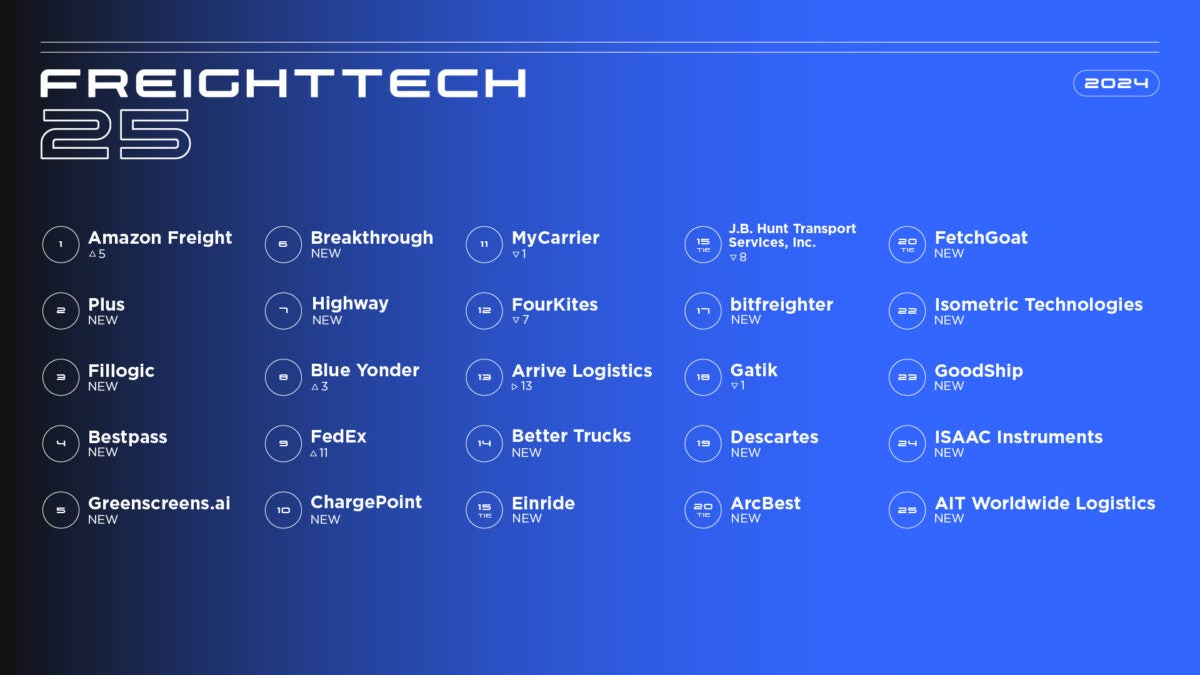
2024 FreightTech 25
Here is the list of the 2024 FreightTech 25 companies, ranked according to voter results. (Company descriptions are from Crunchbase, among other sources.)
1. Amazon Freight Blends technology with a network of Amazon trailers and carriers to move full truckload freight.
2. Plus Developer of self-driving trucks to enable large-scale commercialization of autonomous transport.
3. Fillogic Generates efficiencies for retailers and freight delivery networks via mall-based microdistribution hubs.
4. Bestpass Provides a comprehensive payment platform with a focus on nationwide toll management for commercial fleets.
5. Greenscreens.ai Builder of a dynamic pricing infrastructure for freight.
6. Breakthrough Provider of fuel recovery and network intelligence solutions.
7. Highway Offers carrier verification services to cut down on fraud.
8. Blue Yonder World leader in digital supply chain transformations and omni-channel commerce and fulfillment.
9. FedEx Provides customers and businesses worldwide with a broad portfolio of transportation, e-commerce and business services.
10. ChargePoint Provider of end-to-end fleet electrification solutions including charging stations, software, and services.
11. MyCarrier Transportation management platform that allows SMB companies to manage their freight needs directly with their carriers.
12. FourKites Supply chain visibility platform designed for transportation into yards, warehouses and stores.
13. Arrive Logistics A technology-enabled logistics company for multimodal freight.
14. Better Trucks Last-mile parcel carrier that specializes in rapid-residential deliveries.
15. (tie) Einride Provider of digital, electric and autonomous shipping.
15. (tie) J.B. Hunt Provides logistics management services and integrated transportation solutions to major corporations.
17. bitfreighter Provider of EDI and data integrations platform.
18. Gatik Technology developer for autonomous light- and medium-duty trucks for B2B short-haul logistics.
19. Descartes Provider of real-time freight visibility and capacity matching (MacroPoint) and freight broker TMS (Aljex) software solutions.
20. ArcBest Asset-based carrier and freight broker.
20. (tie) FetchGoat Provider of fulfillment and last-mile management services.
New mode, more data: FreightWaves announces SONAR updates at F3
As more and more companies partner with FreightWaves to revolutionize the way they look at their supply chains, new and unique applications arise that create growth opportunities. The SONAR team has listened to customer input and is launching a new mode and new ways to analyze and leverage data.
Here are the new features announced this during F3: Future of Freight Festival in Chattanooga, Tennessee:
Announcing flatbed spot rates
FreightWaves already boasts more than $200 billion in annual high-frequency truckload data, delivered with more accuracy than any other provider. While the SONAR team has been collecting flatbed rate data for quite some time, the volume and velocity of the data was not at thresholds that met proper standards for analysis. The SONAR data science team seeks to uphold strict IOSCO data protocols to give customers the highest level of confidence as they benchmark their current and potential freight.
Flatbed pricing — currently only available via application programming interface — is created through the Trusted Rate Assessment Consortium (TRAC), which is built by industry leaders sharing daily load data to create the most up-to-date and transparent spot rate data in the industry. Flatbed is now added to the longest list of market benchmark data in one solution — van, reefer, flatbed, rail, ocean, air, energy and equipment — providing more than 300,000 unique market defining signals across more than 1 million lanes.
New benefits for more TRAC contributors
TRAC is the spot rate engine for SONAR. Unlike other rate providers that gather historical invoice data in batches, TRAC is built in partnership with roughly 30% — and growing — of the top 100 brokers and 3PLs that provide actual booking data on every single load booked each day. This makes TRAC data far more accurate and reliable than any other spot rate source on the market.
The newest round of contributors includes seven of the largest companies in the space. To thank our contributors and add more value for new partners, SONAR is now offering TRAC Benchmarking, a tool that specifically gives these companies a unique way to see how their business stacks up against the industry.
FreightWaves has also added the TRAC data into Supply Chain Intelligence (SCI) to give shippers a stronger understanding of transactional market pricing while benchmarking their entire supply chain in one strategic tool.
But wait, there’s more …
SONAR also has a new methodology to allow customers to analyze pricing by key market area to key market area (KMA to KMA). KMA to KMA rates allow for better trend analysis since they minimize volatility by incorporating more data into each rate. It also limits the distance out from a location that a system may look on a given lane, often creating more accuracy over time. This provides users with a new way to view rates using legacy systems they may already have in place and paves the way for new, highly impactful customization that will give users additional speed and flexibility.
The future is limitless
SONAR is partnering with companies to create dynamic pricing methodologies, optimize transportation strategies and continue to build a single source of truth for the supply chain world. These features and new data points are the foundation for significant growth and development.
Connect with FreightWaves at sales@www.freightwaves.com.
Shipping line Hapag-Lloyd suffers ‘big miss’ as Q3 profits slump
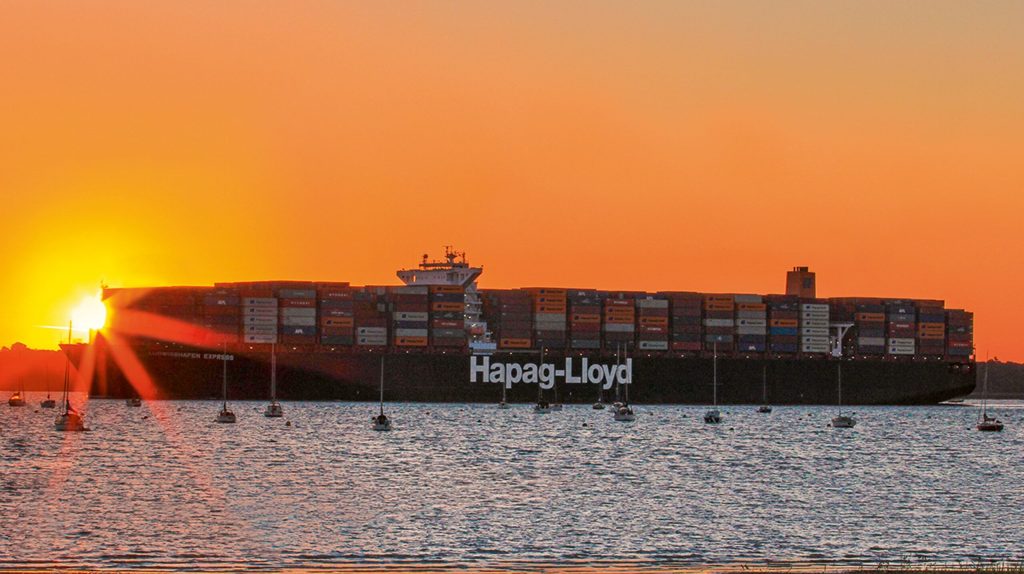
Germany’s Hapag-Lloyd, the world’s fifth-largest ocean carrier, reported much lower profits than expected for the third quarter as sinking freight rates offset improved volumes.
“Volume is really not that bad. Rates are the problem,” said Rolf Habben Jansen, Hapag-Lloyd’s CEO, on Thursday’s conference call with analysts.
Rates are being driven down by overcapacity as a record wave of newbuildings is delivered and capacity removals — ship idling and scrapping — do not keep pace.
“The orderbook is still very substantial with quite a lot of deliveries scheduled,” said Habben Jansen. “This leads us to the view that for a number of quarters — probably six to eight — we certainly expect supply growth to outpace demand growth, which will continue to put pressure on the market.
“We do not expect a dramatic recovery of demand in the next couple of quarters. The macro environment remains challenging, there are two wars going on, interest rates are still pretty high, inflation is higher than it should be, and investor sentiment is not great.
“So, it will be a challenging market, not only for the remainder of this year, but certainly also in 2024 and potentially a bit after that.”
Earnings miss the mark
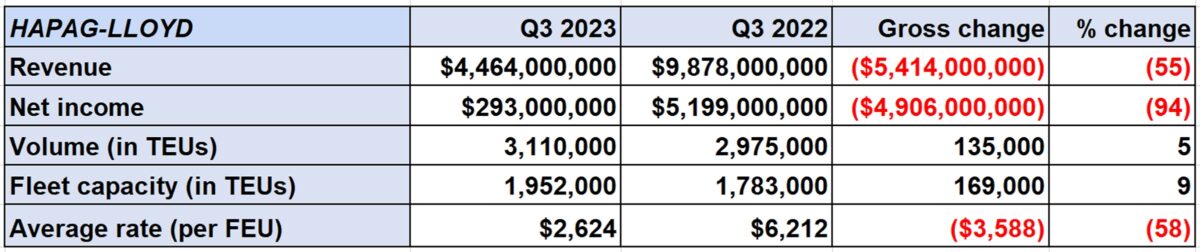
Hapag-Lloyd reported net income of $293 million for Q3 2023, down 94% year on year and down 73% sequentially versus net income of $1.102 billion in the second quarter of this year.
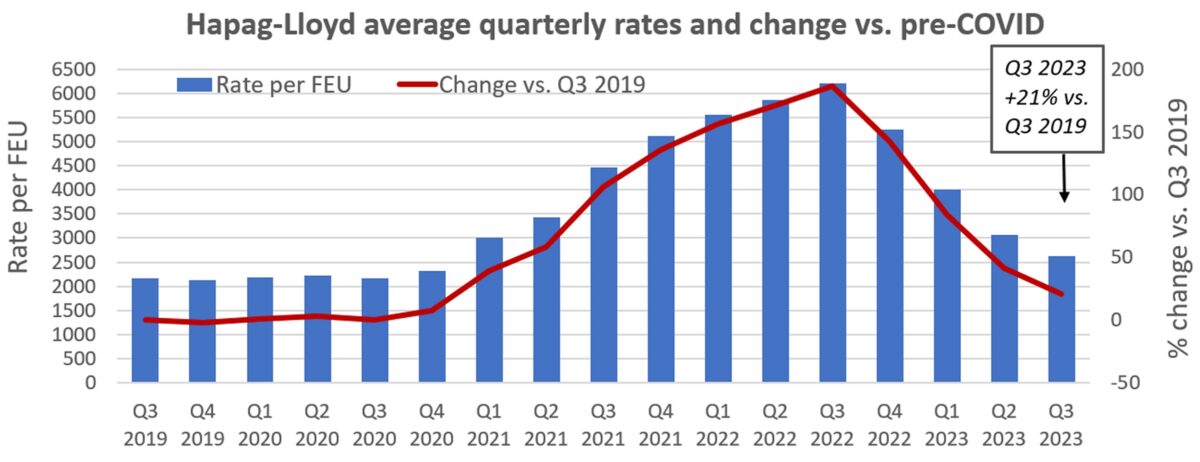
Freight rates (including contract and spot rates) averaged $2,624 per forty-foot equivalent unit in Q3 2023, a 14% decline versus the second quarter, while volume rose 5% quarter on quarter. Rates in the latest quarter were still 21% higher than rates in Q3 2019, the corresponding period pre-COVID.
(Chart: FreightWaves based on Hapag-Lloyd financial filings)
Hapag-Lloyd’s earnings came in at $1.63 per share, 42% below analyst consensus. Earnings before interest, taxes, depreciation and amortization of $744 million was 21% under the consensus, while earnings before interest and taxes (EBIT) of $228 million came in 47% below consensus.
It was “a big miss,” wrote Deutsche Bank analyst Andy Chu.
Hapag-Lloyd tightened its guidance and now expects full-year EBIT (operating profits) of $2.4 billion to $3.4 billion. Given that its EBIT in the first nine months totaled $2.99 billion, this implies Q4 2023 EBIT of minus-$590 million to $410 million, with a midpoint in the red.
Hapag-Lloyd won’t sign loss-making contracts
Rates are at loss-making levels in the Asia-Europe and trans-Atlantic trades, which “are under tremendous pressure at this time,” said Habben Jansen.
In response, Hapag-Lloyd and its partners in THE Alliance have canceled four major east-west services to date, three more recently plus one previously. “What we’ve done differently this time is we have chosen not to go out and ‘blank’ [cancel] services on a week-by-week basis, but rather, remove entire services from the network.”
Hapag-Lloyd and other liner operators are about to negotiate new annual contracts for their Asia-Europe services that renew at the beginning of the calendar year. Because these negotiations are taking place when spot rates are extremely weak, contract rates could fall significantly year on year.
But Habben Jansen maintained that Hapag-Lloyd would rather lose business than lock in year-long losses under a contract. To the extent contract volumes are lost, the company would idle ships and reduce voyage costs (65% of its voyage costs are variable).
“We see expectations out there for contract rates that are unrealistic. At those levels, we will not close, because we’re not going to close contracts at rate levels where we would, for sure, lose a lot of money.
“We’d rather take out cost and capacity if and when that’s needed. So, I would expect that in the end, those contracts that start at the beginning of the year will be above spot levels we see today.”
Potential trade disruptions ahead
During the analyst call, Habben Jansen also cited potential trade flow disruptions, including the Panama Canal water-level crisis and the threat of a port worker strike next year on the U.S. East and Gulf coasts.
“I think the drought in the Panama Canal is a real problem. The latest news is that capacity is potentially going down 30-40% at the beginning of next year. That means the number of ships going through there today cannot all go through there — and we have to find solutions for that. Rerouting some ships via the Suez Canal is certainly one of the options.”
On a potential U.S. dockworker strike, he said, “We have seen in the past — many, many times — that we all of a sudden have space constraints, and then the market changes tremendously. If you look at 2024, there are all kinds of scenarios. With the negotiations taking place on the U.S. East Coast, there are already people talking about a possible strike. These are the types of risks you need to factor in.”
Daily Infographic: National animal strike claim frequency
To view more FreightWaves infographics, click here
Cargo airlines throttle back on aircraft leases, ATSG says
A number of freighter operators are starting to back out of, or postpone, commitments for upcoming aircraft leases, underscoring how the prolonged contraction in demand for air cargo shipping is squeezing cash flow across a wider cross-section of the industry.
Executives at Air Transport Services Group (NASDAQ: ATSG), a leading lessor of cargo jets that also provides cargo flying and other services, said Tuesday that weak interest from international airlines is a key reason why it lowered second-half profit guidance by $45 million and is taking a more conservative approach towards freighter investments.
The company presented a window into how pain from the freight downturn is spreading during an analysts briefing on its disappointing third-quarter earnings one day after the board of directors fired Rich Corrado and named its chairman, Joe Hete, as CEO.
Air Transport Services Group late Monday reported adjusted earnings before interest, taxes, depreciation and amortization of $137 million, 16% below the third quarter of 2022. Other drags on performance included inflation, the conflict in Israel and unexpected maintenance. The company’s stock price dropped 23% on Tuesday and another eight points Wednesday to close at $14.32. The stock is down more than 40% year to date.
Susquehanna Financial Group downgraded ATSG’s stock to “neutral” because of the magnitude of the earnings miss against Wall Street expectations and the revised guidance, which likely will carry over into 2024.
“Our new reality is that growth will be more difficult to achieve than before,” said Hete, who once ran the company for 17 years and is tasked with shoring up results and investor confidence.
The markdown in second-half operating profit includes $24 million for the company’s leasing business, Cargo Aircraft Management, because all-cargo airlines are scaling back on planned freighter leases. The company now expects to deliver 16 newly converted freighters in 2023, three fewer than previously communicated. It has commitments for 14 passenger-to-freighter conversions next year, two less than listed during the summer.
“In mid-October, we were contacted by certain airline customers of CAM expressing that they were experiencing lower customer demand, which is negatively impacting their financial results and outlook,” President Mike Berger told analysts. “The air cargo industry is undergoing rapid changes this fall. Unfortunately, we are not immune to that.”
Many carriers aren’t in a hurry to take aircraft as they would be in a more robust economic environment, CFO Quint Turner added.
According to Mexican aviation news outlets, mas Cargo Airline has parked both of its Boeing 767-300s to optimize operations around a uniform fleet of Airbus A330 freighters. Mas leases the 767s from ATSG and was recently scheduled to receive another one. Berger said mas hasn’t returned any aircraft so far and ATSG expects the airline to honor its lease commitments. The decision, however, indicates there won’t be any future growth with that customer.
ATSG’s biggest commercial customers are Amazon and DHL Express, which lease aircraft and pay ATSG’s two cargo airlines to fly packages on their behalf. Passenger charter subsidiary Omni Air International flies troops and other personnel for the U.S. government, accounting for about 30% of company revenues. The leasing business is increasingly placing aircraft outside the U.S. with smaller operators, most of which function as contractors for global express operators Amazon, DHL, FedEx and UPS.
The parcel giants, with double-digit declines in volumes, are rationalizing oversized air networks and partner carriers are feeling the trickle-down effect. ATSG’s comments are further evidence that more all-cargo operators and lessors are pausing new orders and, in some cases, reversing course. Earlier this year, Cargojet canceled plans to buy and convert four Boeing 777s and Air Canada told Boeing it no longer needed two factory-built 777 freighters.
Cargo airlines ABX Air and Air Transport International are flying fewer hours on long-haul routes for international customers, with overall cargo hours down 4% during the quarter, management said. But both carriers are on track to meet full-year targets for adjusted pretax income.
ATSG, until the third quarter, had largely escaped fallout from the ongoing freight recession, which has seen air cargo volumes fall about 13% since the end of 2021, with rate declines of 40% to 50% for the majority of this year. During the second quarter, revenue increased 4% and adjusted earnings were on par with the prior year.
And there were few signs of customer backpedaling, other than Vietnam Airlines quietly canceling plans for two Airbus A321 narrowbody freighters. Company leaders said last summer they would time future aircraft purchases closer to when production slots for conversions open up.
Showing more caution
But investors pressured the cargo-focused company to downsize capital expenditures because of deteriorating market conditions. Management responded in August, trimming $65 million from the investment budget for 2023. On Monday, the company went further, cutting 2024 capital expenditures to $505 million, $100 million less than mentioned in September and $280 million less than this year.
Executives said their hybrid business model, which includes maintenance and airport ground services, gives them the flexibility to hold off on acquiring feedstock and moving ahead with the conversion process as market conditions change.
Hete said the aviation firm is not sending additional 767-300s for conversion beyond the seven currently in process. Six Boeing 767 passenger aircraft already purchased on the second-hand market will be parked until demand improves. CAM can still generate income from those assets by leasing out the engines to other operators, loaning aircraft to Omni Air if there is demand for more passenger service or leasing aircraft to a needy passenger airline, he said.
Berger said ATSG still has its eye on long-term growth, reiterating the refrain that e-commerce growth and airlines’ need to replace older freighters justified capital spending.
Airbus and Boeing have forecast air cargo demand will grow at a compound annual rate of about 3.5% to 4% through 2040. Changing operating behaviors in the passenger sector, including greater use of smaller jets with better fuel efficiency on longer routes and more point-to-point flying that bypasses airport hubs, could also increase shipper interest for dedicated freighters.
Berger said Asia will be a magnet for converted freighters. “A big part of our future is international. And we are a global organization. We’re looking forward to that growth going forward,” he said. Uzbekistan-based My Freighter on Wednesday took delivery of its first 767 cargo aircraft, Turner confirmed to FreightWaves. The lease was initially reported by Cargo Facts.
ATSG’s revenues were impacted by the return of 11 Boeing 767-200s in the past year after their leases expired. The planes are near end of life and more expensive to operate than 767-300s currently being marketed. CAM intends to sell two of the fully depreciated planes this quarter and more next year.
Interior of an Airbus A330 aircraft being converted to carry containers instead of passengers. ATSG has plans to modify and lease 29 A330s. (Photo: Elbe Flugzeugwerke GmbH)
ATSG is also adding the Airbus A330 converted freighter to diversify its midsize aircraft offering as the availability of used 767 passenger aircraft begins to dry up. An Airbus facility in October inducted ATSG’s first A330 for conversion.
Israel Aerospace Industries, the Tel Aviv-based company that turns ATSG’s Boeing 767s into a cargo configuration, lost a substantial number of employees who are reservists to military duty when the war against Hamas started a month ago. Berger said ATSG has been in constant contact with IAI and is confident the supplier can meet upcoming delivery schedules.
Management questions
Forty percent of the reduction in projected profits is associated with Omni Air. Management said the outbreak of war in the Middle East caused the Pentagon to pause troop rotations at a normally busy time of year while it monitors the need to adjust its force posture in the region.
Analysts criticized leadership for being caught off guard by the change in fortunes, especially after delivering a positive message at Investor Day on Sept. 27. The disappointing third-quarter results compounded shareholders’ perception that the company has underperformed for years, and Corrado took the fall.
Executives responded that the 767 sales weren’t finalized as expected during the quarter and that a late maintenance issue stranded an Omni plane in Guam for three days, resulting in unexpected hotel costs for about 250 passengers and crew, as well as overtime pay for pilots.
“A lot of the deterioration occurred late in the quarter. And we did not have that visibility at the time,” CFO Turner said. The Israel conflict, which also weighed on guidance, came after the quarter ended, he added.
Hete acknowledged the need to improve financial results and reporting lines to top management.
“We don’t find it acceptable. Rest assured that that is top of the list of getting back in terms of where the numbers we put out are credible to the market,” he said.
“We believe new (and former) CEO Joe Hete is the best person to manage ATSG through this difficult period, with his focus on ‘maximizing returns’ and taking a ‘more measured’ approach to growth strategically right-minded. At the same time, with ATSG finally delivering an investor day approximately just six weeks ago and then sharply pivoting on its outlook, we believe it’s going to take some time before investors are again comfortable with the story,” said Susquehanna equity analyst Christopher Stathoulopoulos, in a client note.
Executives, including Corrado, have long lamented that investors and analysts misunderstand ATSG’s value proposition, noting that the ability to secure long-term leases, and carry out dedicated contract flying for e-commerce customers, differentiates the company from traditional cargo airlines wholly subject to volatile market forces.
Stifel transportation analyst Frank Galanti said the market is overreacting to the downward revisions in guidance given future requirements for midsize freighters and expects the company to soon outperform low expectations, which will improve the stock price.
Satish Jindel, CEO of parcel consultancy ShipMatrix, blasted ATSG’s board for making Corrado the scapegoat for a profit shortfall during a prolonged freight recession that was out of his control.
Corrado was Hete’s hand-picked successor and Hete was able to provide mentorship as chairman.
“No one should get the blame. Shareholders should not set the direction of a company because they can be in today and out tomorrow. They have no allegiance,” Jindel said. “If the shippers, the customers, were complaining and employees were complaining about Rich Corrado, then yes. And the board should not be wrapped up in trying to please the shareholders.”
Pilot contract
Meanwhile, the federal government is mediating stalled contract talks between subsidiary Air Transport International and its pilots’ union. Talks have broken down over work rules, retirement and compensation. On Oct. 30, the Air Line Pilots Association opened voting to give union leadership authorization to call a strike when legally allowed. The sides can’t initiate self-help tactics until the National Mediation Board releases them from the mediation process.
ALPA says 207 pilots have left ATI so far this year, a third of the current pilot roster.
Hete acknowledged that ATI is experiencing attrition, with pilots taking significant hiring bonuses to join mainline passenger carriers. Other cargo and regional passenger airlines face similar staffing challenges.
“At the end of the day, you’ve got to have a contract that works for both sides. So if you’ve got the union side asking for FedEx or UPS wages or industry-leading, and that’s not in the cards from what we get from our customers, then that’s just not something we can agree to. So the key is finding a happy middle ground between their demands and our needs to keep things on the rails,” said Hete.
CHATTANOOGA, Tenn. — A brand-new interface for the FreightWaves SONAR product was introduced to the trucking community at the F3: Future of Freight Festival.
Rollout of the upgraded SONAR, which was unveiled at the FreightWaves festival in Chattanooga, Tennessee, on Monday, will begin next month.
“It has been core to everything that we have done inside of our organization,” FreightWaves CEO and founder Craig Fuller said during an F3 session to introduce the upgraded product. “The high-frequency data of SONAR is so important to use and provide fresh insights.”
While SONAR will continue to add new data streams to its offerings, including flatbed trucking information that will be introduced in the coming weeks, the primary goal of the upgraded version of SONAR is customer usability and speed.
“One of the things that we have invested in significantly is improving the quality of the data,” Fuller said, citing “the speed and freshness and depth of it.”
“But we have done a poor job on actually improving the interface and experience,” he added, noting that the user interface in SONAR dates back to the product’s launch in 2018.
Zach Strickland, FreightWaves’ director of freight market intelligence, said the speed of the system “was one of the biggest things we really focused on because we listened to you. … A lot of the feedback we got was that it just wasn’t moving fast enough.”
Testing is showing that pages are loading 2.5 to 3.5 times faster than previously.
Among the new features:
More functionality moved to the top of the page. “We’ve moved a lot of the stuff that was on the left side of the page to the top,” Strickland said. “This just makes the geography a lot easier to work with and a lot bigger.”
Those commands at the top of the page now include a Chart button that will produce a graphic far quicker than in previous versions and also can be quickly saved to a download. And the charting tools in general have far greater graphic capabilities to display multiple data streams in one graph.
The new user interface, when SONAR is opened, will have greater immediate visibility into trucking rates from TRAC, the Trusted Rate Assessment Consortium that provides data on the cost of moving truckload freight between key points. That data will be for both spot and contract rates. Those rates include not just a per-mile rate but the recently rolled out data on the all-in cost in a lane, a new feature in SONAR.
Making a window containing a chart smaller in the old interface had the unfortunate side effect of cutting down on the data that was visible. But in the new interface, the chart will shrink proportionately so that all the data will be displayed in the new smaller window. That would enable a full chart to be seen on a screen as small as that in a tablet.
Although changing an interface doesn’t change the speed that a server delivers a piece of data to a dashboard, a drawback to the existing SONAR interface is that an update kicked off an update of every page, slowing the speed of the data dashboard being fully uploaded. With just the requested page uploading in the new interface, speed will be enhanced even though there is no change to the delivery time of API data to the system.
Finding data will be significantly easier. Various tools in the system will allow a more direct language search for data streams so that knowledge of the exact code isn’t necessary to do a quick search for a data stream.
“SONAR will still have the high-frequency data that your market and our customers use on a daily basis,” Fuller said. “It still has many of the features that drive quick decisions and market intelligence. But it doesn’t have the clunkiness and the inability to search for data and find what you’re looking for if you don’t know the ticker.”
China’s COVID policy showed global supply chain’s fragility
CHATTANOOGA, Tenn. — A leading authority on supply chain, geopolitical tensions and financial risks in China says that country’s zero-COVID-19 policy exposed an already fractured global supply chain.
Leland Miller, CEO of China Beige Book, which compiles independent Chinese economic data, urges companies to diversify and disentangle themselves from the world’s second-largest manufacturer and exporter of goods.
“What really broke the dam on this is COVID-zero because you had all these problems,” Miller said during his keynote address at F3: Future of Freight Festival on Wednesday. “I think a lot of companies thought they could deal with the geopolitical tensions; they thought that this was a much longer fuse than they had. But COVID-zero showed that if the economy could be shut down and supply chains be shut down, then every company that has a China presence could have a serious problem.”
China’s policy involved extensive testing, strict lockdowns and quarantining in an effort to limit COVID cases.
Companies should be evaluating their vulnerabilities amid ongoing geopolitical tensions with China and Taiwan, according to Miller.
“My message to CEOs would be take your blinders off and be honest with yourself: ‘What are our vulnerabilities going forward? And are we doing enough to disentangle ourselves from China considering the threats that we see in the future?” he said.
In speaking with policymakers in Washington, Miller said there’s a desire to address ongoing political tensions to a certain degree regarding exports but he sees the U.S. government becoming more involved toward the end of the decade if tensions continue to deteriorate between the U.S. and China.
“I think there’s gonna be a continued evolution of the corporate mindset in terms of what we can afford and what we can risk getting from China,” Miller said. “What are our vulnerabilities? I think we’re at the very beginning of that stage right now. But I think that we still have a much more difficult path in the years ahead.”
China’s pandemic policy, implemented by President Xi Jinping, exposed a fragile supply chain, and manufacturers are making significant investments in Vietnam, India and North America, mainly Mexico, to produce goods.
“For a few years, we were talking about export control on technology. Now there is technical decoupling going on, whether it’s semiconductors and things related to sort of the fourth Industrial Revolution of advanced technology and anything related to 5G, AI, quantum, biotech, robotics,” he said.
As the Chinese government continues to grapple with an aging population and a declining birth rate, investment firms that offer solutions like taking care of the elderly, generating more babies and offering services around incentivizing childbirth may be welcomed with open arms, Miller said.
FreightWaves CEO Craig Fuller asked Miller if he was more bullish on the U.S. economy versus China’s over the next decade.
“Am I worried about the U.S. economy? Sure,” Miller said. “But, I’m worried about China’s economy a lot more.”
Hyliion spikes powertrain business and lays off 175 employees
Hyliion Holdings is giving up on making hybrid electric powertrains and will lay off 175 employees — two-thirds of its workforce — as it pivots to develop a business around fuel-agnostic generator technology it purchased from GE Aviation.
“Our focus on Karno aligns with the growing demand for electricity,” Hyliion founder and CEO Thomas Healy said in a news release. “With commercial deliveries planned for the upcoming year, the Karno generator offers a more capital-efficient path to market.”
The expected pivot came after markets closed Wednesday as part of the Austin, Texas-based, startup’s third-quarter earnings report. Hyliion’s board of directors approved the moves Tuesday.
After delays and cost overruns, the board began a strategic review in October of the powertrain business Healy founded in 2015. Hyliion stopped taking orders for the powertrain Oct. 11. The wind-down is expected to conclude by the end of the first quarter of 2024 and cost $18.4 million.
The strategic review announcement led shareholders to dump Hyliion (NYSE:HYLN) stock. It lost about half its value on Oct. 11. Shares closed at 59 cents Thursday. The New York Stock Exchange told Hyliion last Thursday that it was out of compliance with its listing requirements because its shares traded below $1 for 30 consecutive days. The exchange could move to begin delisting procedures.
A rare startup with cash on its balance sheet
Hyliion is a rare transportation startup in that it retains much of the cash raised in a reverse merger with special purpose acquisition company Tortoise Acquisition Corp. in 2020. Development of the Hypertruck ERX platform burned through cash with no certainty of market acceptance and no line of sight to raising more money.
As fleets begin replacing diesel models with zero-emission battery-electric trucks, the Hypertuck ERX solution falls short because of complexity, cost and missing out on being a true zero-emissions powertrain.
Hyliion received California Air Resources Board certification for the Cummins 12-liter natural gas engine for the Hypertruck. But CARB won’t recertify it next year. That would require Hyliion to adopt Cummins’ 15-liter replacement and go through the process again.
“The decision around our powertrain business was very difficult,” Healy said. “But we believe it is a necessary step to safeguard our financial stability, especially given the current economic climate.”
Hyliion said it would try to sell its powertrain assets but could not predict whether that would happen. The job cuts were included in Hyliion’s 10-Q filed with the Securities and Exchange Commission.
Originally intended as a second-generation powertrain for the ERX, Karno is now Hyliion’s main business. It expects to begin customer deliveries of stationary generators fueled by natural gas, hydrogen, propane or up to 20 additional fuel types.
For electric vehicle charging, bringing Karno generators to a location where utility-installed power is delayed could help match the regulation-driven demand for electric trucks.
“I do see a lot of shippers and carriers testing temporary solutions until they get their permanent solutions in place,” Salim Youssefzadeh, founder and CEO of Truck-as-a-Service startup WattEV, told FreightWaves.
“There are cases where some people can’t get power to their site fast enough. Rather than putting in a diesel generator, they may look at putting a linear generator there using natural gas to create energy. It’s something we are evaluating at some of our locations that are years out in terms of getting power.”
Hyliion has moved into a new research and development and low-volume Karno production facility near Cincinnati. Technology progress reported so far includes:
Delivering power successfully to the grid as part of ongoing development and validation.
Executing customer showcases to gin up future sales.
Performing simulations and in-lab testing indicating achievable power, efficiency and emissions objectives.
Hyliion has enough money to commercialize the Karno, Healy said.
By the numbers
The company projects to finish 2023 with approximately $285 million of available capital. It expects a cash burn of approximately $40 million in 2024.
Third-quarter operating expenses totaled $33.3 million, compared to $62.9 million in the prior-year quarter, which included $28.8 million for the Karno purchase.
Year-to-date expenses totaled $103.7 million, compared to $120.8 million in the prior-year period. Hyliion ended Q3 with $324 million in cash, short-term and long-term investments.
Hyliion expects full-year operating expenses of approximately $140 million, including the cost of winding down powertrain operations. It expects no additional revenue from powertrain sales in 2023.
Editor’s note: Updates with layoffs, NYSE noncompliance letter and edits throughout.
Jacobs, executive chairman of Greenwich, Connecticut-based XPO Inc. (NYSE: XPO), is a career CEO and serial entrepreneur with a unique track record, having started five companies that all became billion-dollar or multibillion-dollar enterprises.
Along with XPO, Jacobs is the non-executive chairman of its two relatively recent spinoffs: logistics management company GXO (NYSE: GXO) and 3PL RXO (NYSE: RXO).
Jacobs also recently authored a book titled “How to Make a Few Billion Dollars” by Greenleaf Book Group Press. The book, which will be released in January, is for people who want to accomplish “big stuff in life,” he said.
“The book was everything I know about making money; I don’t know anything else,” Jacobs said. “The book could help you not even necessarily make a few billion, but make whatever you want to make, whatever your goal is. It’s also not just about money. … It’s about how do you accomplish big stuff in life? How do you think big? How do you get out of your rut of just thinking the same old, same old and go for it? And then how do you execute on that?”
Jacobs’ wide-ranging town hall at F3 tackled everything from how he started in business to rewiring the mind for positivity to learning from failures to his next big move.
Here are five takeaways:
Jacobs’ next billion-dollar venture will be in the industrial sector
An audience member asked Jacobs, “What’s next? Do you see an opportunity still in transportation? Or do you have another industry or sector on your radar?”
He replied, “I have another industry in mind. I haven’t announced it yet, and I’m not going to do it today. But I will before the end of the year in all likelihood, and it’s not in transportation.”
He revealed only that the next company he starts will be in the “industrial” sector.
“I’m going to do something in another industry that’s industrial, that is large, as in hundreds of billions of dollars in size, where there’s an opportunity to consolidate because that’s my thing, where I can buy, buy, buy, and I can start a company from zero and get it up to tens of billions of dollars in revenue within a few years. That’s what I want to do. That’s what makes me excited. That’s what gets me to wake up in the morning.”
(Photo: Jim Allen/FreightWaves)
Fear of failure is not necessarily a bad thing
When an audience member said he goes to bed at night fearing that the family-owned company he runs might go out of business, Jacobs said being afraid of failure can be valuable.
“The fear of failure, that’s a good thing. It’s good to have that anxiety. It’s good to not to feel like I’m invincible, I’m definitely going to succeed, because there are going to be setbacks. There’s going to be bad years, there’s going to be people letting you down, there’s going to be problems along the way. That fear, that vigilance for problems coming up, it’s actually your friend. That’s probably one of the reasons you’re successful, is that you’re thinking about what could go wrong, and then dealing with that proactively.”
(Photo: Jim Allen/FreightWaves)
Middle managers are the backbone of companies
“In the transportation and logistics business, it’s not the C-suite level that determines the success of the company. C-suite level raises all the money and keeps it all together. Take the warehouse business: The warehouse manager is definitely the most important person. If you have a really strong warehouse manager, you’re going to have a profitable, safe, thriving warehouse. If you have a mediocre warehouse manager, you’re going to have fantastic everything else in the organization, but you’re still going to have a very mediocre and maybe not perfectly safe and not a customer-pleasing warehouse. The midlevel management is where it’s at.”
(Photo: Jim Allen/FreightWaves)
Scaling a company starts with teamwork
When scaling a company, Jacobs said he first focuses on people and then on technology.
“My office is right next to the chief human resources officer’s office, and we walk into each other’s office many times a day talking about our people. Are we paying them right? Is their head in a good place? Are the employee surveys coming out right? Are the engagement scores going up? What problems do we have? How is our [employee] retention? It’s people, people, people, but right after that is technology. Technology makes you better than the competition, and that’s why I’ve always spent huge amounts of money on technology.”
(Photo: Jim Allen/FreightWaves)
He remains ‘bullish’ on freight brokerages
“We happen to be in the part of the brokerage cycle where it’s very hard to make money. That’s OK. That’s part of the cycle. That’s why it’s a good business. It’s not a flat business. The fact that it is volatile over the course of the years, that’s why brokers exist. Brokers exist to fulfill the needs of shippers and of carriers, because there’s uncertainty. If it was really clear how to find a truck or how to find a load, no one would need brokers. So it’s good that there is volatility there. I think long term, the prospects of brokerages are really strong. I am actually bullish on the long term of the brokerages. Short term, it’s tough.”
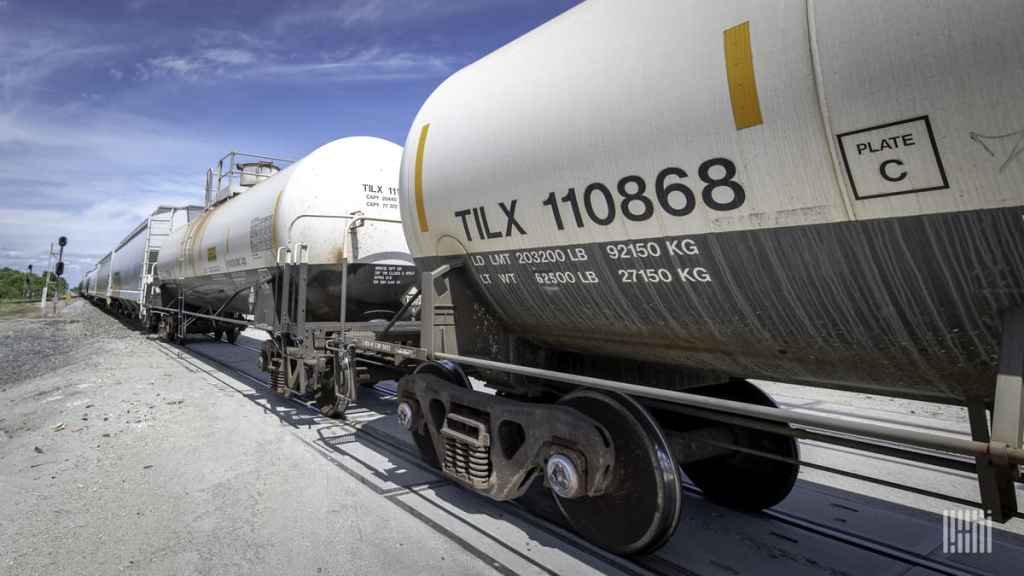
FreightCar America, Trinity Industries take hit from migrant crossings
Freight traffic disruptions at the U.S.-Mexico border due to high numbers of daily migrant crossings — as well as responses by state and federal officials to those crossings — prompted rail car manufacturer FreightCar America and rail car lessor and manufacturer Trinity Industries to lower their 2023 earnings guidance, executives from both companies said during recent earnings calls.
If the disruptions continue, expect impacts to fourth-quarter results as well, according to Trinity Industries President and CEO Jean Savage. Her company said it delivered 4,325 new rail cars in the third quarter, 685 fewer than projected, because of the closure of U.S.-Mexico border trade lanes by U.S. Customs and Border Protection in October.
“Additional congestion or closures will negatively impact our ability to get railcars across the border and may require us to slow down or temporarily suspend production,” Savage said in prepared remarks during Trinity’s (NYSE: TRN) third-quarter earnings call last Thursday. Trinity has a rail car production plant in Monclova, Mexico, about 152 miles south of Laredo, Texas. “We are working with the railroads and government agencies to do what we can to keep operations running smoothly for both inbound and outbound rail and truss track.”
As a result of the situation at the border as well as other supply chain challenges, Trinity lowered its 2023 adjusted earnings per share guidance to $1.20 to $1.35 from earlier EPS guidance of $1.50 to $1.70.
Moving rail car production to Trinity’s U.S. operations isn’t feasible because of the difference in production costs between the two countries, according to Savage. To account for uncertainties at the border, Trinity has brought materials into Mexico for car assembly as well as explored different routes and entry points to bring rail cars back into the U.S., Savage said.
“While rail traffic operations resumed on September 23, congestion and rail traffic challenges continue to evolve,” Savage said. “While we have started moving railcars again, we still have railcars temporarily sitting in storage and at our facilities, and we continue to evaluate available alternatives for rail and truck transportation between Mexico and the United States.”
Trinity reported third-quarter 2023 EPS of 29 cents, compared with 35 cents per diluted share for the third quarter of 2022. Adjusted EPS was 26 cents versus 34 cents a year ago.
FreightCar America President and CEO Jim Meyer also said the disruptions from migrant crossings had caused the company to limit rail car shipments in the third quarter. The company lowered its fiscal 2023 guidance for revenue to $365 million to $380 million, based on forecast production of 3,150 to 3,300 rail cars, because of continued concerns over rail service disruptions, Meyer said. The company previously forecast 2023 revenue of $400 million to $430 million.
“We experienced, obviously, a level of disruption in the third quarter [that] has not abated itself. It has sort of ebbed and flowed. We’re hoping to get this thing behind us as quickly as we can, but our guidance adjustment, our top-line guidance adjustment is based on what we think might happen, based on the ebbing and flowing of this,” Meyer said during FreightCar America’s (NYSE: RAIL) earnings call on Tuesday.
The executives’ comments follow embargoes that took place on the networks of Union Pacific and BNSF in September. Both Class I railroads placed embargoes because CBP had closed train traffic at the Eagle Pass Gateway at the U.S.-Mexico border because of the migrant crisis. Gateways at other border crossings such as El Paso, Texas, also became stressed from the additional traffic.
Meyer said FreightCar America completed the fourth production line at its Castaños, Mexico, manufacturing campus during the third quarter, with the first deliveries from this line anticipated in the fourth quarter. The completion of the fourth line will bring the company’s total annual production capacity to 4,000 to 6,000 rail cars.
“Although weakness in freight loadings, the migrant issue at the border, and the overall macro environment continue to pose market uncertainties, we agree with industry forecasts of railcar deliveries of approximately 45,000 railcars in 2023,” FreightCar America Chief Commercial Officer Matt Tonn said. FreightCar America reported net income of $3.2 million and adjusted net income of $176,000 in the third quarter of 2023, compared with a net loss of $17.8 million and an adjusted net loss of $5.4 million in the third quarter of 2022.
“Our sales pipeline remains strong, with customer inquiries indicating that demand is still largely tied to railcar replacements across a diversified range of car types. Order activity by customer segment, including lessors, shippers, and Class 1 railroads, has remained consistent and includes the development of new customers who value our commercial proposition,” Tonn added.