Montana-based brokerage, trucking affiliate file for bankruptcy liquidation

Three weeks after a 40-year-old Montana-based trucking company and freight brokerage abruptly ceased operations, Meadow Lark Agency and its affiliate, Meadow Lark Transport, filed for bankruptcy liquidation late Monday.

The companies, headquartered in Billings, Montana, filed for Chapter 7 protection in the U.S. Bankruptcy Court for the District of Montana.

In its petition, the Meadow Lark entities list assets of between $10 million and $50 million and liabilities of between $1 million and $10 million. The petition states they have up to 5,000 creditors and that no funds will be available to unsecured creditors once it pays administrative fees. 

The petition lists assets of nearly $15.4 million in receivables from Meadow Lark Transport.

Prior to filing for bankruptcy, Meadow Lark CEO Amanda Roth provided the following statement to FreightWaves.

“Due to unforeseen events in 2022-2023, which included banking and funding issues, higher costs with lower rates, and last-minute insurance issues, the 2023 economy was not sustainable for a medium-sized company,” Roth said. 

According to the petition, Meadow Lark made $60 million in gross revenue from Oct. 1, 2022, through Sept. 30, 2023. The company posted $103 million in gross revenue in 2022 and $76 million in 2021, according to the filing.

Roth also stated that the company had been targeted by a cyberattack and that a chameleon carrier stole Meadow Lark’s identity.

“It was not our year — we had both [occur] one right after another,” Roth told FreightWaves. “The first was a cyber attack in which we had to rebuild [our] networks. Our name was being used, fake loads, payments going to scams.”

Former employees, trucking companies remain unpaid

Nearly 120 ex-employees are owed about $800,000 while around 1,300 trucking companies are owed almost $2.7 million, according to Meadow Lark’s bankruptcy petition.

On Oct. 12, FreightWaves reported that Meadow Lark Transport had abruptly shuttered operations. At the time, the company had 273 drivers and 337 power units, according to the Federal Motor Carrier Safety Administration’s SAFER website.

FMCSA data states the company’s broker authority was involuntarily revoked on Aug. 15 and its contract carrier authority was canceled on Oct. 28.

Since May, motor carriers claim they had been fighting for months to get paid after hauling brokered loads for Meadow Lark.

Meadow Lark’s attorney James A. Patten, of Patten Peterman Bekkedahl of Billings, failed to respond to FreightWaves’ requests for comment.

Among the company’s top secured creditors are OTR Solutions Capital LLC of Roswell, Georgia; The LCF Group Inc. of New Hyde Park, New York, a fast business funding company; and Alpine Advance 5 of Middletown, Connecticut.

Meadow Lark is also facing multiple lawsuits, including a class action lawsuit filed in the U.S. District Court for the District of Montana, a breach-of-contract lawsuit filed in Harris County, Texas, and a small claims action filed in the Superior Court of New Jersey.

A creditor’s meeting is scheduled for Dec. 21.

Do you have a news tip or story to share? Send me an email or message me @cage_writer on X, formerly known as Twitter. Your name will not be used without your permission.

Twin Express equipment going on auction block after $19M loan default
Pennsylvania brokerage lays off nearly 65 employees, sources say
‘Fraud, theft and abuse’ force Texas freight brokerage to shut down

Family-owned California trucking company ceasing operations after 95 years

Check Call: The bankruptcy dominoes

people gathered around a desk of computers. Check Call news and analysis for 3pls and brokers

The former ripple of unfavorable market conditions has been crashing in like waves over the past few months. More and more freight brokerages are filing for Chapter 11 bankruptcy, leaving the all-important question of what that means for small and medium-size carriers.

When a company files for Chapter 11 bankruptcy, it can choose a small selection of vendors for priority for payment in bankruptcy court. All other parties have to file claims with the courts for guidance on payment, which doesn’t always guarantee they get paid. Typically those partners that are crucial to the future success of the business are in the priority group. However, that gets sticky in the freight world as so many brokers face financial issues and carriers work with a variety of brokers.

A white paper from OTR Solutions says, “This perilous shift in sentiment against carriers’ rights has already started to occur, as a recent trend in highly leveraged freight brokers going bankrupt has created motivation for these carrier funds to be misallocated in favor of protecting other parties, which are financially exposed to the failing freight brokers.”

If more brokers head for bankruptcy, it could create a real problem for carriers as they could potentially not get paid to the tune of tens of thousands of dollars — which in a market where carriers are struggling to run at a profit could lead more carriers down the road to bankruptcy. 

F3 has taken over Chattanooga, Tennessee, this week. The big news is that J.B. Hunt Transport Services and BNSF Railway announced Quantum. Not just for Ant-Man anymore, The new premium intermodal offering cuts transport times by at least a day in some areas with 95% on-time delivery. 

In case you missed the first day of F3 or want to keep up over the next few days, you can catch up on all that you missed here or watch some of the fireside chats on YouTube. You can even catch a LIVE episode of Check Call!

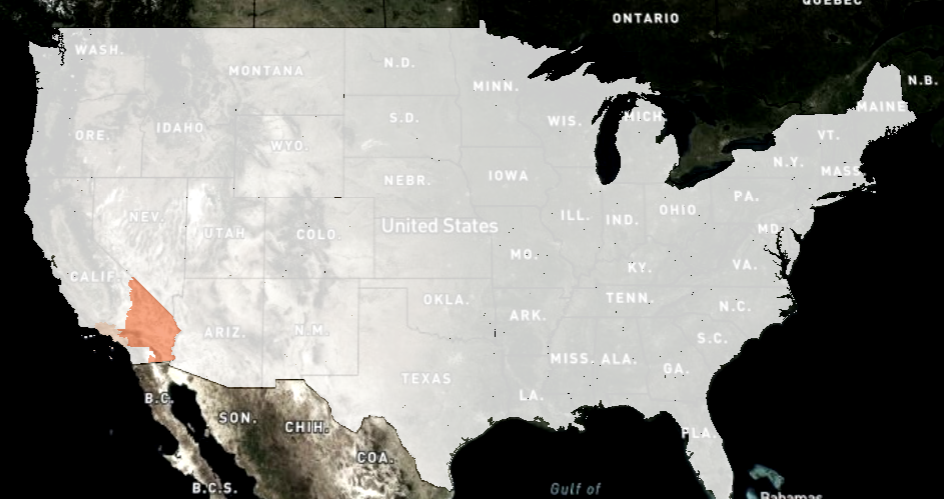
Market Check. This week’s SONAR chart is the Weighted Rejection Index. The index is the product of the Outbound Tender Market Share (OTMS) and Outbound Tender Rejection Index Weekly Change (OTRIW) for an individual market. The WRI prioritizes tender rejection rate changes by market size. WRI by market on a heat map targets the most relevant areas on any given day by placing a higher value on larger market changes. Southern California being a darker shade of red would indicate that prices in the market are falling, and spot rates should reflect that.

Who’s with whom? UPS Airlines pilots are in an interesting position. About 200 senior pilots at UPS have taken a voluntary severance package as airlines reduce head count amid poor market conditions. The affected pilots were urged to apply at PSA Airlines, a subsidiary of American Airlines. 

The air cargo industry has drastically tapered off as the market has slowed. While capacity leaves something to be desired, it’s likely only the beginning of changes to come to the air cargo market.

The more you know

Borderlands: 3 Texas seaports awarded $37M in federal upgrade grants 

What downturn? US imports still rising, highest since boom

Supreme Court denies UPS driver’s request for vehicle accommodation 

Slync, winding down operations, to auction off intellectual property 

See you on the internet.

Mary

Join the community in freight and subscribe for more at www.freightwaves.com/subscribe.

Slync, winding down operations, to auction off intellectual property

Logistics visibility platform Slync, which is winding down operations, is having its intellectual property auctioned off.

Chicago-based DSI Assignments, which is handling the auction process, said Tuesday that it is seeking a buyer for all assets relating to Slync’s platform. This includes Slync’s Intelligent Carrier Management, Ocean Booking 360, Inventory in Motion and Air Freight Management. The assets will be sold free and clear of all liens, claims, encumbrances and interests, DSI said.

DSI said it is in discussions with several interested parties and is conducting due diligence. It did not elaborate.

Parties wishing to make competitive offers for the assets must submit qualified bids no later than 5 p.m. Pacific time on Nov. 20, DSI said. The bids must demonstrate that the bidder has the financial capacity to consummate a transaction if selected, the ability to expeditiously consummate the transaction, and a signed mutual confidentiality and nondisclosure agreement. A bidder must also make a deposit of at least 10% of the bid, DSI said.

Slync had hoped that new management and a $24 million cash infusion in February would be enough to save the FreightTech company after its former CEO was indicted on fraud charges. However, the company said late last month that it will proceed with an alternative to a traditional bankruptcy and plans to wind down operations and sell off its technology.

The timing of Slync’s filing in October came nearly three weeks after former Slync CEO Chris Kirchner — who was indicted in May on charges he swindled $25 million from investors for personal use — filed suit on Sept. 26 against his former employer for legal fee advancement and indemnification in Delaware’s Court of Chancery.

Uber Freight records tiny levels of improvement in Q3

(Editor’s note: this article has been revised to reflect the fact the company had negative EBITDA of $23 million in the first quarter of this year.)

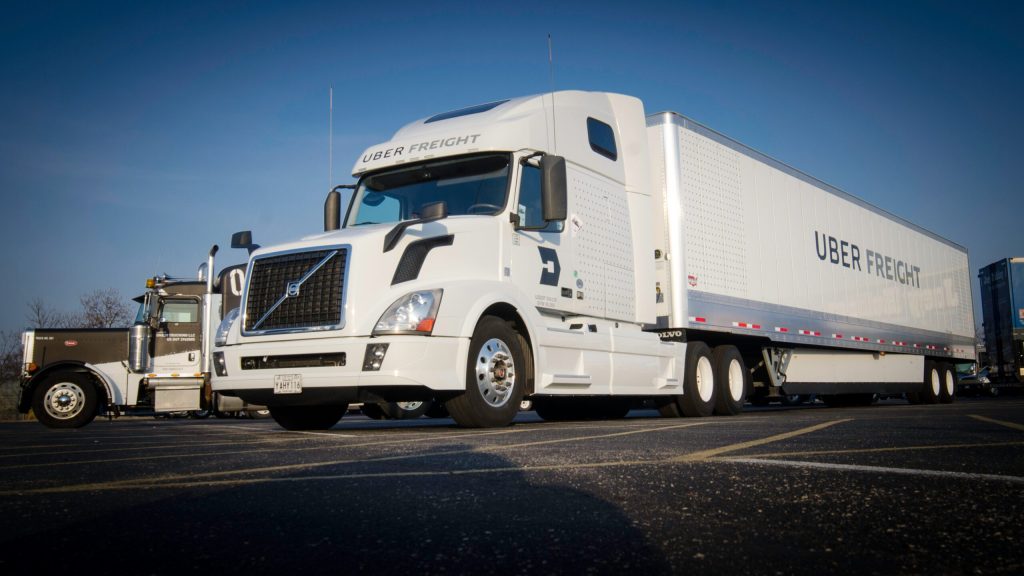
Uber Freight managed to record a slightly improved fiscal performance in the third quarter compared to the second, with a small reduction in its EBITDA loss and an increase in revenue.

Uber Freight’s adjusted earnings before interest, depreciation and amortization, which continues to be the benchmark most closely watched on its performance, rose to negative $13 million, up from negative $14 million in the second quarter. Year over year (y/y), Uber Freight’s EBITDA declined from positive $1 million in the third quarter of 2022.

The last five quarters of adjusted EBITDA at Uber Freight, starting with the third quarter of 2022, have come in at $1 million, negative $8 million, negative $23 million, negative $14 million and negative $13 million. 

What might have been the biggest development at Uber Freight in recent months didn’t take place inside the company. Instead, it was the demise of fellow digital brokerage Convoy. 

Without identifying Convoy by name, Dara Khosrowshahi, CEO of the parent company (NYSE: UBER), said in prepared remarks that coincided with the company’s earnings release that current conditions may create an opportunity for Uber Freight.

“Uber Freight has been able to weather trends better than some of its competitors, as evidenced by several industry players winding down operations,” Khosrowshahi said. “While we see early signs of stability in the market, we aren’t hanging our hats on an imminent rebound. In fact, it’s in tough market environments where we can further differentiate our offerings from sub-scale traditional competitors.”

In the statement, Khosrowshahi said Uber Freight had implemented “approximately $50 million of annualized cost savings in a tough market backdrop.”

Uber Freight’s revenue rose slightly, to $1.29 billion from $1.28 billion in Q2. A year earlier, revenue was $1.75 billion.

Another metric for Uber Freight is the adjusted EBITDA margin as a percentage of gross bookings. That number was down 110 basis points y/y but was up 10 bps sequentially, rising to 1%.

In his statement, Khosrowshahi focused on several steps taken by Uber Freight recently to improve and enhance its technology offerings. 

Those offerings, released to Uber Freight’s users at a late-September conference, include an update of the company’s transportation management system, the introduction of software offering Uber Freight Exchange, which aims to improve procurement, and greater use of AI. 

With the outlook for the freight market not improving, Khosrowshahi said that reality is “why Uber Freight continues to diversify far beyond being a leading digital brokerage into a full enterprise suite of technology and services that power the global movement of goods.”

More articles by John Kingston

Uber Freight’s EBITDA loss widens from ’22 but improves from Q1

Uber Freight’s Souder trying to balance automation and the human experience

Uber Freight may be on the way to stand-alone company

Daimler Truck deliveries fall in Q3, outlier to other OEMs

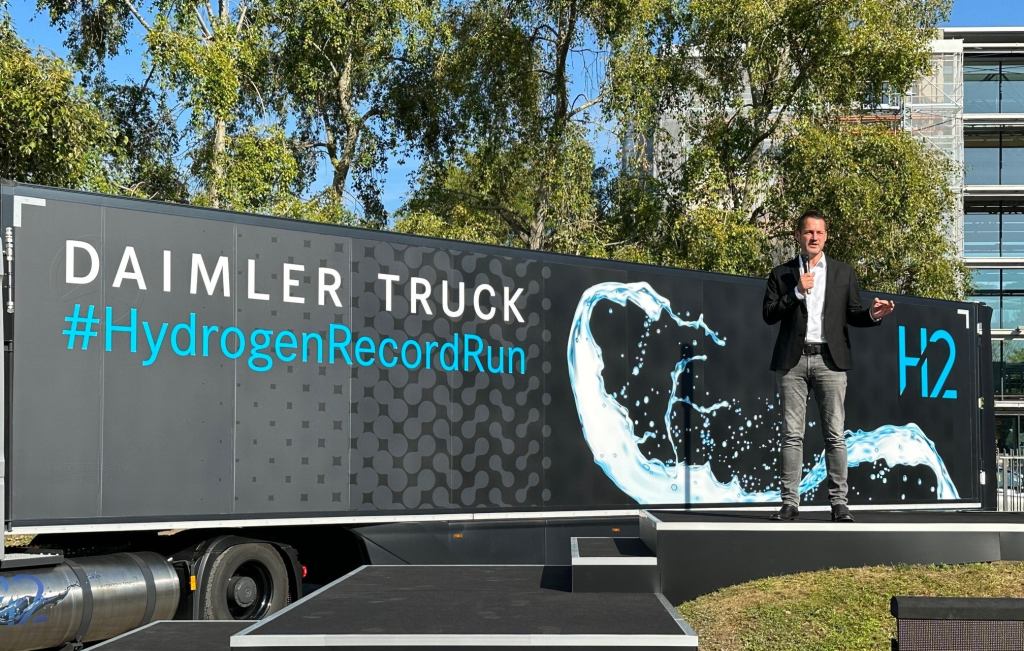
Daiml;er Truck following 1,00-kilometer hydrogen record run in Germany

Daimler Truck reported lower third-quarter deliveries, an outlier to its OEM competitors that reported more trucks reaching customers even as concern about a slowdown grows.

The German company reported slightly higher revenue at 13.9 billion euros ($14.84 billion) compared to 13.5 billion euros a year ago. Adjusted return on sales (ROS) in the industrial business increased to 9.8% from 9.4%.

Adjusted earnings before interest and taxes rose to 1.34 billion euros from 1.27 billion. Net profit of 957 million euros was slightly lower than the year-ago 990 million euros, influenced by a one-time low tax rate. Earnings per share amounted to 1.13 euros compared to 1.17 a year ago.

“Despite a volatile environment, we confirm our forecast for the full year 2023 and expect record earnings for Daimler Truck,” CEO Martin Daum said in a news release.

Free cash flow soars

As with its rivals — Volvo Group, Paccar Inc. and Traton Group — Daimler’s free cash flow soared in the quarter, due in part to higher prices. It rose to nearly 1.1 billion euros from 592 million euros in the same quarter last year.

Daimler said its lower deliveries — 128,861 units compared to 134,972 in Q3 2022 — were due to supplier bottlenecks. Supply disruptions have vexed all truck makers for more than two years. Most indications are the problems are easing.

For the first three quarters ending Sept. 30, Daimler’s deliveries of 385,921 outpaced nine-month results of 365,219 in 2022.

Across its five reporting units, Daimler reported mixed results.

In North America, unit sales dropped to 47,249 from 49,171. Revenue fell 7% and EBIT was 4 percentage points lower.

For the full year, Daimler expects the adjusted ROS for its industrial business to be in a range of 8.5%-10%. North America, where Daimler sells the Freightliner and Western Star truck brands, is expected to be in a range of 11%-13%. 

Daimler picks Hexagon Purus to electrify Freightliner eM2 vocational trucks

Rizon EV brand joins Daimler Truck lineup

Daimler Truck flexes financial muscle a year after going solo

Click for more FreightWaves articles by Alan Adler.

Weekly Fuel Report: November 07, 2023


Learn more at SONAR.FreightWaves.com

What downturn? US imports still rising, highest since boom

a photo of containerized imports

American consumers just keep on spending — and the volume of containerized imports keeps on rising. October import numbers released Tuesday by Descartes came in exceptionally strong.

The U.S. imported 2,307,918 twenty-foot equivalent units of containerized goods last month, according to Descartes Systems Group (NASDAQ: DSGX), which obtains its data from customs filings. That’s up 3.9% year on year and 4.7% compared to September.  

chart of imports volumes
(Chart: Descartes. Data: Descartes Datamyne)

Imports have surged 33% from their recent low in February. October’s inbound volumes were the highest since August 2022, back when volumes were still inflated by the one-off pandemic boom.

It was the third best October ever for the U.S. imports, with the exception of the boom-inflated months in 2020 and 2021.

China continued to be the top driver of inbound volumes. According to Descartes, America imported 886,842 TEUs of containerized goods from China in October, 38.4% of total imports and the highest volume from China since August 2022.

chart of imports from China
(Chart: FreightWaves based on data from Descartes Datamyne)

Volume up vs. pre-COVID years

This year’s imports continue to outpace volumes in the years prior to the pandemic.

Descartes put October’s imports 11.5% above imports in October 2019, 2.5% higher than in October 2018 and 15% higher than in October 2017. (In 2018, importers brought in shipments early to avert the Trump administration tariffs, hiking fall 2018 volumes at the expense of fall 2019 volumes.)

Total imports in January through October of this year were up 3.4% versus the same period in 2019, 4.4% versus 2018 and 11.8% versus 2017.

chart of 2023 imports vs. pre-COVID volumes
(Chart: FreightWaves based on data from Descartes Datamyne)

Trans-Pacific rates strengthen

Meanwhile, trans-Pacific spot rates have strengthened recently and remain within the normal pre-COVID range.

The Drewry World Container Index (WCI) assessment for spot rates from Shanghai to Los Angeles was $2,175 per forty-foot equivalent unit in the week ending Thursday, up 11% versus the prior week.

Current rates in this lane are 20% below the WCI assessment in 2018, when rates were inflated by the tariff effect, and 38% above 2019 levels, when rates were depressed because imports had been pulled forward by tariffs. The Shanghai-Los Angeles index is currently 33% above 2017 levels.

Spot rate in USD per FEU. Blue line: 2023. Orange line: 2019. Purple line: 2018. Yellow line: 2017. (Chart: FreightWaves SONAR)

The WCI Shanghai-New York spot index was at $2,616 per FEU in the week ending Thursday, up 3% from the week before.

It was flat versus 2019 levels, down 24% from tariff-boosted 2018 levels and up 9% from the same time in 2017.

Spot rate in USD per FEU. Blue line: 2023. Purple line: 2019. Yellow line: 2018. Pink line: 2017. (Chart: FreightWaves SONAR)

Click for more articles by Greg Miller 

RXO expands through the downcycle

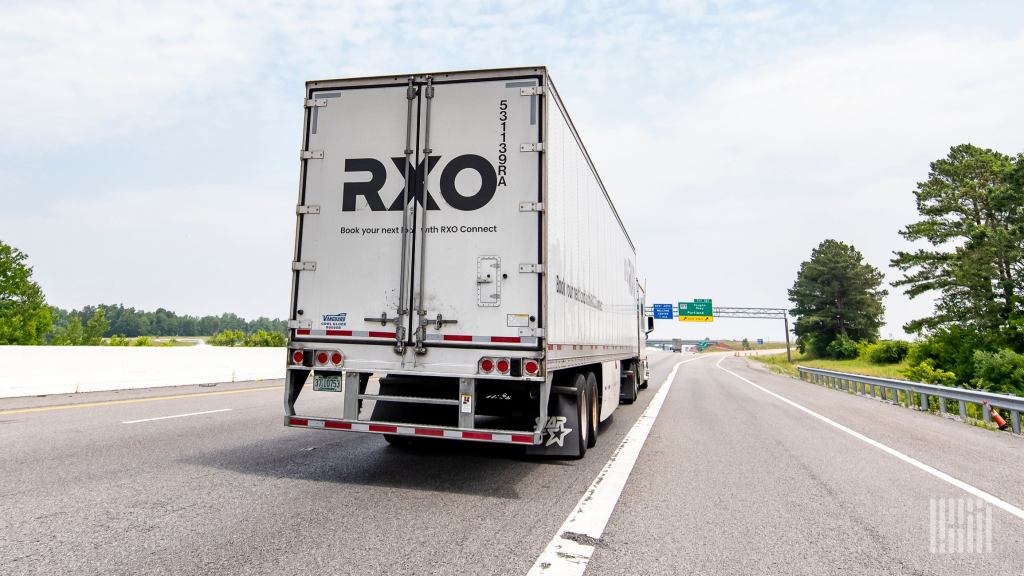
A white RXO trailer being pulled on a highway

Third-party logistics provider RXO grew brokerage load counts again in the third quarter but noted some softening during October.

RXO (NYSE: RXO) reported Tuesday a net loss of 1 cent per share for the 2023 third quarter, which included a 6 cent headwind from transaction and restructuring costs tied to the spinoff from XPO (NYSE: XPO) a year ago. Adjusted EPS was 5 cents excluding the items, 4 cents higher than the consensus estimate but 29 cents lower year over year (y/y).

“While RXO’s results improved as the third quarter progressed, the market remains soft and we’re monitoring the freight markets closely,” said CEO Drew Wilkerson. “We’ll continue to follow our playbook of taking profitable market share while controlling costs and making strategic investments in our business.”

The company’s largest segment, truck brokerage, saw revenue decline 14% y/y to $591 million.

Total brokerage volumes were up 18% y/y with truckload volumes 13% higher. Loads per day grew in every month of the quarter with contractual volumes up 30% y/y. A drop in revenue per load bridged the gap between the volume increase and the revenue decline. A shorter length of haul, unfavorable mix and lower fuel surcharges were headwinds. Excluding those items, revenue per load was off y/y by a mid-teen percentage.  

Brokerage gross margin was 15.1%, down 390 basis points y/y, but improved 100 bps in each month of the period. The company said gross profit per load bottomed in July to the lowest level seen since the second quarter of 2017. The metric increased by more than 20% from July to September. Gross profit per load in October was level with September.

Table: RXO’s key performance indicators

Ninety-seven percent of brokerage loads were created or covered digitally in the third quarter compared to 81% a year ago. RXO said 77% of carriers that used the platform returned to it within a week.

The company continues to take market share and said less-than-truckload volumes increased 55% y/y in the quarter. RXO’s sales pipeline is 115% higher than it was two years ago as it grew brokerage head count again in the quarter.

“Our strategy has always been during this part of the cycle that we’ll grow and we’ll build our foundation,” Wilkerson told analysts on a Tuesday call. “We’ll prepare ourselves for the inflection and to show the power of the model and the earnings when the market inflects.”

The company likes “to stay staffed for growth of 15% overnight if we need it,” Wilkerson said. “When the market turns, as you’ve seen us do before, we’ll be able to handle the volume.”

RXO expects volumes to be up again in the fourth quarter but at a slower pace than in the third quarter.

It noted load-to-truck ratios improved from 2-to-1 earlier in the year to 3-to-1 by the end of the third quarter and that customer inventory positions have been rightsized. However, management did say October was softer and that minibid activity increased. RXO’s brokerage volumes were up in October but by lower percentages. Truckload volumes increased by mid-single digits while overall brokerage loads were up double digits.  

The company expects declines in revenue per load to again moderate in the fourth quarter.

Consolidated adjusted earnings before interest, taxes, depreciation and amortization equaled $26 million in the quarter, a 61% y/y decline. Adjusted EBITDA is expected to increase 20% sequentially in the fourth quarter even though the company expects a “muted peak season.” RXO has taken $31 million in cost savings on an annualized basis so far this year.

Net debt leverage increased to 2.1 times adjusted EBITDA from 1.6 times last quarter. The increase was due to a reduction in EBITDA and a $19 million increase in net debt to $350 million. Total liquidity remained above $600 million.

Shares of RXO were off 2.1% Tuesday at 10:10 a.m. EST compared to the S&P 500, which was up 0.1%.

More FreightWaves articles by Todd Maiden

Investment firm acquiring SMBC Rail Services

Acquisitions are continuing apace within the U.S. freight rail industry, with an infrastructure investment firm acquiring SMBC Rail Services and CN taking a stake in Atlanta Canada short-line railroad.

ITE Management affiliate to acquire SMBC Rail Services

An affiliate of ITE Management, a transportation and infrastructure investment firm, plans to acquire SMBC Rail Services, a full-service rail car lessor, the companies announced Tuesday.

As part of the acquisition, SMBC Rail Services’ rail cars and other assets will be transferred to ITE affiliate American Industrial Transport (AITX), a rail car services provider of fleet management, repair services and rail car data.

The acquisition, which is subject to closing conditions and regulatory approval, comes as some industry observers say that shippers have been considering full-service options for leasing, repair, fleet management and rail car data amid growing complexity in the supply chain and regulatory space. 

SMBC Rail Services is affiliated with SMBC Americas Holdings, which in turn is part of SMBC Group, a global financial group headquartered in Tokyo.

“As one of the leading full-service railcar platforms in North America, AITX provides an integrated, customer-centric solution to the freight shipping market through its expansive leasing offering and its railcar repair and maintenance network,” the companies said in the news release. “The transaction will add over 50,000 additional railcars to AITX’s fleet, along with an experienced team and longstanding customer relationships. The transaction will enable AITX to create significant incremental value for customers, employees, and all stakeholders.”

CN takes stake in Atlantic Canada short line

Canadian railway CN (NYSE: CNI) recently said it acquired a stake in the Cape Breton & Central Nova Scotia (CBNS) Railway from short-line operator Genesee & Wyoming (G&W). 

CBNS has 145 miles of active track and interchanges with CN at Truro, Nova Scotia. A G&W subsidiary will continue to operate the CBNS line, which CN says will ensure a seamless continuation of service for customers. 

“We are proud to be partnering with Genesee & Wyoming to serve existing customers on this line,” Patrick Lortie, CN senior vice president and chief strategy officer, said in a news release last week. “This partnership will further reinforce CN’s presence in eastern Canada where we believe there will be a growing role to play in the competitiveness of North American trade. It will also enable our network to reach new opportunities in the longer-term, further advancing our strategic agenda of accelerating profitable, sustainable growth.”

Subscribe to FreightWaves’ e-newsletters and get the latest insights on freight right in your inbox.

Click here for more FreightWaves articles by Joanna Marsh.

J.B. Hunt, BNSF launch premium intermodal service Quantum

J.B. Hunt Transport Services and BNSF Railway announced Tuesday the launch of Quantum, a premium intermodal offering ensuring improved delivery times with consistent service. The companies made the announcement at FreightWaves’ F3: Future of Freight Festival 2023 in Chattanooga, Tennessee.

Quantum will be run by employees from both companies at a new intermodal center at BNSF’s (NYSE: BRK.B) headquarters in Fort Worth, Texas. The customized offering will cut delivery times by one day from normal intermodal service. The shipments will be given priority drayage and rail positions to meet the time thresholds. The companies are informing customers to expect 95% on-time delivery.

“Quantum allows customers with service-sensitive freight to benefit from the cost savings of intermodal, while reducing their carbon footprint and maintaining the level of service and consistency needed in their supply chains,” said Darren Field, J.B. Hunt’s president of intermodal.

The preplanning process is expected to minimize the need to implement contingencies, however, a team will oversee Quantum shipments around the clock, resolving any service obstacles by initiating alternate solutions when needed.

“Its solutions are flexible to address supply chain challenges in real time,” said Spencer Frazier, J.B. Hunt’s executive vice president of marketing and sales. “Customers have access to multiple modes for unexpected concerns such as potential delays, volume surges or production issues.”

Specifics on costs weren’t provided but the price is expected to be between regular intermodal service and over-the-road truckload transportation.

J.B. Hunt (NASDAQ: JBHT) estimates there are roughly 7 million to 11 million loads annually that could be converted from full highway transit to intermodal rail service. Quantum is expected to expand the intermodal market by capturing the customer-sensitive freight that shippers have been hesitant to transport over the rails.

When incorporating rail, a shipment’s carbon footprint is reduced by as much as 60%, the company estimates.

“Quantum will provide a faster and more consistent intermodal solution to customers,” said Tom Williams, BNSF’s group vice president of consumer products. “Our new Intermodal Innovation Center will foster continued collaboration between our companies to continue evolving with our customers’ supply chain needs and create the intermodal solution of the future.”

The latest announcement by both companies expands on a 34-year partnership. The Quantum name dates back to when the companies first started working together, launching an intermodal offering with just 150 trailers carrying the same name.

J.B. Hunt is becoming further aligned with its rail partner in the West. It acquired the brokerage operations of BNSF Logistics in September.

The companies announced a joint collaboration last year. J.B. Hunt said it would grow its container fleet to 150,000 units by 2025 to 2027. At the same time, BNSF announced expansion plans at multiple facilities and added rail cars to support J.B. Hunt’s container growth plan. It also unveiled plans for the Barstow International Gateway, a $1.5 billion facility with 4,500 acres that will serve the ports in Southern California.

Over the last couple of years, J.B. Hunt has been adding transloading facilities along the coasts.

J.B. Hunt closed the third quarter with 117,000 containers. 

More FreightWaves articles by Todd Maiden