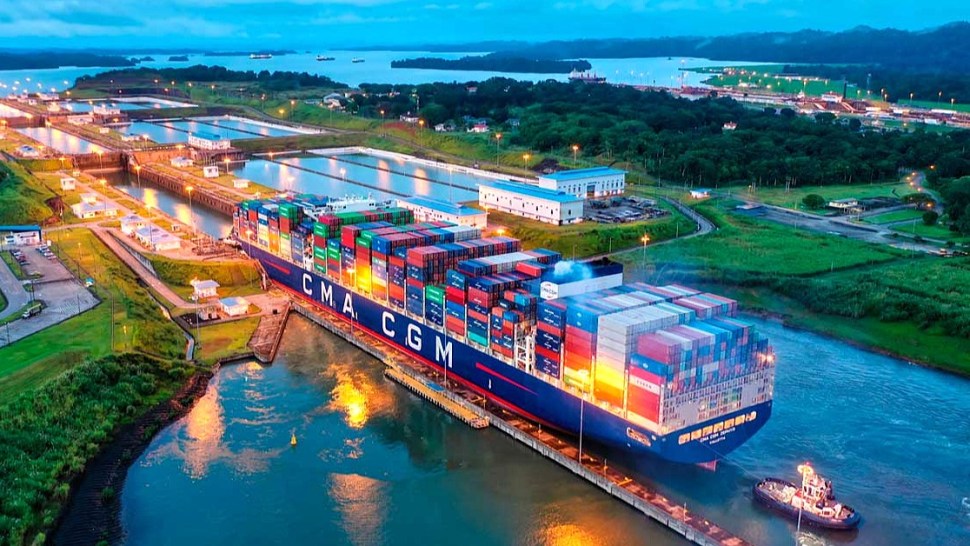
HOUSTON —Panama Canal Administrator Ricaurte Vásquez Morales said the waterway’s sweeping $8.5 billion modernization plan — which includes new port terminals, a gas pipeline, and a water-reservoir project — is designed to keep the 110-year-old canal competitive as global trade patterns and climate pressures evolve.
In an interview with FreightWaves at the Houston International Maritime Conference, Vásquez said the Panama Canal Authority (ACP) is moving forward with two new container terminals — Corozal on the Pacific and Telfers on the Atlantic — expected to add 5 million to 6 million twenty-foot equivalent unit (TEUs) of annual capacity and create roughly 17,000 jobs.
“There is a very good potential of having a significant increase of at least five to six million boxes per year in the remainder of this decade,” Vásquez said. “The existing port terminal capacity is at the limit.”
The initiative, now in a consultation phase with major maritime players, forms part of a ten-year strategy to expand infrastructure while reducing dependence on water-intensive operations.
‘Full house’ interest from global operators
Vásquez said the canal held a soft-market approach in late October, drawing what he described as a “full house” of participants including APM Terminals, DP World, PSA International, COSCO Shipping Ports, Maersk Line, MSC, and Terminal Investment Limited.
One-on-one meetings with potential partners are scheduled for early December, followed by a prequalification round in 2026 and final concession awards by 2027.
“We had a full house,” Vásquez said. “That is a requirement — now we have to go to one-on-one meetings. We want to listen and accommodate the playing field, always with the fundamental concept that it should be in the best interest of Panama.”
He added that governance will be “open and transparent,” noting that the canal’s strong balance sheet allows it to co-invest while avoiding dominance by any single operator.
“We have to remain open to all trades of the world,” Vásquez said.
Related: Panama Canal Authority sees Rio Indio project as answer to future droughts
Ports, pipeline, and water resilience
The Corozal and Telfers terminals are part of a three-pillar investment plan that also includes a $4 billion liquefied petroleum gas pipeline and the $1.2 billion Río Indio reservoir project.
The 47.2-mile (76-kilometer) pipeline would carry propane, butane, and ethane between the Atlantic and Pacific coasts — freeing canal slots for other vessels without additional water use.
“We’re rainfall-dependent,” Vásquez said. “That’s why we’re building a new lake. Some of these projects — terminals, gas lines, roads — are alternatives to move cargo, not vessels, across the isthmus of Panama with technologies that are not water-dependent.”
The Río Indio reservoir will be the first canal project constructed outside ACP property and will require the relocation of nearby communities, a process Vásquez said must be handled “carefully and transparently.”
Economic impact and roadmap to success
The ACP estimates the new terminals will contribute 0.4% to 0.8% of Panama’s gross domestic product once operational. Vásquez emphasized that the benefits will ripple well beyond construction jobs.
“The Panama Canal employs about 8,700 people, but there are about 150,000 jobs that depend on it,” Vásquez said. “The spillover effect of these activities is significant. The key is ensuring those benefits reach local communities — and that’s why governance is critical.”
The new development comes amid heightened U.S.–China tensions and a stalled $22.8 billion deal for Hong Kong-based CK Hutchison Holdings to sell its Panama ports to a BlackRock- and MSC-led consortium.
Asked how ACP balances foreign influence with open investment, Vásquez said maintaining neutrality is “built into the canal’s DNA.”
“We are reducing the potential impact of a dominant player in the hinterland,” Vásquez said. “The Panama Canal, by nature of its treaties and constitution, has to remain open to all trades.”
Despite shifting trade flows due to tariffs and nearshoring trends, Vásquez said the canal’s relevance endures.
“There will be some reshuffling, but I don’t think it will be significant enough to change the relevance of the Panama Canal,” he said. “We have to be resilient, adaptive, and have foresight in what we do. The market has volatility — we have a long-term view.”
Brokerage Compliance Symposium
The day before F3. Every compliance issue you face - fraud exposure, carrier liability, FMCSA rules, cargo theft, insurance gaps - navigated by attorneys and operators defining best practices in a changing industry.
F3 Awards Dinner
The night before F3. FreightTech100 companies honored. FreightTech 25 and Shipper of Choice winners revealed live. Cocktail reception into dinner and live music - 300 industry leaders in one purpose-built room.
F3: Future of Freight Festival
Industry-defining keynotes, rapid-fire technology demos, and industry leaders networking in experiences across Chattanooga - plus the inaugural F3 Awards Dinner featuring the FreightTech and Shipper of Choice reveals.
The day before F3. Every compliance issue you face - fraud exposure, carrier liability, FMCSA rules, cargo theft, insurance gaps - navigated by attorneys and operators defining best practices in a changing industry.
The Signal at Chattanooga Choo Choo • Chattanooga, TN Register NowThe night before F3. FreightTech100 companies honored. FreightTech 25 and Shipper of Choice winners revealed live. Cocktail reception into dinner and live music - 300 industry leaders in one purpose-built room.
The Signal at Chattanooga Choo Choo • Chattanooga, TN Register NowIndustry-defining keynotes, rapid-fire technology demos, and industry leaders networking in experiences across Chattanooga - plus the inaugural F3 Awards Dinner featuring the FreightTech and Shipper of Choice reveals.
The Signal at Chattanooga Choo Choo • Chattanooga, TN Register Now