In a stark reversal of fortune, the bustling Port of Los Angeles, long a reliable source of freight for truckers across the nation, is facing a significant downturn in container volumes. This decline is expected to have far-reaching consequences for the trucking industry, particularly for carriers that have traditionally relied on Southern California for steady business.
Recent data from SONAR’s Container Atlas reveals a troubling trend: Daily ocean container bookings from China to the United States have plummeted by 20% compared to the same period last year. This sharp decline is largely attributed to the escalating trade tensions between the two economic powerhouses, with the Trump administration’s aggressive tariff policies, including a recently imposed 245% tariff on Chinese imports, playing a central role.
For trucking companies that have long depended on the steady flow of goods from the Port of Los Angeles, this downturn spells trouble. As fewer containers make their way across the Pacific, the volume of freight available for overland transport is expected to diminish substantially. This reduction in available loads could lead to increased competition among carriers and potentially lower rates for those able to secure shipments.
The situation is further complicated by the fact that many importers have temporarily halted inbound shipments as they reassess their strategies in light of the new tariff regime. While some of these pauses may be transient, the overall trend suggests a more prolonged period of reduced volume, especially for businesses heavily reliant on goods targeted by the Trump administration’s tariffs.
Gene Seroka, executive director of the Port of Los Angeles, had previously reported record-breaking volumes, with January 2024 seeing 924,245 twenty-foot equivalent units processed, an 8% year-over-year increase. However, the current data suggests that this growth trend is unlikely to continue in the face of ongoing trade disputes and tariff increases.
While Los Angeles’ container volumes won’t fall in perfect lockstep with China-U.S. trade (many ports ship into LA), the evidence is clear that volumes are already being affected. According to SONAR’s Container Atlas, daily ocean container bookings on Monday from all ports globally into Los Angeles were down 18.8% year over year.
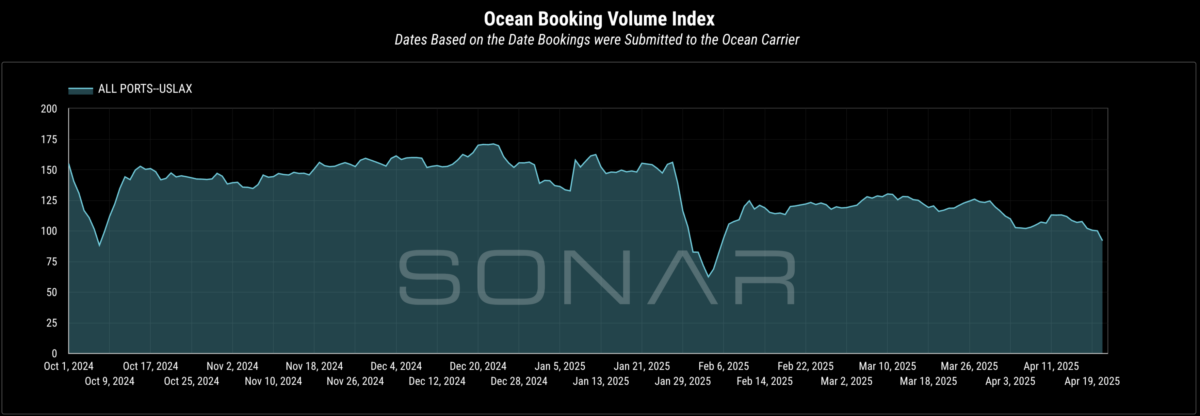
(The chart displays ocean container bookings bound from all global ports to Los Angeles, with volumes indexed to the day of booking, approximately eight to 10 days prior to departure. Chart: SONAR Container Atlas. To learn more about SONAR, click here.)
For trucking companies, the message is clear: Diversification of routes and client bases may be crucial for survival in the coming months. Carriers that have traditionally relied on the steady stream of freight from Southern California may need to look elsewhere to keep their trucks loaded and their businesses profitable.
The ripple effects of this decline in container volumes are likely to extend far beyond the immediate Los Angeles area. As shipping lines adjust their capacity and routing strategies, and ports and logistics providers face reduced activity, the entire supply chain ecosystem could experience significant disruptions.
Outbound truckload volumes from Los Angeles are now running below every year in the past five, except for 2020 (and April 2020 was in the middle of a nationwide lockdown that disrupted production and froze inventory in place).
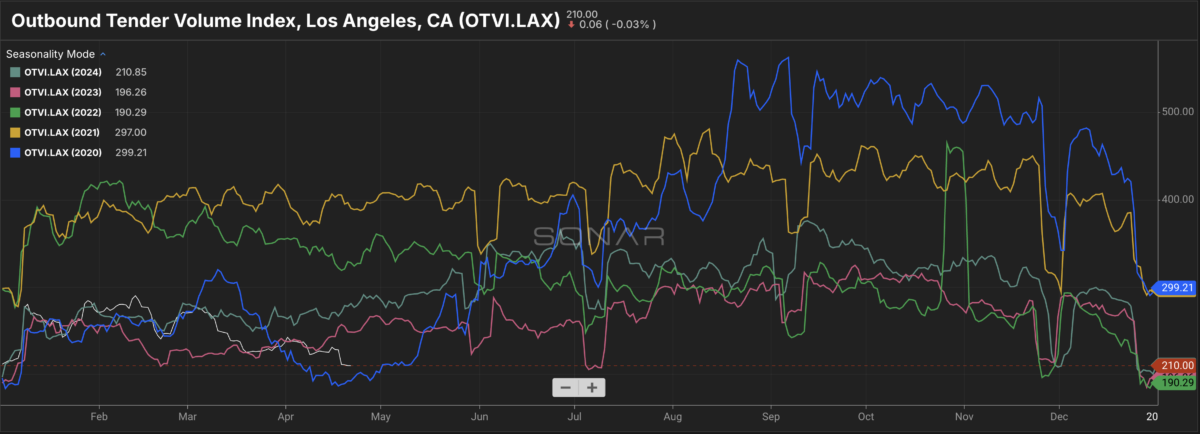
(The Outbound Tender Volume Index – Los Angeles indexes the electronically tendered truckload shipments outbound from LA. Chart: SONAR. To learn more about SONAR, click here.)
Moreover, the impact on consumer prices and product availability in the United States remains to be seen. As importers grapple with higher costs and potential supply disruptions, these challenges may eventually translate into higher prices or reduced options for American consumers.
While it’s too early to determine the long-term implications of this sudden downturn in container bookings, industry observers are closely monitoring the situation. The coming months will reveal whether this is a temporary adjustment or the beginning of a more permanent shift in trans-Pacific trade patterns.
For now, one thing is certain: Trucking companies that have long depended on the Port of Los Angeles as a reliable source of freight must prepare for a period of uncertainty and potential hardship. As volumes dry up in Southern California, the ability to adapt quickly to changing market conditions may well determine which carriers weather this storm and which are left by the wayside.
Brokerage Compliance Symposium
The day before F3. Every compliance issue you face - fraud exposure, carrier liability, FMCSA rules, cargo theft, insurance gaps - navigated by attorneys and operators defining best practices in a changing industry.
F3 Awards Dinner
The night before F3. FreightTech100 companies honored. FreightTech 25 and Shipper of Choice winners revealed live. Cocktail reception into dinner and live music - 300 industry leaders in one purpose-built room.
F3: Future of Freight Festival
Industry-defining keynotes, rapid-fire technology demos, and industry leaders networking in experiences across Chattanooga - plus the inaugural F3 Awards Dinner featuring the FreightTech and Shipper of Choice reveals.
The day before F3. Every compliance issue you face - fraud exposure, carrier liability, FMCSA rules, cargo theft, insurance gaps - navigated by attorneys and operators defining best practices in a changing industry.
The Signal at Chattanooga Choo Choo • Chattanooga, TN Register NowThe night before F3. FreightTech100 companies honored. FreightTech 25 and Shipper of Choice winners revealed live. Cocktail reception into dinner and live music - 300 industry leaders in one purpose-built room.
The Signal at Chattanooga Choo Choo • Chattanooga, TN Register NowIndustry-defining keynotes, rapid-fire technology demos, and industry leaders networking in experiences across Chattanooga - plus the inaugural F3 Awards Dinner featuring the FreightTech and Shipper of Choice reveals.
The Signal at Chattanooga Choo Choo • Chattanooga, TN Register Now