
Proficient Auto Logistics’ (NASDAQ: PAL) earnings report and conference call with analysts sounded very similar to others that have been heard this quarter: tough quarter overall, January and February were terrible, March was better and it’s looking good into April and May.
The difference is that Proficient’s stock price was pummeled as a result, while others, like RXO (NYSE: RXO), rebounded on the stronger outlook.
Proficient’s stock dropped Friday after the earnings release and conference call late Thursday. On Friday, the price fell almost 19%, to $5.95, a decline of 1.39%.
At about 2:20 pm EDT Monday, Proficient had rebounded 4.03% to $6.19. However, earlier in the day it had hit its 52-week low of $5.72.
It has been a rough ride for Proficient shareholders who held the stock after the company went public.
A long slide
In August 2020, Proficient stock, according to Yahoo Finance, touched $20 during intraday trading. The gap between that price and Monday’s earlier 52-week low is a decline of more than 71%.
On the earnings call, CEO Richard O’Dell’s first comments were about the bad news. “The first two months of the quarter were affected by extended automotive plant shutdowns, weaker-than-expected industry seasonally adjusted annual rate (SAAR for auto sales), severe winter weather and a slow recovery of the rail and sea transportation pipelines that feed our network,” O’Dell said. “These factors constrained volumes and resulted in revenue levels below the comparable periods of 2025 and below comparably higher fixed cost coverage levels with the Brothers acquisition reflected in our 2026 expense base.”
Improvement in March
But in line with what other transportation-related companies have noted this quarter, “revenue and volume trends improved in March,” O’Dell said. As a result, revenue was only 2% less than a year earlier, he added. “Looking to the second quarter, recent trends indicate more stable volume levels, supported by seasonal strengthening, improved weather, dealer inventory and strong tax refunds,” O’Dell said.
O’Dell also said the annual SAAR for April was 16.1 million vehicles, compared to 16.3 million in March, both a healthy number.
Some of the data comparisons year-over-year were positive, even as sequential numbers took a hit.
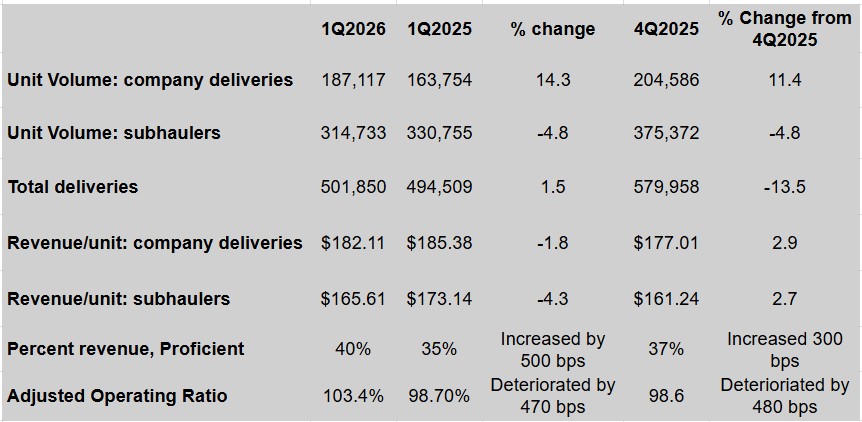
Total deliveries, both by company drivers and subhaulers, were up 1.5% from a year ago, with company deliveries up 14.3% and subhaulers down 4.8%. But deliveries were down 13.5% sequentially from the fourth quarter.
The growth in company deliveries is part of the company’s strategic plan to bring more business in house.
But revenue per unit was down 1.8% year-on-year for company deliveries and down 4.3% for subhaulers. That figure rose slightly from the fourth quarter, up 2.9% for company deliveries and 2.7% for subhaulers.
OR exceeds 100%
The worst number was in operating ratio: it deteriorated to 103.4% for the first quarter, compared to 98.7% a year earlier and 98.6% sequentially.
O’Dell echoed a theme heard from other trucking executives this earnings season: capacity is tightening even in the fairly niche market of auto transportation.
“The rebound in volumes in March and April made capacity tightening more evident, exposing underlying supply loss that had previously been less visible,” O’Dell said. “Supply losses appear to be driven by a combination of factors, including financial pressure from low volume, compounded by relatively weaker rates, increased relative scrutiny or regulatory scrutiny and driver migration towards other forms of trucking as the broader trucking rates have improved.”
More than with most trucking companies, Proficient spoke openly about the “headwinds” created by fuel surcharges. While the anomalies of surcharges mean that it can benefit some trucking companies beyond passing higher pump prices down to the shipper, Proficient appears to have been negatively impacted by the rise in retail diesel.
Impact of higher fuel
O’Dell put a number on it: higher fuel prices had a $1 million hit on the company’s profitability in the first quarter. (It wasn’t clear what measure of profitability O’Dell was referring to. Proficient had EBITDA of $4.47 million in the quarter, for an EBITDA margin of 4.8%, and a net loss of $8.3 million before income taxes. The operating loss was $3.17 million).
He said the lag between changes in the fuel surcharge and what was paid to secure those supplies hurt Proficient.
“In Q1, fuel started to increase markedly in March,” O’Dell said. “And because the indexes that set the fuel surcharge don’t reset until the beginning of April, we were paying out real-time fuel costs during the month of March that didn’t have a comparable increase in the reimbursement.”
O’Dell spelled out how Proficient sees a shift in the market that can benefit auto haulers.
What he described as “third party capacity” would be pulled from contracted markets, as it moves toward higher levels in the spot market. Those contracts at lower-priced numbers, in turn, according to O’Dell, “have struggled to secure consistent capacity when seasonal volume returns and in several instances leading to a redistribution at market-level economics.”
He added that situation “is clearly a turning point in the auto haul market.”
Amy Rice, the company’s president and COO, said that change in market structure was not opening the door to new business opportunities for Proficient, as it mostly has stuck with what it already had on the books.
She said spot business was less than 5% across Proficient’s activities in the quarter, “so it continues to be a very small portion of the portfolio.”
Proficient said the company’s estimate on second quarter revenue is between $105 million and $110 million. First quarter revenue before fuel surcharge revenue was $86.2 million.
Second quarter 2025 revenue was $115 million, though Proficient executives said on the call that the 2025 numbers were inflated by “pull forward” activity by auto buyers trying to get ahead of tariffs.
More articles by John Kingston
Motus steps up: what carriers need to know about new FMCSA ystem
Moody’s cuts Wabash rating third time in a year, execs eye ‘27 rebound
ORBCOMM pulls in new financing, replaces all publicly-traded debt
Brokerage Compliance Symposium
The day before F3. Every compliance issue you face - fraud exposure, carrier liability, FMCSA rules, cargo theft, insurance gaps - navigated by attorneys and operators defining best practices in a changing industry.
F3 Awards Dinner
The night before F3. FreightTech100 companies honored. FreightTech 25 and Shipper of Choice winners revealed live. Cocktail reception into dinner and live music - 300 industry leaders in one purpose-built room.
F3: Future of Freight Festival
Industry-defining keynotes, rapid-fire technology demos, and industry leaders networking in experiences across Chattanooga - plus the inaugural F3 Awards Dinner featuring the FreightTech and Shipper of Choice reveals.
The day before F3. Every compliance issue you face - fraud exposure, carrier liability, FMCSA rules, cargo theft, insurance gaps - navigated by attorneys and operators defining best practices in a changing industry.
The Signal at Chattanooga Choo Choo • Chattanooga, TN Register NowThe night before F3. FreightTech100 companies honored. FreightTech 25 and Shipper of Choice winners revealed live. Cocktail reception into dinner and live music - 300 industry leaders in one purpose-built room.
The Signal at Chattanooga Choo Choo • Chattanooga, TN Register NowIndustry-defining keynotes, rapid-fire technology demos, and industry leaders networking in experiences across Chattanooga - plus the inaugural F3 Awards Dinner featuring the FreightTech and Shipper of Choice reveals.
The Signal at Chattanooga Choo Choo • Chattanooga, TN Register Now