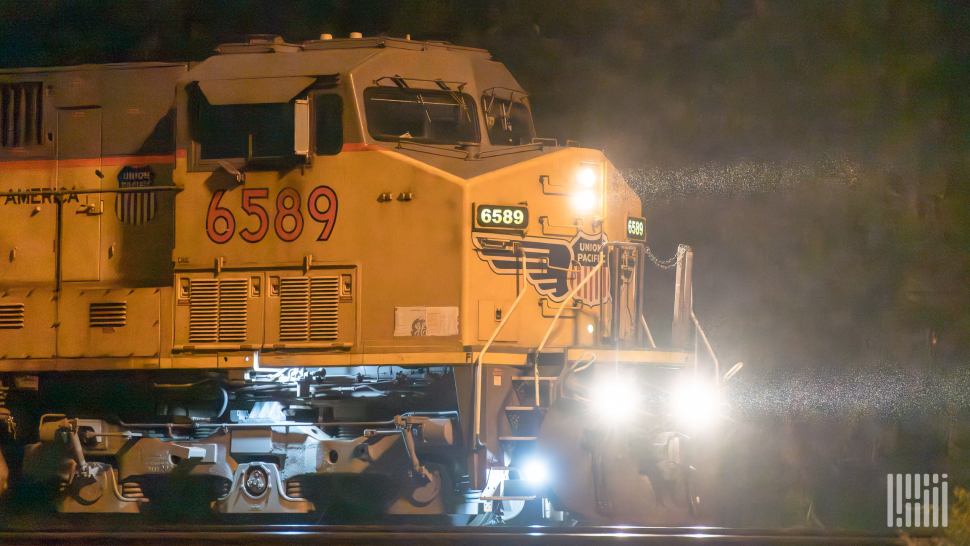
NEW YORK — While the prospect of the first transcontinental railroad has created rare buzz in a staid business, analysts questioned whether Union Pacific and Norfolk Southern can produce the kind of growth in freight traffic they say an historic merger would bring.
“Over the past 10 years intermodal freight has underperformed versus benchmarks,” said consultant Larry Gross, during a panel discussion at the RailTrends conference. “This includes gross domestic product, long-haul trucking and containerized imports. Unless something changes, we’re not going to see growth or recovery.”
Gross said a re-opening of the Red Sea shipping route would be a headwind for intermodal because more freight will be end up being routed to the East Coast, and intermodal share off the East Coast is much lower than off the West Coast. The federal crackdown on commercial driver licenses could shrink motor carrier capacity and raise rates that may push more freight to intermodal. “But international freight will continue to be under pressure and I see no increase in domestic truckloads, so for 2026 I am forecasting intermodal to be flat to down overall,” said Gross.
Analyst Rick Paterson told the conference that all six Class 1 railroads “are running well at the same time. This never happens,” but he was skeptical of assertions by UP (NYSE: UNP) and NS (NYSE: NSC) that the merger will drive substantial freight gains in an industry that has struggled with carload declines in recent years.
“They’re asking us to believe that these two companies, which have recorded zero volume growth over the last 10 years, will now grow by 10% within three [years, following merger approval],” Paterson said.
The prospective merger has attracted praise from President Donald Trump and backing from hundreds of shippers amid a sustained campaign by UP Chief Executive Jim Vena, who was in the audience, to garner support for the historic tie-up. But it has also spurred expressions of concern from other railroads, chemical shippers and scores of Republican state legislators who worry that the consolidation will choke economic growth amid higher rates and service difficulties.
One longtime industry observer said too much is unknown to pass judgment.
“We don’t know what the merger is,” said analyst Tony Hatch, noting that details of the merger agreement won’t be known until UP-NS file their formal application with the Surface Transportation Board in the coming weeks.
“Stakeholders can oppose, support or extort this deal. UP is sailing in the dark on their own, so it’s not a slam dunk. The benefits are clear but undefined, and the question has to be asked, ‘What do you pay for those benefits?’”
Notably, Hatch said that UP has budgeted $750 million to cover potential concessions in the merger. One thing that is certain, he said, is the integrity of the regulatory review.
“I have full faith in the Surface Transportation Board to evaluate this proposal. And I can tell you, they don’t rubber stamp for anybody.”
STB Chairman Patrick Fuchs in a separate panel while noting he cannot comment on a pending matter, in his first public comments since the merger was announced recalled that his agency had a variety of specialists on hand to review of the consolidation of Kansas City Southern and Canadian Pacific in 2023.
“We had an environmental impact specialist, a historic preservation specialist and they touch a substantial portion of the agency. We have other people for economic and data analysis,” Fuchs said.
Vice Chair Michelle Schultz said that agency held a listening session with practitioners, “who made a hundred suggestions” for the review process. Member Karen Hedlund pointed out that no agency staff was eliminated during the Doge cuts early on in the Trump administration.
“Patrick convinced them we didn’t have any excess staff.,” Hedlund said. “We have sufficient staff for the work we have.”
The conference is hosted by Progressive Railroading.
This article was updated Nov. 23 to correct a quote by Rick Paterson on post-merger growth claims by UP and NS., and to correct quotes from Larry Gross that a re-opening of the Red Sea would be a headwind for intermodal, not a tailwind.
Subscribe to FreightWaves’ Rail e-newsletter and get the latest insights on rail freight right in your inbox.
Find more articles by Stuart Chirls here.
Related coverage:
Weekly rail freight lower but still ahead of 2024 for year
Rail merger could raise prices, hurt US ability to compete, say GOP legislators
Red state AGs: Rail merger could threaten national security
UP, NS shareholders overwhelmingly approve $85 billion rail merger
Brokerage Compliance Symposium
The day before F3. Every compliance issue you face - fraud exposure, carrier liability, FMCSA rules, cargo theft, insurance gaps - navigated by attorneys and operators defining best practices in a changing industry.
F3 Awards Dinner
The night before F3. FreightTech100 companies honored. FreightTech 25 and Shipper of Choice winners revealed live. Cocktail reception into dinner and live music - 300 industry leaders in one purpose-built room.
F3: Future of Freight Festival
Industry-defining keynotes, rapid-fire technology demos, and industry leaders networking in experiences across Chattanooga - plus the inaugural F3 Awards Dinner featuring the FreightTech and Shipper of Choice reveals.
The day before F3. Every compliance issue you face - fraud exposure, carrier liability, FMCSA rules, cargo theft, insurance gaps - navigated by attorneys and operators defining best practices in a changing industry.
The Signal at Chattanooga Choo Choo • Chattanooga, TN Register NowThe night before F3. FreightTech100 companies honored. FreightTech 25 and Shipper of Choice winners revealed live. Cocktail reception into dinner and live music - 300 industry leaders in one purpose-built room.
The Signal at Chattanooga Choo Choo • Chattanooga, TN Register NowIndustry-defining keynotes, rapid-fire technology demos, and industry leaders networking in experiences across Chattanooga - plus the inaugural F3 Awards Dinner featuring the FreightTech and Shipper of Choice reveals.
The Signal at Chattanooga Choo Choo • Chattanooga, TN Register Now