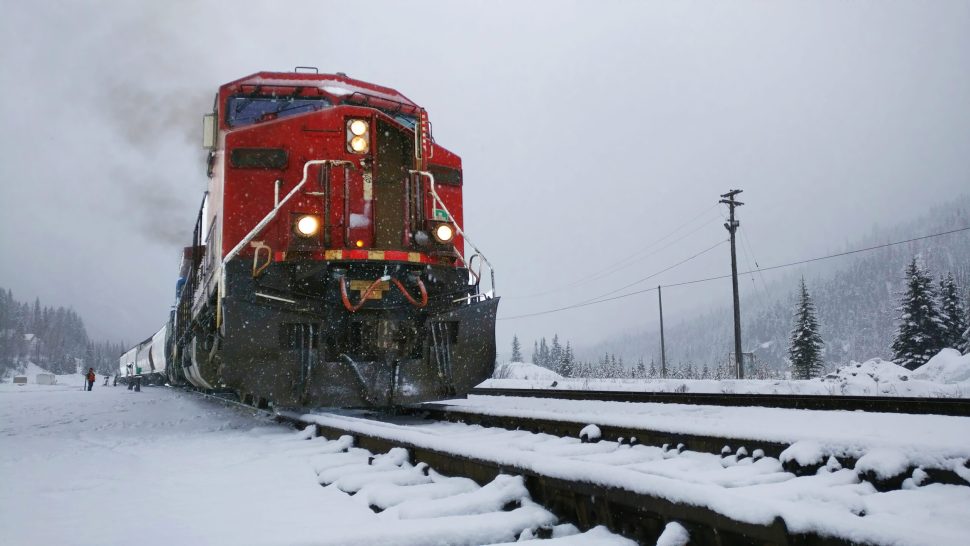
As you are aware, a major winter storm is forecast to impact the south-central and eastern U.S. late this week – regions that are generally less equipped to handle severe winter weather. As the National Weather Service describes it, “an expansive winter storm will start Friday in the Southern Rockies/Plains and Mid-South.” The resulting ice, snow, and extremely low temperatures are expected to significantly disrupt nationwide transportation networks with impacts felt into next week.
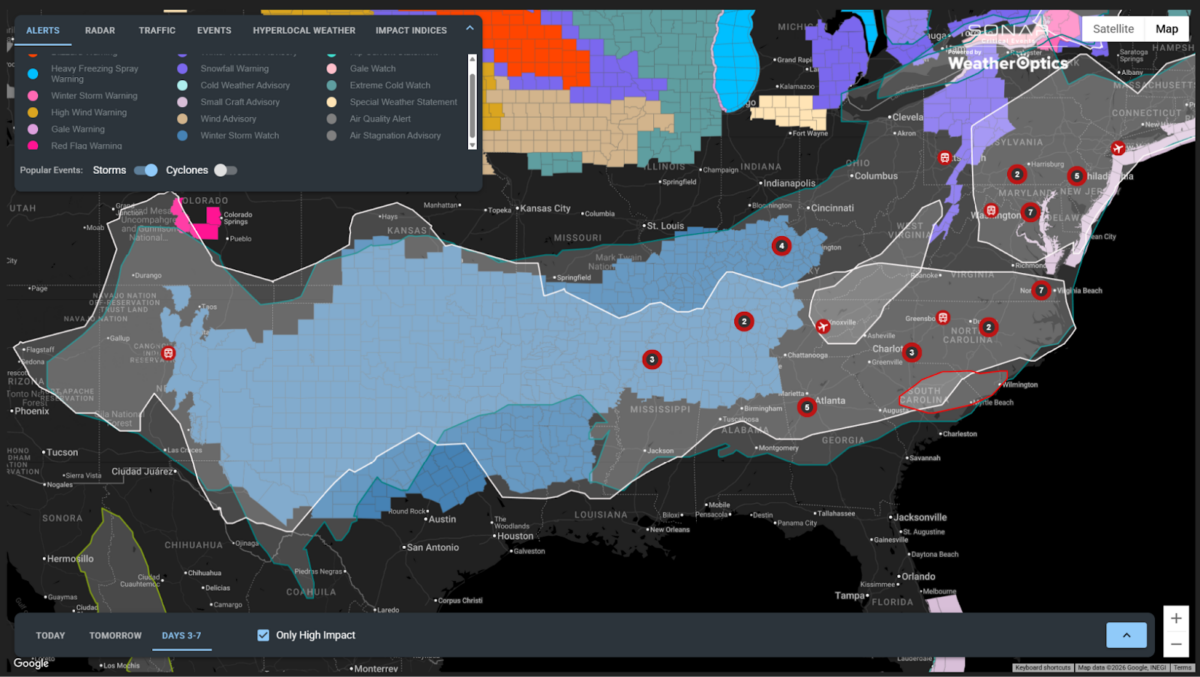
The light blue areas in the South denote a Heavy Freezing Spray Warning in the next 3-7 days. Areas within white polygons denote expected storms. Red circles are key locations (e.g., airports) expected to be highly impacted. Impacted areas include Atlanta, Nashville, Louisville, and large portions of Mississippi and Texas. (Map: SONAR Weather Optics)
Eastern railways highlight areas to watch
CSX and Norfolk Southern, the two Class I railroads with the most extensive operations in the eastern U.S., issued customer advisories in the past two days. CSX says the weather event may impact operations within its Southwest Region, including Evansville (Indiana), Nashville, and Chattanooga. It also said that operations could be impacted as far south as Atlanta. CSX has major terminals in Louisville (across the river from Evansville), Nashville, and Atlanta, as well as a mainline that connects Atlanta and Nashville. CSX also has terminals in Birmingham and Montgomery, which could be impacted by the storm.
A major winter weather event reaching Atlanta would be highly disruptive across modes since the metro area serves as the primary transportation hub in the Southeast for rail, road, and air. SONAR data shows that Atlanta is the largest inbound and outbound truckload market in the U.S. currently. Class I railroad Norfolk Southern is headquartered there and has numerous nearby facilities. It published a service alert on Wednesday saying that its intermodal facilities are currently operating under normal conditions and no terminal or gate closures are planned at this time. In addition to the locations mentioned by CSX, Norfolk Southern’s alert said snow could impact the Southern Appalachians, Virginia, and the Mid-Atlantic, while freezing rain could impact Texas, the Lower Mississippi Valley, and the Carolinas.
Severe winter weather is disruptive to railway operators for several reasons. Adverse highway conditions make completing the first and last miles of intermodal shipments difficult or impossible. Snow needs to be cleared from tracks using special equipment, and any delays typically lead to congestion in terminals, which, depending on severity, can persist for days or even weeks after a storm passes. Delays at a major terminal can be felt throughout the rail network. During periods of extreme cold, trains need to be shorter and run slower than normal to maintain adequate functioning of the air brakes. Extreme cold can also damage track, signals, and switches since metal contracts in severe cold, exacerbating network congestion.
Texas trauma
My colleague JP Hampstead already described how severe winter weather can impact the Dallas-Fort Worth area. Those impacts can be illustrated through numerous SONAR data sets using a local granularity and going back to February 2021. Hopefully, there will never be another weather event like that one, which involved widespread and lengthy power failures. Burst pipes that destroyed homes and industrial facilities that had to be shut down.
Consider the outbound rail intermodal traffic for Dallas (which includes Fort Worth) in the first chart below. Containers processed went from around 2,200 per day in DFW to fewer than 500, and the data set might have hit zero if not for using a seven-day moving average. In truckload, carriers went from rejecting about 15% of outbound Dallas loads to more than 32%, a level that hasn’t been reached in the five years since.
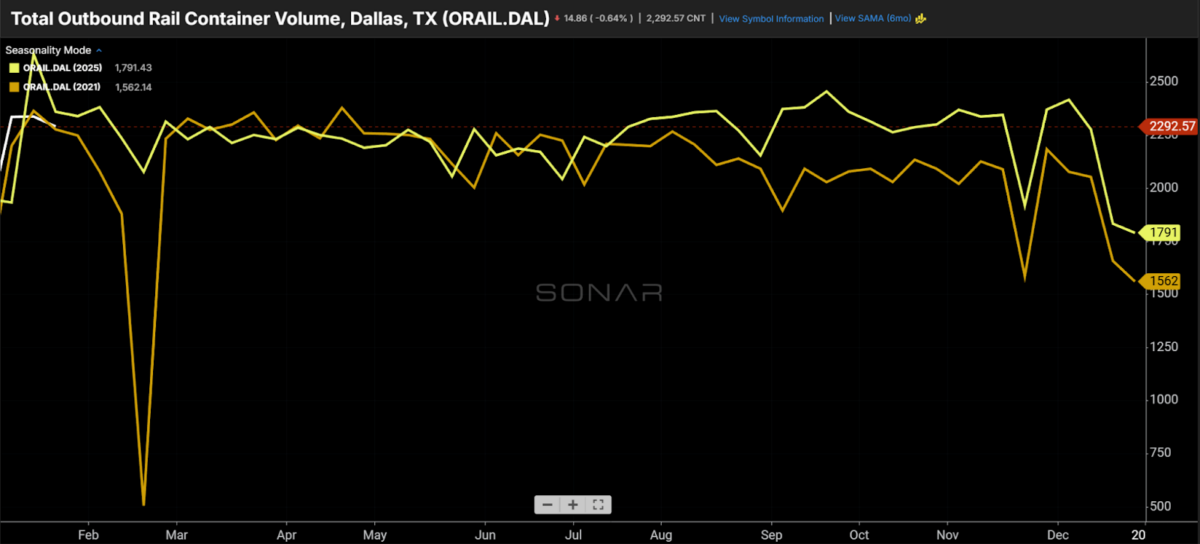
DFW outbound containerized intermodal volume for 2025 (orange) and 2021 (yellow). 2022-2024 are removed for the purpose of readability. (Chart: SONAR)
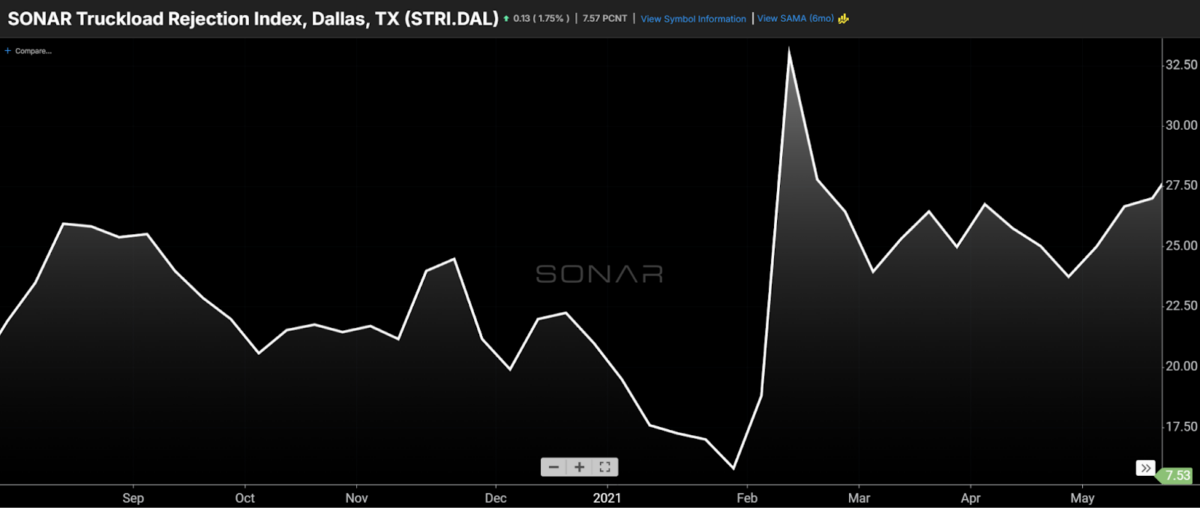
The SONAR Truckload Rejection Index shows a steep increase in the portion of outbound Dallas truckload tenders rejected by carriers following the 2021 Texas freeze. (Chart: SONAR)
Brokerage Compliance Symposium
The day before F3. Every compliance issue you face - fraud exposure, carrier liability, FMCSA rules, cargo theft, insurance gaps - navigated by attorneys and operators defining best practices in a changing industry.
F3 Awards Dinner
The night before F3. FreightTech100 companies honored. FreightTech 25 and Shipper of Choice winners revealed live. Cocktail reception into dinner and live music - 300 industry leaders in one purpose-built room.
F3: Future of Freight Festival
Industry-defining keynotes, rapid-fire technology demos, and industry leaders networking in experiences across Chattanooga - plus the inaugural F3 Awards Dinner featuring the FreightTech and Shipper of Choice reveals.
The day before F3. Every compliance issue you face - fraud exposure, carrier liability, FMCSA rules, cargo theft, insurance gaps - navigated by attorneys and operators defining best practices in a changing industry.
The Signal at Chattanooga Choo Choo • Chattanooga, TN Register NowThe night before F3. FreightTech100 companies honored. FreightTech 25 and Shipper of Choice winners revealed live. Cocktail reception into dinner and live music - 300 industry leaders in one purpose-built room.
The Signal at Chattanooga Choo Choo • Chattanooga, TN Register NowIndustry-defining keynotes, rapid-fire technology demos, and industry leaders networking in experiences across Chattanooga - plus the inaugural F3 Awards Dinner featuring the FreightTech and Shipper of Choice reveals.
The Signal at Chattanooga Choo Choo • Chattanooga, TN Register Now