




In fact, according to the freight research and consulting firm, the market was already experiencing an improvement in terms of truck availability before the rule change.
The omnibus appropriation bill signed by President Obama late Tuesday includes a provision, fought for by the trucking industry, that rolls back the 34-hour restart rule to where it was prior to June 2013, when the Federal Motor Carrier Safety Administration adjusted rules governing how long drivers can stay behind the wheel each day and week.
Before then, drivers could take their end-of-week rest period at any time. The agency, instead, dictated that drivers who reach their 70-hour weekly driving limit could only restart the clock by taking at least two nighttime sleeping periods during their mandated break. The FMCSA claimed that a driver’s body clock requires two nights’ rest to function safely.
Motor carriers were upset because the new rules eliminated operational flexibility by preventing drivers who end work early one day from resuming their work cycle in the evening, or night, another day. That meant drivers often had to break for longer than 34 hours to clear the second night, which increased delivery times and exacerbated the short supply of truck drivers. And it often forced truckers onto congested roads Monday mornings along with commuters. The trucking industry lobbied Congress for more than a year to suspend the rule until the FMCSA conducted a study on the benefits and rationale for the rule change.
The agency has immediately suspended enforcement of the restart restrictions and will issue a Federal Register Notice, also to be posted on its website, advising the public of the new situation. It is also working to inform state and federal motor carrier inspectors to revert back to the previous restart rules, a spokesman said.
The new budget law also instructs the FMCSA to launch a study comparing the operational, health and fatigue impacts of the two versions of the restart rules, as well as safety incidents, over at least a five-month period, using historical data.
Perry, in a blog posted on FTR’s website, estimated that it will take at least two years before the study is completed and reviewed, and any modified regulations are published. The productivity benefits will extend at least through early 2017, he said.
Many motor carriers say the 2013 driving limits have curtailed productivity by at least 3 percent, so going back to the status quo on the weekly rest break essentially reduces the rule’s burden by two-thirds.
Still in place is a requirement for a 30-minute rest period within the 11-hour maximum daily driver shift, which observers say often amounts to an hour by the time a driver finds suitable parking and walks to and from a truck stop.
The new regulatory situation furthers the slight loosening in truck capacity noticed during the fall. Perry said capacity utilization next year will be near 96.6 percent, which is high by historical standards, but 300 basis points below the critical level of 96.9 percent a year ago. Utilization was at 99 percent in early 2014.
“This means that the industry will have an important reserve of surge capacity to handle seasonal peaks or other issues in 2015. FTR expects price increases to moderate as a result, especially for spot markets,” Perry wrote.
But, he said, the freight industry shouldn’t relax too much because other safety regulations are in the pipeline that will further weed out drivers from the industry and make it difficult for carriers to keep all their equipment in service.
The omnibus law, for example, also directs the FMCSA to publish its proposed regulation requiring electronic logging devices in June — three months earlier than originally planned. The technology is viewed as a way to eliminate cheating by some drivers who produce fraudulent paper logs of their driving schedules in order to work longer and make more money.
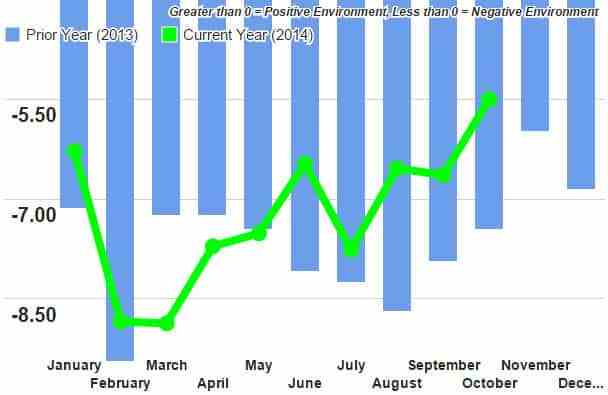
Meanwhile, new analysis from FTR suggests that the available supply of trucks has improved slightly from earlier this year. But the econometrics firm predicted that rates will worsen for buyers of truck service in the coming months.
FTR’s Shippers Conditions Index for October was -5.5. A reading below zero indicates a less-than-ideal environment for shippers. Readings below 10 signal that conditions for shippers are approaching critical levels, based on available capacity and expected rates.
Fuel is the only positive contribution to the index, as the price of diesel fuel has declined significantly in recent months.
Shippers gradually are expected to see reductions in their fuel surcharges, although the pass through from carriers tends to lag actual reductions at the pump, industry experts say.
“Tight capacity and the corresponding rate increases remain the biggest challenge for shippers,” Jonathan Starks, FTR’s director of transportation analysis, said in news release. “While truck utilization has eased from the level seen last winter, it still remains historically high. Likewise, contract rates continue to steadily move higher, and spot rates are quite elevated — up 20 percent, year-over-year, in late November… As the economy looks likely to accelerate in 2015, it could cause capacity to tighten once more, leading to further acceleration in base freight rates. The recent inclusion of hours-of-service changes in the congressional budget bill is a modest positive for the industry, but would not be enough to offset demand from a strong economy.”
Brokerage Compliance Symposium
The day before F3. Every compliance issue you face - fraud exposure, carrier liability, FMCSA rules, cargo theft, insurance gaps - navigated by attorneys and operators defining best practices in a changing industry.
F3 Awards Dinner
The night before F3. FreightTech100 companies honored. FreightTech 25 and Shipper of Choice winners revealed live. Cocktail reception into dinner and live music - 300 industry leaders in one purpose-built room.
F3: Future of Freight Festival
Industry-defining keynotes, rapid-fire technology demos, and industry leaders networking in experiences across Chattanooga - plus the inaugural F3 Awards Dinner featuring the FreightTech and Shipper of Choice reveals.
The day before F3. Every compliance issue you face - fraud exposure, carrier liability, FMCSA rules, cargo theft, insurance gaps - navigated by attorneys and operators defining best practices in a changing industry.
The Signal at Chattanooga Choo Choo • Chattanooga, TN Register NowThe night before F3. FreightTech100 companies honored. FreightTech 25 and Shipper of Choice winners revealed live. Cocktail reception into dinner and live music - 300 industry leaders in one purpose-built room.
The Signal at Chattanooga Choo Choo • Chattanooga, TN Register NowIndustry-defining keynotes, rapid-fire technology demos, and industry leaders networking in experiences across Chattanooga - plus the inaugural F3 Awards Dinner featuring the FreightTech and Shipper of Choice reveals.
The Signal at Chattanooga Choo Choo • Chattanooga, TN Register Now