




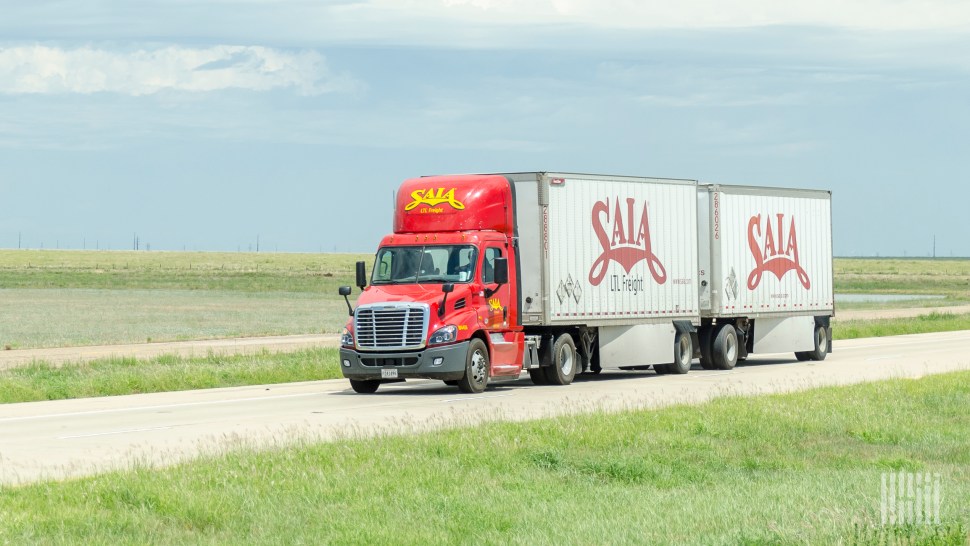
Less-than-truckload carrier Saia said it didn’t get the March lift in demand it normally sees as customers pulled back in response to trade uncertainty.
Johns Creek, Georgia-based Saia (NASDAQ: SAIA) reported first-quarter earnings per share of $1.86 before the market opened on Friday. The result was well light of the $2.76 consensus estimate and the $3.38 the carrier posted in the year-ago period.
Further, the consensus number came down 31 cents in the 90 days ahead of the print as analysts lowered expectations on mounting trade fears.
Click for full report – “Saia’s shares sag 30% as tariffs tank demand, exacerbate growing pains”
Saia’s revenue increased 4.3% year over year to $788 million (6% higher on a per-day comparison) as tonnage per day increased 12.8% and revenue per hundredweight, or yield, fell 5.8% (5.1% lower excluding fuel surcharges).
The tonnage increase was largely due to recent terminal openings. The decline in the yield metric was driven by a 7.8% increase in weight per shipment.
“Primarily resulting from an uncertain macroeconomic environment, we did not see the typical sequential growth in shipments through the quarter, with March shipments flat to February, causing our first-quarter revenues to fall well below our expectations,” President and CEO Fritz Holzgrefe said in a news release.
Click for full report – “Saia’s shares sag 30% as tariffs tank demand, exacerbate growing pains”
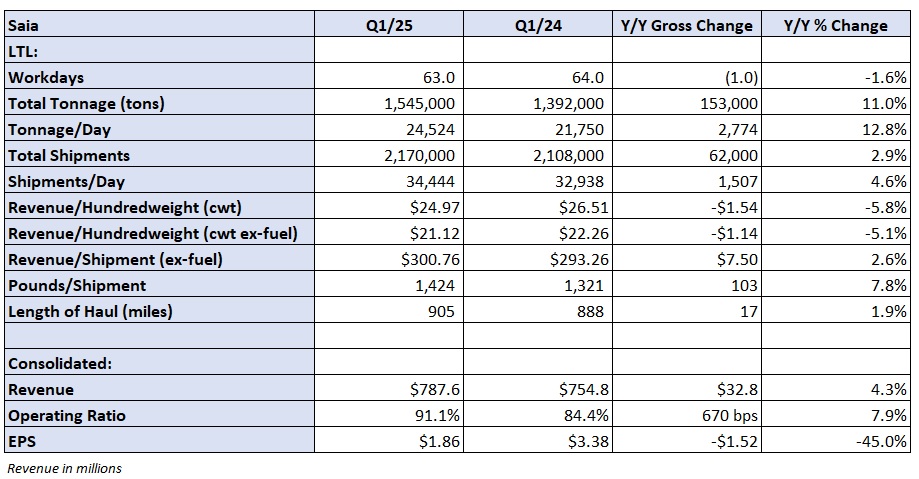
A 91.1% operating ratio (inverse of operating margin) was 670 basis points worse y/y and notably worse than management’s guidance, which implied an OR near 87.5%. Costs from new terminals and abnormally poor weather in January were some of the factors.
Cost per shipment was up 9.4% y/y while revenue per shipment increased just 1.5%, a nearly 800-bp negative spread. Salaries, wages and benefits expenses (as a percentage of revenue) were 410 bps higher y/y, and depreciation expense was up 100 bps y/y.
A $4.5 million swing from net interest income a year ago to net interest expense was a 13-cent drag on EPS in the quarter. Net debt was up $207 million y/y to fund the terminal acquisitions.
Shares of SAIA were off 23.8% in pre-market action on Friday.
Saia will host a conference call at 10 a.m. EDT on Friday to discuss first-quarter results.
Brokerage Compliance Symposium
The day before F3. Every compliance issue you face - fraud exposure, carrier liability, FMCSA rules, cargo theft, insurance gaps - navigated by attorneys and operators defining best practices in a changing industry.
F3 Awards Dinner
The night before F3. FreightTech100 companies honored. FreightTech 25 and Shipper of Choice winners revealed live. Cocktail reception into dinner and live music - 300 industry leaders in one purpose-built room.
F3: Future of Freight Festival
Industry-defining keynotes, rapid-fire technology demos, and industry leaders networking in experiences across Chattanooga - plus the inaugural F3 Awards Dinner featuring the FreightTech and Shipper of Choice reveals.
The day before F3. Every compliance issue you face - fraud exposure, carrier liability, FMCSA rules, cargo theft, insurance gaps - navigated by attorneys and operators defining best practices in a changing industry.
The Signal at Chattanooga Choo Choo • Chattanooga, TN Register NowThe night before F3. FreightTech100 companies honored. FreightTech 25 and Shipper of Choice winners revealed live. Cocktail reception into dinner and live music - 300 industry leaders in one purpose-built room.
The Signal at Chattanooga Choo Choo • Chattanooga, TN Register NowIndustry-defining keynotes, rapid-fire technology demos, and industry leaders networking in experiences across Chattanooga - plus the inaugural F3 Awards Dinner featuring the FreightTech and Shipper of Choice reveals.
The Signal at Chattanooga Choo Choo • Chattanooga, TN Register Now