(This article has been updated to add comments from C.H. Robinson)
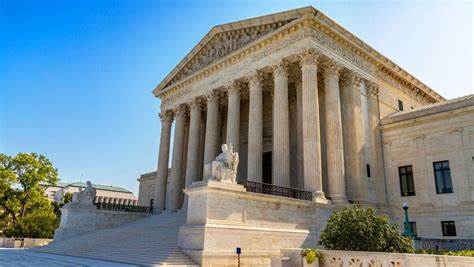
The U.S. Supreme Court will take up the issue of broker liability.
In a Friday announcement, the court said it had granted certiorari in the case of Montgomery vs. Caribe II.
However, in the list of the five cases it accepted, with no rejections reported, it did not mention a parallel case involving broker liability, Cox vs. Total Quality Logistics, where the giant 3PL had requested certiorari.
Join the leaders shaping freight’s future at
F3: Future of Freight Festival, Oct 21-22.
Network with the industry’s best and discover what’s next.
Both Montgomery and Cox involve the same fundamental question: under the safety exception of the Federal Aviation Administration Authorization Act (F4A), can a broker be considered akin to a motor vehicle?
The two cases came to the Supreme Court from opposite directions.
“This is extraordinarily good news for the freight brokerage industry which, more than anything else, needs certainty in order to serve the public,” Marc Blubaugh, head of the transportation practice at the Benesch law firm, said in an email to FreightWaves. Benesch has represented the Transportation Intermediaries Association in various filings connected to the broker liability issue.
In the Montgomery case, first filed in the Southern District of Illinois and then later heard in the Seventh Circuit Court of Appeals, broker C.H. Robinson was ruled to have been protected by the safety exception from negligent hiring claims. C.H. Robinson (NASDAQ: CHRW) had hired Caribe Transport II, whose truck had been involved in an accident in Illinois that injured plaintiff Shawn Montgomery.
But in Cox vs. TQL, coming first out of the Southern District of Ohio and then the Sixth Circuit Court of Appeals, the appellate level reversed the lower court finding and found that TQL was not protected by the safety exception, and that TQL fell under the umbrella of that part of the law that says the exception is “with respect to motor vehicles.”
What the Sixth Circuit said in Cox
In the Cox case, the widower of Greta Cox argued that TQL should be held negligent in the hiring of the driver that crashed into Greta Cox’ car in Oklahoma.
In language that if ultimately upheld could pose serious issues for the brokerage community, the Sixth Circuit said in the Cox case in July that “the exception… focuses on the connection between the state law and motor vehicles, and not necessarily on the connection between the regulated entity and motor vehicles. Requiring that the regulated entity directly own or operate motor vehicles would impose an additional limitation beyond what the text of the exception requires.”
The Cox vs. TQL case was on the court’s schedule for review at a conference Monday, along with Montgomery.. With no word on the case yet, but with the Court taking up the broker liability issue solely through Montgomery–at least for now–it suggests the Cox case was very much on the court’s mind when it finally accepted the issue after punting on it three previous times in the past three years.
But even as the industry awaits to see whether there will be a Supreme Court review of Cox, it isn’t a big leap to assume the court was at least looking at the case in deciding to grant certiorari in the Montgomery case. The reason: outside of Cox, the only other significant case that came out of the circuits on the question of broker liability in recent years where a brokerage was ruled to be not protected by the safety exception was Miller vs. C.H. Robinson, a Ninth Circuit decision. The court already passed on reviewing that decision in 2022.
Blubaugh said in a TIA filing in connection with the Cox case, he had urged the Supreme Court to grant certioriari in Cox but also to “consolidate it, group it, or otherwise link it with the petition in Montgomery. “
“The Court may very well still take that approach since the two petitions obviously raise the same core legal issue, albeit from different procedural postures and with subtle distinctions in the respective petitioners’ arguments,” he said. “(But) the Court could of course simply treat Montgomery as the effective ‘stand in’ for Cox (while not expressly stating so) and, as a result, could in theory deny cert in Cox. Regardless of the procedural treatment of Cox, the granting of cert in Montgomery is most certainly cause for celebration.”
C.H. Robinson was a defendant in the original Montgomery case, before the district and appellate courts removed them through its application of F4A. But it is still watching closely.
““We welcome the Supreme Court’s decision to hear the Montgomery case.” the company said in a statement provided to FreightWaves. “For years, we’ve maintained that federal law protects brokers from a patchwork of state-level liability claims that threaten the efficiency of interstate commerce. The Court’s decision to take up this issue validates the importance of that position and opens the door to long-overdue clarity.”
Previous rejections
Since the 2022 Miller rejection, the Supreme Court rejected certiorari requests on two other cases where a combination of lower or appellate courts had found various 3PLs protected by the safety exception. The core of those rulings was that brokers were not what Congress was thinking about in 1994 when the F4A said the safety exception was “with respect to motor vehicles.”
Those two cases were Ye vs. GlobalTranz, certiorari denied in 2024, and Gauthier vs. TQL, certiorari denied earlier this year.
In both the Montgomery and Gauthier cases, although 3PLs C.H. Robinson and TQL were victorious at the circuit court level, they supported their defeated plaintiffs in asking the court to review the lower court rulings. That’s a sign of just how important the brokerage community thinks the issue of broker liability is and how much it wants the Supreme Court to settle conflicting circuit court precedents.
The need for a safety exception is that the F4A was written to preclude state action that could impact a transportation “price, route or service.” It was created to stop a tide of state laws and legal actions that its backers more than 30 years ago believed were undercutting the broad deregulation movement that impacted transportation sectors such as trucking and aviation starting in the late 1970’s and into the 1980’s.
But the safety exception was included for what its name suggests: the ability of a state to still pursue various types of legal actions against transportation companies acting in an unsafe manner, even if those legal actions might at minimum have a tangential impact on a “price, route or service.”
More articles by John Kingston
Echo Global keeps Moody’s B3 rating in tough market
California guts key Advanced Clean Fleet Rules; what’s next?
Brokerage Compliance Symposium
The day before F3. Every compliance issue you face - fraud exposure, carrier liability, FMCSA rules, cargo theft, insurance gaps - navigated by attorneys and operators defining best practices in a changing industry.
F3 Awards Dinner
The night before F3. FreightTech100 companies honored. FreightTech 25 and Shipper of Choice winners revealed live. Cocktail reception into dinner and live music - 300 industry leaders in one purpose-built room.
F3: Future of Freight Festival
Industry-defining keynotes, rapid-fire technology demos, and industry leaders networking in experiences across Chattanooga - plus the inaugural F3 Awards Dinner featuring the FreightTech and Shipper of Choice reveals.
The day before F3. Every compliance issue you face - fraud exposure, carrier liability, FMCSA rules, cargo theft, insurance gaps - navigated by attorneys and operators defining best practices in a changing industry.
The Signal at Chattanooga Choo Choo • Chattanooga, TN Register NowThe night before F3. FreightTech100 companies honored. FreightTech 25 and Shipper of Choice winners revealed live. Cocktail reception into dinner and live music - 300 industry leaders in one purpose-built room.
The Signal at Chattanooga Choo Choo • Chattanooga, TN Register NowIndustry-defining keynotes, rapid-fire technology demos, and industry leaders networking in experiences across Chattanooga - plus the inaugural F3 Awards Dinner featuring the FreightTech and Shipper of Choice reveals.
The Signal at Chattanooga Choo Choo • Chattanooga, TN Register Now