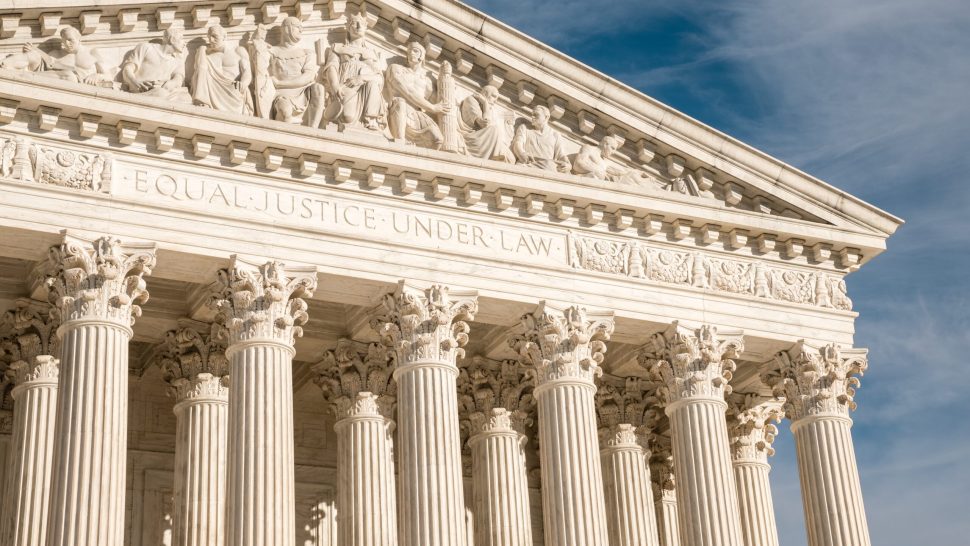
Broker liability is now knocking on the door of the U.S. Supreme Court twice, with two separate cases separately requesting that the high court review an issue it has chosen to pass on previously.
As expected, Total Quality Logistics (TQL) has formally requested the Court grant certiorari in the case of TQL vs. Robert Cox. In early July, the Sixth Circuit overturned a lower court decision and found that TQL was not fully protected from liability by the Federal Aviation Administration Authorization Act (F4A), and that plaintiffs in the case could pursue damages against TQL under the act’s so-called safety exception.
The TQL case joins the case of Montgomery vs. Caribe II, a case that also has 3PL C.H. Robinson as a defendant, in asking the Supreme Court to clarify issues of broker liability under F4A. .
In the Montgomery case, the Seventh Circuit found that the safety exception of the F4A did protect C.H. Robinson (NASDAQ: CHRW). The plaintiff in the case, Shawn Montgomery, has requested certiorari from the Supreme Court.
Even the winners want SCOTUS to weigh in
But to demonstrate the importance the 3PL industry is putting on the goal of getting the high court to weigh in on the issue, C.H. Robinson–even though it won at the circuit level–joined with Montgomerey and also asked the court to review the case.
That isn’t the first time that happened. In the case of Gauthier vs. TQL, the brokerage won at the 11th Circuit on its argument that F4A protected it against the claims of Katia Gauthier, widow of a woman killed in a crash with a truck hired by TQL. But when Gauthier made a request to the Supreme Court for review, TQL backed that request, also seeking clarity despite the fact it had been victorious at the circuit level.
The Supreme Court rejected certiorari, as it did in the Ying Ye case against GlobalTranz in 2024 (the brokerage was victorious) and Miller vs. C.H. Robinson in 2022 (where C.H. Robinson lost on the question of protection under the safety exception).
Earlier court denials total three
That’s three times the court has punted on the question of a brokerage’s exposure to liability under the protections under 1994’s F4A and, more specifically, the law’s safety exception.
With TQL’s action, the Supreme Court now has two opportunities in front of it to reverse its earlier decisions to pass on the issue.
It would be doing so with a pair of cases that present themselves as opposites: one where a circuit backed the 3PL and another where it didn’t. That conflict among circuits has always been seen as increasing the odds that the Supreme Court might agree to a certiorari request.
Marc Blubaugh, head of the transportation practice at the Benesch law firm, cautioned about the odds of success. “As a matter of simple mathematics, the prospect of the U.S. Supreme Court accepting any case for review is always a statistical longshot,” he said in comments emailed to FreightWaves. “A petitioner always has a less than 1% chance of the Court accepting a case for review.”
But maybe the 3PL industry will get its wish, Blubaugh added. “The chances of the Court accepting TQL’s petition for review are greater than ever before,” he wrote. “This is the fifth time that the Court has been asked to determine whether plaintiffs may sue freight brokers for state common law negligence on the basis that the so-called ‘safety exception’ saves such claims from federal preemption.”
While there have been five broker liability cases that have sought review in recent years, they have come out of just four circuits, since two of them were from Seventh Circuit decisions.
“We now face an entrenched 2-2 circuit split (amplified by a wide range of conflicting lower federal court and state court decisions) on an issue that plaintiffs and defendants all agree is of great public importance,” Blubaugh said. “In short, the time is now.”
Once again the question: is a broker a motor vehicle?
In its writ to the Supreme Court asking for certiorari, TQL summed up the issue before the court.
“The question presented is whether a common-law negligence claim alleged against a freight broker, based on the broker’s selection of a motor carrier to provide transportation of cargo, is preempted because it does not constitute an exercise of the ‘safety regulatory of a state claim with respect to motor vehicles’ within the meaning of the F4A,” TQL’s writ says.
The quote within the TQL statement is taken directly from the wording of the safety exception.
When the Sixth Circuit overturned the lower court decision in the Cox vs. TQL case, according to the TQL writ, it “reasoned that a common-law negligent-selection claim involves an exercise of the State’s ‘safety regulatory authority’ and that the enforcement of such a claim against a freight broker constitutes an exercise of such authority ‘with respect’ to motor vehicles.’”
TQL’s writ described that decision as “erroneous.”
Among the other arguments TQL makes, it notes the two distinct parts of the F4A.
In the key portion, passed by Congress to ensure states did not undercut the goals of transportation deregulation, the F4A prevents states from passing any legislation or regulation that could affect a “price, route or service.” F4A also contains the safety exception, which says the restriction on state action on price, route or service “shall not restrict the safety regulatory authority of a State with respect to motor vehicles.”
But while there are portions of F4A that are specifically aimed at brokerages and freight forwarders, the TQL argument is that the safety exception is just for motor vehicles. And that brings the issue around to the debate that has gone on in the lower courts: is a broker a motor carrier?
Blubaugh noted that two circuits-the Seventh and Eleventh-found that the phrase “with respect to motor vehicles” excluded brokers, which meant that the safety exception that could be used to find a motor vehicle liable under state law–like a truck–didn’t apply to brokers. Two others–the Ninth and Sixth–found the other way.
“Plaintiffs and defendants may find it hard to believe that the future of freight broker liability for negligence could turn on something as seemingly pedestrian as the meaning of the three words ‘with respect to,’” Blubaugh said. “However, this really is the heart of the dispute.”
Litigation goes on elsewhere
Blubaugh also noted that the issue of broker liability is messy beyond the cases in front of the Supreme Court. It is possible, he said, that the Supreme Court might lean toward granting certiorari but would want to wait until some of the other cases are resolved, though they are not all in the federal court system.
There is a case in a South Carolina state court where Echo Global Logistics has come out on top so far, citing F4A and the safety exception.
RXO (NYSE: RXO) in a North Carolina federal court is citing F4A as a defense in a case involving a load of stolen cell phones.
And on Wednesday, Landstar revealed in a filing with the SEC that it was on the losing side of a verdict last week in a Texas state court that found Landstar Ranger (NASDAQ: LSTR) 15% liable for a fatal accident on the final day of 2021. That bill came to $3.42 million out of the total judgement of $22.8 million.
Landstar said in the SEC filing that it had been found by a jury to be acting as a broker and not a motor carrier.
More articles by John Kingston
‘Impossible position’ cited by truck manufacturers in lawsuit against California
In brief comments, Trimble CEO introduces new product for matching capacity with shippers
Truck sales in the second quarter might have been the worst performing metric of all
Brokerage Compliance Symposium
The day before F3. Every compliance issue you face - fraud exposure, carrier liability, FMCSA rules, cargo theft, insurance gaps - navigated by attorneys and operators defining best practices in a changing industry.
F3 Awards Dinner
The night before F3. FreightTech100 companies honored. FreightTech 25 and Shipper of Choice winners revealed live. Cocktail reception into dinner and live music - 300 industry leaders in one purpose-built room.
F3: Future of Freight Festival
Industry-defining keynotes, rapid-fire technology demos, and industry leaders networking in experiences across Chattanooga - plus the inaugural F3 Awards Dinner featuring the FreightTech and Shipper of Choice reveals.
The day before F3. Every compliance issue you face - fraud exposure, carrier liability, FMCSA rules, cargo theft, insurance gaps - navigated by attorneys and operators defining best practices in a changing industry.
The Signal at Chattanooga Choo Choo • Chattanooga, TN Register NowThe night before F3. FreightTech100 companies honored. FreightTech 25 and Shipper of Choice winners revealed live. Cocktail reception into dinner and live music - 300 industry leaders in one purpose-built room.
The Signal at Chattanooga Choo Choo • Chattanooga, TN Register NowIndustry-defining keynotes, rapid-fire technology demos, and industry leaders networking in experiences across Chattanooga - plus the inaugural F3 Awards Dinner featuring the FreightTech and Shipper of Choice reveals.
The Signal at Chattanooga Choo Choo • Chattanooga, TN Register Now