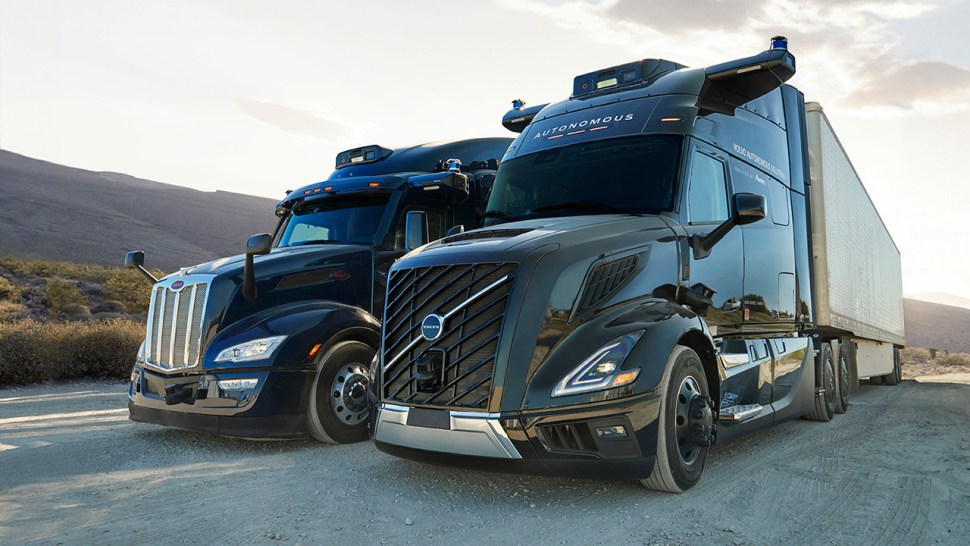
Self-driving trucks could deliver major savings across the more than $1 trillion U.S. trucking industry, according to a new report commissioned by Aurora Innovation and conducted by the Steer Group.
The analysis projects $9 billion in annual consumer savings, account for $70 billion in gross domestic product and nearly 500 lives saved per year by 2035 in an accelerated deployment scenario.
The report, released Thursday, shows the autonomous trucking sector already supports 17,000 jobs and $3.3 billion in total economic output even in these early stages. By 2035, it projects 170,000 self-driving trucks on U.S. highways — roughly 15 percent of the trucking market — logging 33 billion miles annually.
“We believe that autonomous trucking can be a massive engine for the American economy and fortify the national transportation industry,” said Chris Urmson, co-founder and chief executive officer of Aurora. “This report supports our conclusion that technology, like the Aurora Driver, can make our roads safer, our supply chain more resilient, and our operations more efficient than ever before.”
The Safety Dividend
Large trucks are involved in one in every eight fatal crashes on U.S. roads, killing 5,300 people annually. The Federal Motor Carrier Safety Administration attributes 87 percent of at-fault truck crashes to driver error — inattention (28 percent), poor decision-making (38 percent), fatigue and physical impairment.
Under an accelerated deployment scenario, self-driving technology could prevent 490 fatalities, 8,800 injuries and 23,000 crashes each year by 2035. Measured against U.S. Department of Transportation standards, those reductions represent $9.4 billion in annual socioeconomic safety benefits.
Improved safety could also deliver direct bottom-line benefits. The report forecasts a 40 percent drop in insurance premiums, saving carriers $1.4 billion per year. Aurora says its trucks can see more than 450 meters ahead and react to pedestrians 11 seconds faster than human drivers at highway speeds at night.
The robotaxi sector offers supporting evidence. Waymo has logged a 90 percent reduction in serious and fatal crashes compared with human drivers across 125 million miles in San Francisco, Los Angeles, Phoenix and Austin.
Efficiency Gains and Consumer Savings
Federal hours-of-service rules limit human drivers to 11 hours of driving within a 14-hour window, followed by 10 consecutive hours off duty. Self-driving trucks face no such restrictions.
Consider a 1,000-mile trip from Fort Worth to Phoenix. In my experience managing fleets, human-driven trucks typically cover anywhere from 500 to 750 miles before a required DOT break, depending on the driver and their hours of service. An autonomous truck can complete the full distance in one day and even start the return leg — more than doubling equipment utilization.
That efficiency is expected to generate 32 percent fuel savings through optimized acceleration, speed control and gradient management. Across the industry, carriers could save $5.7 billion annually on fuel while conserving 1.6 billion gallons. Reduced emissions would bring another $730 million in public health benefits.
Lower costs should eventually reach consumers. Because trucking moves virtually everything Americans buy, those efficiency gains are projected to deliver $9 billion in increased purchasing power for U.S. households by 2035.
Workforce Opportunities and Economic Growth
Trucking fleets continue to battle high driver turnover and a persistent shortage of qualified applicants. The report argues self-driving technology can help close that gap while opening higher-skilled jobs in software engineering, advanced manufacturing and specialized operations.
Research shows 82 percent of autonomous vehicle workers earn above the national median wage, and many positions do not require a college degree.
“Through the Aurora Works program, we are making a $1 million commitment to ensure that as our technology scales, so do the opportunities for the people who power this industry,” Urmson said.
Tara Andringa, executive director of Partners for Automated Vehicle Education, praised the initiative. “This report shows the autonomous trucking sector is already supporting jobs and economic activity across the country, with enormous potential to further strengthen the U.S. economy,” she said.
Beyond direct trucking benefits, lower freight costs could support regional specialization and stronger exports, adding a net $6 billion to broader GDP.
Path to Nationwide Deployment
Initial rollout will focus on the Sun Belt states of Texas, Arizona, Florida and Georgia, with a national network targeted for 2030. Regulatory clarity remains the biggest hurdle. States with supportive frameworks will attract investment; those without risk being left behind.
The report concludes that Level 4 autonomy represents a major productivity boost for an industry responsible for moving more than 60 percent of domestic freight tonnage.
Brokerage Compliance Symposium
The day before F3. Every compliance issue you face - fraud exposure, carrier liability, FMCSA rules, cargo theft, insurance gaps - navigated by attorneys and operators defining best practices in a changing industry.
F3 Awards Dinner
The night before F3. FreightTech100 companies honored. FreightTech 25 and Shipper of Choice winners revealed live. Cocktail reception into dinner and live music - 300 industry leaders in one purpose-built room.
F3: Future of Freight Festival
Industry-defining keynotes, rapid-fire technology demos, and industry leaders networking in experiences across Chattanooga - plus the inaugural F3 Awards Dinner featuring the FreightTech and Shipper of Choice reveals.
The day before F3. Every compliance issue you face - fraud exposure, carrier liability, FMCSA rules, cargo theft, insurance gaps - navigated by attorneys and operators defining best practices in a changing industry.
The Signal at Chattanooga Choo Choo • Chattanooga, TN Register NowThe night before F3. FreightTech100 companies honored. FreightTech 25 and Shipper of Choice winners revealed live. Cocktail reception into dinner and live music - 300 industry leaders in one purpose-built room.
The Signal at Chattanooga Choo Choo • Chattanooga, TN Register NowIndustry-defining keynotes, rapid-fire technology demos, and industry leaders networking in experiences across Chattanooga - plus the inaugural F3 Awards Dinner featuring the FreightTech and Shipper of Choice reveals.
The Signal at Chattanooga Choo Choo • Chattanooga, TN Register Now