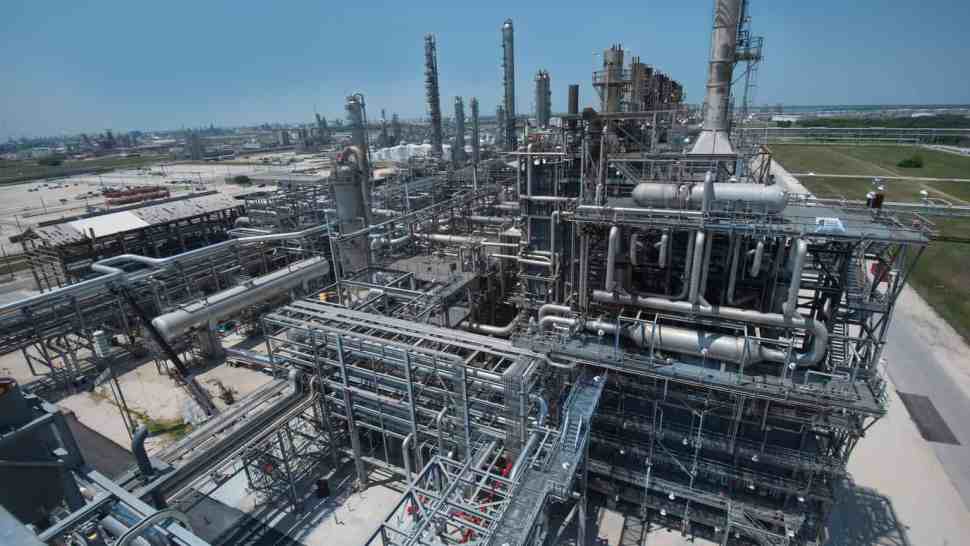
The growing movement to end plastic pollution and ban single-use plastics poses a significant risk to the petroleum and petrochemical industries. The International Energy Agency estimates that the petrochemical industry will account for one third of global oil demand growth to 2030, about 3.2 million barrels per day.
Last Monday, June 10, Canadian Prime Minister Justin Trudeau declared his intention to ban single-use plastics in Canada as early as 2021. Trudeau’s announcement follows bans on single-use plastic bags in California, Hawaii, and New York. In 2015, Great Britain imposed a five pence charge on grocery shoppers who used plastic bags, saying that the fees would help fund the clean-up of plastic pollution.
The World Economic Forum estimates that there are currently about 50 million tons of plastic in the world’s oceans, a crisis that has spurred international calls for plastics bans and more intensive recycling of plastics.
The oil industry has taken note of the evolving public sentiment and regulatory outlook around plastics and is considering the possibility of sharply reduced demand for plastics in its projections for future oil and gas demand.
Common plastics like polyethylene, used in plastic shopping bags, and polypropylene, used in Tupperware plastic containers, are made from a class of petrochemicals called olefins, which include the ‘feedstocks’ ethylene and propylene. Olefins are produced in oil refineries and chemical plants by ‘cracking’ — or separating — the various components of crude oil and natural gas. Another group of plastics comes from the second major class of petrochemicals, aromatics: one kind of aromatic, xylenes, are used to make plastic bottles and synthetic fibers like polyester.
Since 2012, oil production in the United States has doubled from six million barrels per day to more than 12 million barrels per day, largely on the back of advances in hydraulic fracturing (fracking) and horizontal well design. The American oil and gas boom had a major downstream effect: it also fueled the American petrochemicals boom.
U.S. production of ethane, a liquid separated from raw natural gas and used to make ethylene, is projected to reach two million barrels per day by 2020, double 2013’s production levels. Ethane is feedstock for almost half of all U.S. plastic production, and in 2015, the United States became the world’s largest exporter of ethane.
Newly abundant feedstock chemicals like ethane have transformed the American petrochemical industry, which has announced 334 new chemicals and plastics projects requiring $204 billion of investment in the current growth cycle, according to the American Chemistry Council. Where the Persian Gulf was once the center of global petrochemical production, now it’s the Gulf Coast.
Publicly-traded petrochemical company valuations, while highly cyclical and tied to commodity prices (both oil and chemicals), have benefited from the overall growth of the industry. LyondellBasell (NYSE: LYB), a Dutch chemicals company with enormous petrochemical facilities in Texas, has seen the price of its shares more than triple since 2011. Shares of Westlake Chemical (NYSE: WLK) also tripled in value in the same time period.
That growth is now under threat. In the 2019 edition of BP’s (NYSE: BP) Energy Outlook, the oil company explicitly outlined the risk of tighter-than-expected plastics regulation. Its base case for non-combusted oil demand, which includes petrochemicals and lubricants, shows demand rising from 15 million barrels per day in 2017 to about 22 million barrels per day in 2040. In that base case scenario, the impact of tighter plastics regulations removes about three million barrels per day from 2040 demand (it would have been about 25 million barrels per day).
“The growth of fuels as a feedstock is slower than in the past,” BP wrote, “largely reflecting the assumption that regulations governing the use and recycling of plastics tighten materially over the next 20 years, including a doubling of recycling rates to around 30%. This reduces the growth in oil demand by around 3 Mb/d relative to a continuation of past trends.”
However, in its ‘Alternative Scenario’, where increasing environmental concerns lead to a worldwide ban on single-use plastics in 2040, the demand for liquid fuels as feedstock is utterly crushed.
“In this alternative scenario, the growth in liquid fuels used in the non-combusted sector is reduced to just 1 Mb/d — 6 Mb/d lower than in the [base] scenario — and the overall growth of liquids demand is limited to 4 Mb/d, compared with 10 Mb/d in the [base] scenario,” BP wrote.
BP concluded that “a substantial tightening in the regulation of plastics could significantly reduce the growth of oil demand.”
Petrochemicals and products associated with the industry move by pipeline, rail, and truck. Chemicals are an important commodity category for railroads. Chemicals account for 12.6 percent of Canadian Pacific’s (NYSE: CP) volumes, the most of any Class 1 railroad, and CP has grown its chemicals volume by an additional 3.8 percent year-to-date. The ‘bulk’ category in rail freight reporting includes plastic pellets, a product of the petchem industry — Union Pacific (NYSE: UNP) hauls plastic pellets by the trainload from facilities in the Houston area to West Coast ports.
Trucking companies including Halliburton, Schlumberger Limited, C & J Energy Services, Helena Chemicals, Gemini Motor Transport, and Univar Inc. are all exposed to a potential petrochemical bust if increasingly strict plastics regulations suppress demand for oil and petrochemical feedstocks.
The Trump administration and its EPA, headed by Andrew Wheeler, a former coal industry lobbyist, are unlikely to impose a single-use plastics ban on the entire United States. So far, the most sweeping rules have come from deep blue states. But remember, as a massive exporter of crude oil and petroleum products, the American petrochemical industry is a participant in global markets. International regulation — whether it comes from institutions like the United Nations or the European Union — will have a material effect on the industry and the transportation companies that support it.
Brokerage Compliance Symposium
The day before F3. Every compliance issue you face - fraud exposure, carrier liability, FMCSA rules, cargo theft, insurance gaps - navigated by attorneys and operators defining best practices in a changing industry.
F3 Awards Dinner
The night before F3. FreightTech100 companies honored. FreightTech 25 and Shipper of Choice winners revealed live. Cocktail reception into dinner and live music - 300 industry leaders in one purpose-built room.
F3: Future of Freight Festival
Industry-defining keynotes, rapid-fire technology demos, and industry leaders networking in experiences across Chattanooga - plus the inaugural F3 Awards Dinner featuring the FreightTech and Shipper of Choice reveals.
The day before F3. Every compliance issue you face - fraud exposure, carrier liability, FMCSA rules, cargo theft, insurance gaps - navigated by attorneys and operators defining best practices in a changing industry.
The Signal at Chattanooga Choo Choo • Chattanooga, TN Register NowThe night before F3. FreightTech100 companies honored. FreightTech 25 and Shipper of Choice winners revealed live. Cocktail reception into dinner and live music - 300 industry leaders in one purpose-built room.
The Signal at Chattanooga Choo Choo • Chattanooga, TN Register NowIndustry-defining keynotes, rapid-fire technology demos, and industry leaders networking in experiences across Chattanooga - plus the inaugural F3 Awards Dinner featuring the FreightTech and Shipper of Choice reveals.
The Signal at Chattanooga Choo Choo • Chattanooga, TN Register Now