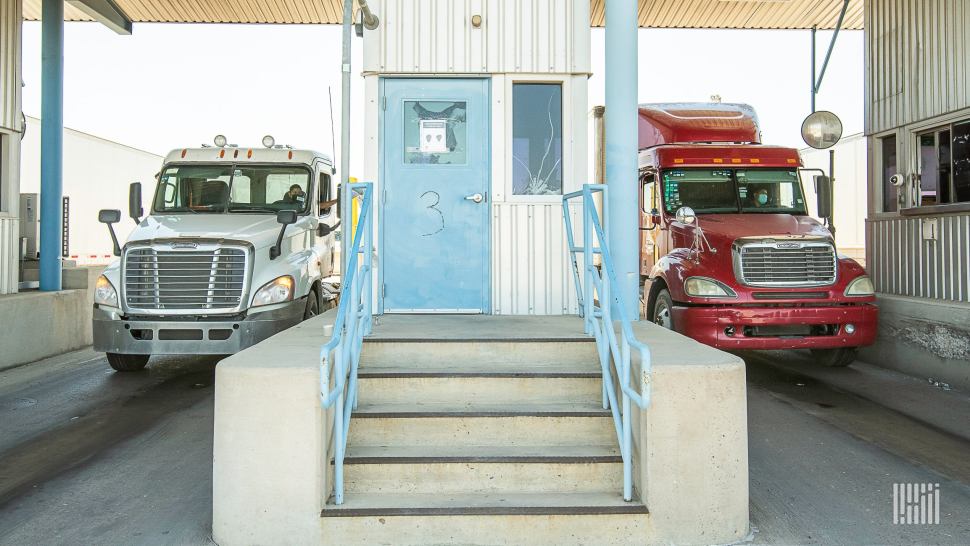
When Adalberto Campero, CEO of Pharr, Texas-based Unimex Group, heard that hundreds of truck drivers in his state had been pulled off the road for failing English-language tests, his first reaction was confusion — and then concern.
Since January, roughly 5,000 to 6,000 truck drivers nationwide were placed out of service for failing to meet English-language requirements, including almost 600 in Texas.
“There’s no directive from the federal government on how they’re going to do these inspections. “Every state is putting its own criteria and drivers are afraid they’re going to be singled out or stereotyped,” Campero told FreightWaves.
“Were a U.S. trucking company, but we also have certain lanes where we use Mexican drivers. We just want to comply to whatever regulations are happening. But we just want to know the rules or the regulations, because it’s too general. We need to know the guidelines and how they apply, so that everybody can all know that this is exactly what you need to do.”
Unimex Group is a carrier and logistics provider offering cross-border trucking and logistics services from Mexico to throughout the U.S.
Related: Visa pause, ICE crackdowns squeeze Laredo carriers
Campero said the recent spike in roadside testing has created uncertainty among drivers — particularly bilingual or immigrant operators who worry that a Latino accent or hesitation to take the English language proficiency test could be mistaken for noncompliance.
“They’re saying drivers have to have conversational English — but what’s the criteria?” he asked. “It shouldn’t be up to each state; it should be federally regulated because we’re on federal highways. We need clear guidelines so every driver — and every officer — understands exactly what the rule means.”
Campero’s concerns echo the scale of a national crackdown that has caught much of the trucking industry off guard.
According to the Federal Motor Carrier Safety Administration (FMCSA), inspectors have issued between 5,000 to 6,000 out-of-service (OOS) violations in 2025 for drivers who failed English-language proficiency requirements under rule 391.11.
The rule requires that commercial drivers be able to “read and speak the English language sufficiently” to communicate with officials, understand signs, and complete reports.
FMCSA’s Motor Carrier Management Information System shows that three violation codes tied to English proficiency — 391.11B2Q, 391.11B2Z, and 391.11B2 — account for more than 26,800 inspection citations this year, with over 5,100 resulting in out-of-service orders, according to research by FreightWaves.
The Washington Post first reported Oct. 16 that approximately 6,000 drivers were pulled off the road between June 1 and Oct. 9, citing FMCSA’s raw inspection-level data — including 596 in Texas, 379 in Tennessee, 467 in Wyoming, and 345 in Arizona.
Campero said no drivers from Unimex have been placed out of service, but many are reconsidering routes that pass through states with high enforcement activity.
“It’s starting to create paranoia about going to certain places,” Campero said. “Warehouses are even asking to see citizenship or driver’s-license documents more often now because everyone’s being extra cautious.”
FMCSA renewed emphasis on the English-language standard earlier this year after a Department of Transportation directive ordered tighter driver-qualification checks during roadside inspections. The agency said effective communication with law enforcement and understanding of traffic signs are essential to highway safety.
But carriers like Campero say the rule is too subjective and lacks measurable criteria.
“They need to tell us exactly what the criteria are,” he said. “Otherwise, one officer’s opinion becomes the rule of law — and that’s too much power for a single inspection.”
Brokerage Compliance Symposium
The day before F3. Every compliance issue you face - fraud exposure, carrier liability, FMCSA rules, cargo theft, insurance gaps - navigated by attorneys and operators defining best practices in a changing industry.
F3 Awards Dinner
The night before F3. FreightTech100 companies honored. FreightTech 25 and Shipper of Choice winners revealed live. Cocktail reception into dinner and live music - 300 industry leaders in one purpose-built room.
F3: Future of Freight Festival
Industry-defining keynotes, rapid-fire technology demos, and industry leaders networking in experiences across Chattanooga - plus the inaugural F3 Awards Dinner featuring the FreightTech and Shipper of Choice reveals.
The day before F3. Every compliance issue you face - fraud exposure, carrier liability, FMCSA rules, cargo theft, insurance gaps - navigated by attorneys and operators defining best practices in a changing industry.
The Signal at Chattanooga Choo Choo • Chattanooga, TN Register NowThe night before F3. FreightTech100 companies honored. FreightTech 25 and Shipper of Choice winners revealed live. Cocktail reception into dinner and live music - 300 industry leaders in one purpose-built room.
The Signal at Chattanooga Choo Choo • Chattanooga, TN Register NowIndustry-defining keynotes, rapid-fire technology demos, and industry leaders networking in experiences across Chattanooga - plus the inaugural F3 Awards Dinner featuring the FreightTech and Shipper of Choice reveals.
The Signal at Chattanooga Choo Choo • Chattanooga, TN Register Now