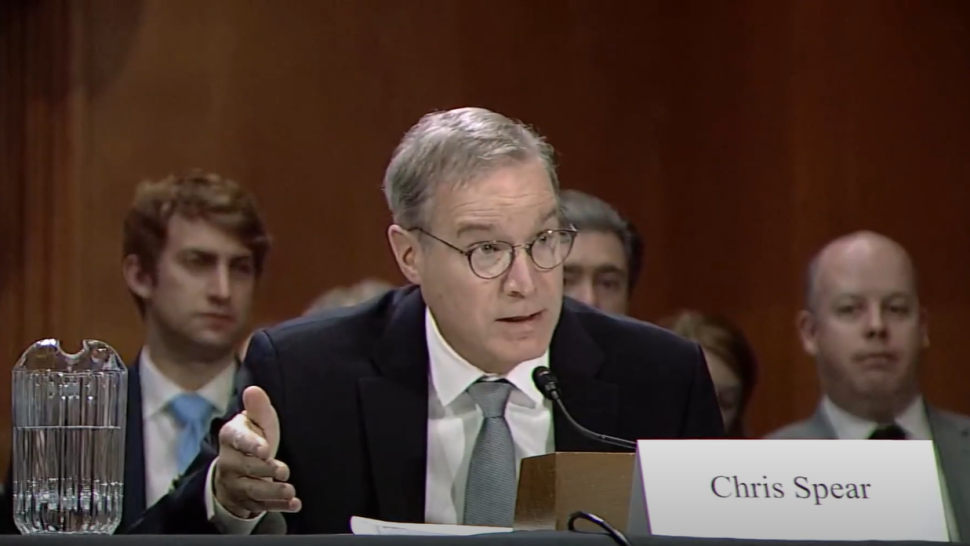
The American Trucking Associations (ATA), once the pre-eminent voice of the trucking industry, is losing ground. Its president, Chris Spear, is not pleased.
Last week, I posted on X a chart from SONAR, based on Federal Motor Carrier Safety Administration (FMCSA) data, showing that independent owner-operators are capturing a growing share of the trucking industry at the expense of larger fleets. Large fleets typically belong to the ATA; smaller carriers often do not.
Small operators frequently criticise the ATA, arguing it misrepresents the industry and backs legislation that harms independent truckers. The ATA claims to speak for all truckers, citing its membership figures. Yet it is primarily a lobbying organisation, funded by fees tied to members’ company size. Larger carriers, which dominate the ATA’s budget, wield disproportionate influence.
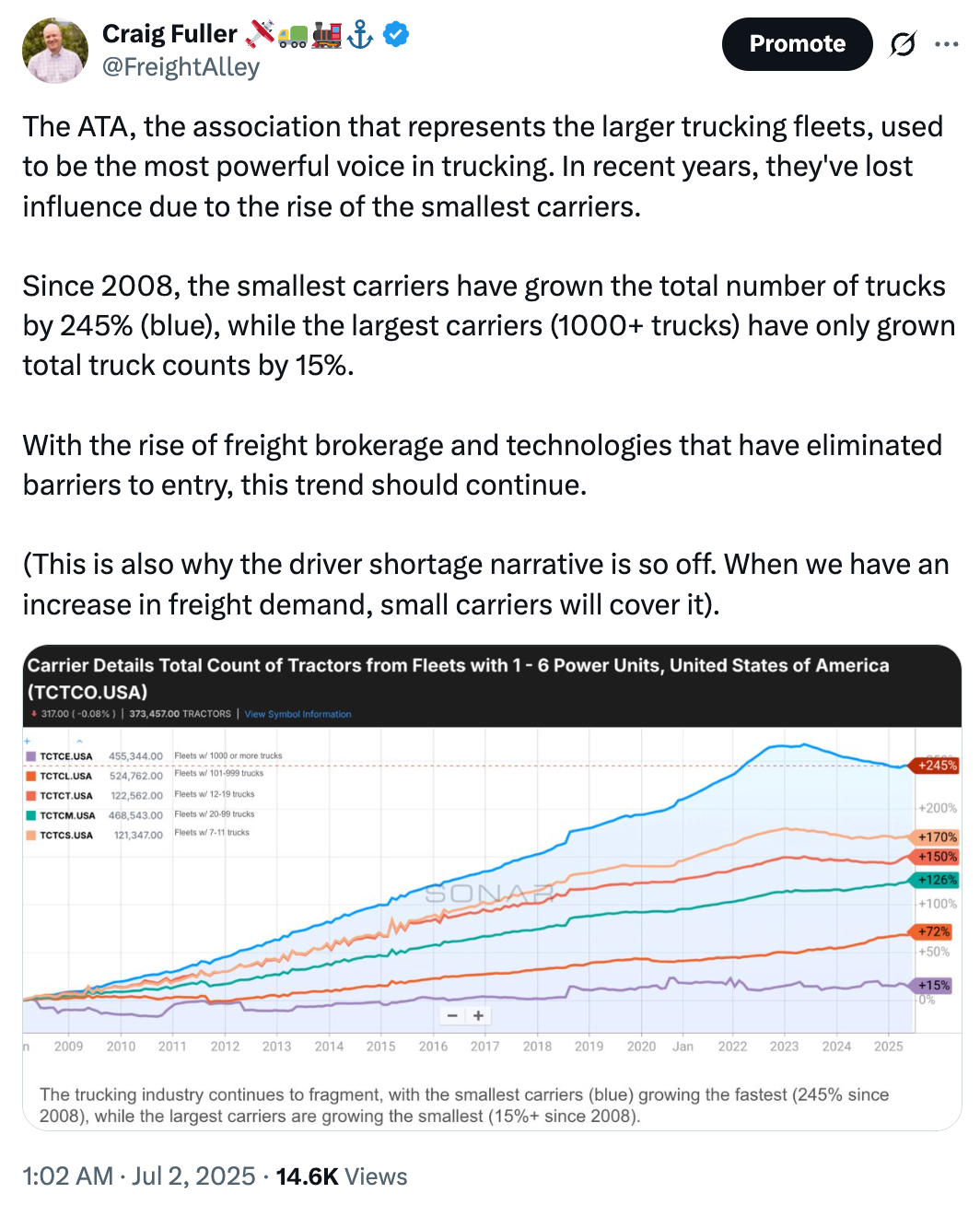
My post on X read:
“The ATA, which represents larger trucking fleets, was once the industry’s loudest voice. Its influence has waned as smaller carriers have grown.
Since 2008, the smallest carriers have increased their truck numbers by 245%, while fleets with over 1,000 trucks have grown by just 15%.
Freight brokerage and technology have lowered barriers to entry, and this trend is likely to persist.
(This also explains why talk of a driver shortage is misleading. When freight demand rises, small carriers fill the gap.)”
Shared on a Facebook truck driver forum, the post drew a sharp response from Mr. Spear:
Mr. Spear’s homework appears incomplete
FreightWaves, my company, weathered the pandemic with a board-led bridge round in March 2020, as half our 2019 revenue came from in-person events. We ended that month strongly, prompting our board to forgo a Paycheck Protection Program loan on ethical grounds. We have not raised capital since a 2021 growth round, most of which remains untouched.
Mr. Spear targets FreightWaves for two reasons.
First, we challenge the ATA’s claims without owing it allegiance. Second, the ATA owns Transport Topics, a competitor one-tenth our size but with 90 years of history (vs. our 7). As for “failed ventures”, I built Transcard over a decade, selling its fleet card to U.S. Bank, and later developed a bank payment platform sold secondary at a $500m valuation. Claims of failure are baseless.
Had Chris Spear conducted any diligence on his baseless claims, any FreightWaves funding would be disclosed on the SEC’s EDGAR system, with our last filing in 2021.
What provoked Mr. Spear? Perhaps it was the data highlighting the ATA’s declining relevance or our critique of its driver-shortage narrative. Last year, I offered $50,000 to a charity of the ATA’s choice for a live debate on the driver shortage, with Bloomberg willing to host. The offer stands.
Alternatively, Mr. Spear may resent the fading relevance of Transport Topics, the ATA’s publication. In 2018, when FreightWaves was barely a year old, Mr Spear blocked our employee Dean Croke (now at DAT) from speaking at an ATA conference, citing competition with Transport Topics.
FreightWaves has since eclipsed Transport Topics, which holds little sway beyond the ATA’s core members. We draw 1.1m monthly visitors to Transport Topics’ 300,000, with 2.4m page views to their 500,000. Our readers engage longer and wield greater market influence. FreightWaves’ reach extends further, appearing on Yahoo Finance, Bloomberg Terminal, and Dow Jones. Far from failing, we have become the industry’s leading voice, offering transparency and holding the ATA accountable.

A few years ago, when my brother led U.S. Xpress, a large dues-paying member of the ATA, the organisation asked him to curb my criticism of its messaging. We shared a laugh then of the ATA’s arrogance that I would be influenced by such a request, and still do.
Brokerage Compliance Symposium
The day before F3. Every compliance issue you face - fraud exposure, carrier liability, FMCSA rules, cargo theft, insurance gaps - navigated by attorneys and operators defining best practices in a changing industry.
F3 Awards Dinner
The night before F3. FreightTech100 companies honored. FreightTech 25 and Shipper of Choice winners revealed live. Cocktail reception into dinner and live music - 300 industry leaders in one purpose-built room.
F3: Future of Freight Festival
Industry-defining keynotes, rapid-fire technology demos, and industry leaders networking in experiences across Chattanooga - plus the inaugural F3 Awards Dinner featuring the FreightTech and Shipper of Choice reveals.
The day before F3. Every compliance issue you face - fraud exposure, carrier liability, FMCSA rules, cargo theft, insurance gaps - navigated by attorneys and operators defining best practices in a changing industry.
The Signal at Chattanooga Choo Choo • Chattanooga, TN Register NowThe night before F3. FreightTech100 companies honored. FreightTech 25 and Shipper of Choice winners revealed live. Cocktail reception into dinner and live music - 300 industry leaders in one purpose-built room.
The Signal at Chattanooga Choo Choo • Chattanooga, TN Register NowIndustry-defining keynotes, rapid-fire technology demos, and industry leaders networking in experiences across Chattanooga - plus the inaugural F3 Awards Dinner featuring the FreightTech and Shipper of Choice reveals.
The Signal at Chattanooga Choo Choo • Chattanooga, TN Register Now