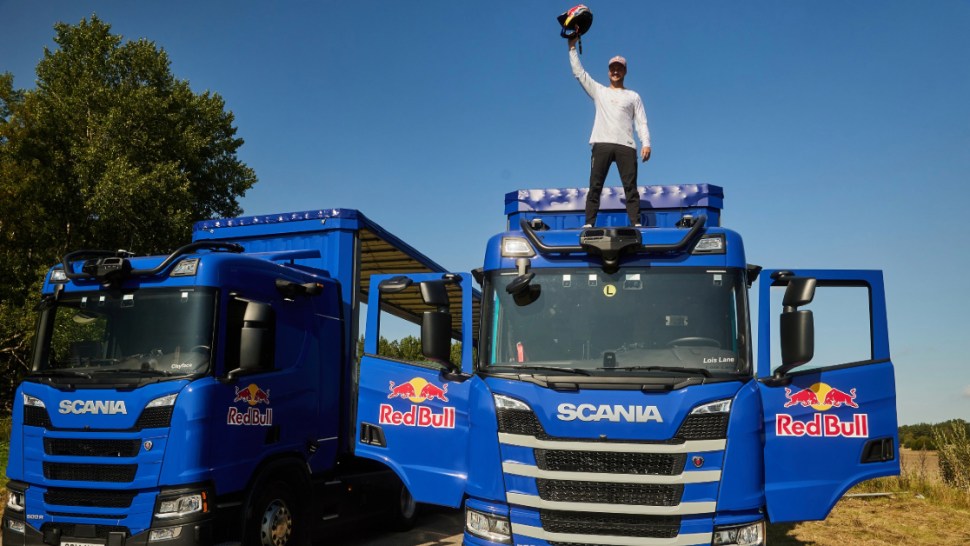
In the annals of human history, there have been many firsts: the moon landing, the circumnavigation of the globe and the invention of sliced bread. For trucking, aspirations have historically been less lofty — mostly getting cargo from point A to point B, or packing in more of it. That changed when Matt Jones, a Red Bull athlete and mountain bike star, became the first human to jump through two Scania autonomous trucks moving toward each other at full speed.
The challenge was of NASA-like proportions: Could two trucks moving in perfect synchronization create a window of less than one second for a professional biker traveling at approximately 40 mph to pass through both open trailers? The answer was yes — but only with two Scania autonomous trucks powered by Plus’ SuperDrive virtual driver system.
The legendary run took place on an airfield near Stockholm, Sweden, where Jones was towed to 65 km/h (40 mph) by a 600-plus-bhp Audi RS Q8. The trucks were each traveling at 11 meters per second, giving Jones less than one second to thread the needle.
“When I got halfway up the ramp and the trucks had initially passed each other, I felt huge adrenaline because I could see the target on the other side. I instantly went from feeling numb to being flooded with adrenaline — it was nothing like I’ve experienced before,” Jones said.
The entire feat lasted only 10 seconds — two seconds less than the Wright brothers’ first flight at Kitty Hawk, North Carolina. Making those 10 seconds of history required months of training and testing.
First, they needed someone crazy enough to try it. Jones had already built his reputation with stunts like Red Bull’s Frames of Mind, in which he rode a woodland course that included a Hot Wheels-style loop, and “The House Jump,” in which he cleared his own home (and chimney) off a 3.5-meter-tall ramp at 43 mph before dropping 7 meters to land.
Jones’ concept began, as many great ideas do, on a napkin — the same way Jeff Bezos sketched Amazon’s flywheel in the early 2000s. Instead of e-commerce dominance, Jones drew two tractor-trailers passing each other with a biker flying between them.
There was zero margin for error. Fortunately, Scania’s autonomous trucks, equipped with LiDAR and radar, delivered the required precision for the 8-meter gap.
“The concept of autonomous trucks was very new to me. It kind of made me nervous at first because I didn’t really understand it. The more we thought about it, the more we realized this project actually lives or dies on autonomy — it has to be so perfect and so precise,” Jones said.
Months of rehearsals followed in the U.K. and Sweden. The trucks not only had to synchronize perfectly with each other but also adapt in real time to the speed of Jones’ Audi tow vehicle.
Scania has been developing autonomous technology since 2018, when its cabless mining trucks began operating in Rio Tinto’s Australian mines. For this stunt, however, a cabbed truck was required — and Silicon Valley-based Plus provided its SuperDrive virtual driver.
Plus noted: “The challenge required repeatable, sub-decimeter path holding, reliable sensing in dynamic conditions, and real-time prediction to maintain safe and consistent behavior across every rehearsal run.”
This is the same Plus SuperDrive system currently being validated with OEM partners for factory-installed autonomous trucks targeted for 2027.
For the autonomous trucking industry, the stunt showcased superhuman precision and timing. For everyday motorists, the takeaway is that these systems are designed to create larger — not smaller — windows of safety on public roads.
Scania’s head of autonomous solutions, Peter Hafmar, summed it up: “Thanks to our autonomous trucks, we could create the exact window of opportunity Matt needed. Seeing firsthand the precision and safety our technology delivered fills us with immense pride.”
Caveat to all riders: Do not attempt to jump between moving tractor-trailers under any circumstances, autonomous or otherwise. This stunt was performed on a closed course with extensive safety protocols.
Brokerage Compliance Symposium
The day before F3. Every compliance issue you face - fraud exposure, carrier liability, FMCSA rules, cargo theft, insurance gaps - navigated by attorneys and operators defining best practices in a changing industry.
F3 Awards Dinner
The night before F3. FreightTech100 companies honored. FreightTech 25 and Shipper of Choice winners revealed live. Cocktail reception into dinner and live music - 300 industry leaders in one purpose-built room.
F3: Future of Freight Festival
Industry-defining keynotes, rapid-fire technology demos, and industry leaders networking in experiences across Chattanooga - plus the inaugural F3 Awards Dinner featuring the FreightTech and Shipper of Choice reveals.
The day before F3. Every compliance issue you face - fraud exposure, carrier liability, FMCSA rules, cargo theft, insurance gaps - navigated by attorneys and operators defining best practices in a changing industry.
The Signal at Chattanooga Choo Choo • Chattanooga, TN Register NowThe night before F3. FreightTech100 companies honored. FreightTech 25 and Shipper of Choice winners revealed live. Cocktail reception into dinner and live music - 300 industry leaders in one purpose-built room.
The Signal at Chattanooga Choo Choo • Chattanooga, TN Register NowIndustry-defining keynotes, rapid-fire technology demos, and industry leaders networking in experiences across Chattanooga - plus the inaugural F3 Awards Dinner featuring the FreightTech and Shipper of Choice reveals.
The Signal at Chattanooga Choo Choo • Chattanooga, TN Register Now