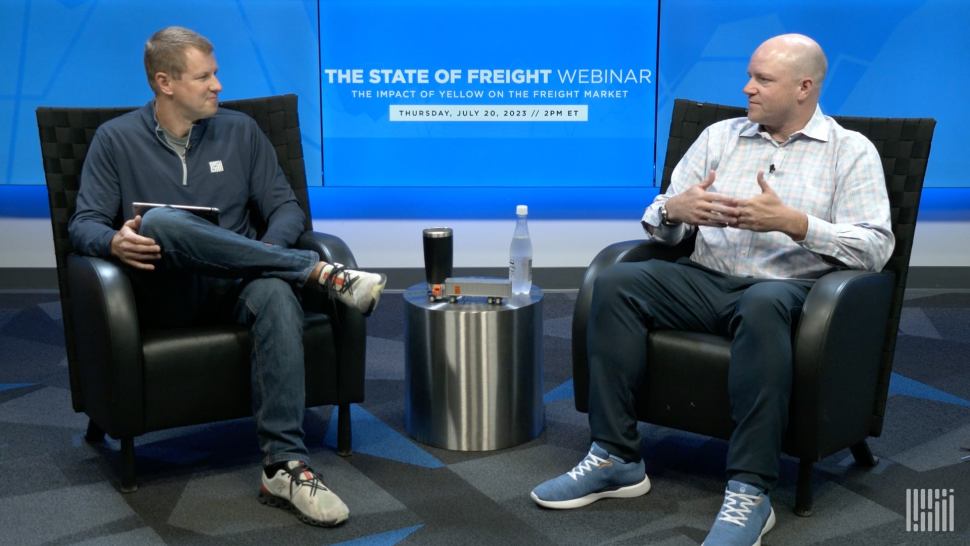
With two big Teamsters-related issues grabbing the trucking headlines, it was no surprise that the focus of the State of Freight webinar for July was on Yellow Corp. and UPS.
Here’s are five takeaways from the more than one-hour chat Thursday between FreightWaves CEO Craig Fuller and Director of Freight Market Intelligence Zach Strickland. (You can register for it and view the archive here).
The history between Yellow and the Teamsters is key to the story
Fuller said understanding the back-to-back combination of a 2006 freight recession and the financial crisis that began in 2008 and dragged into 2009 is important in analyzing the current standoff. Yellow (NASDAQ: YELL) management led by Chairman, President and CEO Bill Zollars had brought several less-than-truckload carriers under the Yellow banner, including Roadway Corp., which it acquired in 2003. That left the company with significant debt when the freight market took those successive hits.
Jimmy Hoffa Jr., head of the Teamsters at the time and son of the legendary Teamsters leader, “worked diligently to rally to save Yellow,” Fuller said. “He really brought the Teamsters in on this process of saving the company. They actually took it on the chin because they gave up a lot to really help the company out and have done so over the last decade.” The end result, however, is “resentment” that its members at Yellow are facing yet another crisis, one that might be existential.
But Fuller also was critical of the Teamsters. He said the union has frustrated Yellow management’s so far unsuccessful efforts to consolidate Yellow, Roadway, USF Corp. and other acquired carriers into one integrated LTL carrier. “So there’s really a lot of arguments on both sides of the table,” Fuller said.
The end result is that the union structure — in part but not completely — has helped stick Yellow with a cost basis “that is much higher than its competitors.” Yellow also is not viewed as a high-quality carrier, he said.
The Teamsters have bigger fish to fry
As it is increasingly apparent that the Teamsters seem prepared to see Yellow disappear, the question becomes why, given that 30,000 jobs in total — not all of them unionized — will be lost.
Fuller noted that when the Teamsters came to Yellow’s rescue in 2009, economic conditions faced by a worker impacted by the collapse of the company were far harsher than they are today. “The Teamsters knew that there were no alternatives for them if Yellow shut down,” he said. But today, if the Yellow jobs disappeared, “while unfortunate, the majority of those folks will be able to find alternative employment, and that’s just because of the really tight employment market that exists.”
But alongside that is the desire of Teamsters President Sean O’Brien to be a transformative figure, like Hoffa Sr., and “the grand prize is Amazon,” where the Teamsters so far have been unsuccessful in unionization efforts. Also in debate is what will happen with current Teamsters negotiations on a new contract with UPS (NYSE: UPS), which is far bigger than Yellow and where the Teamsters is the largest private-sector union in the country. “If O’Brien can prove out that he has won concessions from UPS and that he is willing to let a company go under, that is costing me something, but I gave this up to achieve a higher goal, then that’s a different standard that he has in future negotiations.” With UPS and Amazon (NASDAQ: AMZN) at the top of the Teamsters’ priority list, “you really don’t want this laggard [Yellow], who is bringing you down,” Fuller said. “And that unfortunate reality is that they’ve written it off.”
The exodus of Yellow customers is in full swing
“Anyone who has ever been in a trucking shutdown knows the last thing you want is your freight on a truck or a dock,” Fuller said, explaining the dilemma that a Yellow customer faces.
When there’s a shutdown, the facilities are unmanned and the end result, according to Fuller, is that a shipper might see its freight show up on eBay, resold by people who stole it out of a shutdown network.
Various shippers and TMS systems have cut off Yellow this week, Fuller said. Bills of lading handled by Yellow totaled about 50,000 per day not all that long ago, he said; it’s below that now and might be in the high teens soon. If Yellow is struck by the Teamsters over the company’s failure to make contributions into the Central States pension fund, that is likely to be the end of the company, according to Fuller.
So while a looming strike at a company that is likely to survive might not result in customer exits, because there’s life at the other end of the walkout, getting freight stuck at a carrier that isn’t coming back is a completely different scenario.
As to why that shutdown hasn’t happened yet, Fuller said Yellow management still has its fiduciary responsibilities, “and your only goal as a fiduciary is to survive. So they are hoping that some white knight shows up.”
The market would mostly handle a shutdown of Yellow …
Fuller said Yellow’s share of the LTL market is about 10%. “What I understand in talking to other LTL carriers is they believe that there’s sufficient capacity right now in this market, across the freight economy, to handle the volume,” he added.
He cited one exception: cross-country freight for retail customers, which he said has been a “bread and butter” business at Yellow. That freight might end up moving in a contract truckload arrangement “or a national carrier like XPO (NYSE: XPO) or FedEx (NYSE: FDX) that combined with incremental purchased transportation services from the truckload market” will be able to fill the hole. Fuller did say he expects that short-term LTL rates could shoot up 9% to 12% quickly.
“Some of the stuff being thrown around now is shippers’ revenge,” Fuller said of the current market. “But if you’re an LTL carrier, there’s opportunity. I’m sure they will get it. The question is, how long will this happen?” Freight will be able to move, he said: “The fact that the freight market is incredibly soft means there should be ample capacity,” Fuller said, adding one caveat:
… Unless the Teamsters strike UPS
Measuring the impact of a UPS strike is challenging, Fuller said. The company is a $100 billion business, and about $70 billion of that is in the U.S. Regardless of the specific size, Fuller harkened back to the UPS strike of 1997. “Anyone who lived in trucking those days talks about just how chaotic it was,” he said. The strike was a “massive, massive gift” to trucking because it drove “volume and disruption.” And since e-commerce barely existed then — Amazon was just a fledgling company — the impact of a UPS strike this time would be far greater, Fuller said.
His projection of how a UPS strike would play out foresees that LTL carriers would be “flooded with freight opportunities.” Volume also would “show up” at FedEx, the U.S. Postal Service and parts of the DHL network. But the problem is that “they simply aren’t going to have the capacity” to handle the freight moving out of the UPS network.
These companies that would be the first choice of diverted UPS freight “are going to be buying a lot of linehaul capacity, and they won’t have the capacity on their docks to handle it.” The result: Some freight that would normally move on LTL carriers is going to get moved over to truckload carriers. In an odd twist, Fuller said, independent truckers might be rooting for the Teamsters now, because if there’s a UPS strike, there might be “unprecedented” volumes coming into the truckload market.
How does that impact capacity? The national Outbound Tender Reject Index (OTRI), a measurement of capacity, has lingered below 4% most of the year, reflecting a loose truckload market with plenty of capacity.
If there’s a UPS strike, OTRI will accelerate “across the board,” Fuller said. Tender rejections will rise and companies will be forced to “pay up” for capacity, he predicted. “The ballpark is going to be electric.”
More articles by John Kingston
State of Freight for June: Few signs of upturn from historic lows
State of Freight for March: Bullish signs amid mostly bearish news
Port of Cleveland attempts to punch above its weight
Brokerage Compliance Symposium
The day before F3. Every compliance issue you face - fraud exposure, carrier liability, FMCSA rules, cargo theft, insurance gaps - navigated by attorneys and operators defining best practices in a changing industry.
F3 Awards Dinner
The night before F3. FreightTech100 companies honored. FreightTech 25 and Shipper of Choice winners revealed live. Cocktail reception into dinner and live music - 300 industry leaders in one purpose-built room.
F3: Future of Freight Festival
Industry-defining keynotes, rapid-fire technology demos, and industry leaders networking in experiences across Chattanooga - plus the inaugural F3 Awards Dinner featuring the FreightTech and Shipper of Choice reveals.
The day before F3. Every compliance issue you face - fraud exposure, carrier liability, FMCSA rules, cargo theft, insurance gaps - navigated by attorneys and operators defining best practices in a changing industry.
The Signal at Chattanooga Choo Choo • Chattanooga, TN Register NowThe night before F3. FreightTech100 companies honored. FreightTech 25 and Shipper of Choice winners revealed live. Cocktail reception into dinner and live music - 300 industry leaders in one purpose-built room.
The Signal at Chattanooga Choo Choo • Chattanooga, TN Register NowIndustry-defining keynotes, rapid-fire technology demos, and industry leaders networking in experiences across Chattanooga - plus the inaugural F3 Awards Dinner featuring the FreightTech and Shipper of Choice reveals.
The Signal at Chattanooga Choo Choo • Chattanooga, TN Register Now