




A monthly survey of supply chain managers showed extreme increases in transportation pricing during May as capacity continued to dwindle.
The Logistics Managers’ Index—a diffusion index in which a reading above 50 indicates expansion, while one below 50 signals contraction—returned a 96 reading for transportation prices in May. That was 1 percentage point higher than April and the fastest growth rate ever logged by the 10-year-old dataset. (The index maximum is 100.)
Transportation capacity (31.7) continued to contract, but at a pace that was 3.3 points slower. Transportation utilization (69.5) remained elevated but largely unchanged from the prior reading.
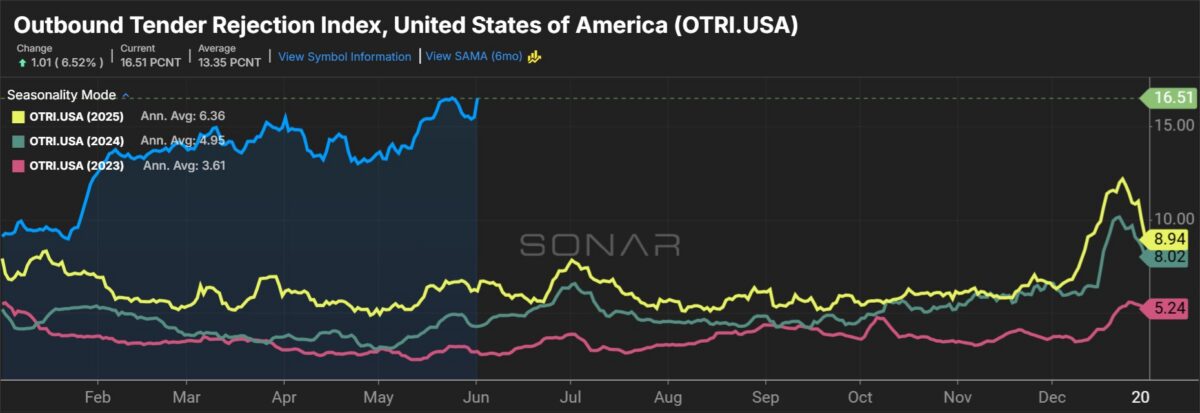
The Tuesday report pointed to the closure of the Strait of Hormuz and higher fuel prices as catalysts for the jump in freight rates. But shipping managers are also contending with surging truckload rates as regulatory agencies and law enforcement clamp down on non-compliant drivers. With this layer of capacity exiting the industry, shippers are seeing carriers reject a larger number of daily tenders as spot rates continue to reach new highs.

The report said upstream respondents (manufacturers and wholesalers) reported tighter freight market conditions than companies downstream in the supply chain (retailers). It said the difference is due to manufacturers pulling forward inventories to avoid potential shortages, while retailers are maintaining reduced stock levels because of high carrying costs and tariffs.
Inflation and higher interest rates were flagged as headwinds to a more meaningful recovery in freight volumes.
“This is the hottest that the transportation market has been in over four years,” the report said. … “Automotive manufacturing and housing construction soak up significant transportation and warehousing volumes. Continued slowness in these sectors could eventually bleed over into reduced freight volumes.”
Logistics managers surveyed expect the transportation market to remain very tight over the next 12 months, returning future readings of 40.4 for capacity, 70.2 for utilization and 91.4 for pricing.
The overall LMI registered a 69.5 reading in May, down just 40 basis points from April. This was the second-highest reading for the index since March 2022.
Inventory levels (54.8) expanded at a rate that was 1.5 points slower than April. Inventories registered a 60.5 reading in the first two weeks of May, but the growth rate slowed to just 50.9 in the back half of the month.
The slowdown in inventory build pushed warehouse capacity (50.5) back into expansion territory, up 5 points during the month. Warehouse utilization (62.9) slowed by 1.5 points, but warehouse prices (70.7) remained elevated (down 2 points).
Inventory costs (84.1) jumped 9.4 points to the highest reading in four years, in part due to elevated warehouse prices. The 29-point gap between the readings for inventory costs and inventory levels was the largest in the index’s history.
“The previous high was in November of 2021, which was the height of the rush of emergency shipments in the post-Covid year at the peak of the previous freight cycle,” the report said. The freight market fell into recession a few months later “due to a combination of too much inventory and high inflation.” However, inventories are leaner in the current cycle, “so the chance of a crash may be softened in this case.”
Aggregate logistics costs (inventory, warehousing and transportation) increased 8.4 points to 250.9 in May, the fastest rate of expansion since March 2022.
The LMI is a collaboration among Arizona State University, Colorado State University, Florida Atlantic University, Rutgers University and the University of Nevada, Reno, conducted in conjunction with the Council of Supply Chain Management Professionals.
Brokerage Compliance Symposium
The day before F3. Every compliance issue you face - fraud exposure, carrier liability, FMCSA rules, cargo theft, insurance gaps - navigated by attorneys and operators defining best practices in a changing industry.
F3 Awards Dinner
The night before F3. FreightTech100 companies honored. FreightTech 25 and Shipper of Choice winners revealed live. Cocktail reception into dinner and live music - 300 industry leaders in one purpose-built room.
F3: Future of Freight Festival
Industry-defining keynotes, rapid-fire technology demos, and industry leaders networking in experiences across Chattanooga - plus the inaugural F3 Awards Dinner featuring the FreightTech and Shipper of Choice reveals.
The day before F3. Every compliance issue you face - fraud exposure, carrier liability, FMCSA rules, cargo theft, insurance gaps - navigated by attorneys and operators defining best practices in a changing industry.
The Signal at Chattanooga Choo Choo • Chattanooga, TN Register NowThe night before F3. FreightTech100 companies honored. FreightTech 25 and Shipper of Choice winners revealed live. Cocktail reception into dinner and live music - 300 industry leaders in one purpose-built room.
The Signal at Chattanooga Choo Choo • Chattanooga, TN Register NowIndustry-defining keynotes, rapid-fire technology demos, and industry leaders networking in experiences across Chattanooga - plus the inaugural F3 Awards Dinner featuring the FreightTech and Shipper of Choice reveals.
The Signal at Chattanooga Choo Choo • Chattanooga, TN Register Now