Truck transportation jobs in the U.S. for November and December came in at the same number, and it’s the lowest total in about 4/12 years.
The Bureau of Labor Statistics’ monthly employment report said truck transportation jobs in December were 1,513,300 jobs. After a November upward revision of 3,900 truck transportation jobs, it put the November and December levels at the same number.
That figure is also the lowest number of truck transportation jobs since 1,514,600 jobs in July 2021.
An October upward revision of 2,400 jobs put the December numbers at a job loss of 3,100 job loss compared to October.
While the up and down changes in truck transportation jobs have been relatively small, and could signal that the total is something of a rut, the downward drift is still clear even if the magnitude of the decline is not particularly large.
Since the start of 2024, the number of truck transportation jobs has fallen in 16 of 24 months. The overall decline from December 2023 stands at 21,300 jobs.
The one month that showed any particularly large gain was March 2025, with a gain of 8,000 jobs. But there also was an 8,000 job decline in September which when combined with other monthly declines now puts jobs at 10,800 jobs less than where they were in that month.
The relentless decline in warehouse jobs continued in January. The loss 0f 7,200 jobs puts the six-month total decline in jobs at 38,200 jobs. At a total of 1,791,500 jobs, the number of warehouse workers compared to the all-time high recorded in March 2022 now stands at 151,600 jobs less than that.
Mazen Danaf, an economist at Uber Freight, looked also at the one-month lag data for specific sectors such as LTL or over the road trucking.
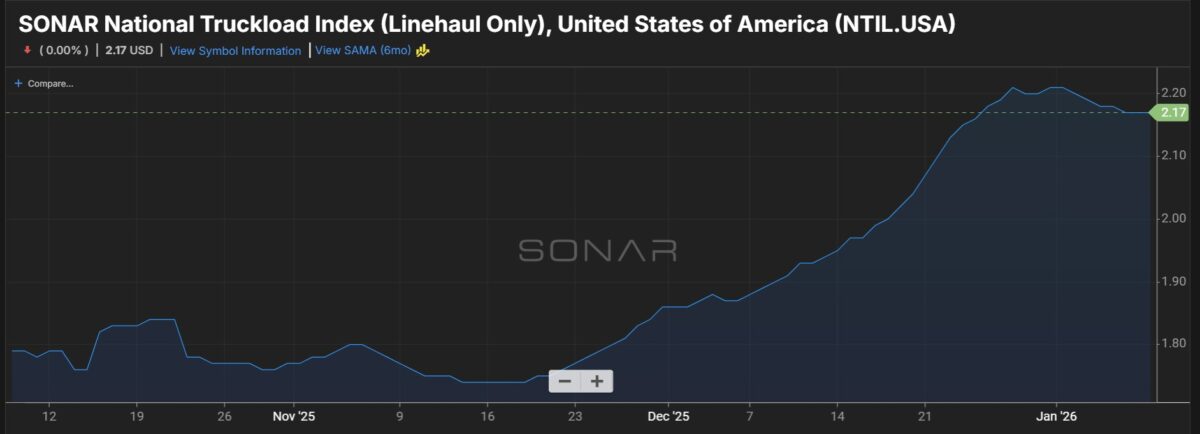
“While overall trucking employment remained stable in December, the long-distance truckload sector continued its two-year downward trend in headcount,” he said in an email to FreightWaves. “This sustained decrease in capacity has been the root cause of the gradual market tightening observed over the last two years. This was clearly evidenced in December when a seasonal spike in demand led to significant increases in spot rates.
David Spencer, vice president of market intelligence at Arrive Logistics, said the stability in employment can tie itself back to higher truckload spot rates.
That increase,he said, was “ a likely boost in the trucking business that kept employment stable throughout the month. Job reductions from October and November were reduced, indicating that not as many drivers had left as previously reported, but they remain at the lowest levels since the pandemic disruption faded.”
“The sudden improvement in truckload rates in December may be enough to encourage more wait and see approach from carriers as it pertains to employment this year, however seasonal demand slowdowns later in Q1 could test their patience,” Spencer said in an email to FreightWaves. “If tighter conditions persist, that could spark hiring, but I would not count on that until we see elevated rates persist beyond the typical period of tightness in early January.”
The overall report–a modest increase in jobs and a small reduction in the unemployment rate–led independent economist Aaron Terrazas to say that “with inflation risks still lurking, December’s jobs numbers likely pump the brakes on conversations about the path ahead for interest rate cuts.”
“The headline numbers mostly look like a job market in approximate balance,” he said.
The January report with December data is the last one for the current base model.
In other highlights from the report:
- Rail transportation jobs rose 700 jobs to 151,000. While that may not seem like much, it’s the biggest increase since a 500-job gain in November 2024. It’s also only the second month in 2025 where the number of rail jobs has increased. The recent high water mark for rail jobs was in April 2024, when tney totaled 157,900 jobs. The latest number is 6,900 jobs less than that.
- Hourly earnings for production and non-supervisory employees in truck transportation in November–that data lags by a month–was $31.75, a record. It does not always rise each month but the one-year trend is that through November is was $1.65/hour more than it was a year ago.
More articles by John Kingston
How is C.H. Robinson using AI? Its CFO has a story
Benesch panelists: Why 2026 could be a strong year for logistics M&A3-way combo emerges for digital load matching: DAT, AscendTMS and Convoy
3-way combo emerges for digital load matching: DAT, AscendTMS and Convoy
Brokerage Compliance Symposium
The day before F3. Every compliance issue you face - fraud exposure, carrier liability, FMCSA rules, cargo theft, insurance gaps - navigated by attorneys and operators defining best practices in a changing industry.
F3 Awards Dinner
The night before F3. FreightTech100 companies honored. FreightTech 25 and Shipper of Choice winners revealed live. Cocktail reception into dinner and live music - 300 industry leaders in one purpose-built room.
F3: Future of Freight Festival
Industry-defining keynotes, rapid-fire technology demos, and industry leaders networking in experiences across Chattanooga - plus the inaugural F3 Awards Dinner featuring the FreightTech and Shipper of Choice reveals.
The day before F3. Every compliance issue you face - fraud exposure, carrier liability, FMCSA rules, cargo theft, insurance gaps - navigated by attorneys and operators defining best practices in a changing industry.
The Signal at Chattanooga Choo Choo • Chattanooga, TN Register NowThe night before F3. FreightTech100 companies honored. FreightTech 25 and Shipper of Choice winners revealed live. Cocktail reception into dinner and live music - 300 industry leaders in one purpose-built room.
The Signal at Chattanooga Choo Choo • Chattanooga, TN Register NowIndustry-defining keynotes, rapid-fire technology demos, and industry leaders networking in experiences across Chattanooga - plus the inaugural F3 Awards Dinner featuring the FreightTech and Shipper of Choice reveals.
The Signal at Chattanooga Choo Choo • Chattanooga, TN Register Now