
Chart of the Week: Van contract rate initial report – USA SONAR: VCRPM1.USA
Long-term or contract rates for the dry van truckload market (VCRPM1) have lost momentum this year compared to last, falling a marginal 0.3% y/y as of early September. While this is still slower than the ~2% drop from 2023 to 2024, contract rates had started to show signs of upward pressure in the second half of last year. Those gains now appear to have been completely erased. What does this mean for the upcoming late-year round of bids?
According to the American Transportation Research Institute (ATRI), the average cost of operating a truck rose about 33% from 2019 to 2024. By comparison, contract rates are up only 17% over the same period.
Combined with the current flatlining trend, this suggests carriers have largely found their floor on pricing. While some efficiency can still be gained by leveraging multiple networks against each other, shippers relying on a limited base of carriers have few long-term cost savings opportunities left.
Spot rates are the floor
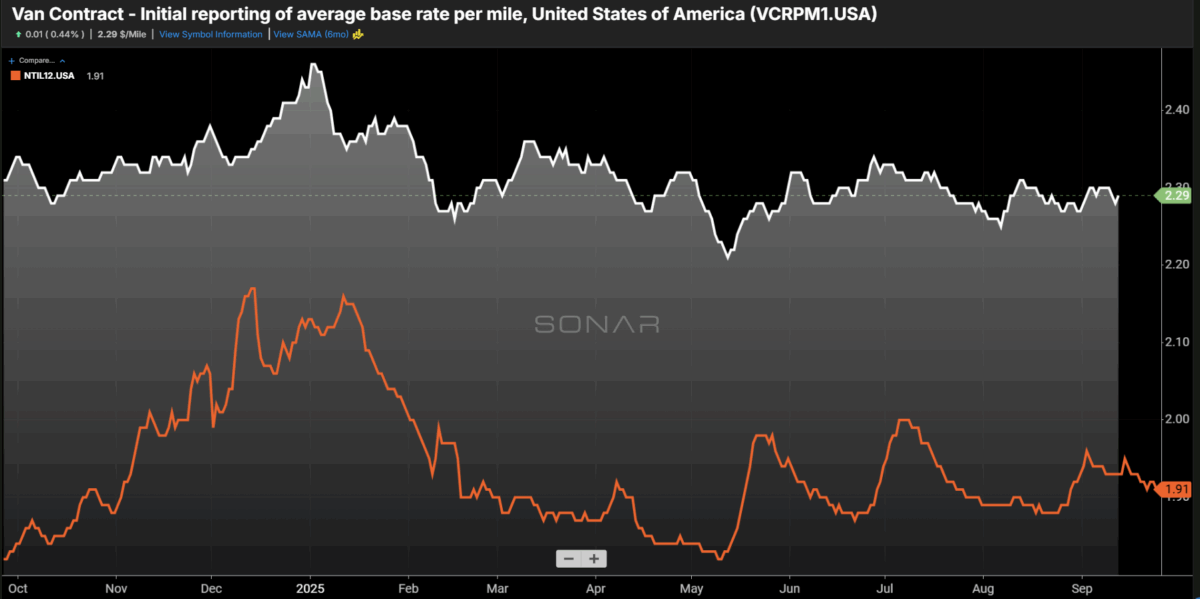
Looking at the relationship between spot (NTIL12) and contract rates, spot rates continue to offer discounts for those willing to buy capacity on the fly. However, the divergence between the two is notable: spot rates are gradually increasing, while contract rates remain flat to slightly lower.
In this sense, the spot market represents the true floor of pricing — where all operational efficiencies have been realized — and that floor is rising.
The spot data is based on broker data who target smaller fleets and owner operators while the contract data is based on invoices between larger fleets and larger shipping operations. It is helpful to think about the white line as the rate situation when using 20-30 carriers, while the orange line represents leveraging 200,000 carrier networks. This is why the spot rate tends to be lower.
Spot data comes primarily from brokers targeting smaller fleets and owner-operators, while contract data is based on invoices between larger fleets and major shippers. Put another way: the white line reflects conditions when working with 20–30 carriers, while the orange line reflects leveraging a 200,000-carrier network. This explains why spot rates are typically lower.
FMCSA data shows the market has been losing 100–200 carriers per week over the past 18 months. Because this data lags — carriers take time to report or be recognized as inactive — the true figure is likely higher. This attrition also helps explain the gradual upward pressure on spot rates.
A market in limbo
From a shipper’s perspective, uncertainty still dominates. Transportation procurement has been relatively easy in recent years, but the data now suggests conditions are becoming more challenging — though not enough to drive long-term rates higher.
Perhaps the bigger signal is that contract rates have not meaningfully fallen despite ongoing softness. This may reflect shipper hesitancy to push for lower costs in an environment many see as unsustainable. According to Zac Rogers, co-author of the Logistics Managers’ Index (LMI), many respondents were expecting significant rate increases at this point last year — expectations that remain intact this year despite the lack of meaningful upward pressure.
In short, while shippers expect conditions to change, carriers are holding rates steady to retain business. This will continue until it no longer can. The best advice for shippers is to ensure their high-value lanes are priced above spot market benchmarks, as those are going out of date quickly and will be abandoned just as quickly when market conditions shift.
Overall, little movement is likely in the contract rate environment while shippers remain uncertain about what comes next. Cost savings may still be found in today’s market, but capturing them could increase long-term risk exposure.
About the Chart of the Week
The FreightWaves Chart of the Week is a chart selection from SONAR that provides an interesting data point to describe the state of the freight markets. A chart is chosen from thousands of potential charts on SONAR to help participants visualize the freight market in real time. Each week a Market Expert will post a chart, along with commentary, live on the front page. After that, the Chart of the Week will be archived on FreightWaves.com for future reference.
SONAR aggregates data from hundreds of sources, presenting the data in charts and maps and providing commentary on what freight market experts want to know about the industry in real time.
The FreightWaves data science and product teams are releasing new datasets each week and enhancing the client experience.
To request a SONAR demo, click here.
Brokerage Compliance Symposium
The day before F3. Every compliance issue you face - fraud exposure, carrier liability, FMCSA rules, cargo theft, insurance gaps - navigated by attorneys and operators defining best practices in a changing industry.
F3 Awards Dinner
The night before F3. FreightTech100 companies honored. FreightTech 25 and Shipper of Choice winners revealed live. Cocktail reception into dinner and live music - 300 industry leaders in one purpose-built room.
F3: Future of Freight Festival
Industry-defining keynotes, rapid-fire technology demos, and industry leaders networking in experiences across Chattanooga - plus the inaugural F3 Awards Dinner featuring the FreightTech and Shipper of Choice reveals.
The day before F3. Every compliance issue you face - fraud exposure, carrier liability, FMCSA rules, cargo theft, insurance gaps - navigated by attorneys and operators defining best practices in a changing industry.
The Signal at Chattanooga Choo Choo • Chattanooga, TN Register NowThe night before F3. FreightTech100 companies honored. FreightTech 25 and Shipper of Choice winners revealed live. Cocktail reception into dinner and live music - 300 industry leaders in one purpose-built room.
The Signal at Chattanooga Choo Choo • Chattanooga, TN Register NowIndustry-defining keynotes, rapid-fire technology demos, and industry leaders networking in experiences across Chattanooga - plus the inaugural F3 Awards Dinner featuring the FreightTech and Shipper of Choice reveals.
The Signal at Chattanooga Choo Choo • Chattanooga, TN Register Now