
Chart of the Week: Outbound Average Length of Haul – USA SONAR: OALOHA.USA
The national average length of haul index (OALOHA) has been running at or near all-time lows in 2025 as the truckload market has lost a significant share of transcontinental moves to intermodal. It may also reflect broader shifts in supply chain strategies. The OALOHA bottomed in August at around 522 miles but has since recovered to more than 571 miles. The question now is whether the truckload market is beginning to regain long-haul share or if this is simply a seasonal blip in a longer-running trend.
According to SONAR’s tender data, the average length of haul in the truckload market was about 8% higher year-over-year in the most recent data, a modest recovery from the 13% decline in August. Still, the sharp drop in the OALOHA in 2025 marks the steepest decline in the data set, which goes back to 2018.
The primary driver of this decline has been the sharp reduction in long-haul demand.
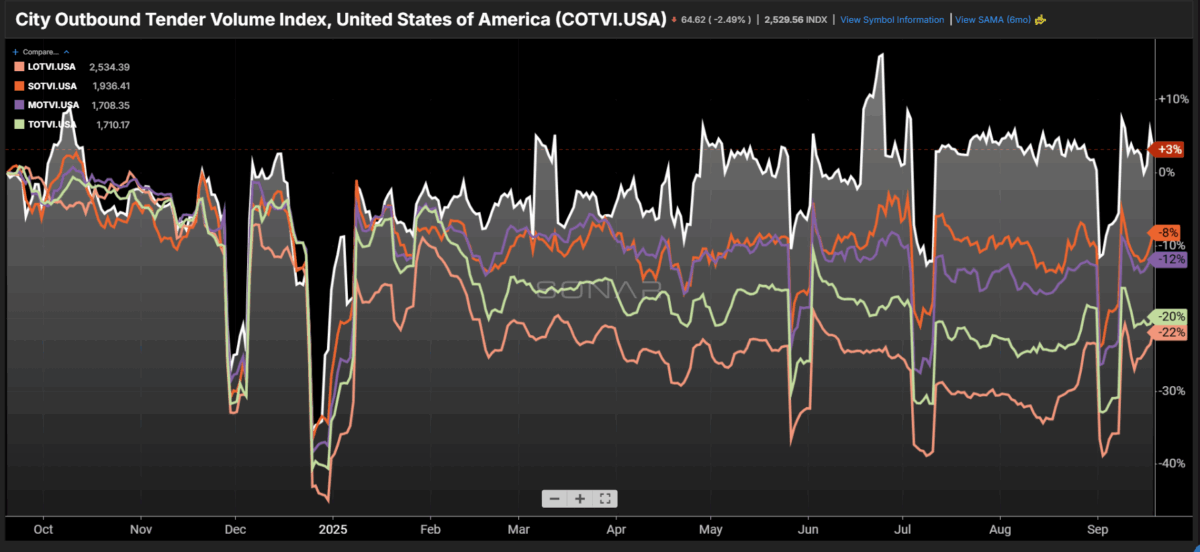
Breaking the tender data into mileage bands, the long-haul segment (loads moving more than 800 miles) has deteriorated the most. The tweener band (TOTVI), covering 450- to 800-mile moves, is a close second, with the other bands falling in sequence. The only exception is the shortest-haul band (COTVI), which measures loads under 100 miles and is the only category showing year-over-year growth.
Short-haul loads are typically tied to upstream manufacturing and intra-warehouse moves, as well as downstream distribution into storefronts and fulfillment centers for retailers.
Longer-haul loads, by contrast, compete directly with intermodal container shipping, particularly when tied to imports. Every major U.S. port has a nearby railhead, making it easier and more cost-effective for shippers to move goods inland via rai l— especially when speed is not critical.
Geopolitical uncertainty and trade disputes have further reshaped strategies. Many shippers now bring inventory into the U.S. earlier than usual to avoid disruptions or sudden tariffs. While this has pushed up inventory carrying costs and warehousing prices, shippers see it as preferable to risking stockouts or absorbing extreme duties — such as the now-paused 145% tariff on Chinese imports.
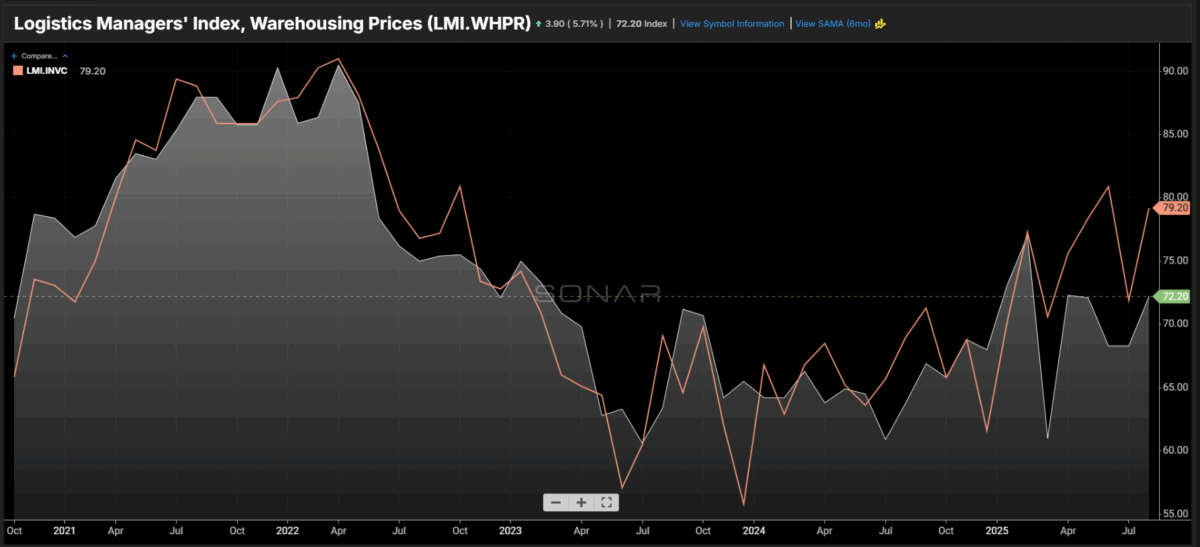
The Logistics Managers’ Index (LMI) shows warehousing and inventory costs rising at their fastest pace since the pandemic. Carrying higher inventory levels gives shippers more flexibility to spread out transportation needs, which helps keep freight rates lower.
Rail remains 15–30% cheaper than trucking, but with a trade-off: slower service and vulnerability to congestion at touchpoints. During the pandemic, these bottlenecks severely limited rail performance and pushed volume back to trucks.
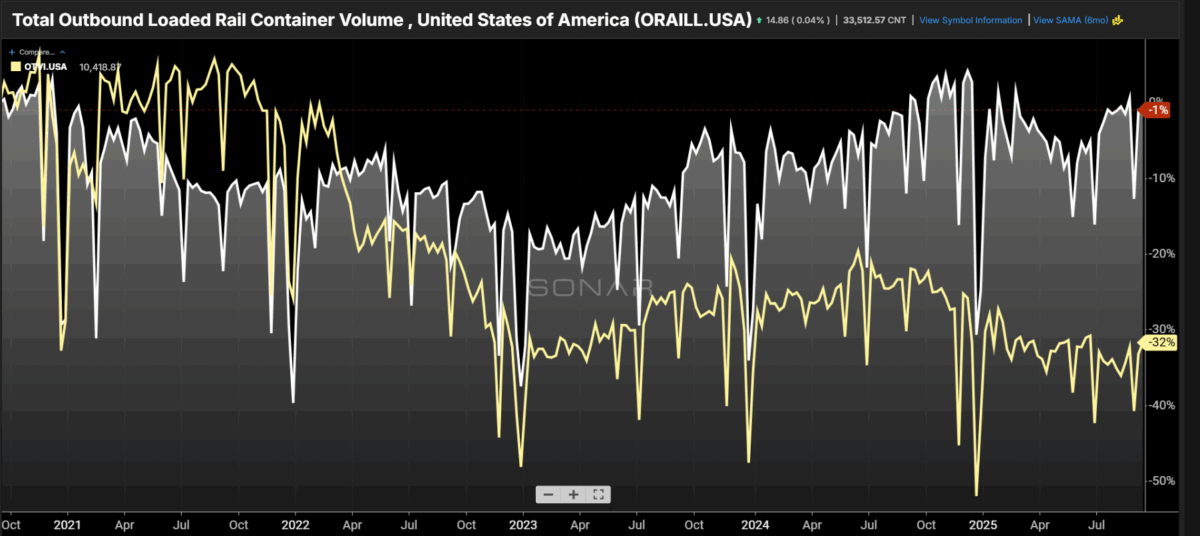
With inventories buffered this year, urgency around domestic moves has diminished, and demand remains flat to down across many sectors. The recent increase in long-haul freight appears seasonal rather than structural, though it could still have short-term consequences in the fourth quarter when retailers ramp up activity.
One 800-mile load ties up roughly two full days of truckload capacity, compared with about a quarter of a day for a sub-100-mile move. If long-haul volumes bounce back, even temporarily, they could spark sharp increases in spot rates—highlighting the truckload market’s ongoing vulnerability.
About the Chart of the Week
The FreightWaves Chart of the Week is a chart selection from SONAR that provides an interesting data point to describe the state of the freight markets. A chart is chosen from thousands of potential charts on SONAR to help participants visualize the freight market in real time. Each week a Market Expert will post a chart, along with commentary, live on the front page. After that, the Chart of the Week will be archived on FreightWaves.com for future reference.
SONAR aggregates data from hundreds of sources, presenting the data in charts and maps and providing commentary on what freight market experts want to know about the industry in real time.
The FreightWaves data science and product teams are releasing new datasets each week and enhancing the client experience.
To request a SONAR demo, click here.
Brokerage Compliance Symposium
The day before F3. Every compliance issue you face - fraud exposure, carrier liability, FMCSA rules, cargo theft, insurance gaps - navigated by attorneys and operators defining best practices in a changing industry.
F3 Awards Dinner
The night before F3. FreightTech100 companies honored. FreightTech 25 and Shipper of Choice winners revealed live. Cocktail reception into dinner and live music - 300 industry leaders in one purpose-built room.
F3: Future of Freight Festival
Industry-defining keynotes, rapid-fire technology demos, and industry leaders networking in experiences across Chattanooga - plus the inaugural F3 Awards Dinner featuring the FreightTech and Shipper of Choice reveals.
The day before F3. Every compliance issue you face - fraud exposure, carrier liability, FMCSA rules, cargo theft, insurance gaps - navigated by attorneys and operators defining best practices in a changing industry.
The Signal at Chattanooga Choo Choo • Chattanooga, TN Register NowThe night before F3. FreightTech100 companies honored. FreightTech 25 and Shipper of Choice winners revealed live. Cocktail reception into dinner and live music - 300 industry leaders in one purpose-built room.
The Signal at Chattanooga Choo Choo • Chattanooga, TN Register NowIndustry-defining keynotes, rapid-fire technology demos, and industry leaders networking in experiences across Chattanooga - plus the inaugural F3 Awards Dinner featuring the FreightTech and Shipper of Choice reveals.
The Signal at Chattanooga Choo Choo • Chattanooga, TN Register Now