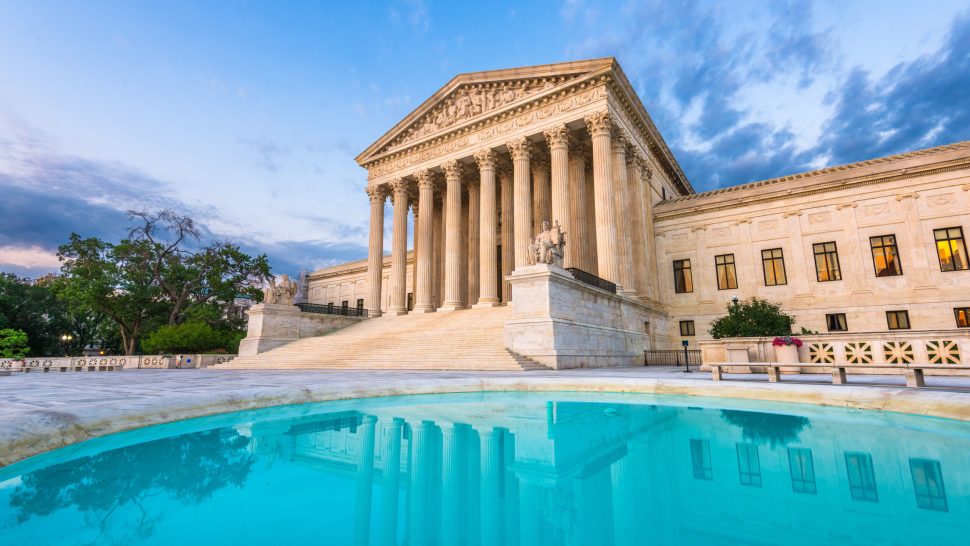
The list of amicus briefs filed in support of C.H. Robinson in the pending Supreme Court case over broker liability had a surprising entrant: the Trump administration.
Not only that, it’s going beyond just filing a brief (which it did).
The administration is also asking to make oral arguments in favor of C.H. Robinson when the case comes before the nine justices March 4. The office of Solicitor General D. John Sauer said in its request to the court filed Wednesday that C.H. Robinson has agreed to transfer 10 minutes of its allotted time for oral arguments.
The Solicitor General, an office currently held by D. John Sauer, argues the federal government’s case before the Supreme Court.
In his filing, Sauer says the involvement of the federal government in a case involving the Federal Aviation Administration Authorization Act (F4A), which is the issue before the court, is not unusual.
He cites several cases from 2013 and before that as instances where the federal government has argued in support of one of the goals of the F4A: keeping state regulatory and legal action away from the federal goals of deregulation of transportation, also known as preemption.
But the cases cited by Sauer do not include the more recent litigation that in just a few years’ time has resulted in conflicting decisions coming out of several circuits on the issue of broker liability when a carrier it hires is involved in an incident that ends up in court.
The current case before the court is Montgomery vs. Caribe. Effectively, however, it is Montgomery–a truck driver struck by another truck while standing on an Illinois highway–versus C.H. Robinson, as it was C.H. Robinson (NASDAQ: CHRW) that hired Caribe Transport, the carrier that was driving the vehicle that hit Montgomery.
The Seventh Circuit held that the so-called safety exception of F4A, which allows a state tort against a transportation company involved in interstate commerce, did not apply to brokers. C.H. Robinson as a result was severed as a defendant.
That decision lined up with the findings of Ye vs. GlobalTranz, where the same circuit court upheld a lower court decision shielding the broker under F4A. An 11th circuit decision in the case of Gauthier vs. TQL made a similar finding.
But the cases of Miller vs. C.H. Robinson and Cox vs. TQL found the safety exception could find a broker was guilty of negligence or liability and that it did not protect 3PLs. Those cases were all the focus of conflicting circuit court decisions just in the past few years.
Why the federal government is interested
“The United States has filed a brief as amicus curiae arguing that the FAAAA preempts petitioner’s claims because those claims fall within the scope of the express preemption rule in (F4A),” Sauer writes in his filing. The phrase in the safety exception that it is “with respect to motor vehicles,” Sauer writes, “lacks a sufficiently direct connection to the ownership or operation of the motor vehicles themselves.”
Whether “respect to motor vehicles” is a net that can haul in a broker is the essence of the question before the Supreme Court.
“The United States has a substantial interest in the resolution of the question presented here,” the filing adds. F4A was enacted, Sauer says, “to prevent States from undermining federal deregulation of the prices, routes, and services of motor carriers, brokers, and freight forwarders. The United States therefore has a substantial interest in an interpretation of (F4A) that protects and appropriately balances the Act’s deregulatory, pro-competitive purposes;
the federal government’s duties and responsibilities with respect to commercial motor vehicle safety; and the States’ safety regulatory authority.”
In its filing, Sauer said C.H. Robinson has agreed to give up 10 minutes of its time during the March 4 oral arguments. The 60 minutes would be divided up with 30 minutes for the attorneys representing Montgomery, 20 minutes for C.H. Robinson and 10 minutes for the solicitor general.
The full docket and all the briefs filed in the case can be found here.
TIA makes its case
Among the other amicus briefs in favor of C.H. Robinson filed with the court Wednesday was that of the brokers’ trade group, the Transportation Intermediaries Association.
Filed on behalf of the TIA by Marc Blubaugh and Nicholas Lacey of the Benesch Law Firm’s transportation practice, among the arguments the TIA makes is that considering a 3PL to be subject to a state action like a lawsuit is asking the industry to take on a role that is already the responsibility of a bigger entity: the federal government.
“No valid way exists for a broker to compare and contrast motor carrier safety records in any consistent and meaningful way in order to yield uniform outcomes necessary for efficient interstate commerce,” the TIA brief says. That argument is made under a subheading: The Practical Dilemma: What’s a Broker to Do?
The TIA argues that opening brokers to state litigation for an incident involving a carrier it booked would subject the 3PL industry to “myriad state and federal jurisdictions” that could all reach different conclusions.
If a broker were to be held liable for the hiring of an incompetent or reckless driver, “even if a broker wanted to second-guess a motor carrier’s decision to hire a particular driver, a broker does not have the tools to do so,” the TIA says. “Little imagination is required to understand how impractical it would be for a small broker employing a handful of employees to begin evaluating the hiring practices of tens of thousands of motor carriers across the country and to reach sound decisions as to whether the motor carrier has ‘safe enough’ hiring practices.”
‘No one knows’
Arguments have been made that brokers should somehow be familiar with or judge how a driver is trained. The TIA response: “How would a broker do so, and how often would such an evaluation need to occur before a broker would be deemed reasonable for tendering a load to the motor carrier? No one knows.”
A parallel argument has been that brokers should also be aware of a driver’s background. “However, a broker is not privy to the citations received by a given driver, a driver’s hours-of-service logs, the driver’s health status, or any other host of other data points that a motor carrier might take into consideration when deciding to keep a driver in its workforce,” the TIA writes. “A small broker cannot be expected to ask a motor carrier to share all of this private information with the broker (so that the broker can independently evaluate the driver’s competence) before the motor carrier assigns a driver to haul a given load.”
After several other examples of specific decision-making processes, the TIA sums up their members’ dilemma. “Brokers cannot pry into and evaluate all the minute operational details regarding a specific motor carrier. Requiring brokers to conceive somehow of every potential operational factor that could possibly implicate negligence under a given state’s tort law would require brokers to be omniscient.”
‘Interested Freight Brokers’
Another brief in support of C.H. Robinson was filed by a group that called itself “Interested Freight Brokers,” represented by trucking attorney Robert Moseley and other attorneys in the Moseley Marcinak Law Group.
The brokers represented by Moseley Marcinak are actually the brokerage units of several carriers: ArcBest (NASDAQ: ARCB), Anderson Trucking Service, CRST, J.B. Hunt (NASDAQ: JBHT), NFI Industries and Saia (NASDAQ: SAIA).
Although the brokerage units of these companies are under the corporate umbrella, Moseley argues that they are different in their operations. That difference is an argument in favor of having negligence findings against brokers preempted by F4A.
“Should this Court reverse the judgment of the lower courts, (the companies) will effectively have the same responsibilities for motor vehicle safety as brokers as they have as motor carriers,” the brief says. “Placing the same responsibilities on these distinct businesses is not only inconsistent with and preempted by the FMCSA, but it will also have a significant impact on the market efficiency gained by keeping these businesses distinct.”
More articles by John Kingston
Solicitor general urges Supreme Court not to review California AB5 case
In Flowers Foods drivers’ case, employee arbitration vs. litigation issue can’t be overlooked
Brokerage Compliance Symposium
The day before F3. Every compliance issue you face - fraud exposure, carrier liability, FMCSA rules, cargo theft, insurance gaps - navigated by attorneys and operators defining best practices in a changing industry.
F3 Awards Dinner
The night before F3. FreightTech100 companies honored. FreightTech 25 and Shipper of Choice winners revealed live. Cocktail reception into dinner and live music - 300 industry leaders in one purpose-built room.
F3: Future of Freight Festival
Industry-defining keynotes, rapid-fire technology demos, and industry leaders networking in experiences across Chattanooga - plus the inaugural F3 Awards Dinner featuring the FreightTech and Shipper of Choice reveals.
The day before F3. Every compliance issue you face - fraud exposure, carrier liability, FMCSA rules, cargo theft, insurance gaps - navigated by attorneys and operators defining best practices in a changing industry.
The Signal at Chattanooga Choo Choo • Chattanooga, TN Register NowThe night before F3. FreightTech100 companies honored. FreightTech 25 and Shipper of Choice winners revealed live. Cocktail reception into dinner and live music - 300 industry leaders in one purpose-built room.
The Signal at Chattanooga Choo Choo • Chattanooga, TN Register NowIndustry-defining keynotes, rapid-fire technology demos, and industry leaders networking in experiences across Chattanooga - plus the inaugural F3 Awards Dinner featuring the FreightTech and Shipper of Choice reveals.
The Signal at Chattanooga Choo Choo • Chattanooga, TN Register Now