




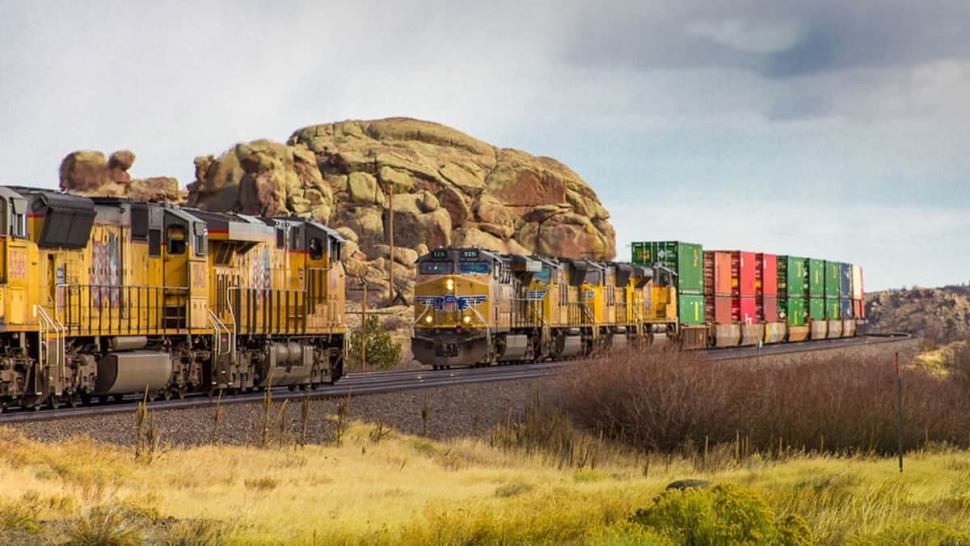
Union Pacific (NYSE: UNP) is shifting how it categorizes commodities for its sales and marketing efforts.
Effective Jan. 1, 2020, Union Pacific (UP) will consolidate its business groups from four to three: bulk, industrial and premium, the company said on Dec. 10.
Coal, petroleum coke products and agricultural products will form the bulk business group, while liquefied petroleum gas (LPG), petroleum and sand products will move to the industrial business group. The premium group, which consists of UP’s automotive and intermodal segments, will remain as is.
Coal, LPG, petroleum, petroleum coke and sand have been part of UP’s energy business group.
“This new structure will allow us to better serve our customers while helping Union Pacific remain agile to market conditions,” said Kenny Rocker, UP’s executive vice president for marketing and sales.
Earlier this fall, UP also announced changes to its sales and marketing teams.
UP’s category shifts come as the railroad has seen lower rail volumes in 2019, just like its peers, and as the company implements Unified Plan 2020, its version of precision scheduled railroading.
UP executives said at recent investor conferences that the railroad plans to develop its domestic intermodal business, as well as take advantage of steady auto demand, the impending boom in plastics production and potential growth in residential and industrial construction.
“We think [domestic intermodal is] vastly under-penetrated in general by the rails and certainly by Union Pacific,” said Jennifer Hamann, UP’s incoming chief financial officer, at a Nov. 14 investor conference.
Brokerage Compliance Symposium
The day before F3. Every compliance issue you face - fraud exposure, carrier liability, FMCSA rules, cargo theft, insurance gaps - navigated by attorneys and operators defining best practices in a changing industry.
F3 Awards Dinner
The night before F3. FreightTech100 companies honored. FreightTech 25 and Shipper of Choice winners revealed live. Cocktail reception into dinner and live music - 300 industry leaders in one purpose-built room.
F3: Future of Freight Festival
Industry-defining keynotes, rapid-fire technology demos, and industry leaders networking in experiences across Chattanooga - plus the inaugural F3 Awards Dinner featuring the FreightTech and Shipper of Choice reveals.
The day before F3. Every compliance issue you face - fraud exposure, carrier liability, FMCSA rules, cargo theft, insurance gaps - navigated by attorneys and operators defining best practices in a changing industry.
The Signal at Chattanooga Choo Choo • Chattanooga, TN Register NowThe night before F3. FreightTech100 companies honored. FreightTech 25 and Shipper of Choice winners revealed live. Cocktail reception into dinner and live music - 300 industry leaders in one purpose-built room.
The Signal at Chattanooga Choo Choo • Chattanooga, TN Register NowIndustry-defining keynotes, rapid-fire technology demos, and industry leaders networking in experiences across Chattanooga - plus the inaugural F3 Awards Dinner featuring the FreightTech and Shipper of Choice reveals.
The Signal at Chattanooga Choo Choo • Chattanooga, TN Register Now