




United Parcel Service parcel volumes fell during the second quarter as it completed the phase out of low-margin Amazon business, but revenue per piece and profits increased behind a focus on premium shipments, efficiency gains, and strong pricing amid ongoing economic volatility.
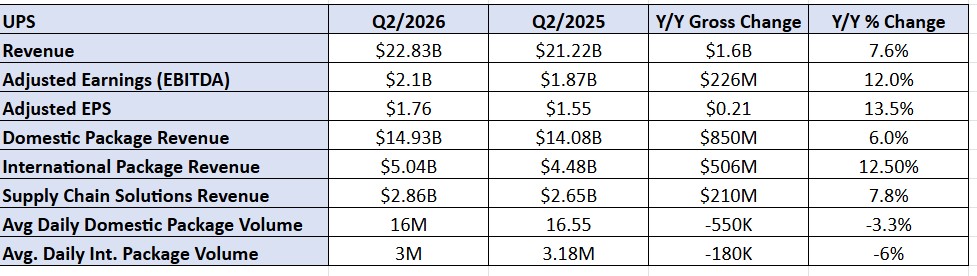
The integrated parcel and logistics giant on Tuesday reported revenues of $22.8 billion, up 7.6% year over year, with adjusted operating profit increasing 12% to $2.1 billion, or $1.76 per share, delivering a modest beat of analyst expectations. Management raised full-year guidance 2% for revenue, now expected at $91.2 billion, and adjusted operating profit plus 0.5% to $8.6 billion.
UPS (NYSE: UPS) has worked with Amazon over 18 months to eliminate unprofitable shipments from its network, which accounted for half the volume tendered by the retail marketplace — its largest customer. In total, UPS eliminated 2 million pieces per day of Amazon volume and $4.5 billion in related expenses. The drawdown, along with slower overall parcel demand, led UPS to initiate a network reconfiguration aimed at aligning capacity with market demand. The initiative involved closing 150 parcel sort facilities, eliminating 30,000 positions and 50 million labor hours, and adding technology to improve the throughput of existing distribution stations.
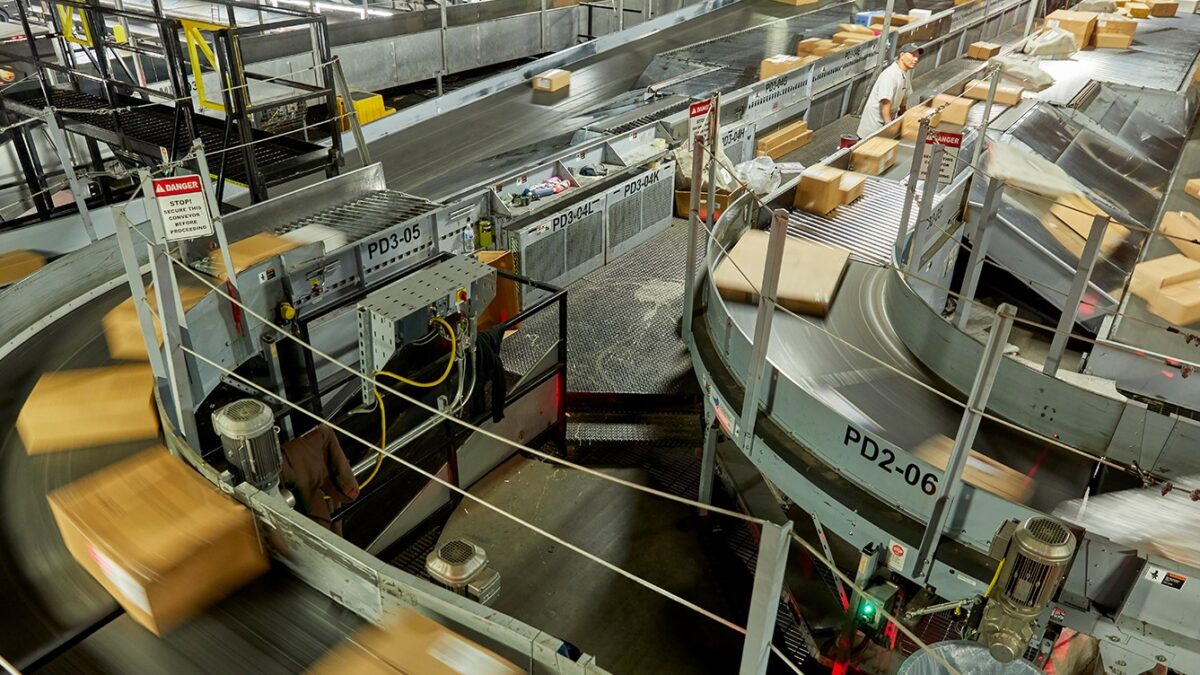
The company closed 45 buildings in the first half of 2025, with several additional closures planned in the second half, CFO Brian Dykes said on a conference call with analysts. By the end of June, 68.5% of U.S. volume flowed through an automated facility compared to 64% the year prior. The cost per piece in an automated handling facility is about 28% lower than a conventional facility with mechanical systems, which spreads out unit costs and drives operating leverage.
“That gives us confidence in the productivity that we should continue to deliver going forward,” he said.
Management previously identified a total of 51 facility closures this year.
Amazon is still responsible for about 9% of UPS revenue, down a point from last year and from 13% during the Covid e-commerce boom. The goal now is to optimize the remaining Amazon volume across the various air and ground modes.
“This reconfiguration was never the destination. It was the foundation. We now have a leaner, more automated, more agile network that will deliver operating leverage as volume grows. And importantly, incremental volume today carries materially better economics than before because of the structural changes we’ve made,” CEO Carol Tomé emphasized.
UPS shares closed down 6.5% to $105.53 at market close, suggesting investor wariness about the below-consensus second-half guidance heading into peak season, along with lower domestic margins versus the second quarter and larger-than-expected volume losses. But the price turned slightly positive in after-hours trading.
Analysts said long-term risks to the stock’s growth include growing competition from Amazon and other last-mile couriers, Amazon pulling remaining volumes, and a looming negotiation with the Teamsters union on a new contract for 2028.
UPS Supply Chain Solutions posted a 7.8% increase in revenue to $2.86 billion, highlighting the company’s continued activity in contract logistics as rival FedEx prepares to sell its supply chain unit to Ceva Logistics.
Results were weighed down by an $891 million charge for employee separation costs associated with a voluntary program that encouraged 7,500 drivers to leave the company as part of the company’s network streamlining effort. About 80% of participating drivers departed the company in the second quarter.
Stronger pricing came from a combination of higher base rates and broad application of fees and surcharges. The TD/Cowen Freight Index quantified how fuel surcharges, higher billed weight per parcel and other fees increased prices for ground and expedited shippers at FedEx and UPS during the quarter. UPS officials maintained that higher fuel costs negated most of the revenue increase from fuel surcharges, with international margins more impacted by fuel because there is more air volume flying longer distances, making it a larger portion of the cost base.
Domestic package revenue increased 6%, driven by a 9.3% increase in revenue per piece, while volume declined 3.3%. When adjusting for the exit from Amazon and other low-yield delivery accounts, average daily volume actually grew in the second quarter.
International
International package revenue increased 12.5% with a 19% increase in revenue per piece as volume fell 5.8%. But international operating profit slipped 7.2% to $623 million because of higher fuel costs and extra expenses associated with having to adjust the air network to avoid the Middle East conflict zone, including contracting with third-party cargo airlines with existing permissions to fly to new destinations in the region.
The decline in international volume was led by domestic declines in Europe, with cross-border volumes decreasing 4.2% year over year. On a positive note, volumes grew on the China-U.S. trade lane as the effects from last year’s U.S. cancellation of duty-free access for de minimis e-commerce shipments reset the market, CFO Brian Dykes said.
Earlier this month, UPS opened a new operations center in Kaohsiung to support growing customer demand for premium international logistics services in southern Taiwan. The new facility doubles the size and package processing capacity of UPS’s operations, providing customers in Gangshan Industrial Park, Gangshan Beizhou Industrial Park, Nanzi Technology Park and Renwu Industrial Park — where semiconductor and technology manufacturers are concentrated — with better access to UPS’s end-to-end global logistics network. They also benefit from an up to three-hour extension in pickup cutoff times for exports to the United States, according to a company news release.
In March, UPS opened its largest logistics center in Asia Pacific, in Taiwan which features advanced automation technology and sophisticated storage and warehouse management solutions.
Go premium
UPS, like FedEx, is ceding ground in last-mile delivery for large e-commerce retailers to focus on premium segments that require more complex logistics actions and command higher yields, such as small-and-medium businesses, healthcare, industrial and automotive. In the second quarter, B2B volume represented 44% of total U.S. volume.
A key to retaining and winning higher-margin customers is the development of capabilities that enable UPS to provide differentiated service rather than competing on price, executives explained.
Small-business package volumes grew 4.3% during the quarter and the Digital Access Program generated $1.4 billion in global revenue, marking the third consecutive quarter of producing more than $1 billion. DAP is a partnership between UPS and shipping platforms like Shopify and EasyPost that extends UPS’s discounted, enterprise-level rates, typically reserved for high-volume shippers, to businesses of any size without complex contracts or big monthly commitments.
Healthcare logistics revenue topped $3 billion for the second quarter in a row, putting the run rate at $12 billion for the year. FedEx, by comparison, had about $10 billion in revenue from healthcare-related services during the fiscal year ended May 31. In the past two years, UPS invested $48 million to open 27 refrigerated truck cross-dock facilities around the world to meet rising demand from pharmaceutical companies, medical labs and biotech companies for temperature-controlled transport and storage of sensitive products.
Management said its continued investment in radio frequency identification and artificial intelligence technology will drive future growth, and attract new customers, by allowing it to mine sensor data and map it against digital twins of vehicles, aircraft, facilities and package flow, allowing managers to immediately adapt to weather delays, updated volume forecasts or other changing conditions.
In April, UPS said it had completed installation of RFID sensors on every package van, following deployment in last-mile terminals and UPS Store locations, becoming the first major logistics provider to roll out RFID technology at scale across an integrated network. The company said then that it will begin outfitting regional sortation hubs with the tracking technology, which eliminates the need for workers to use handheld scanners to capture package movements.
Tomé said UPS is now rolling out RFID to international facilities and enabling customers with RFID printers to print RFID labels.
“We believe RFID is the most significant package visibility advancement in a decade,” she said.
The CEO described how UPS was able to capture a high-end retailer from a competitor because of the ability to provide RFID labeling at origin.
“Why? Because at the previous carrier’s location, they had to have security guards watch every scan occur as packages were being loaded onto the package carrier vehicle. At our location, we don’t need security guards any longer. And we have visibility from the point of origin to the point of destination. That allowed us to win that high end jeweler,” she said.
Other capabilities that help UPS stand out include cold chain logistics, time-definite delivery and managing returns through subsidiary Happy Returns and the UPS Stores, Tomé added, downplaying any potential threat from Amazon’s recent evolution into a provider of third-party, end-to-end logistics solutions.
“If we do a side by side comparison, where they have strengths would be on lightweight short-zone urban delivery. Where we have strengths is every other place. We’re going to lean into the parts of the market capabilities that we will do better than anybody else,” she stressed.
Segment outlook
Management expects U.S. domestic operating margin for the full year to reach 8.8%, reflecting margin growth in the back half. International is poised to see revenue growth in the mid-single digits year over year, with operating margin in the mid-teens. Supply Chain Solutions is projected to have low-double digit revenue growth with operating margin of about 10.5%.
Click here for more FreightWaves/American Shipper stories by Eric Kulisch.
Write to Eric Kulisch at ekulisch@freightwaves.com.
RELATED STORIES:
DHL eCommerce to acquire Baltic parcel carrier Venipak
UPS explores outsourcing UK parcel delivery to third-party couriers
UPS upgrades service level for US-Mexico industrial shippers
Brokerage Compliance Symposium
The day before F3. Every compliance issue you face - fraud exposure, carrier liability, FMCSA rules, cargo theft, insurance gaps - navigated by attorneys and operators defining best practices in a changing industry.
F3 Awards Dinner
The night before F3. FreightTech100 companies honored. FreightTech 25 and Shipper of Choice winners revealed live. Cocktail reception into dinner and live music - 300 industry leaders in one purpose-built room.
F3: Future of Freight Festival
Industry-defining keynotes, rapid-fire technology demos, and industry leaders networking in experiences across Chattanooga - plus the inaugural F3 Awards Dinner featuring the FreightTech and Shipper of Choice reveals.
The day before F3. Every compliance issue you face - fraud exposure, carrier liability, FMCSA rules, cargo theft, insurance gaps - navigated by attorneys and operators defining best practices in a changing industry.
The Signal at Chattanooga Choo Choo • Chattanooga, TN Register NowThe night before F3. FreightTech100 companies honored. FreightTech 25 and Shipper of Choice winners revealed live. Cocktail reception into dinner and live music - 300 industry leaders in one purpose-built room.
The Signal at Chattanooga Choo Choo • Chattanooga, TN Register NowIndustry-defining keynotes, rapid-fire technology demos, and industry leaders networking in experiences across Chattanooga - plus the inaugural F3 Awards Dinner featuring the FreightTech and Shipper of Choice reveals.
The Signal at Chattanooga Choo Choo • Chattanooga, TN Register Now