




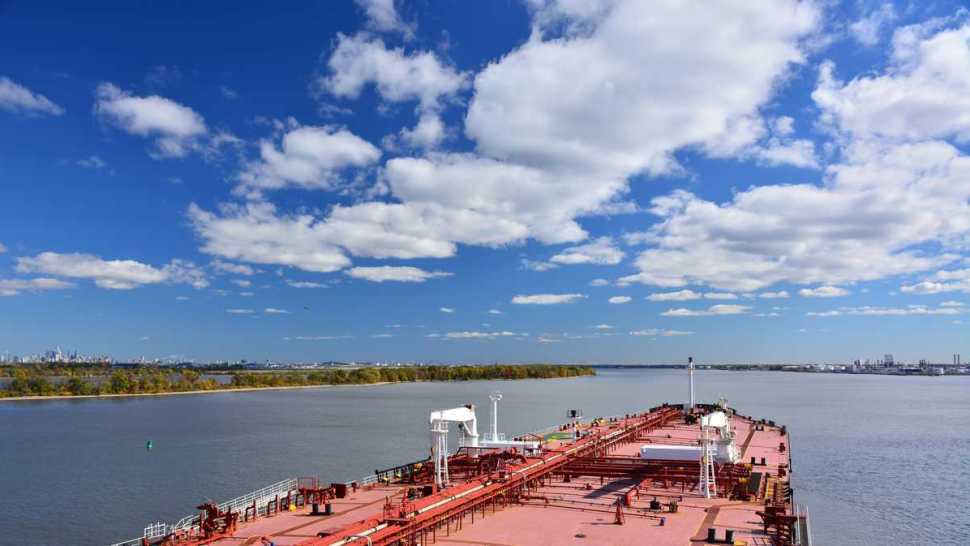
The U.S. Department of Transportation (DOT) is assessing whether American tankers can meet emergency fuel demands caused by the Colonial Pipeline shutdown or if foreign ships will be needed to help fill the gap.
“The Biden-Harris administration is continually assessing the impact of the ongoing Colonial Pipeline incident on fuel supplies for the East Coast and is monitoring reported shortages in parts of the Southeast,” DOT stated Tuesday. “This ongoing effort includes evaluating resources the federal government can mobilize to mitigate potential impacts.”
One of those resources is the U.S. domestic tanker fleet, of which there are 57, according to the latest data from the U.S. Maritime Administration (MarAd). If MarAd determines that there is not enough capacity available to move the needed fuel supplies, the administration will consider waiving the Jones Act, allowing foreign ships to step in.
The Jones Act requires vessels moving between U.S. ports be built, flagged and crewed in the United States.
After MarAd conducts a survey of Jones Act-qualified ships, the Department of Homeland Security, through Customs and Border Protection, has the authority to receive and approve waivers.
Vortexa, an energy analyst group, pointed out that Jones Act waivers can be provided to foreign tankers originally destined for international destinations that could then be rerouted to U.S. ports.

“We count about 10 tankers that have recently left the U.S. Gulf Coast for southern destinations that could in theory be rerouted,” the company stated in a research note on Monday. “In general, the U.S. oil industry tends to support these waiver requests during oil market disruptions, while the U.S. shipping industry has usually opposed them.”
The American Maritime Partnership (AMP), which lobbies on behalf of preserving the Jones Act, took issue with allowing waivers. US domestic shipping “has capacity available and the experience to transport refined products to help alleviate the distribution issues along the Colonial Pipeline, and is working with key energy stakeholders and policymakers to be part of the solution,” commented AMP President Mike Roberts.
DOT also revealed that the Federal Motor Carrier Safety Administration (FMCSA), which issued an emergency work-rule waiver on Sunday to allow trucks to help move emergency supplies over the highways, is working with the Federal Highway Administration (FHWA) to assess the addition of weight waivers in Georgia and North Carolina.
“Other states are considering similar action,” DOT stated. “FMCSA and FHWA are working with the full list of potentially affected states to share information and best practices and try to harmonize and align their efforts.”
The Federal Railroad Administration is also conducting a capacity assessment, DOT confirmed. “FRA is canvassing rail operators to determine their capacity to help transport fuel from ports inland and if there are additional steps FRA could do to help them increase capacity to do this. They are also engaging industry to identify trends indicating capacity pressures.”
Related articles:
Brokerage Compliance Symposium
The day before F3. Every compliance issue you face - fraud exposure, carrier liability, FMCSA rules, cargo theft, insurance gaps - navigated by attorneys and operators defining best practices in a changing industry.
F3 Awards Dinner
The night before F3. FreightTech100 companies honored. FreightTech 25 and Shipper of Choice winners revealed live. Cocktail reception into dinner and live music - 300 industry leaders in one purpose-built room.
F3: Future of Freight Festival
Industry-defining keynotes, rapid-fire technology demos, and industry leaders networking in experiences across Chattanooga - plus the inaugural F3 Awards Dinner featuring the FreightTech and Shipper of Choice reveals.
The day before F3. Every compliance issue you face - fraud exposure, carrier liability, FMCSA rules, cargo theft, insurance gaps - navigated by attorneys and operators defining best practices in a changing industry.
The Signal at Chattanooga Choo Choo • Chattanooga, TN Register NowThe night before F3. FreightTech100 companies honored. FreightTech 25 and Shipper of Choice winners revealed live. Cocktail reception into dinner and live music - 300 industry leaders in one purpose-built room.
The Signal at Chattanooga Choo Choo • Chattanooga, TN Register NowIndustry-defining keynotes, rapid-fire technology demos, and industry leaders networking in experiences across Chattanooga - plus the inaugural F3 Awards Dinner featuring the FreightTech and Shipper of Choice reveals.
The Signal at Chattanooga Choo Choo • Chattanooga, TN Register Now