





Improved revenues from price increases and lower costs helped the U.S. Postal Service in reducing its fiscal second-quarter deficit from the prior year by 24% despite a slowdown in mail and parcel volumes.
The postal organization on Friday reported an operating loss of $642 million, a significant year over year improvement. The net loss, which includes certain mandated obligations outside management’s control also fell — to $2 billion from $3.3 billion. The Postal Service attributed the decreased loss to a $463 million revenue gain and a $1.3 billion cut in workers compensation expense, partly offset by an increase in retiree health benefits and other operating expenses.
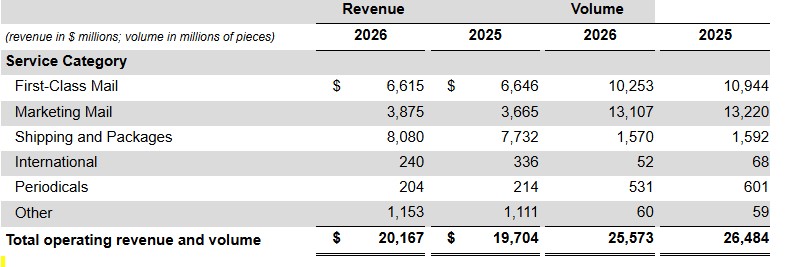
Total operating revenue was $20.2 billion for the quarter, an increase of 2.3%, compared to the same quarter last year. The increase was largely due to price increases in parcel shipping, marketing mail and First-Class mail.
Shipping and Packages revenue increased $348 million, or 4.5%, on a volume decline of 22 million pieces, or 1.4%. First-Class mail volume fell 6.3%. And parcel volumes likely will continue to decline after Amazon recently re-enlisted for last-mile postal delivery, but said it would hand over about 20% less volume than in recent years.
“During the quarter we were able to get revenue, cost and service results moving in the right direction,” said Postmaster General David Steiner in a statement. “However, the scale of our financial improvements compared to the prior year was modest and we have a long road [ahead] to achieve anything close to long-term financial sustainability. It is a simple fact that we are in a cash crisis, and we are now taking serious and appropriate steps to conserve funds to operate. To avoid disruption and to sustain our role supporting American commerce and the public, we require urgent Congressional action to expand our borrowing authority and to address outdated constraints on the organization.”
The USPS has a statutory debt limit of $15 billion, pays a disproportionate share of pension coverage compared to private companies, is subject to antiquated workers’ compensation requirements and can only invest retirement funds in Treasury notes. Management again pressed the Postal Regulatory Commission to eliminate the price cap on mail or allow other rate adjustments so the agency can capture more revenue.
Steiner warned Congress in March that the Postal Service could run out of money by next spring, citing the increase in digital communication that has caused a 50% drop in mail volume, costly policy mandates and the universal service obligation. Officials say a decision is pending on whether to exercise a Postal Regulatory Commission waiver on certain pension payment obligations so the money can be used for operations and capital expenses. The Postal Service also temporarily suspended retirement contributions to the federal retirement fund, which is expected to conserve $2.5 billion in cash for the remainder of the fiscal year and help maintain liquidity.
The postmaster general reiterated that Congress has two options: allow the Postal Service to reduce service levels and charge higher rates so it can become profitable or provide subsidies, what he called a “public service reimbursement.”
But Steiner isn’t laying all the blame on Congress, saying there is much the Postal Service needs to do on its own to become a financially sustainable organization. The USPS, for example, plans to raise mail and package prices by 4.8% in July and recently implemented an 8% transportation surcharge on all parcels, largely in response to higher fuel prices triggered by the Iran war. It has cut hundreds of millions of dollars in transportation, operations and labor costs. And it recently launched an auction for e-commerce shippers to bid on last-mile delivery, part of an effort to grow volume and revenue.
“I continue to believe the market wants to do business with a postal service that is competitive, responsive and easier to work with. And we’re seeing movement in that direction through major commercial relationships and partnership opportunities. We’ve seen encouraging developments in certain key customer relationships, including Amazon and DHL,” Steiner said during a presentation to the postal board of governors.
“How do we become easier to do business with? How do we fit our network to customer needs? How do we create more value from the assets that we’ve built? If we’re going to grow, we have to be more responsive, more transparent, more market aware, and less burdened by unnecessary friction. That is why we’re working to ensure that our network responds to the needs of our customers rather than forcing customers to fit the wants of our bureaucracy,” he added.
Keep US Posted, an advocacy group of nonprofits, newspapers, greeting card publishers, catalogs and other small businesses, said in a news release that the Postal Service’s main problem is spending and productivity, not revenue. It urged Congress not to provide financial relief that doesn’t include spending reforms.
“Raising the Postal Service’s borrowing authority or providing funds without guardrails would be a blank check that only delays the inevitable collapse of the agency’s finances and leads to a massive taxpayer bailout. USPS has already maxed out its borrowing, which is currently capped at $15 billion. Given that it faces $8 billion in projected losses this year, even doubling its borrowing authority would buy months, not years, without key reforms,” said Executive Director Kevin Yoder. “USPS needs help from Congress, but any financial assistance should be tied to a CPI-based price cap, stronger Postal Regulatory Commission oversight, and measurable cost controls that protect universal service and affordability.”
Click here for more FreightWaves/American Shipper stories by Eric Kulisch.
Write to Eric Kulisch at ekulisch@freightwaves.com.
RELATED STORIES:
Maine lawmakers press USPS over $350K default to rural air carrier
Postal service can proceed with 8% parcel surcharge, regulator says
Troubled Postal Service moves to raise stamp prices, conserve cash
Brokerage Compliance Symposium
The day before F3. Every compliance issue you face - fraud exposure, carrier liability, FMCSA rules, cargo theft, insurance gaps - navigated by attorneys and operators defining best practices in a changing industry.
F3 Awards Dinner
The night before F3. FreightTech100 companies honored. FreightTech 25 and Shipper of Choice winners revealed live. Cocktail reception into dinner and live music - 300 industry leaders in one purpose-built room.
F3: Future of Freight Festival
Industry-defining keynotes, rapid-fire technology demos, and industry leaders networking in experiences across Chattanooga - plus the inaugural F3 Awards Dinner featuring the FreightTech and Shipper of Choice reveals.
The day before F3. Every compliance issue you face - fraud exposure, carrier liability, FMCSA rules, cargo theft, insurance gaps - navigated by attorneys and operators defining best practices in a changing industry.
The Signal at Chattanooga Choo Choo • Chattanooga, TN Register NowThe night before F3. FreightTech100 companies honored. FreightTech 25 and Shipper of Choice winners revealed live. Cocktail reception into dinner and live music - 300 industry leaders in one purpose-built room.
The Signal at Chattanooga Choo Choo • Chattanooga, TN Register NowIndustry-defining keynotes, rapid-fire technology demos, and industry leaders networking in experiences across Chattanooga - plus the inaugural F3 Awards Dinner featuring the FreightTech and Shipper of Choice reveals.
The Signal at Chattanooga Choo Choo • Chattanooga, TN Register Now