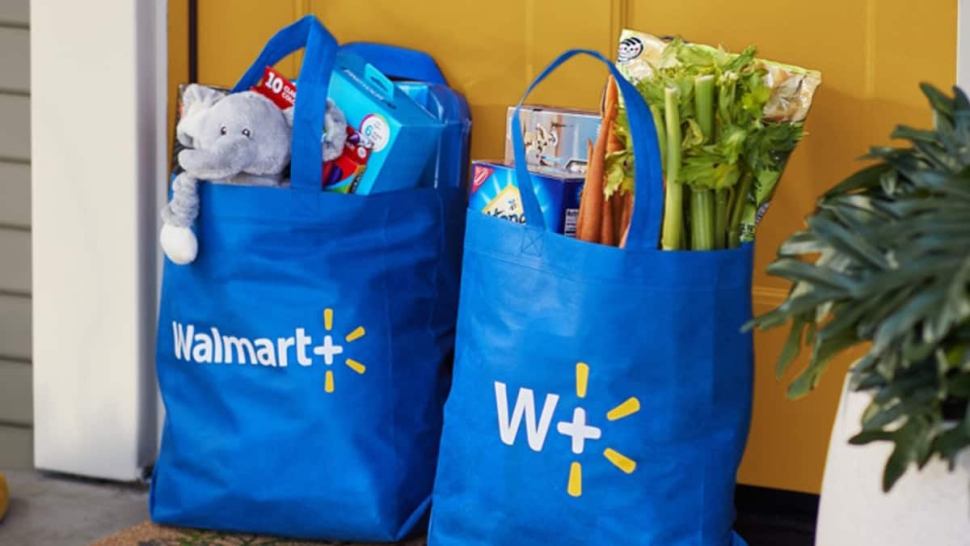
Walmart Inc. (NYSE:WMT) said Wednesday that it will lift its $35 minimum order requirement for members of its new Walmart+ service to qualify for unlimited free shipping.
The new feature, which launches Friday, means that Walmart+ members will receive free next-day and two-day shipping regardless of the dollar value of their orders, the Bentonville, Arkansas-based retail giant said. Prices for the item will remain the same, the company said.
Launched at the end of September, Walmart+ offers free unlimited same-day deliveries on groceries and general merchandise. However, there had been a $35 order minimum to be eligible for free shipping under the program.
The Walmart+ program, which costs members $98 a year or $12.95 per month, represented an expansion of a pure e-grocery delivery program that Walmart launched late last year. The service was launched at a lower price point than Amazon Prime, Amazon.com Inc.’s (NASDAQ:AMZN) successful online offering, which costs $119 a year for unlimited one- and two-day shipping, and offers same-day deliveries for an additional fee. However, Amazon Prime members have access to millions of items on Amazon’s site. About 160,000 items were available for same-day deliveries under Walmart+ when the program began.
The Walmart+ service is unlikely to pose a competitive threat to Amazon, and Walmart executives have never positioned it in such a way.
The launch was primarily aimed at countering moves made by multiple retailers, including Amazon, into online grocery fulfillment and delivery, a fast-growing though still relatively small segment of the total e-commerce landscape. Walmart generates about 55% of its revenue from groceries, according to industry estimates.
Online grocery will swell to 21.5% of total U.S. grocery sales by 2025, more than doubling its current share of the overall grocery market, a recent study by grocery e-commerce specialist Mercatus and research firm Incisiv has projected.
For 2020, online grocery’s percentage of the $1.04 trillion grocery market is pegged at 10.2%, or about $106 billion, up from 3.4%, or $34.54 billion, of the $1.02 billion market in 2019, according to the study. By 2025, online grocery’s dollar share stands to climb to $250.26 billion of the estimated $1.16 trillion overall grocery market.
Brokerage Compliance Symposium
The day before F3. Every compliance issue you face - fraud exposure, carrier liability, FMCSA rules, cargo theft, insurance gaps - navigated by attorneys and operators defining best practices in a changing industry.
F3 Awards Dinner
The night before F3. FreightTech100 companies honored. FreightTech 25 and Shipper of Choice winners revealed live. Cocktail reception into dinner and live music - 300 industry leaders in one purpose-built room.
F3: Future of Freight Festival
Industry-defining keynotes, rapid-fire technology demos, and industry leaders networking in experiences across Chattanooga - plus the inaugural F3 Awards Dinner featuring the FreightTech and Shipper of Choice reveals.
The day before F3. Every compliance issue you face - fraud exposure, carrier liability, FMCSA rules, cargo theft, insurance gaps - navigated by attorneys and operators defining best practices in a changing industry.
The Signal at Chattanooga Choo Choo • Chattanooga, TN Register NowThe night before F3. FreightTech100 companies honored. FreightTech 25 and Shipper of Choice winners revealed live. Cocktail reception into dinner and live music - 300 industry leaders in one purpose-built room.
The Signal at Chattanooga Choo Choo • Chattanooga, TN Register NowIndustry-defining keynotes, rapid-fire technology demos, and industry leaders networking in experiences across Chattanooga - plus the inaugural F3 Awards Dinner featuring the FreightTech and Shipper of Choice reveals.
The Signal at Chattanooga Choo Choo • Chattanooga, TN Register Now