Walmart’s $152 million purchase of a massive warehouse complex in Glendale is emerging as a big trend for Arizona’s fast-growing commercial logistics real estate market, underscoring the state’s evolution into a key distribution hub for the U.S. Southwest.
The retail giant recently purchased a 1.27-million-square-foot building in a three-building complex totaling 2.4-million-square-foot. It was on of the largest industrial property sales in metro Phoenix in 2025.
The Luke Field site is designed for high-volume warehousing, distribution and potential automation, with direct access to Interstate 10 and Loop 101 in Phoenix’s West Valley submarket.
“Its prime location makes Luke Field a logistics powerhouse. We appreciate the trust being placed in this building by our first official tenant, and look forward to ongoing success as we continue to field strong prospect interest in the project’s remaining available buildings,” Lincoln Property Co. executive vice president John Orsak said in a news release.
With highway and rail connectivity, proximity to California ports and Mexico trade lanes, and a fast-growing consumer base, Arizona is increasingly competing with legacy logistics hubs for large-scale distribution and fulfillment investment, according to officials at Lincoln Property Co.
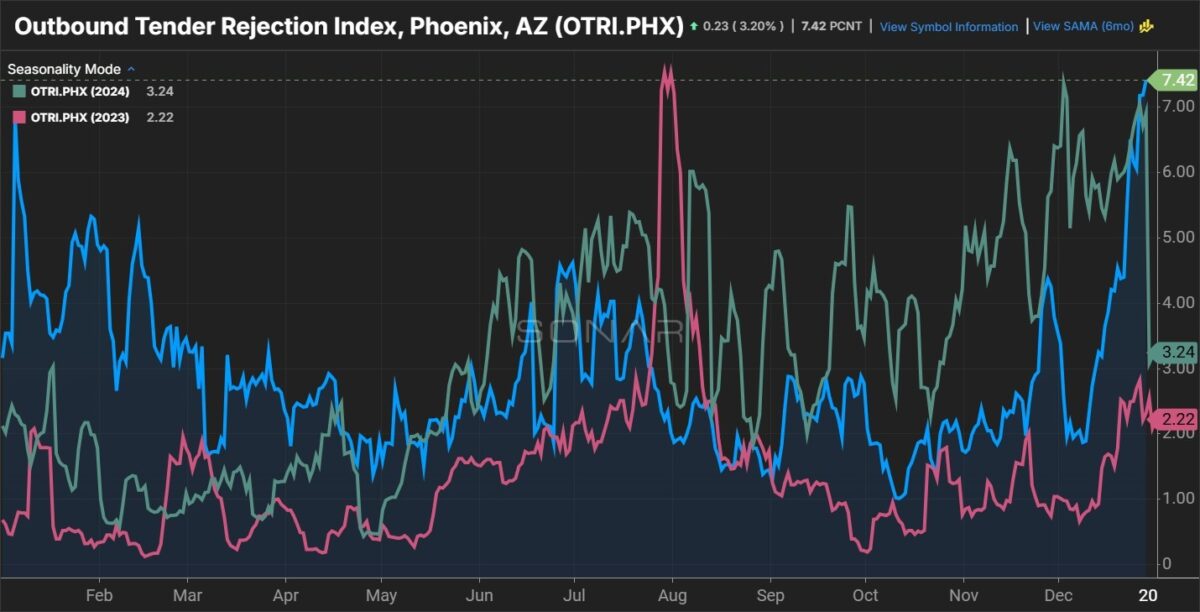
As of Monday, SONAR’s Outbound Tender Rejection Index (OTRI) for the Phoenix market stood at 7.42%, rising week over week and signaling potential tightening in local trucking capacity. The increase suggests carriers are becoming more selective as prolonged low rates continue to push marginal operators out of the market.
While tender rejections are climbing, outbound volumes in Phoenix have remained relatively flat or declined compared with the same period in 2024 and 2023. That divergence points to a shifting balance of power, with carriers gaining leverage despite muted demand — an early indication that spot rates could begin moving higher and the shipper-friendly environment may be fading.
Industrial development accelerates around Phoenix
Walmart’s purchase comes amid a wave of new industrial construction across the Phoenix area, particularly in submarkets tied to advanced manufacturing and semiconductor investment.
In north Phoenix’s Deer Valley area, ViaWest Group and Barings have broken ground on ReDiscover Logistics Park, an 808,448-square-foot Class A industrial development targeting suppliers, manufacturers and distributors serving Arizona’s expanding chip ecosystem, In Business Magazine reported.
The site sits around 15 minutes from Taiwan Semiconductor Manufacturing Co.’s multibillion-dollar fabrication campus, positioning it as a logistics hub for high-value, time-sensitive freight.
Last-mile and logistics firms follow region’s growth
Arizona’s population growth and industrial build-out are also drawing logistics service providers focused on speed and specialization.
Jet Delivery, a 75-year-old same-day and time-critical logistics provider, recently launched Phoenix operations, citing demand from healthcare, manufacturing, aerospace, tech and e-commerce customers for reliable last-mile coverage in the rapidly expanding metro area.
At the same time, Phoenix-based startup Speedora has entered the market with an asset-owned, white-glove delivery model for big and bulky freight, targeting retailers frustrated with damage claims and broker-heavy networks.
The company said Arizona’s growth and proximity to Southern California make it an ideal launchpad for regional expansion, according to a news release.
Specialized logistics firms are also scaling up alongside Phoenix’s industrial real estate boom. RK Logistics Group recently opened an 80,000-square-foot, temperature-controlled warehouse in Tempe, doubling its Phoenix-area footprint to nearly 158,000 square feet to support semiconductor, electric vehicle and renewable energy customers.
Company executives pointed to proximity to Sky Harbor International Airport, interstate highways and rail intermodal facilities as key advantages, reinforcing metro Phoenix’s growing role as a hub for high-value, time-sensitive freight.
Rail investment strengthens Arizona’s freight backbone
Infrastructure investment is reinforcing Arizona’s appeal as a logistics destination. Union Pacific recently completed a major expansion of its Casa Grande Yard west of Tucson, doubling capacity and adding new tracks, industrial leads and signal upgrades along the railroad’s Sunset Route.
The yard serves local industries and supports manifest freight moving across the Southwest.
Rail capacity upgrades are critical to handling growing inbound materials and outbound finished goods tied to manufacturing growth across the state, particularly as shippers seek alternatives to congested coastal gateways.
Brokerage Compliance Symposium
The day before F3. Every compliance issue you face - fraud exposure, carrier liability, FMCSA rules, cargo theft, insurance gaps - navigated by attorneys and operators defining best practices in a changing industry.
F3 Awards Dinner
The night before F3. FreightTech100 companies honored. FreightTech 25 and Shipper of Choice winners revealed live. Cocktail reception into dinner and live music - 300 industry leaders in one purpose-built room.
F3: Future of Freight Festival
Industry-defining keynotes, rapid-fire technology demos, and industry leaders networking in experiences across Chattanooga - plus the inaugural F3 Awards Dinner featuring the FreightTech and Shipper of Choice reveals.
The day before F3. Every compliance issue you face - fraud exposure, carrier liability, FMCSA rules, cargo theft, insurance gaps - navigated by attorneys and operators defining best practices in a changing industry.
The Signal at Chattanooga Choo Choo • Chattanooga, TN Register NowThe night before F3. FreightTech100 companies honored. FreightTech 25 and Shipper of Choice winners revealed live. Cocktail reception into dinner and live music - 300 industry leaders in one purpose-built room.
The Signal at Chattanooga Choo Choo • Chattanooga, TN Register NowIndustry-defining keynotes, rapid-fire technology demos, and industry leaders networking in experiences across Chattanooga - plus the inaugural F3 Awards Dinner featuring the FreightTech and Shipper of Choice reveals.
The Signal at Chattanooga Choo Choo • Chattanooga, TN Register Now