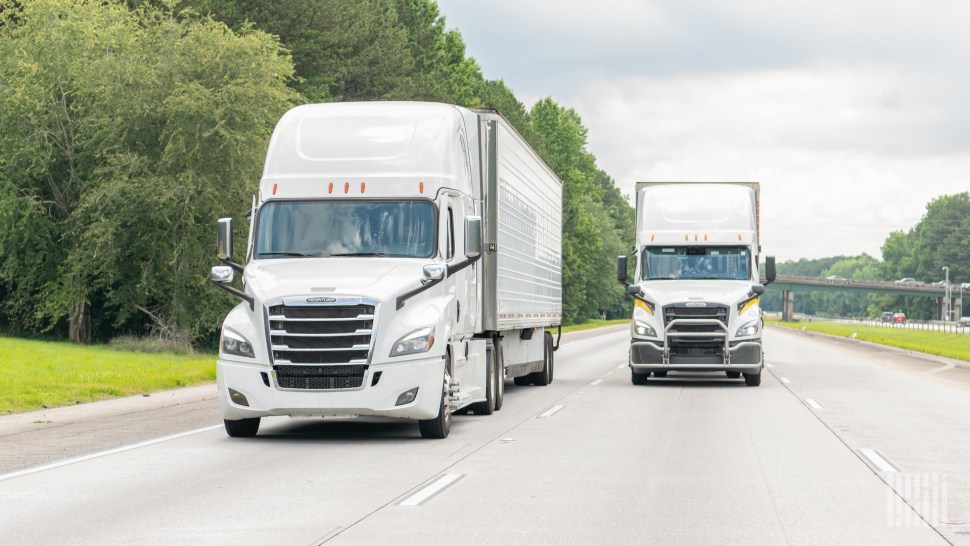

In beer, making the product is only half the challenge; the other half is delivering within strict windows without sacrificing quality or budget. To tackle this challenge, Stone Brewing partnered with Flock Freight to add Shared Truckload (STL) to a blended transportation strategy, cutting spend on underutilized truckloads by 23%, while maintaining 99% on-time pickup and 97% on-time delivery, and eliminating 195 metric tons of CO2e in the first year.
“With Flock, we’ve seen a positive impact on our service KPIs and customer experience. With greater flexibility and visibility, we’re able to plan more proactively, respond faster to changes, and deliver with more consistency. That reliability strengthens our customer relationships and supports long-term growth,” said Tyler Thorpe, Senior Transportation Manager, Sapporo-Stone Brewing.
Why beverage shipping needs a different approach
Beverage shippers often manage orders that fall between LTL and full truckload, with volumes that swing by distributor demand, promotions, and seasonality. Traditional LTL adds handling and dwell time through hub-and-spoke networks, while full truckload can leave unused space and higher costs. STL aggregates compatible freight on similar routes so shippers pay only for the space they need, while preserving truckload-level handling and appointment integrity.
Stone’s network design: A blended mode strategy
Stone didn’t replace existing modes; they built a simple structure that flexes by volume, lane density, and lead time:
- STL for mid-sized shipments and irregular lane patterns
- Multi-stop truckload for higher-volume, sequential deliveries
- Single-stop truckload for direct, high-capacity moves
This keeps operations smooth while safeguarding service KPIs.
How optimization works
Flock Freight evaluates each shipment and recommends the mode in real time using their patented pooling technology, deploying STL only when it provides a clear advantage. When volume or lane patterns are better suited to single-stop or multi-stop TL, the mode adjusts to meet appointment schedules and distributor requirements.
Beyond execution, Flock provides proactive trend analysis and KPI tracking, flagging opportunities and making recommendations ahead of market shifts so Stone can plan with confidence, even through seasonal demand spikes or capacity swings.
Key initiatives:
- Planning around appointment constraints to avoid penalties or rescheduling delays
- Blending STL, multi-stop, and TL modes as markets shift
- Prioritizing service standards to protect distributor and retailer relationships
A broader shift across food and beverage
Beverage and food shippers are adopting STL to balance service with cost, reporting an average 23% savings versus traditional truckload, along with an industry-leading 99.8% damage-free performance.
Where STL fits best:
- Mid-sized shipments that don’t justify a full truckload
- Time-sensitive orders where LTL delay risk is too high
- Fragile and damage-sensitive products
Evaluating lanes that routinely run under full utilization, and incorporating STL alongside single- and multi-stop TL, helps teams reduce cost, improve reliability, and advance sustainability goals.
The model going forward
The Stone and Flock partnership shows how innovation plus focused execution can deliver truckload-level service at a lower cost, tighter control of service performance and customer experience, and measurable environmental impact. To learn more, visit the Stone Brewing × Flock Freight campaign page.
F3: Future of Freight Festival
Industry-defining keynotes, rapid-fire technology demos, and industry leaders networking in experiences across Chattanooga - plus the inaugural F3 Awards Dinner featuring the FreightTech and Shipper of Choice reveals.
Industry-defining keynotes, rapid-fire technology demos, and industry leaders networking in experiences across Chattanooga - plus the inaugural F3 Awards Dinner featuring the FreightTech and Shipper of Choice reveals.
The Signal at Chattanooga Choo Choo • Chattanooga, TN Register Now