




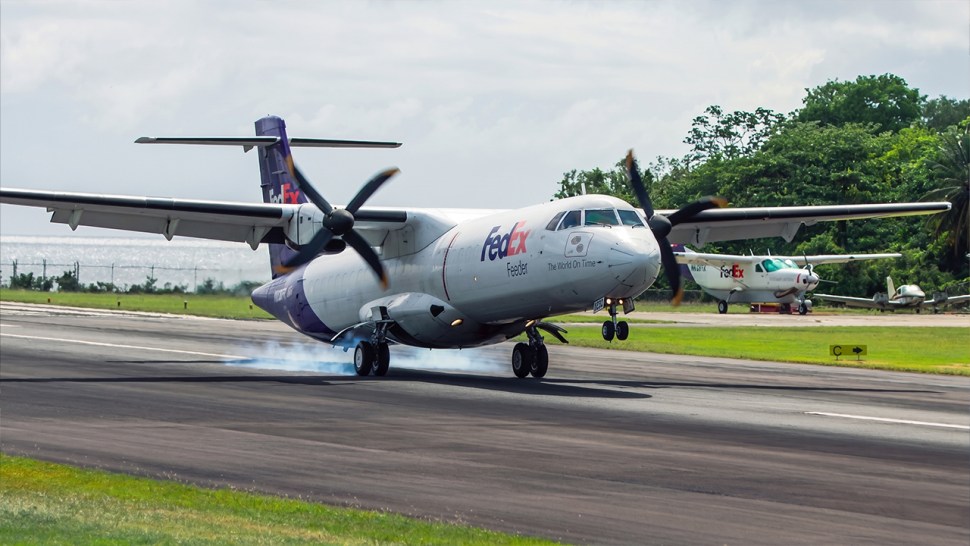
FedEx feeder airline Mountain Air Cargo is seeking a federal waiver from the payload limit for on-demand carriers so it can switch to a regulatory regime with less strict requirements for long overwater flights and continue to serve Caribbean island routes without interruption as it transitions to using larger turboprop cargo aircraft.
North Carolina-based Mountain Air Cargo plans to replace its aging fleet of ATR 42 freighter aircraft with larger ATR 72 freighters, but needs relief from regulations for scheduled airlines that currently govern the aircraft because the islands of Aruba, Curacao and Bonaire are beyond the 60-minute flying limit, the company said Wednesday in a petition to the Federal Aviation Administration.
The FedEx (NYSE: FEDEX) partner airline operates its ATR 42 and ATR 72 fleets under different parts of the federal aviation regulations. The ATR 42s fall under Part 135, which contain rules for commuter and on-demand operators. The ATR 72s are regulated under Part 121, which applies to scheduled commercial airlines. Part 121 operators are subject to stricter rules because they fly more often.
The company operates 10 ATR 42s and 13 ATR 72-200s and 72-600s supplied by FedEx, as well as Cessna 408 SkyCouriers, according to aviation database Planespotters. It provides shuttle service between smaller markets, which are uneconomical for FedEx to serve with mainline jets, and larger airports that serve as transfer hubs in the FedEx network.
Mountain Air currently operates the ATR 42 to Caribbean destinations with a modified payload of 7,500 pounds. The aircraft was chosen when service commenced in 2024 because Part 135 regulations allow extended overwater operations of up to three hours, while following extra safety requirements, and the ATR 42’s capacity fit market demand.
Scheduled carriers are limited to 60 minutes flying time over water unless the aircraft is rated for extended operations based on how many minutes an aircraft can fly on one engine before it needs to land at an airport. The Caribbean destinations Mountain Air serves are less than 20 miles beyond the overwater limits of Part 121 rules, but remain within the limits of Part 135.
Mountain Air said the current rules are overly burdensome and put its Caribbean service at risk.
“Extended-range Twin-engine Operational Performance Standards (ETOPS) approval would be required solely to accommodate an additional 20 miles of overwater distance to the destination. While we fully respect the regulatory framework and the safety protections it provides, the operational cost and administrative burden of maintaining a fully compliant ETOPS program is disproportionate relative to the incremental distance involved.
Mountain Air’s fleet modernization plan calls for replacing the ATR 42s with ATR 72s, including newly acquired ATR 72-600s equipped with advanced avionics, because the 42s are aging and there are fewer of them available since ATR stopped manufacturing 42s in a cargo configuration, according to the filing. Mountain Air said it is expanding its ATR 72 fleet. Last year, FedEx ordered 10 additional ATR 72-600s that will be placed with partner carriers.
The ATR 72s will offer more cargo capacity and improved reliability for customers. Operations to Aruba, Curacao and Bonaire have historically filled 85% to 100% of ATR 42 capacity.
The airline said that the high level of demand means that a single missed flight due to maintenance issues, adverse weather, or aircraft unavailability can create cargo backlogs that persist for several days, or even weeks, as the aircraft’s limited payload capacity and cargo hold volume constrain recovery of delayed shipments.
The ATR 72 can carry about 16,800 pounds. Mountain Air Cargo is asking the FAA to increase the 7,500-pound limit under Part 135 regulations to 10,500 pounds — a 40% increase over the current limit, but a 38% reduction from the aircraft’s maximum payload capacity. The difference between the requested payload amount and the maximum capacity will allow the airline to carry more fuel, providing greater operational flexibility and safety in case of an emergency.
“We believe this increase will provide sufficient capacity to accommodate missed or delayed freight in addition to expected daily totals, thereby ensuring a reliable continuity of service to the public in Aruba, Curaçao, and Bonaire and remain within the spirit of the regulations so that it does not materially encroach upon any 14 CFR Part 121 operation,” Mountain Air said in the petition.
However, with the planned reduction of the ATR 42 fleet and the concurrent expansion of the ATR 72 fleet, the continuation of this Caribbean service is at risk. Because the ATR 72 is currently operated under 14 CFR Part 121, maintaining this service would require Extended Operations (ETOPS) approval. By operating the ATR 72 under 14 CFR Part 135 with the requested payload limit, service to these countries can be sustained without interruption.
While the foregoing material is dated and does not address our specific circumstances, it establishes the principle that certain operators face regulatory constraints that are disproportionately burdensome given their operational context. In this instance, we note that ETOPS approval would be required solely to accommodate an additional 20 miles of overwater distance to the destination. While we fully respect the regulatory framework and the safety protections it provides, the operational cost and administrative burden of maintaining a fully compliant ETOPS program is disproportionate relative to the incremental distance involved.
Click here for more FreightWaves/American Shipper stories by Eric Kulisch.
Write to Eric Kulisch at ekulisch@freightwaves.com.
RELATED STORIES:
GlobalX Airlines accuses shareholder of undermining cargo business
FedEx buys world’s first ATR 72-600 passenger-to-freighter aircraft
Brokerage Compliance Symposium
The day before F3. Every compliance issue you face - fraud exposure, carrier liability, FMCSA rules, cargo theft, insurance gaps - navigated by attorneys and operators defining best practices in a changing industry.
F3 Awards Dinner
The night before F3. FreightTech100 companies honored. FreightTech 25 and Shipper of Choice winners revealed live. Cocktail reception into dinner and live music - 300 industry leaders in one purpose-built room.
F3: Future of Freight Festival
Industry-defining keynotes, rapid-fire technology demos, and industry leaders networking in experiences across Chattanooga - plus the inaugural F3 Awards Dinner featuring the FreightTech and Shipper of Choice reveals.
The day before F3. Every compliance issue you face - fraud exposure, carrier liability, FMCSA rules, cargo theft, insurance gaps - navigated by attorneys and operators defining best practices in a changing industry.
The Signal at Chattanooga Choo Choo • Chattanooga, TN Register NowThe night before F3. FreightTech100 companies honored. FreightTech 25 and Shipper of Choice winners revealed live. Cocktail reception into dinner and live music - 300 industry leaders in one purpose-built room.
The Signal at Chattanooga Choo Choo • Chattanooga, TN Register NowIndustry-defining keynotes, rapid-fire technology demos, and industry leaders networking in experiences across Chattanooga - plus the inaugural F3 Awards Dinner featuring the FreightTech and Shipper of Choice reveals.
The Signal at Chattanooga Choo Choo • Chattanooga, TN Register Now