




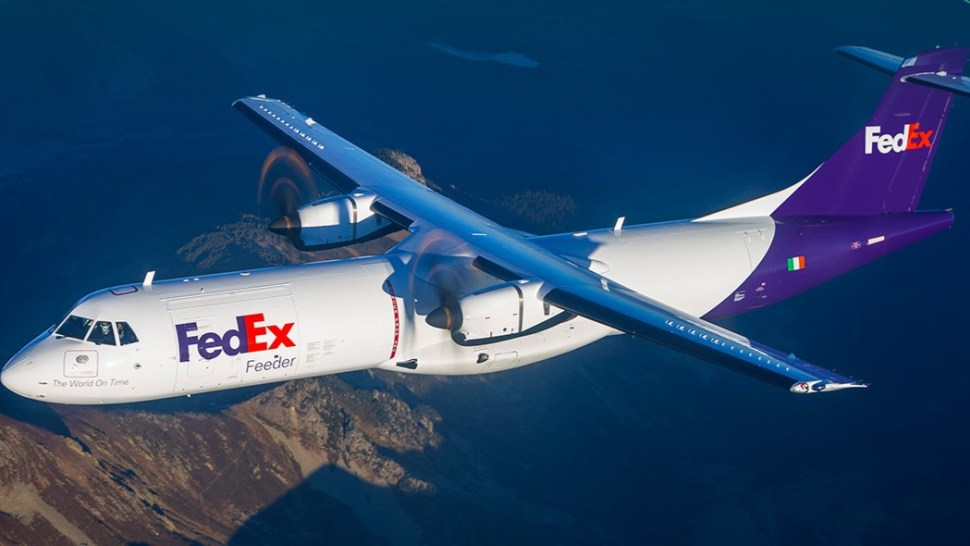
FedEx will operate the world’s first ATR 72-600 turboprop aircraft to undergo conversion from passenger to freighter configuration after signing a purchase agreement last week.
Dublin-based ACIA Aero Leasing said it plans to deliver the converted freighter to FedEx (NYSE: FDX) by December, according to a news release. It’s possible the plane could enter commercial service before the end of the year or in early 2026. Neither company has indicated where the cargo plane will be deployed, but there are several possibilities based on existing business relationships.
The last time FedEx acquired a converted freighter — a Boeing 757 — was in 2016. Most of the 757 fleet consists of converted aircraft. FedEx last received a converted ATR freighter — an ATR 72-200 — was in 2011, company spokesman Jonathan Lyons said.
FedEx owns 24 factory-built ATR 72-600 freighters, 19 older ATR 72-200s and 16 ATR 42s, which it supplies to partner airlines in North America and Europe to fly feeder routes on its behalf. Of the 24 ATR 72-600s, 13 are based in Europe: Spain-based Swiftair operates four of them for FedEx and nine are with ASL Airlines Ireland. The remaining aircraft are almost evenly split between Idaho-based Empire Airlines, Gulf & Caribbean Cargo and Mountain Air Cargo, according to the Flightradar24 database.
Mountain Air Cargo and Empire Airlines operate the ATR 72-200s, along with Morningstar Air Express in Canada.

ACIA launched the ATR 72-600 series conversion program in mid-2024 on a speculative basis. An ACIA subsidiary designed the aircraft modification kit, holds the certificate for commercial use and selected Empire Aerospace, the maintenance and repair sister of Empire Airlines, to perform the structural modifications. Empire Airlines connects smaller cities in the western half of the United States to FedEx hubs.
The conversion process requires technicians to remove the existing upper and lower skin sections, door and door frame; completely rebuild the door frame and surrounding support for the outer surface layer; install a wide cargo door; reinforce the interior floor; and install fire protective liners in the cargo compartment.
Empire says the process can take four to seven months, depending on customer specifications.
ACIA said FedEx will use the ATR 72-600 converted freighter to replace an older aircraft.
FedEx has six more ATR’s scheduled for delivery by the end of next year under a pre-existing order. In March, FedEx placed a firm order with Toulouse, France-based ATR for 10 additional ATR 72-600 production freighters, with deliveries scheduled between 2027 and 2029.
With a payload of about 10 tons, the ATR 72-600 can carry bulk cargo, five 88-by-108-foot pallets or up to seven smaller LD3 containers.
Click here for more FreightWaves/American Shipper stories by Eric Kulisch.
RELATED READING:
FedEx orders Boeing 777 and ATR cargo aircraft, delays MD-11 retirements
Brokerage Compliance Symposium
The day before F3. Every compliance issue you face - fraud exposure, carrier liability, FMCSA rules, cargo theft, insurance gaps - navigated by attorneys and operators defining best practices in a changing industry.
F3 Awards Dinner
The night before F3. FreightTech100 companies honored. FreightTech 25 and Shipper of Choice winners revealed live. Cocktail reception into dinner and live music - 300 industry leaders in one purpose-built room.
F3: Future of Freight Festival
Industry-defining keynotes, rapid-fire technology demos, and industry leaders networking in experiences across Chattanooga - plus the inaugural F3 Awards Dinner featuring the FreightTech and Shipper of Choice reveals.
The day before F3. Every compliance issue you face - fraud exposure, carrier liability, FMCSA rules, cargo theft, insurance gaps - navigated by attorneys and operators defining best practices in a changing industry.
The Signal at Chattanooga Choo Choo • Chattanooga, TN Register NowThe night before F3. FreightTech100 companies honored. FreightTech 25 and Shipper of Choice winners revealed live. Cocktail reception into dinner and live music - 300 industry leaders in one purpose-built room.
The Signal at Chattanooga Choo Choo • Chattanooga, TN Register NowIndustry-defining keynotes, rapid-fire technology demos, and industry leaders networking in experiences across Chattanooga - plus the inaugural F3 Awards Dinner featuring the FreightTech and Shipper of Choice reveals.
The Signal at Chattanooga Choo Choo • Chattanooga, TN Register Now