(Editor’s note: Post-initial publication, FreightWaves was contacted by a beneficiary of the fund about the nature of the Oregon Warehouseman Trust, noting that it was used for the payment of health benefits rather than pensions. There is no firm reference in any of the legal documents connected to the litigation that clearly delineates the fund as solely for health benefits. As a result, the article has been edited to refer to the fund as one that is used to pay benefits).
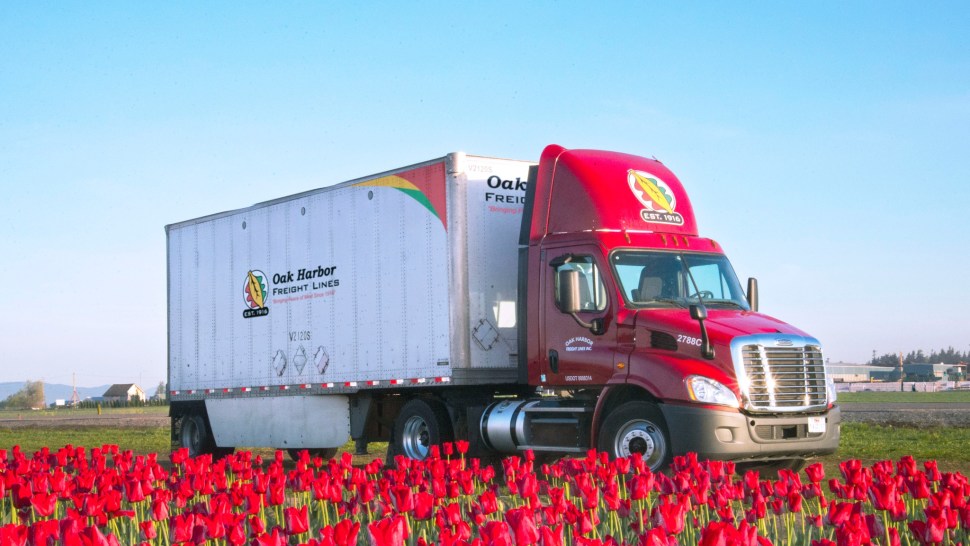
In September 2008, workers at West Coast LTL carrier Oak Harbor Freight Lines represented by the Teamsters went on strike.
The strike dragged on until the following February, when the workers returned without having secured contract terms they sought.
Last week, more than 17 years after the workers first walked the picket line, a group of several Teamsters locals learned of the dollar amount–more than $23 million–one of their benefit funds was entitled to from Oak Harbor in what could be the final legal action in this lengthy dispute.
The dispute involved Oak Harbor actions to halt payments to a benefits fund and the imposition of a new health care plan after the launch of the strike.
As NLRB administrative law judge Brian Gee said in his recent decision regarding what Oak Harbor needed to pay into the fund, “this controversy has been rigorously litigated before administrative law judges, the (NLRB) board, the Courts of Appeal and the U.S. Supreme Court.” The latter body denied certiorari from Oak Harbor on earlier decisions handed down through the NLRB process.
At one point, an NLRB decision in the Oak Harbor dispute was invalidated by the Noel Canning Supreme Court case which ended up sending several NLRB rulings back to the board over the issue of an inadequate quorum, including that of Oak Harbor.
A renewed debate on those issues was not part of Judge Gee’s decision. The earlier process had determined that Oak Harbor had committed unfair labor practices (ULPs) in its actions on pensions and health care in the wake of the strike. That question was settled first in 2012, when the NLRB board ruled that Oak Harbor had committed ULPs on those issues. Post-Noel Canning, which essentially invalidated the 2012 action, the NLRB affirmed the 2012 ruling in 2014. The unsuccessful appeals to the judicial system ensued.
Final payout figure determined
What was at stake in the most recent ruling by Judge Gee was what Oak Harbor needed to pay into the funds to compensate for those violations.
Judge Gee’s ruling was that Oak Harbor needed to make a contribution of $19,735,261.12 to one trust fund, as well as a payment of $3,947,052.21 in “liquidated damages.”
Liquidated damages are defined by the Corporate Finance Institute as “specific sums of money or consideration contractually agreed upon by parties to a contract. Basically, if a contract is breached by one party, liquidated damages are owed to the other, injured party (or parties) to the contract.”
As the On the Labor Front blog wrote about the protracted length of the battle between workers and Oak Harbor, the company “incurred significant legal expenses defending its position through multiple levels of review while simultaneously providing alternative health coverage. Employees experienced disruption to their established benefit arrangements and uncertainty about coverage. The federal agency dedicated considerable resources to investigation, litigation, and compliance proceedings.”
Even after the 2014 NLRB reaffirmation of the pre-Noel Canning decision, the process to get to the payment that was ordered December 19 proved tortuous.
Judge Gee summed up the case’s travel history since then. “Owing to disagreement over the amounts due under the Board order, the original compliance specification and notice of hearing (was) issued on April 26, 2022. Over the next two-plus years, the compliance hearing was postponed four times, the Regional Director granted a motion to intervene by the Trust, and an amended compliance specification issued on September 26, 2024 (the compliance specification) alleging the delinquent contributions owed to the Trust and the amounts of reimbursement owed for medical expenses to make employees whole.”
Not a great time to walk out
The record of the strike that appears in NLRB background summations shows that the union picked a particularly inopportune time to strike: September 22, 2008. That would have been right in the middle of the collapse of Lehman Brothers and similar catastrophes that were the culmination of months of bad financial news leading up to the start of the Great Recession.
With no progress on a new contract and the country in a full-blown economic crisis, the Teamsters locals made “an unconditional offer to return to work” on February 12, 2009, according to the ALJ summaries. They returned to work February 26.
But during the dispute, Oak Harbor implemented its own health care plan for its workers. It also ceased making contributions to a pension fund known as the Oregon Warehouseman Trust.
The NLRB, pre-Noel Canning, had found in 2012 that those two actions constituted ULPs. It ordered Oak Harbor to return to halt the implementation of its own health plan and “bargain in good faith” with the locals to craft a new one. It also ordered Oak Harbor to “make whole” the employees covered by the Oregon Warehouseman Trust. (A stoppage of payments by Oak Harbor to a Washington state-based trust were ruled by the NLRB to not be an unfair labor practice).
The board, post-Noel Canning, affirmed that decision in 2014.
Attorneys named in the most recent ALJ decision contacted by FreightWaves had not responded by publication time.
On its website, Oak Harbor said it has 41 locations, more than 850 tractors and in excess of 2,600 trailers. It said it had direct services in seven states: Arizona, Utah, California, Idaho, Nevada, Oregon and Washington. It also is a partner with Northeast LTL carrier A. Duie Pyle to offer LTL services through the two companies’ networks.
Oak Harbor has been in operation since 1916.
More articles by John Kingston
Love’s factoring business gets bigger, buying trio of companies
New York City bill that targeted Amazon won’t get taken up in 2025
Benesch panelists: Why 2026 could be a strong year for logistics M&A
Brokerage Compliance Symposium
The day before F3. Every compliance issue you face - fraud exposure, carrier liability, FMCSA rules, cargo theft, insurance gaps - navigated by attorneys and operators defining best practices in a changing industry.
F3 Awards Dinner
The night before F3. FreightTech100 companies honored. FreightTech 25 and Shipper of Choice winners revealed live. Cocktail reception into dinner and live music - 300 industry leaders in one purpose-built room.
F3: Future of Freight Festival
Industry-defining keynotes, rapid-fire technology demos, and industry leaders networking in experiences across Chattanooga - plus the inaugural F3 Awards Dinner featuring the FreightTech and Shipper of Choice reveals.
The day before F3. Every compliance issue you face - fraud exposure, carrier liability, FMCSA rules, cargo theft, insurance gaps - navigated by attorneys and operators defining best practices in a changing industry.
The Signal at Chattanooga Choo Choo • Chattanooga, TN Register NowThe night before F3. FreightTech100 companies honored. FreightTech 25 and Shipper of Choice winners revealed live. Cocktail reception into dinner and live music - 300 industry leaders in one purpose-built room.
The Signal at Chattanooga Choo Choo • Chattanooga, TN Register NowIndustry-defining keynotes, rapid-fire technology demos, and industry leaders networking in experiences across Chattanooga - plus the inaugural F3 Awards Dinner featuring the FreightTech and Shipper of Choice reveals.
The Signal at Chattanooga Choo Choo • Chattanooga, TN Register Now