




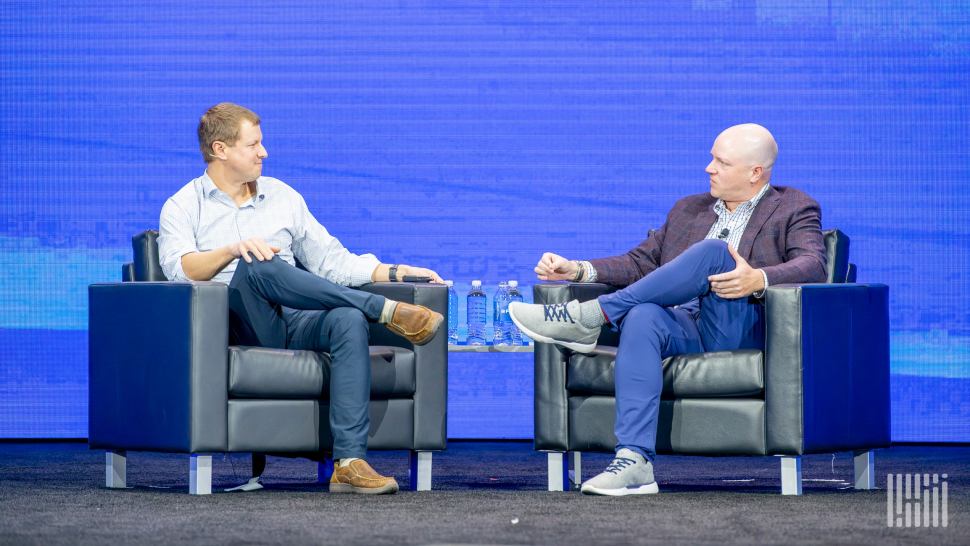
To underscore the fragile state of trucking, FreightWaves CEO Craig Fuller pointed to a development from this past weekend — a small Iowa bank that appeared to be overly exposed to commercial trucking and was taken over by regulators.
“The [Federal Deposit Insurance Corp.] saw that it was underwater on its loans and seized it because it was insolvent,” Fuller related to FreightWaves market analyst Zach Strickland during a State of Freight session at the second annual F3: Future of Freight Festival in Chattanooga, Tennessee, on Tuesday.
“The average person, and the Federal Reserve to an extent, focuses a lot on the jobs aspect when measuring the economy,” Fuller said. “But what actually drives economic activity is the amount of money that’s in the system — liquidity. And when you start having banks fail, or when their ability to lend credit starts to seize up, that’s what actually slows the economy down. These are scary situations, because there are other banks with that kind of exposure to other industries that are facing this.”
Fuller and Strickland noted that during much of 2023, forecasts from the trucking industry — at least from many of the larger public companies — reflected the relatively strong data points used by economists to measure the health of the economy, such as 4.9% GDP growth and low unemployment.
However, “that data suggests that the market isn’t as dire as what it actually feels like to a lot of the carriers in the market,” Fuller said. “J.B. Hunt had been talking about green shoots they were seeing in August, but if you look at their most recent earnings call, they’ve largely taken that off the table. We’re hearing from all the public carriers and the private ones that there’s been a significant deterioration in October.”
In addition, buildup in truck capacity and new entrants into the market over the last two years continues to linger, “and that is what’s also keeping the market really painful, regardless of what GDP or volume data suggests how the trucking market should otherwise be doing.”
Using FreightWaves SONAR freight tender and rejection data to underpin forecasts, Fuller doesn’t see spot rates dropping much further than where they stand now — but they could drag at those levels for a while.
“Possibly marginal deterioration, maybe another 4 to 5 cents [per mile] in the first quarter next year,” he said.
“But they’re not going to get much lower than that, because carriers are simply underwater. And when they’re underwater they have a choice. They can either leave the industry entirely or they can continue to run just for enough cash flow. A lot of carriers can operate at a loss for a while and hope the market will return.”
Brokers will feel the heat
With the fall of a handful of big-name brokers over the last several months — Convoy being the most notable — Fuller reflected on how they’ve been able to thrive as well as what they could be facing in the months to come.
“It used to be that brokers were considered an alternative and didn’t get the primary positions for shippers’ freight,” he said. “But over the last 10 years, we’ve seen a shift where freight brokers are playing a primary role in carrier routing guides. Now they’re providing continuous lines of demand that have enabled carriers to get additional cash flow and load opportunities, and that’s why I think a lot of carriers are holding on a lot longer right now than in past downturns.”
However, because contract rates in the coming months could take another hit over the next two quarters, brokers could be in for more of a shock, Fuller believes.
“Freight brokers get squeezed when that spot rate comes up and the contract rate stays flat or comes down. And if we believe the contract rate is going to go down a few percent next year and the spot rates are going to increase, we will see margin compression. That’s when a lot of brokers will feel substantial pain, because they won’t get the strong spreads that they have been getting.
“I think there are more closures coming, and when that happens it’s going to be challenging.”
Related articles:
Brokerage Compliance Symposium
The day before F3. Every compliance issue you face - fraud exposure, carrier liability, FMCSA rules, cargo theft, insurance gaps - navigated by attorneys and operators defining best practices in a changing industry.
F3 Awards Dinner
The night before F3. FreightTech100 companies honored. FreightTech 25 and Shipper of Choice winners revealed live. Cocktail reception into dinner and live music - 300 industry leaders in one purpose-built room.
F3: Future of Freight Festival
Industry-defining keynotes, rapid-fire technology demos, and industry leaders networking in experiences across Chattanooga - plus the inaugural F3 Awards Dinner featuring the FreightTech and Shipper of Choice reveals.
The day before F3. Every compliance issue you face - fraud exposure, carrier liability, FMCSA rules, cargo theft, insurance gaps - navigated by attorneys and operators defining best practices in a changing industry.
The Signal at Chattanooga Choo Choo • Chattanooga, TN Register NowThe night before F3. FreightTech100 companies honored. FreightTech 25 and Shipper of Choice winners revealed live. Cocktail reception into dinner and live music - 300 industry leaders in one purpose-built room.
The Signal at Chattanooga Choo Choo • Chattanooga, TN Register NowIndustry-defining keynotes, rapid-fire technology demos, and industry leaders networking in experiences across Chattanooga - plus the inaugural F3 Awards Dinner featuring the FreightTech and Shipper of Choice reveals.
The Signal at Chattanooga Choo Choo • Chattanooga, TN Register Now