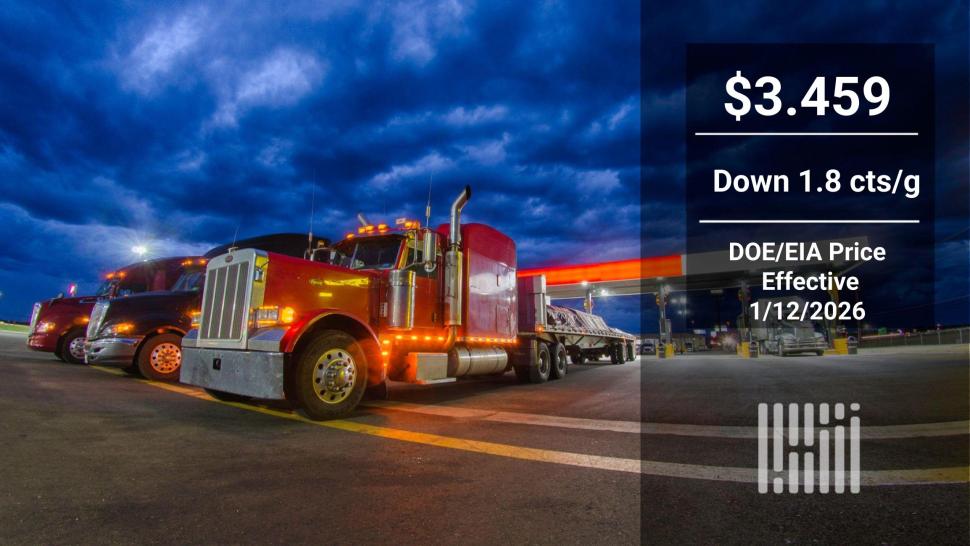
The consecutive week streak of declines in the benchmark retail diesel price is now eight, but market conditions are suggesting it might be a challenge to reach nine.
The Department of Energy/Energy Information Administration average weekly retail diesel price declined 1.8 cents/gallon in the price published Tuesday, effective Monday. The latest price is $3.459/g.
It’s the lowest price since the benchmark used for most fuel surcharges was $3.471/g on June 9. The eight-week decline has sliced 40.9 cts/g off the DOE/IEA price since its recent high of $3.868/g on November 17.
But futures markets have turned notably higher in the past few days, with the latest concern for supplies coming out of Iran.
Ultra low sulfur diesel on the CME commodity exchange settled Wednesday at $2.0567/g on the same set of bearish conditions that have prevailed for weeks: a fundamental supply/demand imbalance that has led most market forecasts for 2026 to lean toward lower prices.
But ULSD settled Monday at $2.1544/g, rising almost 10 cts/g more in three trading days. The runup continued Tuesday, with ULSD at approximately 11 a.m. up just over 4% to $2.2428/g, an increase of 8.604 cts/g. If it settled at that level, it would be the highest price since mid-December.
There are no firm reports of Iranian supplies being disrupted by the street protests in the country and the threats from the United States on the outside.
But Iran is a supplier of anywhere from 3.3 million to 3.5 million barrels/day of crude, and a disruption of that supply as well as the standard threat of a closure or slowdown in the key Strait of Hormuz waterway for oil exports has given oil markets a jolt out of their long downward slide.
More articles by John Kingston
How is C.H. Robinson using AI? Its CFO has a story
Benesch panelists: Why 2026 could be a strong year for logistics
M&A3-way combo emerges for digital load matching: DAT, AscendTMS and Convoy
Brokerage Compliance Symposium
The day before F3. Every compliance issue you face - fraud exposure, carrier liability, FMCSA rules, cargo theft, insurance gaps - navigated by attorneys and operators defining best practices in a changing industry.
F3 Awards Dinner
The night before F3. FreightTech100 companies honored. FreightTech 25 and Shipper of Choice winners revealed live. Cocktail reception into dinner and live music - 300 industry leaders in one purpose-built room.
F3: Future of Freight Festival
Industry-defining keynotes, rapid-fire technology demos, and industry leaders networking in experiences across Chattanooga - plus the inaugural F3 Awards Dinner featuring the FreightTech and Shipper of Choice reveals.
The day before F3. Every compliance issue you face - fraud exposure, carrier liability, FMCSA rules, cargo theft, insurance gaps - navigated by attorneys and operators defining best practices in a changing industry.
The Signal at Chattanooga Choo Choo • Chattanooga, TN Register NowThe night before F3. FreightTech100 companies honored. FreightTech 25 and Shipper of Choice winners revealed live. Cocktail reception into dinner and live music - 300 industry leaders in one purpose-built room.
The Signal at Chattanooga Choo Choo • Chattanooga, TN Register NowIndustry-defining keynotes, rapid-fire technology demos, and industry leaders networking in experiences across Chattanooga - plus the inaugural F3 Awards Dinner featuring the FreightTech and Shipper of Choice reveals.
The Signal at Chattanooga Choo Choo • Chattanooga, TN Register Now