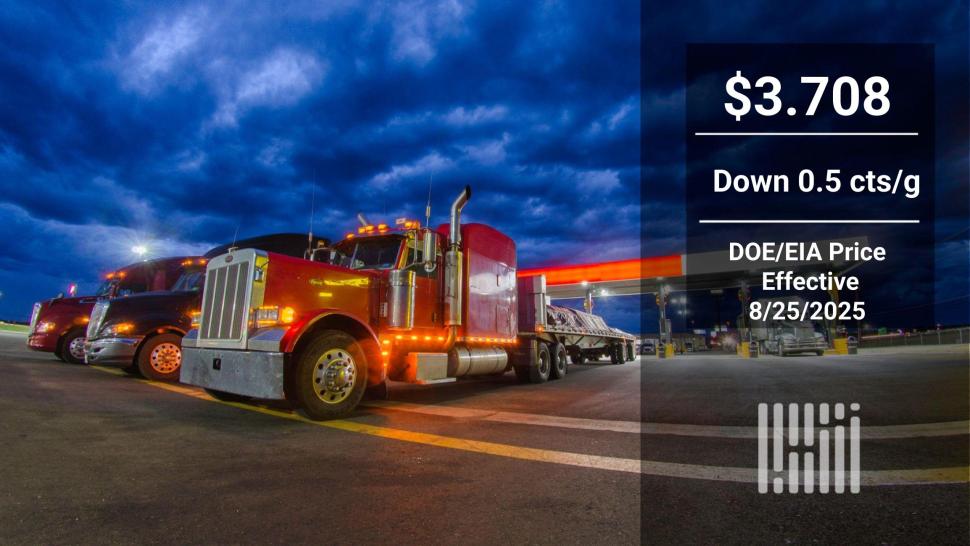
The benchmark diesel price used for most fuel surcharges continued its downward drift this week, with the number declining for the fifth consecutive week.
The Department of Energy/Energy Information Administration average weekly retail price fell 0.5 cents/gallon Monday, posted Tuesday, to $3.708/g. The total of the five declines is relatively modest, just 10.4 cts/g. That takes the price down to its current level from $3.812/g posted July 21, which at the time had been the highest DOE/EIA price in a little more than a year.
It is just another step in a period of relative oil price stability in the midst of highly volatile markets for equities and other assets. Petroleum has been trading in a fairly tight range for several weeks, with demand soft but not collapsing and the flood of oil from OPEC and non-OPEC countries that has been anticipated not yet showing up in huge numbers.
Brent crude, the global benchmark, settled between $65/barrel and $67/b for 11 consecutive days on the CME commodity exchange, with that streak ending Wednesday. It settled Monday at $68.80/b.
With the usual lag in retail prices, the downward drift in the DOE/EIA number is catching up to a decline in futures prices from late July levels. Ultra low sulfur diesel on the CME commodity exchange settled at $2.4491/g on July 29. That slide bottomed August 15 at $2.2215/g.
But with a settlement Monday at $2.3427/g, the five-week drop may have run its course.
If there is any other concern for higher prices in the market, it is coming from the Midwest. Refinery problems at the 435,000 barrel/day Whiting, Indiana refinery operated by BP is sending retail gasoline prices higher.
Operating issues at Whiting, one of the country’s largest refineries, has sent the price of gasoline soaring in the Midwest. For example, the daily average retail gasoline price posted by the American Automobile Association for Michigan was $3.352/g on Tuesday. A week ago it was less than $3.10/g. It also increased more than 14 cts/g from Monday.
Similar increases were reported for other Midwest states affected by the loss of output from the Whiting facility.
However, that has not spread to diesel. The AAA average for Michigan was $3.711/g a week ago. On Tuesday, it was $3.718/g.
It is unclear why gasoline is being affected to such a large degree while diesel has been unscathed so far. The fires at Whiting were in crude units, the first step in turning crude into products like gasoline and diesel. A problem in a crude unit can cause issues with output of gasoline, diesel and all other refined products.
The pump price increases for gasoline are coming almost exclusively from increases in wholesale prices set by gasoline suppliers in the Midwest. The spread between gasoline and Brent crude–the world’s benchmark–and ultra low sulfur diesel on the CME has not surged in the wake of the BP problems.
One of the two affected units was reported Monday as being brought back online. The second is expected back this week. Flooding from heavy thunderstorms caused the problem, according to published reports.
More articles by John Kingston
NFI driver misclassification case in New Jersey could reach individual payouts of $50k
New Jersey truckers await–with dread–possible changes in state’s independent contractor law
American Trucking Associations hit with allegations of employment and race discrimination
Brokerage Compliance Symposium
The day before F3. Every compliance issue you face - fraud exposure, carrier liability, FMCSA rules, cargo theft, insurance gaps - navigated by attorneys and operators defining best practices in a changing industry.
F3 Awards Dinner
The night before F3. FreightTech100 companies honored. FreightTech 25 and Shipper of Choice winners revealed live. Cocktail reception into dinner and live music - 300 industry leaders in one purpose-built room.
F3: Future of Freight Festival
Industry-defining keynotes, rapid-fire technology demos, and industry leaders networking in experiences across Chattanooga - plus the inaugural F3 Awards Dinner featuring the FreightTech and Shipper of Choice reveals.
The day before F3. Every compliance issue you face - fraud exposure, carrier liability, FMCSA rules, cargo theft, insurance gaps - navigated by attorneys and operators defining best practices in a changing industry.
The Signal at Chattanooga Choo Choo • Chattanooga, TN Register NowThe night before F3. FreightTech100 companies honored. FreightTech 25 and Shipper of Choice winners revealed live. Cocktail reception into dinner and live music - 300 industry leaders in one purpose-built room.
The Signal at Chattanooga Choo Choo • Chattanooga, TN Register NowIndustry-defining keynotes, rapid-fire technology demos, and industry leaders networking in experiences across Chattanooga - plus the inaugural F3 Awards Dinner featuring the FreightTech and Shipper of Choice reveals.
The Signal at Chattanooga Choo Choo • Chattanooga, TN Register Now