




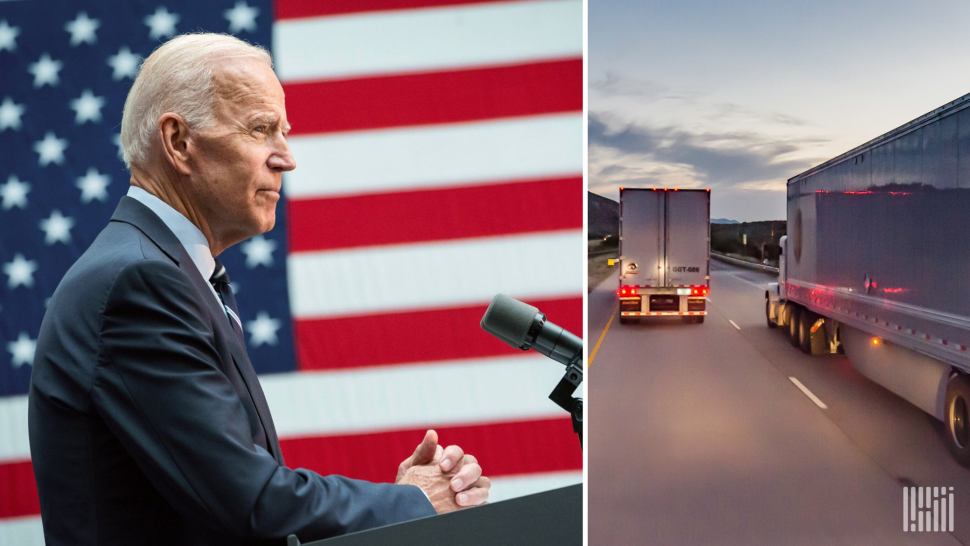
The Biden administration plans to investigate transportation supply-demand imbalances in response to a 100-day review of four key product supply chains.
The White House issued a report on Tuesday following the review that began earlier this year in which the administration assessed vulnerabilities for semiconductor manufacturing and advanced packaging, large capacity batteries such as those used in electric vehicles, critical minerals and materials, and pharmaceuticals and advanced pharmaceutical ingredients.
“As the United States and the broader global economy emerge from the pandemic, we have seen signs of new pressures on supply chains due to changes in demand,” the White House stated in a fact sheet accompanying the report. “While these short-term supply chain disruptions are temporary, the President has directed his Administration to closely monitor these developments and take actions to minimize the impacts on workers, consumers, and businesses in order to bolster a strong economic recovery.”
To address those disruptions, one of the recommendations by the authors of the report — Jake Sullivan and Brian Deese, assistants to President Joe Biden — is that the administration establish a new Supply Chain Disruptions Task Force, to be led by the secretaries of Commerce, Transportation and Agriculture. It will focus on areas where there has been evidence of a “mismatch between supply and demand” within the transportation sector, along with the homebuilding and construction, semiconductor, and agriculture and food sectors.
“The Task Force will bring the full capacity of the federal government to address near-term supply/demand mismatches,” the report states. “It will convene stakeholders to diagnose problems and surface solutions — large and small, public or private — that could help alleviate bottlenecks and supply constraints.”
The task force recommendation comes at a time when spot rates for transportation capacity in the trucking and container shipping sectors have soared due to surges in demand as the country recovers from the pandemic.
Related articles:
Brokerage Compliance Symposium
The day before F3. Every compliance issue you face - fraud exposure, carrier liability, FMCSA rules, cargo theft, insurance gaps - navigated by attorneys and operators defining best practices in a changing industry.
F3 Awards Dinner
The night before F3. FreightTech100 companies honored. FreightTech 25 and Shipper of Choice winners revealed live. Cocktail reception into dinner and live music - 300 industry leaders in one purpose-built room.
F3: Future of Freight Festival
Industry-defining keynotes, rapid-fire technology demos, and industry leaders networking in experiences across Chattanooga - plus the inaugural F3 Awards Dinner featuring the FreightTech and Shipper of Choice reveals.
The day before F3. Every compliance issue you face - fraud exposure, carrier liability, FMCSA rules, cargo theft, insurance gaps - navigated by attorneys and operators defining best practices in a changing industry.
The Signal at Chattanooga Choo Choo • Chattanooga, TN Register NowThe night before F3. FreightTech100 companies honored. FreightTech 25 and Shipper of Choice winners revealed live. Cocktail reception into dinner and live music - 300 industry leaders in one purpose-built room.
The Signal at Chattanooga Choo Choo • Chattanooga, TN Register NowIndustry-defining keynotes, rapid-fire technology demos, and industry leaders networking in experiences across Chattanooga - plus the inaugural F3 Awards Dinner featuring the FreightTech and Shipper of Choice reveals.
The Signal at Chattanooga Choo Choo • Chattanooga, TN Register Now